Heritage · Country
Guernsey Culture and Heritage
A Neolithic figure stands at a churchyard gate in St Martin's and still receives flowers, and a French exile wrote Les Misérables in a house above St Peter Port. This is a guide to the Bailiwick of Guernsey, its four Norman speeches, its smaller islands and its hardest wartime chapter.Written to last.
By Confinity Heritage Editorial · Updated 2026-08-17 · 8-minute readQuiet tools, kept out of the way.
At the gate of St Martin's churchyard in Guernsey stands a granite woman about 1.65 metres tall, carved in the Neolithic and given a cape and headdress by somebody in the Roman period. She is called La Gran'mère du Chimquière, the grandmother of the cemetery. A churchwarden broke her in two in the nineteenth century because he objected to a pagan idol at a Christian door, and the parish put her back together and left her standing. People still lay flowers across her shoulders and leave coins on her head, and brides coming out of the church still leave her a posy for luck (La Gran'mère du Chimquière).
Guernsey rarely throws anything away, and the Bailiwick it heads is a small archipelago rather than a single island. Alderney, Sark, Herm, Jethou, Brecqhou and a scatter of islets each carry their own law, speech and memory, and among them they hold a fifteen-year literary exile, the last feudal parliament in Europe, and the only place on British soil where the SS ran a concentration camp.
Guernsey itself covers about 62 square kilometres and held 63,950 people at the 2022 count, tilting from high southern cliffs down to the low, sandy, heavily quarried north. Its dependencies are small and very unalike: Alderney, eight square kilometres and about 2,100 people, lies close to the French coast and keeps its own States under a 1948 agreement that hands Guernsey policing, health and education; Sark has roughly 560 residents, no cars and its own parliament; Herm is leased and tiny; Jethou and Brecqhou are held by single tenants; Lihou is reached on foot at low tide. The Bailiwick is a Crown Dependency, outside the United Kingdom and never in the European Union, and Guernsey's States of Deliberation seats 38 island-wide deputies plus two representatives sent by Alderney, with the Bailiff presiding as civil head and chief judge. Ten parishes divide the island, each run by a Douzaine of twelve or more elected douzeniers. Financial services make up around 37 per cent of GDP. English is the everyday language, and in 2020 the States gave Guernésiais and standard French formal recognition alongside it (Guernsey).
St Peter Port. The capital falls in steps from the ridge to the harbour, a Regency and Georgian town of painted stucco and granite whose steep lanes were built on the wealth of privateering and the wine trade. Castle Cornet sits on its own rock at the harbour mouth, the Town Church stands at the bottom of the hill, and Hauteville House looks down on all of it from the slope above.
St Sampson. The second harbour, at the north end, once shipped Guernsey granite by the shipload to pave London and now handles the island's fuel and freight.
St Anne, Alderney. A cobbled Victorian garrison town of coloured houses, built around a much older core, ringed by the forts and the great breakwater that Britain put up in the nineteenth century.
Sark. No town at all, only the Avenue, a short row of shops on a plateau reached by a steep hill from the harbour, with tractors and horses in place of cars.
The Bailiwick's oldest monuments are funerary. Les Fouaillages on L'Ancresse Common, found by members of La Société Guernesiaise in 1976 and excavated from 1979 by Ian Kinnes of the British Museum, is a long mound whose earliest phase has been dated to the fifth millennium BC, putting it among the earliest known built monuments to the dead in Europe. Le Déhus in the Vale is a passage grave some ten metres long with a main chamber and four side chambers, and on the underside of one capstone a bearded figure with arms, hands and what looks like a strung bow was noticed in 1916, a prehistoric guardian watching everyone laid beneath him (Le Déhus). Statue-menhirs like the Gran'mère and her sister at Câtel survive above ground because people kept using them.
 Castle Cornet held out for the king for eight years in the civil war, longer than anywhere else, while the rest of Guernsey was for Parliament. Photograph by TheKaphox, CC0, via Wikimedia Commons.
Guernsey passed to Normandy in 933 with the rest of the islands, and in 1204, when King John lost the mainland duchy to Philip Augustus, the Bailiwick stayed with the English crown and kept its Norman law, its own court and its own assembly. What Guernsey gained from the split was a frontier position and centuries of French raids, which is why Castle Cornet was begun on its tidal rock between 1206 and 1256. That castle produced the island's strangest siege: in the Civil War, Guernsey went with Parliament while the castle held for the King, and it shelled the town it stood in for nine years before surrendering in December 1651. In 1672 lightning found the powder magazine and blew the keep apart, killing the governor's wife, his mother and several of the household (Castle Cornet).
Privateering, quarrying and greenhouse tomato growing carried the island through the eighteenth and nineteenth centuries, and in 1855 an exiled French writer arrived who would stay for fifteen years. Then came the Germans. The Luftwaffe bombed St Peter Port harbour on 28 June 1940, killing dozens of islanders who had no idea Britain had already demilitarised them, and Guernsey was occupied on 30 June. About 17,000 of 42,000 residents had evacuated, including nearly all the island's schoolchildren, who left with their teachers and did not come home for five years.
The Bailiwick spoke four kinds of Norman, and each ended differently. Guernésiais, closest of them to the Cotentinais of the French mainland, had 1,327 fluent speakers at the 2001 census, about two per cent of the population, of whom seventy per cent were over sixty-four; the wartime evacuation of the children broke transmission at exactly the wrong moment, and almost nobody learned it at home afterwards. In September 2020 the States voted £300,000 and a Language Commission for it, and recognised Guernésiais and French as official languages (Guernésiais).
Sercquiais on Sark came from about forty families, mostly from St Ouen in Jersey, who settled the empty island in 1565, and it has stayed close to sixteenth-century Jèrriais ever since. Its position is now extreme: two or three native speakers remain, but the Czech linguist Martin Neudörfl has recorded the language extensively and it has been taught in Sark's school since 2019 (Sercquiais). Auregnais, the Norman of Alderney, is simply gone. A Victorian British garrison, imported labourers for the harbour works, and schoolmasters who pushed standard French had already weakened it before the total evacuation of 1940 finished it off, and the last native speaker died around 1960, leaving one known audio recording made by Frank Le Maistre and published in 1982 (Auregnais). Standard French, meanwhile, held the courts and the pulpits into the twentieth century and remains an official language. The map keeps the Norman layer regardless: L'Ancresse, Vazon, Pleinmont, Le Déhus, Les Vauxbelets, and the Old Norse -ey ending shared by Guernsey, Alderney, Jersey and Chausey.
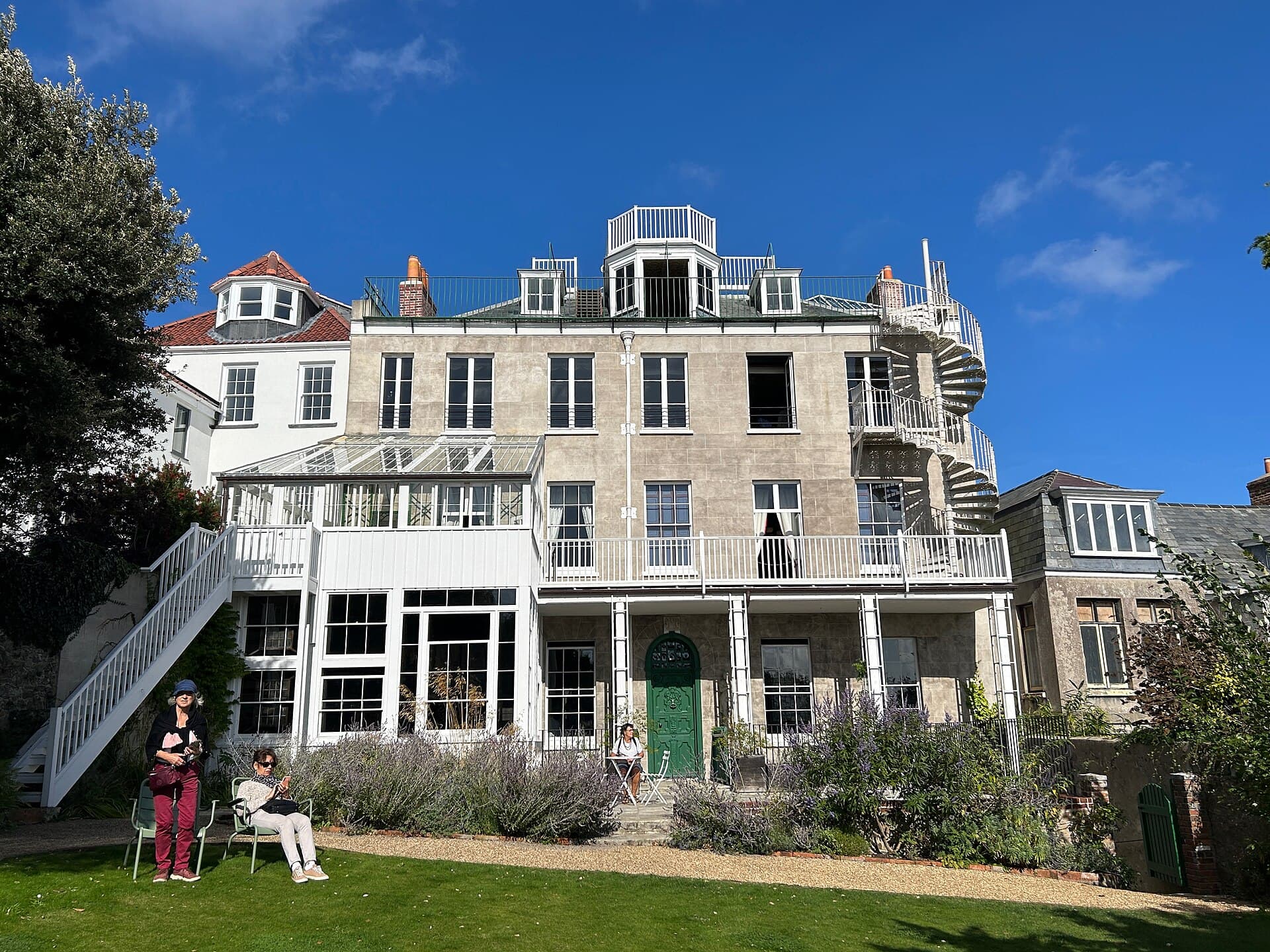
Victor Hugo landed in Guernsey in October 1855 after Jersey expelled him, and stayed until 1870. On 16 May 1856 he bought Hauteville House with the proceeds of his poetry collection Les Contemplations, partly because owning property in Guernsey made him impossible to deport, and then spent fourteen years turning the interior into something he designed himself out of carved chests, panelling, porcelain and salvage, room by room, in a sequence that climbs from dark ground-floor halls to a glass lookout on the roof. He wrote standing at that lookout, facing the sea and the coast of France he could not return to, and the books he finished there include Les Misérables in 1862 and Toilers of the Sea in 1866, which he dedicated to the rock of hospitality and freedom that had taken him in (Hauteville House).
The rest is island-scale and practical. The Guernsey cow and the Guernsey lily carry the name abroad, as does the heavy oiled sweater the fishermen wore. Hedge-veg tables with honesty boxes still stand at the ends of lanes, Le Viaër Marchi each summer revives the old market with Guernésiais songs and gâche, and Alderney Week fills the first week of August. Sark, which banned cars from the start, was designated the world's first Dark Sky Island in 2011 because it has no public street lighting at all.
Ten ancient parish churches ring the island, with the Town Church at the harbour and St Sampson's on the north claiming descent from the sixth-century missionary who is said to have landed there. Lihou keeps the ruins of a Benedictine priory reached across a tidal causeway. The strangest religious building in the Bailiwick is the newest: the Little Chapel at Les Vauxbelets, begun by Brother Déodat in 1914 in imitation of the grotto at Lourdes, demolished and rebuilt twice, the second time after the Bishop of Portsmouth could not fit through the door, and covered inside and out with broken china, shells and pebbles sent in by islanders and strangers. The current chapel measures roughly sixteen feet by nine and holds about eight people; £500,000 of structural work between 2015 and 2017 stopped it collapsing (Little Chapel).
The Reformation reached Guernsey in a Calvinist form and it left a scar the island still marks. On or about 18 July 1556, under Mary I, three women of St Peter Port were burned for heresy: Catherine Cauchés and her daughters Guillemine Gilbert and Perotine Massey. The rope meant to strangle them broke, Perotine was pregnant and gave birth in the fire, and the Bailiff ordered the infant thrown back in. A plaque on the Tower Hill steps, unveiled on 24 April 1999, marks the spot (Guernsey Martyrs). Methodism later took strong hold across Guernsey and Sark, and chapel singing in Guernésiais kept the language audible long after it left the shops.
Guernsey's remembrance runs from the prehistoric to the very recent, and the Gran'mère is the oldest end of it. Parish burial is administered by the Douzaine, family plots repeat the same Norman surnames down generations, and the older churchyards carry inscriptions in French.
The occupation supplies the rest. In September 1942 and February 1943, on Hitler's order, 1,003 people were deported from Guernsey and Sark to internment camps in Germany, Guernsey families mostly to Biberach and unattached men to Laufen, and a plaque in St Peter Port records the number. Three Jewish women living in Guernsey, Therese Steiner and Auguste Spitz from Vienna and Marianne Grünfeld from Katowice, were registered under the German anti-Jewish orders by the island's own administration, deported to France on 21 April 1942 and murdered at Auschwitz-Birkenau that July; a black marble plaque names all three. The Guernsey Underground News Service, run from 1942 by Charles Machon of The Star to circulate BBC bulletins after radios were confiscated, was betrayed by an informer, and Machon died in Hamelin prison hospital while Joseph Gillingham died at Naumburg (Frank Falla Archive).
Alderney carries the heaviest weight. Emptied of its people, the island was turned into a labour camp complex: four camps named after Frisian islands, Helgoland, Borkum, Norderney and Sylt, of which Lager Sylt became a subcamp of Neuengamme run by the SS from March 1943, the only SS concentration camp on British soil (Lager Sylt). The commandant burned the camps and destroyed the records before liberation, which is why the death toll was argued over for eighty years. A UK expert review chaired by Lord Pickles reported in May 2024 that between 7,608 and 7,812 prisoners and labourers were sent to Alderney, that between 641 and 1,027 of them died there, and that the total is unlikely to have exceeded 1,134; it also found no evidence for the claims of many thousands dead (Alderney expert review).
Above Longis Common, where liberating troops found the main burial ground, stands the Hammond Memorial: a granite boulder given by France in 1951, enlarged in 1966 by the States member Bert Hammond into a two-tier monument with nine plaques for the different nationalities of the dead (Hammond Memorial). The graves themselves were emptied in 1961, when the German War Graves Commission exhumed the bodies and reburied them at Mont-de-Huisnes in Normandy, and later work showed the cemetery had been a tidy front with unmarked graves around it. Liberation Day on 9 May is a public holiday in Guernsey, Sark was freed on 10 May and Alderney on 16 May, and Alderney keeps its own date: Homecoming Day, 15 December, the day in 1945 the islanders came back.
Guernsey's records run in parallel with Jersey's and are held separately, which is the first thing to know: the Channel Islands are two jurisdictions, not one.
Parish registers for the ten Guernsey parishes begin in the sixteenth century. Civil registration started in 1840, two years before Jersey's, and is held by the Greffe in St Peter Port. The Island Archives and the Priaulx Library hold the wider collections, and the Royal Court's registers of property contracts, in French, record land transfers and the family relationships behind them across several centuries.
Alderney and Sark keep their own records, and Sark's feudal tenement system, in which the island was divided into forty holdings that descended intact, produces an unusually neat genealogical series.
Huguenot refugees settled here in numbers from the sixteenth century, and the French-speaking Calvinist congregations left their own registers, which is why so many Guernsey surnames are French and so many Guernsey families connect to Normandy and beyond it.
The Occupation record is starker than Jersey's in one respect. Guernsey evacuated around seventeen thousand people, including most of its schoolchildren, to England in June 1940, days before the Germans arrived, while Alderney was evacuated almost completely and then turned into a site of forced labour camps where a large number of people died. The evacuation registers, the camp records and the post-war investigations are held in Guernsey and in Britain, and the Alderney figures are still contested.
Guernsey Museums, run by the States, holds the island's collections at Candie in St Peter Port, where the archaeology, folklore and art galleries sit in a Victorian garden, and it also runs Castle Cornet and Fort Grey. The castle came to the island as a gift from George VI in 1947 in recognition of Guernsey's wartime loyalty, and it now contains several museums and fires a noonday gun. Beside the official institutions sits the German Occupation Museum at Les Houards in the Forest, built up over sixty years by Richard Heaume, who lived through the occupation as a boy and started collecting in the 1960s; it opened in 1966 and holds the largest collection of occupation material in the islands, arranged as reconstructed kitchens, bunker rooms and a street.
La Société Guernesiaise, founded in 1882, runs the archaeology, history, natural history and astronomy sections that do most of the fieldwork in the Bailiwick, publishes annual Transactions, and looks after nature reserves and monuments. On Alderney, the Alderney Society keeps the island museum and its occupation collections, and the archaeological survey of the camp sites has become an international matter, with the International Holocaust Remembrance Alliance sending a delegation to advise on safeguarding ground that holds unmarked graves.
The Bailiwick has put its records online through an unusual joint effort. The Bailiwick of Guernsey Digitisation Partnership brought together the Priaulx Library, Island Archives, the Deanery of Guernsey, La Société Guernesiaise and the Greffe, and over a single year digitised the vital records along with some 210,000 pages of archival material: Greffe records, parish registers, occupation identity cards and conveyance documents. The results went live through Findmypast in April 2025, free to use inside the Priaulx Library and Island Archives, so that a family search that once meant a flight and a reading-room slot can now be started anywhere (familyhistory.gg). The Priaulx Library, endowed in 1889 when Osmond de Beauvoir Priaulx gave Candie House and his books to the island, publishes transcriptions and research notes of its own and holds the Guernsey censuses from 1841 to 1911 (Priaulx Library). The Frank Falla Archive documents Channel Islanders imprisoned in Nazi camps and prisons, person by person, and BBC Radio Guernsey has broadcast a weekly news bulletin in Guernésiais since 2021.
Finance reshaped Guernsey as it did its neighbour, and around 37 per cent of GDP now comes from banking, fund administration and a large captive insurance sector, with the consequences familiar to any small jurisdiction: high housing costs, population policy arguments and steady international scrutiny. The island's other modern export is a novel. The Guernsey Literary and Potato Peel Pie Society, published in 2008 and filmed in 2018, put the occupation and the evacuation in front of a very large audience and brought a wave of visitors looking for the places in it, which is a mixed blessing for an island whose war is still being investigated a few miles north.
Sark has spent the years since 2008 working out what an elected Chief Pleas means in a place with 560 people, after the Barclay brothers of Brecqhou challenged its inheritance laws and forced the end of a constitution granted by Elizabeth I in 1565. Alderney is arguing, openly and painfully, about how to present camps that most visitors do not know existed. Both arguments are heritage questions as much as political ones.
A number, at last, for Alderney. The Lord Pickles expert review of May 2024 established a documented range for the dead of the Alderney camps and for the labourers sent there, replacing eighty years of guesswork and rumour with evidence.
Hugo's house brought back. Hauteville House, given to the City of Paris by Hugo's descendants in 1927, was structurally repaired and then fully restored with about three million euros from François Pinault, reopening on 7 April 2019.
A feudal parliament reformed by ballot. Sark replaced the tenants' seats in Chief Pleas with elected members in 2008, ending the last feudal legislature in Europe without losing the island's separate constitution.
The Bailiwick's records opened. Five institutions digitised the vital records and 210,000 pages of archives together, publishing them online in April 2025 so that descendants anywhere can trace a Guernsey, Alderney or Sark family.
Castle Cornet held out for the king for eight years in the civil war, longer than anywhere else, while the rest of Guernsey was for Parliament. Photograph by TheKaphox, CC0, via Wikimedia Commons.
Guernsey passed to Normandy in 933 with the rest of the islands, and in 1204, when King John lost the mainland duchy to Philip Augustus, the Bailiwick stayed with the English crown and kept its Norman law, its own court and its own assembly. What Guernsey gained from the split was a frontier position and centuries of French raids, which is why Castle Cornet was begun on its tidal rock between 1206 and 1256. That castle produced the island's strangest siege: in the Civil War, Guernsey went with Parliament while the castle held for the King, and it shelled the town it stood in for nine years before surrendering in December 1651. In 1672 lightning found the powder magazine and blew the keep apart, killing the governor's wife, his mother and several of the household (Castle Cornet).
Privateering, quarrying and greenhouse tomato growing carried the island through the eighteenth and nineteenth centuries, and in 1855 an exiled French writer arrived who would stay for fifteen years. Then came the Germans. The Luftwaffe bombed St Peter Port harbour on 28 June 1940, killing dozens of islanders who had no idea Britain had already demilitarised them, and Guernsey was occupied on 30 June. About 17,000 of 42,000 residents had evacuated, including nearly all the island's schoolchildren, who left with their teachers and did not come home for five years.
The Bailiwick spoke four kinds of Norman, and each ended differently. Guernésiais, closest of them to the Cotentinais of the French mainland, had 1,327 fluent speakers at the 2001 census, about two per cent of the population, of whom seventy per cent were over sixty-four; the wartime evacuation of the children broke transmission at exactly the wrong moment, and almost nobody learned it at home afterwards. In September 2020 the States voted £300,000 and a Language Commission for it, and recognised Guernésiais and French as official languages (Guernésiais).
Sercquiais on Sark came from about forty families, mostly from St Ouen in Jersey, who settled the empty island in 1565, and it has stayed close to sixteenth-century Jèrriais ever since. Its position is now extreme: two or three native speakers remain, but the Czech linguist Martin Neudörfl has recorded the language extensively and it has been taught in Sark's school since 2019 (Sercquiais). Auregnais, the Norman of Alderney, is simply gone. A Victorian British garrison, imported labourers for the harbour works, and schoolmasters who pushed standard French had already weakened it before the total evacuation of 1940 finished it off, and the last native speaker died around 1960, leaving one known audio recording made by Frank Le Maistre and published in 1982 (Auregnais). Standard French, meanwhile, held the courts and the pulpits into the twentieth century and remains an official language. The map keeps the Norman layer regardless: L'Ancresse, Vazon, Pleinmont, Le Déhus, Les Vauxbelets, and the Old Norse -ey ending shared by Guernsey, Alderney, Jersey and Chausey.
Victor Hugo landed in Guernsey in October 1855 after Jersey expelled him, and stayed until 1870. On 16 May 1856 he bought Hauteville House with the proceeds of his poetry collection Les Contemplations, partly because owning property in Guernsey made him impossible to deport, and then spent fourteen years turning the interior into something he designed himself out of carved chests, panelling, porcelain and salvage, room by room, in a sequence that climbs from dark ground-floor halls to a glass lookout on the roof. He wrote standing at that lookout, facing the sea and the coast of France he could not return to, and the books he finished there include Les Misérables in 1862 and Toilers of the Sea in 1866, which he dedicated to the rock of hospitality and freedom that had taken him in (Hauteville House).
The rest is island-scale and practical. The Guernsey cow and the Guernsey lily carry the name abroad, as does the heavy oiled sweater the fishermen wore. Hedge-veg tables with honesty boxes still stand at the ends of lanes, Le Viaër Marchi each summer revives the old market with Guernésiais songs and gâche, and Alderney Week fills the first week of August. Sark, which banned cars from the start, was designated the world's first Dark Sky Island in 2011 because it has no public street lighting at all.
Ten ancient parish churches ring the island, with the Town Church at the harbour and St Sampson's on the north claiming descent from the sixth-century missionary who is said to have landed there. Lihou keeps the ruins of a Benedictine priory reached across a tidal causeway. The strangest religious building in the Bailiwick is the newest: the Little Chapel at Les Vauxbelets, begun by Brother Déodat in 1914 in imitation of the grotto at Lourdes, demolished and rebuilt twice, the second time after the Bishop of Portsmouth could not fit through the door, and covered inside and out with broken china, shells and pebbles sent in by islanders and strangers. The current chapel measures roughly sixteen feet by nine and holds about eight people; £500,000 of structural work between 2015 and 2017 stopped it collapsing (Little Chapel).
The Reformation reached Guernsey in a Calvinist form and it left a scar the island still marks. On or about 18 July 1556, under Mary I, three women of St Peter Port were burned for heresy: Catherine Cauchés and her daughters Guillemine Gilbert and Perotine Massey. The rope meant to strangle them broke, Perotine was pregnant and gave birth in the fire, and the Bailiff ordered the infant thrown back in. A plaque on the Tower Hill steps, unveiled on 24 April 1999, marks the spot (Guernsey Martyrs). Methodism later took strong hold across Guernsey and Sark, and chapel singing in Guernésiais kept the language audible long after it left the shops.
Guernsey's remembrance runs from the prehistoric to the very recent, and the Gran'mère is the oldest end of it. Parish burial is administered by the Douzaine, family plots repeat the same Norman surnames down generations, and the older churchyards carry inscriptions in French.
The occupation supplies the rest. In September 1942 and February 1943, on Hitler's order, 1,003 people were deported from Guernsey and Sark to internment camps in Germany, Guernsey families mostly to Biberach and unattached men to Laufen, and a plaque in St Peter Port records the number. Three Jewish women living in Guernsey, Therese Steiner and Auguste Spitz from Vienna and Marianne Grünfeld from Katowice, were registered under the German anti-Jewish orders by the island's own administration, deported to France on 21 April 1942 and murdered at Auschwitz-Birkenau that July; a black marble plaque names all three. The Guernsey Underground News Service, run from 1942 by Charles Machon of The Star to circulate BBC bulletins after radios were confiscated, was betrayed by an informer, and Machon died in Hamelin prison hospital while Joseph Gillingham died at Naumburg (Frank Falla Archive).
Alderney carries the heaviest weight. Emptied of its people, the island was turned into a labour camp complex: four camps named after Frisian islands, Helgoland, Borkum, Norderney and Sylt, of which Lager Sylt became a subcamp of Neuengamme run by the SS from March 1943, the only SS concentration camp on British soil (Lager Sylt). The commandant burned the camps and destroyed the records before liberation, which is why the death toll was argued over for eighty years. A UK expert review chaired by Lord Pickles reported in May 2024 that between 7,608 and 7,812 prisoners and labourers were sent to Alderney, that between 641 and 1,027 of them died there, and that the total is unlikely to have exceeded 1,134; it also found no evidence for the claims of many thousands dead (Alderney expert review).
Above Longis Common, where liberating troops found the main burial ground, stands the Hammond Memorial: a granite boulder given by France in 1951, enlarged in 1966 by the States member Bert Hammond into a two-tier monument with nine plaques for the different nationalities of the dead (Hammond Memorial). The graves themselves were emptied in 1961, when the German War Graves Commission exhumed the bodies and reburied them at Mont-de-Huisnes in Normandy, and later work showed the cemetery had been a tidy front with unmarked graves around it. Liberation Day on 9 May is a public holiday in Guernsey, Sark was freed on 10 May and Alderney on 16 May, and Alderney keeps its own date: Homecoming Day, 15 December, the day in 1945 the islanders came back.
Guernsey's records run in parallel with Jersey's and are held separately, which is the first thing to know: the Channel Islands are two jurisdictions, not one.
Parish registers for the ten Guernsey parishes begin in the sixteenth century. Civil registration started in 1840, two years before Jersey's, and is held by the Greffe in St Peter Port. The Island Archives and the Priaulx Library hold the wider collections, and the Royal Court's registers of property contracts, in French, record land transfers and the family relationships behind them across several centuries.
Alderney and Sark keep their own records, and Sark's feudal tenement system, in which the island was divided into forty holdings that descended intact, produces an unusually neat genealogical series.
Huguenot refugees settled here in numbers from the sixteenth century, and the French-speaking Calvinist congregations left their own registers, which is why so many Guernsey surnames are French and so many Guernsey families connect to Normandy and beyond it.
The Occupation record is starker than Jersey's in one respect. Guernsey evacuated around seventeen thousand people, including most of its schoolchildren, to England in June 1940, days before the Germans arrived, while Alderney was evacuated almost completely and then turned into a site of forced labour camps where a large number of people died. The evacuation registers, the camp records and the post-war investigations are held in Guernsey and in Britain, and the Alderney figures are still contested.
Guernsey Museums, run by the States, holds the island's collections at Candie in St Peter Port, where the archaeology, folklore and art galleries sit in a Victorian garden, and it also runs Castle Cornet and Fort Grey. The castle came to the island as a gift from George VI in 1947 in recognition of Guernsey's wartime loyalty, and it now contains several museums and fires a noonday gun. Beside the official institutions sits the German Occupation Museum at Les Houards in the Forest, built up over sixty years by Richard Heaume, who lived through the occupation as a boy and started collecting in the 1960s; it opened in 1966 and holds the largest collection of occupation material in the islands, arranged as reconstructed kitchens, bunker rooms and a street.
La Société Guernesiaise, founded in 1882, runs the archaeology, history, natural history and astronomy sections that do most of the fieldwork in the Bailiwick, publishes annual Transactions, and looks after nature reserves and monuments. On Alderney, the Alderney Society keeps the island museum and its occupation collections, and the archaeological survey of the camp sites has become an international matter, with the International Holocaust Remembrance Alliance sending a delegation to advise on safeguarding ground that holds unmarked graves.
The Bailiwick has put its records online through an unusual joint effort. The Bailiwick of Guernsey Digitisation Partnership brought together the Priaulx Library, Island Archives, the Deanery of Guernsey, La Société Guernesiaise and the Greffe, and over a single year digitised the vital records along with some 210,000 pages of archival material: Greffe records, parish registers, occupation identity cards and conveyance documents. The results went live through Findmypast in April 2025, free to use inside the Priaulx Library and Island Archives, so that a family search that once meant a flight and a reading-room slot can now be started anywhere (familyhistory.gg). The Priaulx Library, endowed in 1889 when Osmond de Beauvoir Priaulx gave Candie House and his books to the island, publishes transcriptions and research notes of its own and holds the Guernsey censuses from 1841 to 1911 (Priaulx Library). The Frank Falla Archive documents Channel Islanders imprisoned in Nazi camps and prisons, person by person, and BBC Radio Guernsey has broadcast a weekly news bulletin in Guernésiais since 2021.
Finance reshaped Guernsey as it did its neighbour, and around 37 per cent of GDP now comes from banking, fund administration and a large captive insurance sector, with the consequences familiar to any small jurisdiction: high housing costs, population policy arguments and steady international scrutiny. The island's other modern export is a novel. The Guernsey Literary and Potato Peel Pie Society, published in 2008 and filmed in 2018, put the occupation and the evacuation in front of a very large audience and brought a wave of visitors looking for the places in it, which is a mixed blessing for an island whose war is still being investigated a few miles north.
Sark has spent the years since 2008 working out what an elected Chief Pleas means in a place with 560 people, after the Barclay brothers of Brecqhou challenged its inheritance laws and forced the end of a constitution granted by Elizabeth I in 1565. Alderney is arguing, openly and painfully, about how to present camps that most visitors do not know existed. Both arguments are heritage questions as much as political ones.
A number, at last, for Alderney. The Lord Pickles expert review of May 2024 established a documented range for the dead of the Alderney camps and for the labourers sent there, replacing eighty years of guesswork and rumour with evidence.
Hugo's house brought back. Hauteville House, given to the City of Paris by Hugo's descendants in 1927, was structurally repaired and then fully restored with about three million euros from François Pinault, reopening on 7 April 2019.
A feudal parliament reformed by ballot. Sark replaced the tenants' seats in Chief Pleas with elected members in 2008, ending the last feudal legislature in Europe without losing the island's separate constitution.
The Bailiwick's records opened. Five institutions digitised the vital records and 210,000 pages of archives together, publishing them online in April 2025 so that descendants anywhere can trace a Guernsey, Alderney or Sark family.
National Overview
Notable Cities
Historical Foundations
Linguistic and Etymological Roots
Cultural Identity
Religion and Spirituality
Remembrance and Mourning Traditions
Tracing a Family in Guernsey
Heritage Preservation Efforts
Digital Heritage
Contemporary Cultural Influences
Success Stories
References and resources
- Guernsey, Wikipedia: the Bailiwick, its islands and its institutions.
- La Gran'mère du Chimquière, Wikipedia: the statue-menhir at St Martin's and its breaking.
- Hauteville House, Wikipedia: Hugo's exile, the lookout and the 2019 restoration.
- Guernésiais, Wikipedia: speaker numbers, the evacuation effect and recognition.
- Sercquiais, Wikipedia: the 1565 settlement and the surviving speakers.
- Auregnais, Wikipedia: the extinction of Alderney's Norman and the surviving recording.
- Sark, Wikipedia: the fief of 1565, the tenements and the 2008 reform.
- Alderney, Wikipedia: the evacuation, the fortifications and the camps.
- Lager Sylt, Wikipedia: the SS subcamp on Alderney and what survives of it.
- The Lord Pickles Alderney expert review, 2024: the death-toll findings.
- Hammond Memorial, Visit Alderney: the 1951 boulder and its 1966 enlargement.
- Castle Cornet, Wikipedia: the nine-year siege, the 1672 explosion and the 1947 gift.
- Guernsey Martyrs, Wikipedia: the burnings of 1556 and the Tower Hill plaque.
- Frank Falla Archive: Channel Islanders imprisoned by the Nazis, including the GUNS men.
- The Bailiwick of Guernsey Digitisation Partnership: the joint records project published in 2025.
- Priaulx Library: local and family history collections in St Peter Port.