Heritage · Country
Bermuda Culture and Heritage
An English ship bound for Jamestown was driven onto Bermuda's reefs in 1609, and the survivors stayed to found a town that has been lived in ever since. This is a guide to Bermudian heritage, from cedar boats and white water-catching roofs to the Gombeys who dance at Christmas.Written to last.
By Confinity Heritage Editorial · Updated 2026-08-17 · 8-minute readQuiet tools, kept out of the way.
On 28 July 1609 the Sea Venture, flagship of a relief fleet carrying settlers and supplies to the failing English colony at Jamestown, was driven by a hurricane onto the reefs off the eastern end of Bermuda. Her admiral, Sir George Somers, steered the sinking ship deliberately between two rocks so the hull would hold long enough to get everyone off, and all roughly one hundred and fifty people aboard reached the shore alive. They spent ten months on an island nobody lived on, built two new vessels from Bermuda cedar and salvaged timber, and sailed to Virginia in May 1610. A few stayed. The island has been inhabited from that year to this.
Bermuda is not in the Caribbean, and Bermudians will correct you if you say it is. It lies in the sub-tropical North Atlantic about 1,035 kilometres east-southeast of Cape Hatteras in North Carolina, closer to Nova Scotia than to any island in the West Indies, and the difference shows in the winter weather and in the shape of the roofs. What follows is a guide to that island's heritage: the shipwreck founding and the fortified first town, the enslavement its wealth was built on, the cedar and limestone that gave Bermudians their boats and their water, and the customs by which they remember their dead.
Bermuda is a British Overseas Territory of about 181 islands and rocks on the rim of an extinct volcano, with a land area of roughly 54 square kilometres and a population near 64,000. The eight largest are joined by bridges and a causeway into a single fishhook curve some 35 kilometres long and, in places, barely a kilometre wide. Warmed by the Gulf Stream, it carries the northernmost coral reefs in the world, and those reefs, which have wrecked hundreds of ships, are the reason both for its settlement and for the fortifications ringing its coast. It is the oldest of Britain's remaining overseas territories, its House of Assembly first met in 1620, most Bermudians are of African, British or Portuguese descent, and the economy runs on international insurance and reinsurance alongside tourism (Britannica).
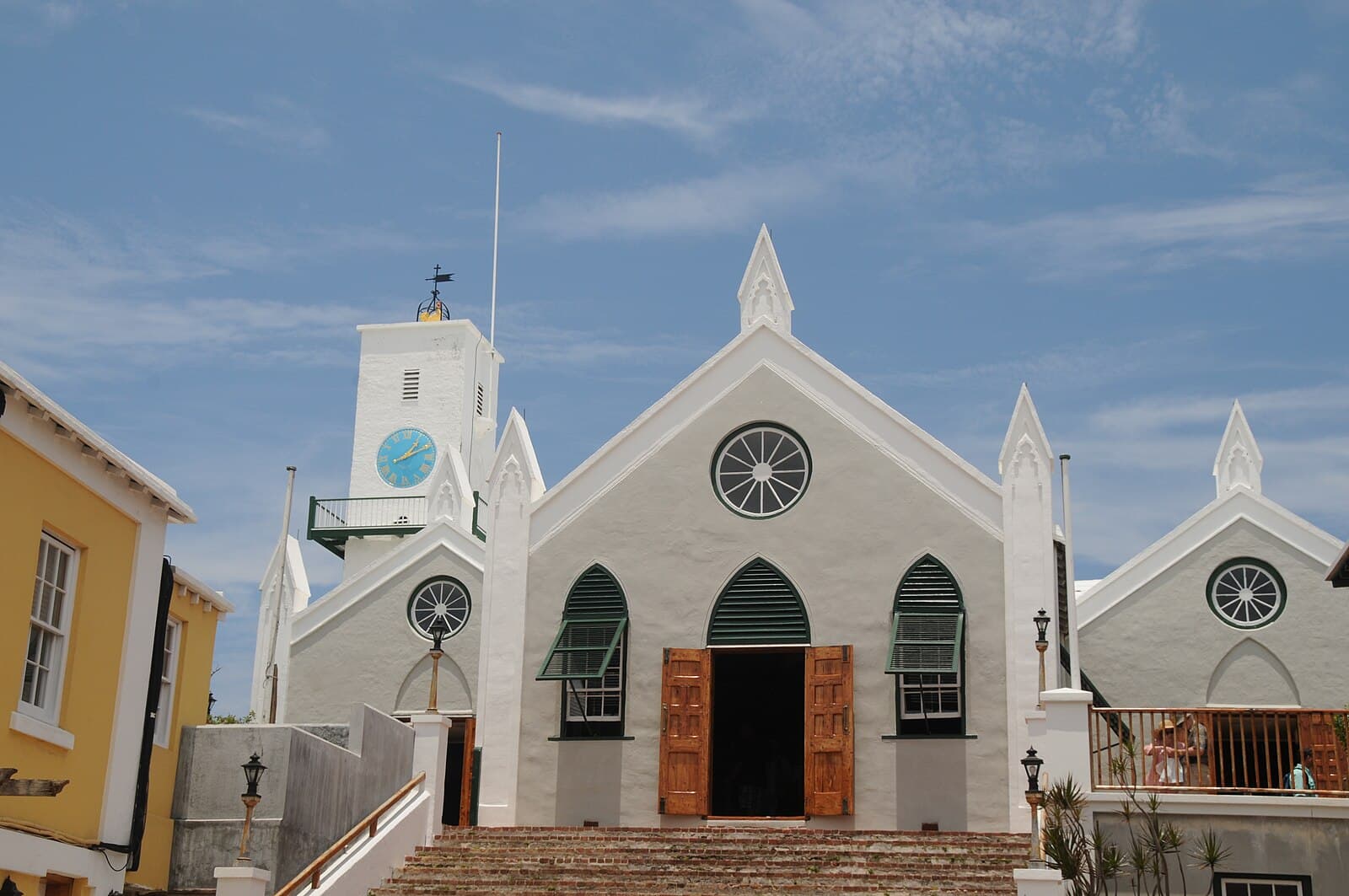
St George's. The town founded by the Sea Venture survivors and their successors in 1612 is the oldest continuously inhabited English town in the New World, and in 2000 UNESCO inscribed it, with its fortifications, as a World Heritage Site (UNESCO). Its streets were laid without a plan and still run at the angles the seventeenth century left them, past King's Square, the State House of 1620, the roofless walls of the Unfinished Church that a nineteenth-century congregation began and never completed, and St Peter's, used for worship since 1612 and the oldest Anglican church still in use outside the British Isles. The forts around it span three centuries, from the stone works begun on the Castle Islands in 1612 to the Victorian bulk of Fort St Catherine, on the beach where the castaways came ashore.
 St George's, founded in 1612, is the oldest continuously inhabited English town in the New World, and it survives largely because the island's commerce moved to Hamilton and left it alone. Photograph by Sean Pol O Creachmhaoil, CC BY-SA 4.0, via Wikimedia Commons.
Hamilton. The capital since 1815, when government moved west to a better central harbour, Hamilton is a small city of pastel commercial buildings along Front Street, home to the Bermuda National Gallery and the Sessions House.
The Royal Naval Dockyard. At the western tip, the Royal Navy built a fortified base with convict labour from 1809, after the loss of the American colonies left Britain without a North Atlantic yard. The Keep of that fortress houses the National Museum of Bermuda.
The islands were charted by the Spanish navigator Juan de Bermúdez early in the sixteenth century and named after him, but nobody settled them; Spanish and Portuguese sailors knew the place as the Isle of Devils, an unpeopled reef trap where the calls of nesting cahow petrels sounded at night like something worse. Two survivors of the 1609 wreck, William Strachey and Sylvester Jourdain, wrote accounts of it, and Strachey's long letter, later printed as A True Reportory of the Wracke, is regarded by most Shakespeare scholars as a source for The Tempest (Wikipedia).
Permanent settlement followed in 1612, and in 1616 and 1617 the surveyor Richard Norwood divided most of the land into eight tribes of fifty twenty-five-acre shares each, allotted to the London investors who had financed the venture. Enslaved Africans were brought in from the earliest years, joined by enslaved Native Americans shipped from New England after the colonial wars there and by Irish prisoners. Bermuda had no room for plantations on the West Indian model, so slavery here was maritime and domestic: enslaved men piloted ships through the reefs, built and sailed the cedar sloops and raked salt in the Turks Islands, while enslaved women ran households and the marketplace. In 1730 an enslaved woman named Sarah Bassett was burned at the stake in Hamilton, convicted of poisoning; a bronze figure of her was unveiled on the Cabinet grounds in 2009.
Emancipation came on 1 August 1834, and it came whole. Bermuda and Antigua were the only British colonies to reject the apprenticeship system that kept the formerly enslaved bound to their old owners elsewhere until 1838, so the roughly four thousand people freed in Bermuda that day were free immediately. Freedom did not bring equality. Segregation of schools, churches, hotels and cinemas hardened through the following century, and the franchise stayed tied to property until 1968. It broke in the summer of 1959, when a secret group of young Bermudians calling themselves the Progressive Group papered the island overnight with posters calling for a boycott of the segregated cinemas; the theatres closed for lack of custom on 23 June and reopened with integrated seating on 2 July, after which hotels and restaurants followed rather than face the same fate (National Museum of Bermuda). Its members kept their identities secret for forty years.
The next two decades were harder. Police Commissioner George Duckett was shot dead in 1972, and in March 1973 the Governor, Sir Richard Sharples, and his aide-de-camp Captain Hugh Sayers were murdered at Government House. Erskine Burrows and Larry Tacklyn were hanged on 2 December 1977, the last executions carried out under British jurisdiction, and Bermuda burned for three days afterwards. The Royal Commission that followed, chaired by Lord Pitt, traced the violence past the killings themselves to entrenched racial inequality in housing, education and work (Pitt Report, 1978).
Bermudian English is its own variety, closer in some respects to the speech of the American mid-Atlantic coast than to Caribbean English, and marked by an exchange of the sounds written v and w, so that older speakers may say wery for very and vell for well. Linguists have connected the feature to seventeenth-century English dialects carried out by the first settlers and preserved by isolation, though West African substrate influence is also argued (Wikipedia).
The map is a shareholder list. Norwood's tribes took the names of the London adventurers who paid for them, and those names became the parishes still in use: Sandys for Sir Edwin Sandys, Southampton for the Earl of Southampton, Warwick, Paget, Pembroke, Devonshire, Smith's for Sir Thomas Smythe and Hamilton for the Marquess of Hamilton, with St George's held back as common land. A Portuguese layer was added from 1849, when the brig Golden Rule brought the first labourers from Madeira, followed by decades of arrivals from the Azores; surnames such as Medeiros, DeSilva and Furtado are as Bermudian now as Tucker or Trott (National Museum of Bermuda).
The Gombeys are the most recognisable Bermudian tradition and the least explicable to outsiders. A troupe is led by a Captain and moves as a body of masked dancers in tall peacock-feather headdresses and capes hung with mirrors and ribbon, driven by snare and bass drums, a whistle and a cracked whip. The form was made by enslaved and free Black Bermudians and draws together West African drumming and masquerade, Caribbean carnival practice and Native American elements carried by the Pequot and Algonquian people brought here in the seventeenth century (Wikipedia). Colonial law restricted masking and drumming for much of the island's history, and performances required police permission well into the twentieth century, which is why the Gombeys came out chiefly on the few days enslaved and then poorly paid people had to themselves: Christmas Day, Boxing Day, New Year's Day and Good Friday. They still do, and a troupe arriving at the top of a lane on Boxing Day will empty every house on it.
The other fixture is Cup Match, the two-day cricket match between the Somerset and St George's clubs played at the turn of July into August, which doubles as the national holiday: its first day is Emancipation Day, its second, long called Somers Day, now honours Mary Prince. On the water, Bermuda gave sailing the triangular Bermuda rig, standard on yachts everywhere, and the Bermuda sloop, a fast cedar-built vessel that carried the island's freight and its privateers. Bermudians still race the fitted dinghy, a fourteen-foot open boat under an absurd press of sail whose crews bail continuously and, on the last leg, go over the side to lighten the hull (Wikipedia). Easter belongs to home-built tissue-paper kites, Christmas to cassava pie.
The white stepped roof is the thing visitors photograph and the thing Bermudians take for granted, and it exists because the island has no rivers, no lakes and no usable groundwater. Roofs are built of thin slabs of local limestone, called slate, laid in overlapping courses on a timber frame so the finished surface rises in shallow steps from eaves to ridge. Rain hitting the stone is slowed by each step instead of sheeting off, which gives it time to run into stone gutters, known as glides, and down a pipe to a tank under the house. The whole is sealed with lime wash, which is what makes the roofs so white, and the wash both waterproofs the porous stone and, being strongly alkaline, helps keep the stored water clean. Building regulations still set required tank capacity against the roof area feeding it (99% Invisible).
The Church of England came ashore with the settlers and was established by law, and its parish churches are among the oldest buildings on the island. Methodism arrived later and met resistance: the Irish missionary John Stephenson, sent to preach specifically to Black Bermudians, was fined and jailed for six months in St George's in 1801 under a law passed to stop him, and went on preaching through the window of his cell (Bermuda Biographies). That episode set the pattern by which Black Bermudians built their own institutions. The African Methodist Episcopal Church took root in the nineteenth century and became one of the largest denominations here, and it was from those congregations and the friendly societies attached to them that much of the twentieth-century civil rights movement drew its people.
Roman Catholicism grew with Portuguese immigration from the mid-nineteenth century, and Seventh-day Adventist, Pentecostal and Baptist congregations are substantial. Older belief survives in speech and in caution: the word obeah still names the practice of spiritual harm or protection, and few will discuss it with a stranger.
A Bermudian funeral is a community occasion and a formal one. Notices go out in The Royal Gazette and on the radio, the church fills far beyond the family, and mourners dress with a strictness visitors notice. Where the deceased belonged to a friendly society or lodge, and a very large number of Black Bermudians did, the society conducts its own rites at the graveside in regalia, and the burial may be paid from the society's funds. Bermuda's friendly societies grew up around emancipation, some older still, and their first purpose was precisely this: to guarantee that members would be buried with dignity, that widows and orphans would be supported, and that the sick would be attended, at a time when no insurer would sell a Black Bermudian a policy (The Royal Gazette). Names such as the Grand United Order of Oddfellows and the Alexandrina Lodge appear on graves and on lodge halls still standing across the island, halls that were also the first Black-owned public buildings in Bermuda (Sankofa Bermuda).
Cedar carried Bermudians through life and out of it. The aromatic red wood of Juniperus bermudiana went into houses, church fittings, cradles, chests, the fast sloops and the coffins, and a cedar coffin was for centuries the ordinary Bermudian way of being buried (The Royal Gazette). The blight of the 1940s made that impossible for two generations, and cedar is now scarce enough that it goes into small commemorative objects rather than caskets, a loss the island has had to absorb. Graveyards are kept close and visited, and the churchyards at St Peter's and elsewhere hold the enslaved and the free in separate ground, a division the parishes have since marked and named.
Public remembrance is organised around emancipation and the people who argued for it. Mary Prince, born into slavery at Brackish Pond in Devonshire around 1788, dictated The History of Mary Prince in London in 1831, the first account of a Black woman's life published in Britain, and its detail on the salt ponds of Turks Island and the households of Bermuda and Antigua fed directly into the abolition debate (London Museum). The second day of Cup Match now carries her name.
Bermuda has the oldest continuous English-speaking records outside England, and it has them because the island was settled by accident and never abandoned.
The Sea Venture wrecked here in 1609 on its way to Virginia, and permanent settlement followed in 1612. Anglican parish registers begin in the 1610s and 1620s, making them among the earliest in the Americas, and they are held by the Bermuda Archives in Hamilton along with the colonial series, wills and civil registration.
Bermudian slavery was domestic and maritime rather than agricultural: enslaved people worked as sailors, pilots, shipwrights and household servants, and the census and probate records of the seventeenth and eighteenth centuries name them within households. The slave registers of 1821 to 1834 name individuals with age and owner, and the compensation records follow. Emancipation came in 1834 without an apprenticeship period, which Bermuda still marks.
A distinctive strand is the Indigenous American presence: Pequot and other Native Americans were transported here as captives in the seventeenth century, along with Irish prisoners, and both appear in the early records.
The maritime record is the other archive. Bermudian ships, the sloops built from island cedar, sailed the Atlantic, and crew lists and salvage records document a working population that was frequently at sea.
The dockyard, built by convict labour from Britain between 1824 and 1863, kept records of the men transported to construct it.
The Bermuda National Trust, formed in 1970 out of an earlier monuments trust, holds historic houses, open land and archaeological sites across the island, among them Verdmont, an unaltered early eighteenth-century house in Smith's Parish with its original cedar staircase, and the Globe Hotel in St George's; its parish-by-parish survey, Bermuda's Architectural Heritage, remains the standard record of the island's building stock (Bermuda National Trust). The National Museum of Bermuda occupies the Keep of the Dockyard fortress and combines shipwreck archaeology, the Commissioner's House with Graham Foster's painted Hall of History, and exhibitions on slavery, emancipation and maritime work (National Museum of Bermuda). The Bermuda Archives in Hamilton holds the registers, wills and court papers by which Bermudian families trace descent back to the seventeenth century (Government of Bermuda).
Two threats shape the work. The first is weather. Bermuda sits in the hurricane track and takes direct hits often enough that preservation here means constant repair: Fabian in 2003 killed four people and destroyed the causeway, and Fay and Gonzalo struck within a week of each other in October 2014, stripping roofs from historic buildings and eating into the exposed coastal forts. The second is the cedar. Scale insects introduced accidentally during wartime construction in the 1940s killed the tree that had covered more than nine-tenths of the island, and by 1978 an estimated 99 per cent of Bermuda cedars were dead (Wikipedia). About one tree in twenty proved resistant, and a long propagation programme has raised the population back to between ten and twenty-five thousand trees (Department of Environment and Natural Resources).
Much of the documentary record of Bermudian slavery sits in London, and it has been opened up over the last twenty years. The slave registers compiled across the British colonies between 1817 and 1834, Bermuda's among them, are held at the National Archives in Kew and have been digitised and indexed, so a descendant can find an ancestor recorded by name, age and owner. University College London's Legacies of British Slavery database, built from the compensation paid to slave owners in 1834, lists the Bermudian claimants and the people they claimed for. Locally, the Bermuda Archives publishes finding aids and has digitised parish registers and newspaper runs, and the Sankofa Bermuda project has assembled a public timeline of Black Bermudian history from 1543 onward with biographies and teaching material (Sankofa Bermuda). The Bermuda National Trust's freely downloadable Black History in Bermuda resource put the same material into every classroom (Bermuda National Trust).
Bermuda's reach runs mostly through sport, music and the sea. The island produces sailors and runners out of proportion to its size, from Flora Duffy's Olympic triathlon gold in Tokyo in 2021 to the crews who race the Newport Bermuda Race every other June, and the America's Cup was staged in the Great Sound in 2017. Gombey troupes now travel to festivals abroad and teach in schools at home, and Bermudian musicians carry the island's sound outward.
The pressures are those of a small, expensive island. Housing costs push young Bermudians overseas, the international business sector that funds the public purse also drives up prices, the historic building stock in St George's is costly to maintain on a small tax base, and hurricanes are getting no gentler. The inheritance of racial inequality in wealth and land remains a subject of active political argument rather than settled history.
A town nobody left. St George's has been continuously inhabited since 1612, and its World Heritage inscription in 2000 brought its forts, street pattern and buildings under one framework.
Freedom without an interval. Bermuda refused apprenticeship and freed roughly four thousand people outright in 1834, four years before most of the British Caribbean.
Segregation ended in two weeks. The Theatre Boycott of June 1959 closed the island's cinemas and reopened them integrated, without violence, and the rest of the colour bar fell that year.
The cedar came back. From an estimated 99 per cent mortality by 1978, propagation built on a small resistant remnant has returned tens of thousands of cedars to the island's parks and gardens.
St George's, founded in 1612, is the oldest continuously inhabited English town in the New World, and it survives largely because the island's commerce moved to Hamilton and left it alone. Photograph by Sean Pol O Creachmhaoil, CC BY-SA 4.0, via Wikimedia Commons.
Hamilton. The capital since 1815, when government moved west to a better central harbour, Hamilton is a small city of pastel commercial buildings along Front Street, home to the Bermuda National Gallery and the Sessions House.
The Royal Naval Dockyard. At the western tip, the Royal Navy built a fortified base with convict labour from 1809, after the loss of the American colonies left Britain without a North Atlantic yard. The Keep of that fortress houses the National Museum of Bermuda.
The islands were charted by the Spanish navigator Juan de Bermúdez early in the sixteenth century and named after him, but nobody settled them; Spanish and Portuguese sailors knew the place as the Isle of Devils, an unpeopled reef trap where the calls of nesting cahow petrels sounded at night like something worse. Two survivors of the 1609 wreck, William Strachey and Sylvester Jourdain, wrote accounts of it, and Strachey's long letter, later printed as A True Reportory of the Wracke, is regarded by most Shakespeare scholars as a source for The Tempest (Wikipedia).
Permanent settlement followed in 1612, and in 1616 and 1617 the surveyor Richard Norwood divided most of the land into eight tribes of fifty twenty-five-acre shares each, allotted to the London investors who had financed the venture. Enslaved Africans were brought in from the earliest years, joined by enslaved Native Americans shipped from New England after the colonial wars there and by Irish prisoners. Bermuda had no room for plantations on the West Indian model, so slavery here was maritime and domestic: enslaved men piloted ships through the reefs, built and sailed the cedar sloops and raked salt in the Turks Islands, while enslaved women ran households and the marketplace. In 1730 an enslaved woman named Sarah Bassett was burned at the stake in Hamilton, convicted of poisoning; a bronze figure of her was unveiled on the Cabinet grounds in 2009.
Emancipation came on 1 August 1834, and it came whole. Bermuda and Antigua were the only British colonies to reject the apprenticeship system that kept the formerly enslaved bound to their old owners elsewhere until 1838, so the roughly four thousand people freed in Bermuda that day were free immediately. Freedom did not bring equality. Segregation of schools, churches, hotels and cinemas hardened through the following century, and the franchise stayed tied to property until 1968. It broke in the summer of 1959, when a secret group of young Bermudians calling themselves the Progressive Group papered the island overnight with posters calling for a boycott of the segregated cinemas; the theatres closed for lack of custom on 23 June and reopened with integrated seating on 2 July, after which hotels and restaurants followed rather than face the same fate (National Museum of Bermuda). Its members kept their identities secret for forty years.
The next two decades were harder. Police Commissioner George Duckett was shot dead in 1972, and in March 1973 the Governor, Sir Richard Sharples, and his aide-de-camp Captain Hugh Sayers were murdered at Government House. Erskine Burrows and Larry Tacklyn were hanged on 2 December 1977, the last executions carried out under British jurisdiction, and Bermuda burned for three days afterwards. The Royal Commission that followed, chaired by Lord Pitt, traced the violence past the killings themselves to entrenched racial inequality in housing, education and work (Pitt Report, 1978).
Bermudian English is its own variety, closer in some respects to the speech of the American mid-Atlantic coast than to Caribbean English, and marked by an exchange of the sounds written v and w, so that older speakers may say wery for very and vell for well. Linguists have connected the feature to seventeenth-century English dialects carried out by the first settlers and preserved by isolation, though West African substrate influence is also argued (Wikipedia).
The map is a shareholder list. Norwood's tribes took the names of the London adventurers who paid for them, and those names became the parishes still in use: Sandys for Sir Edwin Sandys, Southampton for the Earl of Southampton, Warwick, Paget, Pembroke, Devonshire, Smith's for Sir Thomas Smythe and Hamilton for the Marquess of Hamilton, with St George's held back as common land. A Portuguese layer was added from 1849, when the brig Golden Rule brought the first labourers from Madeira, followed by decades of arrivals from the Azores; surnames such as Medeiros, DeSilva and Furtado are as Bermudian now as Tucker or Trott (National Museum of Bermuda).
The Gombeys are the most recognisable Bermudian tradition and the least explicable to outsiders. A troupe is led by a Captain and moves as a body of masked dancers in tall peacock-feather headdresses and capes hung with mirrors and ribbon, driven by snare and bass drums, a whistle and a cracked whip. The form was made by enslaved and free Black Bermudians and draws together West African drumming and masquerade, Caribbean carnival practice and Native American elements carried by the Pequot and Algonquian people brought here in the seventeenth century (Wikipedia). Colonial law restricted masking and drumming for much of the island's history, and performances required police permission well into the twentieth century, which is why the Gombeys came out chiefly on the few days enslaved and then poorly paid people had to themselves: Christmas Day, Boxing Day, New Year's Day and Good Friday. They still do, and a troupe arriving at the top of a lane on Boxing Day will empty every house on it.
The other fixture is Cup Match, the two-day cricket match between the Somerset and St George's clubs played at the turn of July into August, which doubles as the national holiday: its first day is Emancipation Day, its second, long called Somers Day, now honours Mary Prince. On the water, Bermuda gave sailing the triangular Bermuda rig, standard on yachts everywhere, and the Bermuda sloop, a fast cedar-built vessel that carried the island's freight and its privateers. Bermudians still race the fitted dinghy, a fourteen-foot open boat under an absurd press of sail whose crews bail continuously and, on the last leg, go over the side to lighten the hull (Wikipedia). Easter belongs to home-built tissue-paper kites, Christmas to cassava pie.
The white stepped roof is the thing visitors photograph and the thing Bermudians take for granted, and it exists because the island has no rivers, no lakes and no usable groundwater. Roofs are built of thin slabs of local limestone, called slate, laid in overlapping courses on a timber frame so the finished surface rises in shallow steps from eaves to ridge. Rain hitting the stone is slowed by each step instead of sheeting off, which gives it time to run into stone gutters, known as glides, and down a pipe to a tank under the house. The whole is sealed with lime wash, which is what makes the roofs so white, and the wash both waterproofs the porous stone and, being strongly alkaline, helps keep the stored water clean. Building regulations still set required tank capacity against the roof area feeding it (99% Invisible).
The Church of England came ashore with the settlers and was established by law, and its parish churches are among the oldest buildings on the island. Methodism arrived later and met resistance: the Irish missionary John Stephenson, sent to preach specifically to Black Bermudians, was fined and jailed for six months in St George's in 1801 under a law passed to stop him, and went on preaching through the window of his cell (Bermuda Biographies). That episode set the pattern by which Black Bermudians built their own institutions. The African Methodist Episcopal Church took root in the nineteenth century and became one of the largest denominations here, and it was from those congregations and the friendly societies attached to them that much of the twentieth-century civil rights movement drew its people.
Roman Catholicism grew with Portuguese immigration from the mid-nineteenth century, and Seventh-day Adventist, Pentecostal and Baptist congregations are substantial. Older belief survives in speech and in caution: the word obeah still names the practice of spiritual harm or protection, and few will discuss it with a stranger.
A Bermudian funeral is a community occasion and a formal one. Notices go out in The Royal Gazette and on the radio, the church fills far beyond the family, and mourners dress with a strictness visitors notice. Where the deceased belonged to a friendly society or lodge, and a very large number of Black Bermudians did, the society conducts its own rites at the graveside in regalia, and the burial may be paid from the society's funds. Bermuda's friendly societies grew up around emancipation, some older still, and their first purpose was precisely this: to guarantee that members would be buried with dignity, that widows and orphans would be supported, and that the sick would be attended, at a time when no insurer would sell a Black Bermudian a policy (The Royal Gazette). Names such as the Grand United Order of Oddfellows and the Alexandrina Lodge appear on graves and on lodge halls still standing across the island, halls that were also the first Black-owned public buildings in Bermuda (Sankofa Bermuda).
Cedar carried Bermudians through life and out of it. The aromatic red wood of Juniperus bermudiana went into houses, church fittings, cradles, chests, the fast sloops and the coffins, and a cedar coffin was for centuries the ordinary Bermudian way of being buried (The Royal Gazette). The blight of the 1940s made that impossible for two generations, and cedar is now scarce enough that it goes into small commemorative objects rather than caskets, a loss the island has had to absorb. Graveyards are kept close and visited, and the churchyards at St Peter's and elsewhere hold the enslaved and the free in separate ground, a division the parishes have since marked and named.
Public remembrance is organised around emancipation and the people who argued for it. Mary Prince, born into slavery at Brackish Pond in Devonshire around 1788, dictated The History of Mary Prince in London in 1831, the first account of a Black woman's life published in Britain, and its detail on the salt ponds of Turks Island and the households of Bermuda and Antigua fed directly into the abolition debate (London Museum). The second day of Cup Match now carries her name.
Bermuda has the oldest continuous English-speaking records outside England, and it has them because the island was settled by accident and never abandoned.
The Sea Venture wrecked here in 1609 on its way to Virginia, and permanent settlement followed in 1612. Anglican parish registers begin in the 1610s and 1620s, making them among the earliest in the Americas, and they are held by the Bermuda Archives in Hamilton along with the colonial series, wills and civil registration.
Bermudian slavery was domestic and maritime rather than agricultural: enslaved people worked as sailors, pilots, shipwrights and household servants, and the census and probate records of the seventeenth and eighteenth centuries name them within households. The slave registers of 1821 to 1834 name individuals with age and owner, and the compensation records follow. Emancipation came in 1834 without an apprenticeship period, which Bermuda still marks.
A distinctive strand is the Indigenous American presence: Pequot and other Native Americans were transported here as captives in the seventeenth century, along with Irish prisoners, and both appear in the early records.
The maritime record is the other archive. Bermudian ships, the sloops built from island cedar, sailed the Atlantic, and crew lists and salvage records document a working population that was frequently at sea.
The dockyard, built by convict labour from Britain between 1824 and 1863, kept records of the men transported to construct it.
The Bermuda National Trust, formed in 1970 out of an earlier monuments trust, holds historic houses, open land and archaeological sites across the island, among them Verdmont, an unaltered early eighteenth-century house in Smith's Parish with its original cedar staircase, and the Globe Hotel in St George's; its parish-by-parish survey, Bermuda's Architectural Heritage, remains the standard record of the island's building stock (Bermuda National Trust). The National Museum of Bermuda occupies the Keep of the Dockyard fortress and combines shipwreck archaeology, the Commissioner's House with Graham Foster's painted Hall of History, and exhibitions on slavery, emancipation and maritime work (National Museum of Bermuda). The Bermuda Archives in Hamilton holds the registers, wills and court papers by which Bermudian families trace descent back to the seventeenth century (Government of Bermuda).
Two threats shape the work. The first is weather. Bermuda sits in the hurricane track and takes direct hits often enough that preservation here means constant repair: Fabian in 2003 killed four people and destroyed the causeway, and Fay and Gonzalo struck within a week of each other in October 2014, stripping roofs from historic buildings and eating into the exposed coastal forts. The second is the cedar. Scale insects introduced accidentally during wartime construction in the 1940s killed the tree that had covered more than nine-tenths of the island, and by 1978 an estimated 99 per cent of Bermuda cedars were dead (Wikipedia). About one tree in twenty proved resistant, and a long propagation programme has raised the population back to between ten and twenty-five thousand trees (Department of Environment and Natural Resources).
Much of the documentary record of Bermudian slavery sits in London, and it has been opened up over the last twenty years. The slave registers compiled across the British colonies between 1817 and 1834, Bermuda's among them, are held at the National Archives in Kew and have been digitised and indexed, so a descendant can find an ancestor recorded by name, age and owner. University College London's Legacies of British Slavery database, built from the compensation paid to slave owners in 1834, lists the Bermudian claimants and the people they claimed for. Locally, the Bermuda Archives publishes finding aids and has digitised parish registers and newspaper runs, and the Sankofa Bermuda project has assembled a public timeline of Black Bermudian history from 1543 onward with biographies and teaching material (Sankofa Bermuda). The Bermuda National Trust's freely downloadable Black History in Bermuda resource put the same material into every classroom (Bermuda National Trust).
Bermuda's reach runs mostly through sport, music and the sea. The island produces sailors and runners out of proportion to its size, from Flora Duffy's Olympic triathlon gold in Tokyo in 2021 to the crews who race the Newport Bermuda Race every other June, and the America's Cup was staged in the Great Sound in 2017. Gombey troupes now travel to festivals abroad and teach in schools at home, and Bermudian musicians carry the island's sound outward.
The pressures are those of a small, expensive island. Housing costs push young Bermudians overseas, the international business sector that funds the public purse also drives up prices, the historic building stock in St George's is costly to maintain on a small tax base, and hurricanes are getting no gentler. The inheritance of racial inequality in wealth and land remains a subject of active political argument rather than settled history.
A town nobody left. St George's has been continuously inhabited since 1612, and its World Heritage inscription in 2000 brought its forts, street pattern and buildings under one framework.
Freedom without an interval. Bermuda refused apprenticeship and freed roughly four thousand people outright in 1834, four years before most of the British Caribbean.
Segregation ended in two weeks. The Theatre Boycott of June 1959 closed the island's cinemas and reopened them integrated, without violence, and the rest of the colour bar fell that year.
The cedar came back. From an estimated 99 per cent mortality by 1978, propagation built on a small resistant remnant has returned tens of thousands of cedars to the island's parks and gardens.
National Overview
Notable Cities
Historical Foundations
Linguistic and Etymological Roots
Cultural Identity
Religion and Spirituality
Remembrance and Mourning Traditions
Tracing a Family in Bermuda
Heritage Preservation Efforts
Digital Heritage
Contemporary Cultural Influences
Success Stories
References and resources
- UNESCO, Historic Town of St George and Related Fortifications: the 2000 inscription.
- Sea Venture, Wikipedia: the 1609 wreck and the voyage to Jamestown.
- National Museum of Bermuda, The Theatre Boycott: the Progressive Group, June 1959.
- Pitt Report, Royal Commission into the 1977 Disturbances: the inquiry into the riots.
- Juniperus bermudiana, Wikipedia: the cedar and the blight.
- The Royal Gazette, Bermuda's Friendly Societies: burial benefits and mutual aid.
- London Museum, The Life Story of Mary Prince: the 1831 narrative and abolition.
- Bermuda National Trust: historic properties and the architectural survey.
- National Museum of Bermuda: the Dockyard fortress and its collections.
- Government of Bermuda, Department of Archives: public records from 1612.