Heritage · Country
Belize Culture and Heritage
From the limestone temples of Caracol and Lamanai to the coral wall of the Great Blue Hole, Belize keeps the memory of the Maya world and the Caribbean sea in one small country. A guide to its heritage and to the Garifuna dugu, the Maya remembrance rites and the Christian wakes with which Belizeans honour their dead.Written to last.
By Confinity Heritage Editorial · Updated 2026-07-31 · 8-minute readQuiet tools, kept out of the way.
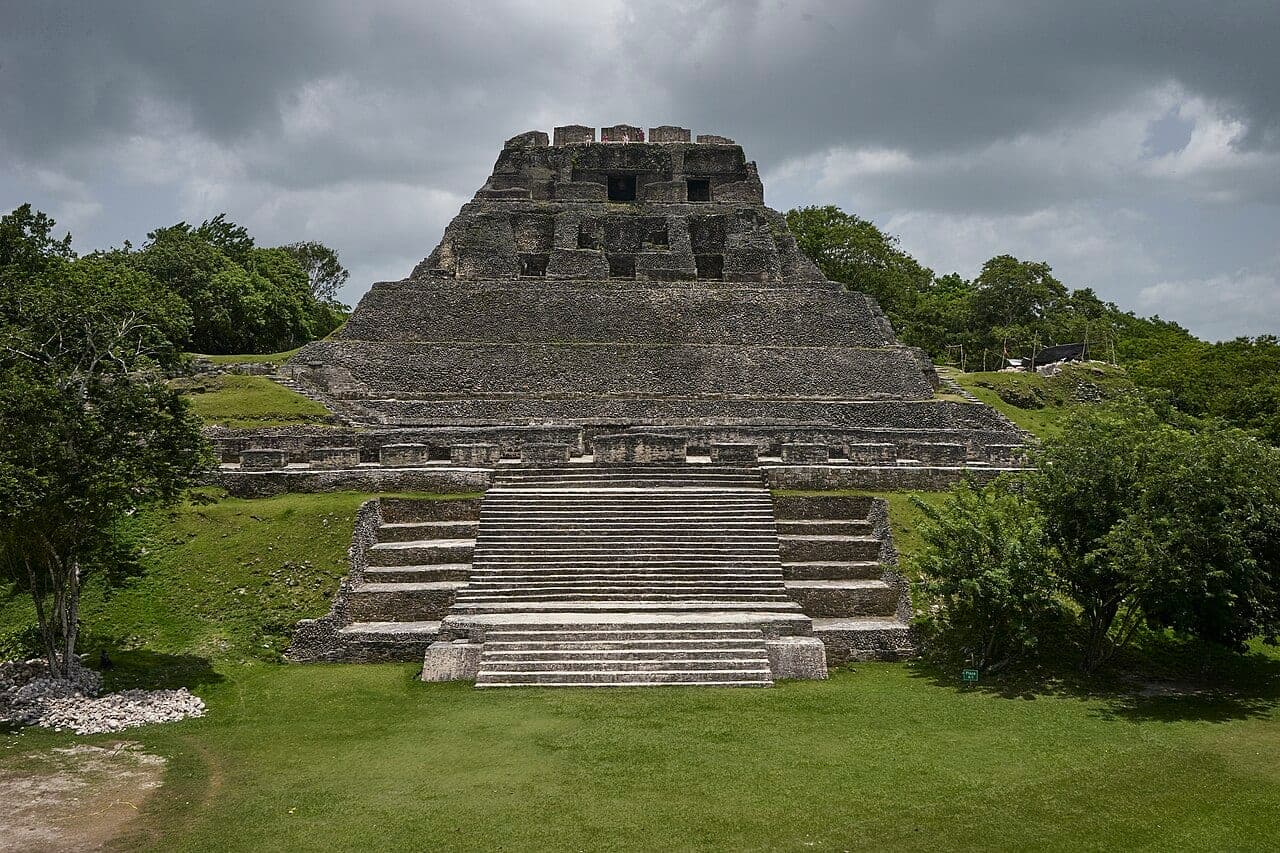
Belize is a small country carrying an outsized store of memory. On the Caribbean shoulder of Central America, its limestone lowlands hold some of the greatest cities the ancient Maya ever raised, Caracol, Lamanai, Xunantunich, Altun Ha and Cahal Pech, where temples still climb above the forest canopy and glyphs record dynasties reckoned in centuries. Offshore, the Belize Barrier Reef, the longest reef in the Western Hemisphere, shelters hundreds of cayes and the near-perfect circle of the Great Blue Hole. Between reef and ruin lives one of the most plural societies in the Americas: Creole, Mestizo, Maya, Garifuna, Mennonite, East Indian and more, sharing a country the size of a small European state.
Remembrance runs through all of it. The Garifuna, descendants of Africans and Island Caribs who reached these shores in 1802, keep the dugu, a feast that calls the ancestors home across the water; Maya families still honour their dead at the turning of the agricultural year; Creole and Mestizo households hold nine nights of wake and prayer.
Belize occupies 22,966 square kilometres on the Caribbean coast of Central America, bordered by Mexico to the north and Guatemala to the west and south, with the sea and its long reef to the east (Britannica). It is the only country on the Central American mainland where English is the official language, an inheritance of British rule, though Spanish and Belizean Kriol are heard as widely. The 2022 census counted about 397,483 people, making Belize one of the least densely settled nations in the hemisphere; more than a third of its land carries formal protection, and forest still covers much of the interior.
The society is plural to its core, with no single group in clear majority. The 2010 census recorded roughly 53 per cent Mestizo, 26 per cent Creole (Afro-Caribbean), 11 per cent Maya and 6 per cent Garifuna, alongside East Indian, Mennonite, Chinese and other communities (Wikipedia). The largest city is Belize City, the old colonial port on the Caribbean, while the capital is inland Belmopan, a purpose-built city established after Hurricane Hattie devastated the coast in 1961 and made capital in 1970. Guatemala has maintained a territorial claim to Belize since independence, a dispute now before the International Court of Justice.
Belize City. The former capital and still the commercial and cultural heart of the country, Belize City grew at the mouth of the Belize River as the port of the woodcutting settlement. It holds the Museum of Belize, the Swing Bridge over Haulover Creek and the oldest Anglican cathedral in Central America, St John's, consecrated in 1826. Battered repeatedly by hurricanes, the low-lying city keeps the wooden Caribbean architecture and the Creole life of the old colony.
Belmopan. Built inland in the Cayo District through the late 1960s and made capital in 1970, Belmopan is one of the youngest capitals in the world. It houses the National Assembly, the Belize Archives and Records Service and the headquarters of the National Institute of Culture and History, the body that oversees the country's museums and Maya sites.
San Ignacio. The lively town of the western Cayo District, paired with neighbouring Santa Elena across the Macal River, is the gateway to the Maya highlands. From here travellers reach Cahal Pech on the ridge above the town, and the great cities of Xunantunich and Caracol beyond, and the region's cave systems long held sacred by the Maya.
Dangriga. The largest town of southern Belize and the cultural capital of the Garifuna people, Dangriga (formerly Stann Creek Town) is where Garifuna Settlement Day is most fully kept. It is the home of the punta rock musician Andy Palacio and the painter Benjamin Nicholas, and the drumming schools that pass the tradition to a new generation.
Belize lay near the centre of the Maya world. Farming villages appear in the archaeological record from around 1500–1200 BC, and Cahal Pech, on its hilltop above modern San Ignacio, counts among the earliest, occupied from roughly 1200 BC (History of Belize). Over the following centuries the lowlands filled with cities. Caracol grew into one of the largest, its great pyramid Caana, the "sky palace", still the tallest built structure in the country at some 43 metres. Lamanai, whose Maya name means "submerged crocodile", was occupied for more than three thousand years, into the period of Spanish contact. Xunantunich raised its temple El Castillo above the Mopan River, and at Altun Ha archaeologists recovered a carved jade head of the sun deity Kinich Ahau, among the largest Maya jade objects known.
 Altun Ha in 1975. The jade head of the sun god found here is the largest Maya jade carving known, and it is kept in a bank vault rather than on display. Family photograph, CC BY-SA 4.0, via Wikimedia Commons.
Spain claimed the region but never effectively settled it. From the seventeenth century, English and Scottish buccaneers and woodcutters, who called themselves Baymen, established camps at the river mouths to cut logwood, a source of textile dye, and later the far more valuable mahogany. This forest economy rested on enslaved African labour. Enslaved people made up a majority of the settlement's population through the eighteenth century, and most enslaved men laboured in the distant forest camps felling and hauling timber (Slavery in Belize). Slavery was abolished across the British Empire in 1834, but a system of compulsory "apprenticeship" delayed full freedom in the settlement until 1 August 1838. The Baymen governed themselves through an assembly called the Public Meeting, and in 1798 a small force of settlers, free people of colour and enslaved men repelled a Spanish fleet at the Battle of St George's Caye, remembered every 10 September (Battle of St George's Caye).
Two arrivals reshaped the population. In 1802 the first Garifuna reached the southern coast, having been exiled from St Vincent by the British in 1797 and settled first on the Honduran coast. From 1847 onward, Mestizo and Maya refugees fleeing the Caste War of Yucatán crossed into the north, founding towns such as Corozal and Orange Walk and bringing Spanish and Yucatec Maya with them. The settlement was declared the colony of British Honduras in 1862, renamed Belize in 1973, granted internal self-government in 1964, and made a fully independent nation within the Commonwealth on 21 September 1981.
Belize is comfortably multilingual. English is the language of government, law and schooling, but the shared vernacular of national life is Belizean Kriol, an English-lexified creole shaped on the woodcutting frontier and now a marker of identity across ethnic lines. Spanish is a first language for much of the Mestizo north and west, and three Maya languages remain in daily use: Yucatec in the north, and Mopan and Q'eqchi' in the south. The Garifuna language, an Arawakan tongue carrying Kalinago, African, French and Spanish layers, is spoken along the southern coast (Britannica).
The name of the country is most often traced to the Maya. A common derivation links it to a Maya word such as belix, understood as "muddy water", describing the Belize River. A persistent legend instead credits a Scottish buccaneer named Peter Wallace, said to have founded a settlement in 1638, with his surname worn down into "Belize"; historians generally treat this story as folklore rather than record (Wikipedia). Whatever its root, the name passed from river to settlement to city and finally, in 1973, to the nation itself.
Belizean culture is a meeting of the Caribbean, Central America and the Maya world, expressed above all in music, festival and food. Garifuna drumming, built on the paired primero and segunda drums, carries the punta, a dance of hip and foot rooted in courtship and celebration; in the 1980s it grew into the electrified genre of punta rock. Creole culture supplies brukdown music, the "bram" house dances, and the trickster tales of Anansi carried from West Africa. Mestizo communities keep marimba, the harvest dances and the Spanish-language customs of the north.
The calendar reaches its height in the September Celebrations, which run from St George's Caye Day on 10 September to Independence Day on 21 September, weeks of parades, carnival and patriotic song. The shared table draws the country together: rice and beans cooked in coconut milk with stewed chicken; the Garifuna hudut, a fish stew in coconut broth served with mashed plantain, and sere fish soup; Mestizo tamales, escabeche, salbutes and the dark chimole soup; cassava bread, called ereba, baked by Garifuna cooks from grated and pressed root. Belikin beer and Marie Sharp's habanero pepper sauce, both made in Belize, are near-national emblems.
Belize is predominantly Christian, with about 62 per cent of the population professing Christianity at the 2022 census, and a growing share, close to a third, reporting no religion (Wikipedia). Roman Catholicism, carried by Spanish and Mestizo settlement and by Jesuit missions, remains the single largest church, alongside Anglican, Methodist, Mennonite, Pentecostal and other Protestant congregations. The Mennonite communities, German-speaking farmers who arrived chiefly from the 1950s, form a distinctive religious and agricultural presence in the interior.
Older systems endure beneath and beside the churches. Garifuna spirituality centres on the ancestors, the Ahari, who are believed to remain in relationship with the living and to require honour and attention; its rites are led by a spiritual specialist called the buyei and conducted in a temple, the dabuyaba, built facing east toward the sea and the sunrise (Garifuna). Maya communities keep their own devotions, blending Catholic saints with older observances tied to maize, rain, the cave and the mountain, and to prayer-keepers who mediate between the community and the sacred landscape.
Across Belize's communities, death is met with gatherings that hold the bereaved and see the dead safely on. In Creole and Mestizo households a wake, often the "nine nights", brings neighbours to sing hymns, pray the rosary, share food and tell stories through the evenings that follow a death, before a Christian burial. Catholic and Protestant funerals shape the public forms of grief, and All Souls, kept in the north as the Day of the Finados, draws families to tend and decorate the graves of their dead.
The most elaborate remembrance customs belong to the Garifuna. When a person dies, the community holds the beluria, a wake on the ninth night after death, an evening of drumming, hymn singing, storytelling and games that marks the soul's passage. Should the ancestors signal, often through illness or dreams, that they wish to be honoured, a family may hold the dugu, the greatest of Garifuna rites (Dugu ceremony). Prepared over months and led by the buyei in the dabuyaba, the dugu gathers relatives from across the diaspora, including a rite of bathing the spirit called amuidahani, days of drumming and possession dance, and a feast laid for the ancestors, so that the living and the dead are reconciled and the family made whole. Maya remembrance likewise keeps the ancestors close, through offerings, prayer and the observances of the agricultural calendar.
The nation also remembers together. Garifuna Settlement Day, on 19 November, re-enacts the 1802 landfall with dugu drums and dawn processions of boats bringing cassava, plantains and palm fronds ashore; the observance was founded by the civic leader Thomas Vincent Ramos in the southern towns in 1941 and became a national public holiday in 1977 (Garifuna). It has grown into the fullest annual expression of Garifuna identity and a day of remembrance for the whole country.
Belize's records are British Honduran, Catholic and, for one community, an expulsion from somewhere else.
The colony grew from logwood and mahogany cutting rather than plantation agriculture, so the eighteenth-century record is about timber concessions and the enslaved men who cut it, whose work was seasonal and mobile. The slave registers of the 1820s and 1830s name individuals, and the compensation records follow.
Anglican and Methodist registers carry the older vital events, and Catholic ones become important after the arrival of the Yucatec refugees. Civil registration and the colonial series are held at the Belize Archives and Records Service in Belmopan, with parallel material at Kew.
Two arrivals define the modern population. The Garifuna reached Belize in 1802 after their deportation from Saint Vincent by way of Roatán, and 19 November is a national holiday commemorating it; Garifuna genealogy is carried in the community, in the dügü ceremony that calls the ancestors, and in church records from the nineteenth century. And the Caste War of Yucatán, from 1847, drove thousands of Maya and mestizo refugees south into what became the north of the country, which is why Belize has a Spanish-speaking Catholic north and an English-speaking Creole centre.
The Maya of the Toledo district hold customary land and their communities' claims, upheld by the courts, rest on continuity of occupation that has had to be documented.
Belize's best-known heritage protection lies underwater. The Belize Barrier Reef Reserve System was inscribed on the UNESCO World Heritage List in 1996 as a serial site of seven protected marine areas, taking in offshore atolls, hundreds of cayes and the Great Blue Hole, the collapsed limestone sinkhole about 318 metres across and 124 metres deep that Jacques Cousteau surveyed with the Calypso in 1971 (Great Blue Hole). The reef was placed on the List of World Heritage in Danger in 2009 as coastal development and the threat of oil drilling grew, and removed from that list in 2018 after Belize strengthened its safeguards.
On land, the country's Maya cities are managed by the Institute of Archaeology, a division of the National Institute of Culture and History, which was created in 2003 to unite the state's cultural bodies (NICH). The institute oversees excavation, conservation and the archaeological reserves that welcome visitors to Caracol, Xunantunich, Lamanai, Altun Ha and Cahal Pech. The Museum of Belize, opened in Belize City in 2002, occupies a building that was once Her Majesty's Prison, built in the 1850s; its galleries hold Maya artefacts, colonial records and exhibits on the country's peoples, a former place of confinement turned into a house of memory (Museum of Belize).
Digital tools have transformed the study of Belize's Maya past. Airborne LiDAR surveys, pioneered at Caracol from 2009 by the archaeologists Arlen and Diane Chase, stripped away the forest canopy in data and revealed a far larger city than excavation alone had shown, with terraces, causeways and settlement spreading for kilometres in every direction; the technique has since been applied across the Maya lowlands. The Institute of Archaeology and its research partners publish site reports and digital records that make these findings available to scholars worldwide.
Belize's living cultures are being documented as well. The Garifuna language, listed by UNESCO among the world's endangered tongues, is the subject of recording projects, dictionaries and community apps meant to keep it in use among younger speakers. The Belize Archives and Records Service in Belmopan safeguards and increasingly digitises the colonial and national record, so that a small country's memory can be consulted far beyond its borders.
Belizean creativity reaches a wide audience. The country's defining musical moment came in 2007 with Andy Palacio's album Wátina, a landmark of Garifuna music recorded with the Garifuna Collective that drew international acclaim shortly before Palacio's early death in 2008; his work turned a coastal tradition into a global voice for a people scattered across Central America and the diaspora. Punta rock, brukdown and marimba continue to carry the country's plural sound.
Belizean literature found its national novel in Zee Edgell's Beka Lamb (1982), a coming-of-age story set against the movement toward independence. A large Belizean diaspora, concentrated in the United States, keeps these traditions alive abroad, returning for the September Celebrations and Garifuna Settlement Day and sustaining the drumming, food and language of home.
The reef comes off the danger list. After nearly a decade under threat, the Belize Barrier Reef Reserve System was removed from the List of World Heritage in Danger in 2018, following a national moratorium on offshore oil activity in its waters, a ban on damaging bottom trawling adopted in 2010, and stronger protection for mangroves and coastal habitat (Belize Barrier Reef).
A debt swapped for the sea. In 2021 Belize completed the largest debt refinancing for ocean conservation then undertaken, working with The Nature Conservancy to restructure its commercial debt and free an estimated 180 million US dollars over two decades for marine protection (The Nature Conservancy). In return the country committed to placing 30 per cent of its ocean under protection through a transparent marine spatial plan, binding its finances to the future of the reef.
Altun Ha in 1975. The jade head of the sun god found here is the largest Maya jade carving known, and it is kept in a bank vault rather than on display. Family photograph, CC BY-SA 4.0, via Wikimedia Commons.
Spain claimed the region but never effectively settled it. From the seventeenth century, English and Scottish buccaneers and woodcutters, who called themselves Baymen, established camps at the river mouths to cut logwood, a source of textile dye, and later the far more valuable mahogany. This forest economy rested on enslaved African labour. Enslaved people made up a majority of the settlement's population through the eighteenth century, and most enslaved men laboured in the distant forest camps felling and hauling timber (Slavery in Belize). Slavery was abolished across the British Empire in 1834, but a system of compulsory "apprenticeship" delayed full freedom in the settlement until 1 August 1838. The Baymen governed themselves through an assembly called the Public Meeting, and in 1798 a small force of settlers, free people of colour and enslaved men repelled a Spanish fleet at the Battle of St George's Caye, remembered every 10 September (Battle of St George's Caye).
Two arrivals reshaped the population. In 1802 the first Garifuna reached the southern coast, having been exiled from St Vincent by the British in 1797 and settled first on the Honduran coast. From 1847 onward, Mestizo and Maya refugees fleeing the Caste War of Yucatán crossed into the north, founding towns such as Corozal and Orange Walk and bringing Spanish and Yucatec Maya with them. The settlement was declared the colony of British Honduras in 1862, renamed Belize in 1973, granted internal self-government in 1964, and made a fully independent nation within the Commonwealth on 21 September 1981.
Belize is comfortably multilingual. English is the language of government, law and schooling, but the shared vernacular of national life is Belizean Kriol, an English-lexified creole shaped on the woodcutting frontier and now a marker of identity across ethnic lines. Spanish is a first language for much of the Mestizo north and west, and three Maya languages remain in daily use: Yucatec in the north, and Mopan and Q'eqchi' in the south. The Garifuna language, an Arawakan tongue carrying Kalinago, African, French and Spanish layers, is spoken along the southern coast (Britannica).
The name of the country is most often traced to the Maya. A common derivation links it to a Maya word such as belix, understood as "muddy water", describing the Belize River. A persistent legend instead credits a Scottish buccaneer named Peter Wallace, said to have founded a settlement in 1638, with his surname worn down into "Belize"; historians generally treat this story as folklore rather than record (Wikipedia). Whatever its root, the name passed from river to settlement to city and finally, in 1973, to the nation itself.
Belizean culture is a meeting of the Caribbean, Central America and the Maya world, expressed above all in music, festival and food. Garifuna drumming, built on the paired primero and segunda drums, carries the punta, a dance of hip and foot rooted in courtship and celebration; in the 1980s it grew into the electrified genre of punta rock. Creole culture supplies brukdown music, the "bram" house dances, and the trickster tales of Anansi carried from West Africa. Mestizo communities keep marimba, the harvest dances and the Spanish-language customs of the north.
The calendar reaches its height in the September Celebrations, which run from St George's Caye Day on 10 September to Independence Day on 21 September, weeks of parades, carnival and patriotic song. The shared table draws the country together: rice and beans cooked in coconut milk with stewed chicken; the Garifuna hudut, a fish stew in coconut broth served with mashed plantain, and sere fish soup; Mestizo tamales, escabeche, salbutes and the dark chimole soup; cassava bread, called ereba, baked by Garifuna cooks from grated and pressed root. Belikin beer and Marie Sharp's habanero pepper sauce, both made in Belize, are near-national emblems.
Belize is predominantly Christian, with about 62 per cent of the population professing Christianity at the 2022 census, and a growing share, close to a third, reporting no religion (Wikipedia). Roman Catholicism, carried by Spanish and Mestizo settlement and by Jesuit missions, remains the single largest church, alongside Anglican, Methodist, Mennonite, Pentecostal and other Protestant congregations. The Mennonite communities, German-speaking farmers who arrived chiefly from the 1950s, form a distinctive religious and agricultural presence in the interior.
Older systems endure beneath and beside the churches. Garifuna spirituality centres on the ancestors, the Ahari, who are believed to remain in relationship with the living and to require honour and attention; its rites are led by a spiritual specialist called the buyei and conducted in a temple, the dabuyaba, built facing east toward the sea and the sunrise (Garifuna). Maya communities keep their own devotions, blending Catholic saints with older observances tied to maize, rain, the cave and the mountain, and to prayer-keepers who mediate between the community and the sacred landscape.
Across Belize's communities, death is met with gatherings that hold the bereaved and see the dead safely on. In Creole and Mestizo households a wake, often the "nine nights", brings neighbours to sing hymns, pray the rosary, share food and tell stories through the evenings that follow a death, before a Christian burial. Catholic and Protestant funerals shape the public forms of grief, and All Souls, kept in the north as the Day of the Finados, draws families to tend and decorate the graves of their dead.
The most elaborate remembrance customs belong to the Garifuna. When a person dies, the community holds the beluria, a wake on the ninth night after death, an evening of drumming, hymn singing, storytelling and games that marks the soul's passage. Should the ancestors signal, often through illness or dreams, that they wish to be honoured, a family may hold the dugu, the greatest of Garifuna rites (Dugu ceremony). Prepared over months and led by the buyei in the dabuyaba, the dugu gathers relatives from across the diaspora, including a rite of bathing the spirit called amuidahani, days of drumming and possession dance, and a feast laid for the ancestors, so that the living and the dead are reconciled and the family made whole. Maya remembrance likewise keeps the ancestors close, through offerings, prayer and the observances of the agricultural calendar.
The nation also remembers together. Garifuna Settlement Day, on 19 November, re-enacts the 1802 landfall with dugu drums and dawn processions of boats bringing cassava, plantains and palm fronds ashore; the observance was founded by the civic leader Thomas Vincent Ramos in the southern towns in 1941 and became a national public holiday in 1977 (Garifuna). It has grown into the fullest annual expression of Garifuna identity and a day of remembrance for the whole country.
Belize's records are British Honduran, Catholic and, for one community, an expulsion from somewhere else.
The colony grew from logwood and mahogany cutting rather than plantation agriculture, so the eighteenth-century record is about timber concessions and the enslaved men who cut it, whose work was seasonal and mobile. The slave registers of the 1820s and 1830s name individuals, and the compensation records follow.
Anglican and Methodist registers carry the older vital events, and Catholic ones become important after the arrival of the Yucatec refugees. Civil registration and the colonial series are held at the Belize Archives and Records Service in Belmopan, with parallel material at Kew.
Two arrivals define the modern population. The Garifuna reached Belize in 1802 after their deportation from Saint Vincent by way of Roatán, and 19 November is a national holiday commemorating it; Garifuna genealogy is carried in the community, in the dügü ceremony that calls the ancestors, and in church records from the nineteenth century. And the Caste War of Yucatán, from 1847, drove thousands of Maya and mestizo refugees south into what became the north of the country, which is why Belize has a Spanish-speaking Catholic north and an English-speaking Creole centre.
The Maya of the Toledo district hold customary land and their communities' claims, upheld by the courts, rest on continuity of occupation that has had to be documented.
Belize's best-known heritage protection lies underwater. The Belize Barrier Reef Reserve System was inscribed on the UNESCO World Heritage List in 1996 as a serial site of seven protected marine areas, taking in offshore atolls, hundreds of cayes and the Great Blue Hole, the collapsed limestone sinkhole about 318 metres across and 124 metres deep that Jacques Cousteau surveyed with the Calypso in 1971 (Great Blue Hole). The reef was placed on the List of World Heritage in Danger in 2009 as coastal development and the threat of oil drilling grew, and removed from that list in 2018 after Belize strengthened its safeguards.
On land, the country's Maya cities are managed by the Institute of Archaeology, a division of the National Institute of Culture and History, which was created in 2003 to unite the state's cultural bodies (NICH). The institute oversees excavation, conservation and the archaeological reserves that welcome visitors to Caracol, Xunantunich, Lamanai, Altun Ha and Cahal Pech. The Museum of Belize, opened in Belize City in 2002, occupies a building that was once Her Majesty's Prison, built in the 1850s; its galleries hold Maya artefacts, colonial records and exhibits on the country's peoples, a former place of confinement turned into a house of memory (Museum of Belize).
Digital tools have transformed the study of Belize's Maya past. Airborne LiDAR surveys, pioneered at Caracol from 2009 by the archaeologists Arlen and Diane Chase, stripped away the forest canopy in data and revealed a far larger city than excavation alone had shown, with terraces, causeways and settlement spreading for kilometres in every direction; the technique has since been applied across the Maya lowlands. The Institute of Archaeology and its research partners publish site reports and digital records that make these findings available to scholars worldwide.
Belize's living cultures are being documented as well. The Garifuna language, listed by UNESCO among the world's endangered tongues, is the subject of recording projects, dictionaries and community apps meant to keep it in use among younger speakers. The Belize Archives and Records Service in Belmopan safeguards and increasingly digitises the colonial and national record, so that a small country's memory can be consulted far beyond its borders.
Belizean creativity reaches a wide audience. The country's defining musical moment came in 2007 with Andy Palacio's album Wátina, a landmark of Garifuna music recorded with the Garifuna Collective that drew international acclaim shortly before Palacio's early death in 2008; his work turned a coastal tradition into a global voice for a people scattered across Central America and the diaspora. Punta rock, brukdown and marimba continue to carry the country's plural sound.
Belizean literature found its national novel in Zee Edgell's Beka Lamb (1982), a coming-of-age story set against the movement toward independence. A large Belizean diaspora, concentrated in the United States, keeps these traditions alive abroad, returning for the September Celebrations and Garifuna Settlement Day and sustaining the drumming, food and language of home.
The reef comes off the danger list. After nearly a decade under threat, the Belize Barrier Reef Reserve System was removed from the List of World Heritage in Danger in 2018, following a national moratorium on offshore oil activity in its waters, a ban on damaging bottom trawling adopted in 2010, and stronger protection for mangroves and coastal habitat (Belize Barrier Reef).
A debt swapped for the sea. In 2021 Belize completed the largest debt refinancing for ocean conservation then undertaken, working with The Nature Conservancy to restructure its commercial debt and free an estimated 180 million US dollars over two decades for marine protection (The Nature Conservancy). In return the country committed to placing 30 per cent of its ocean under protection through a transparent marine spatial plan, binding its finances to the future of the reef.
National Overview
Notable Cities
Historical Foundations
Linguistic and Etymological Roots
Cultural Identity
Religion and Spirituality
Remembrance and Mourning Traditions
Tracing a Family in Belize
Heritage Preservation Efforts
Digital Heritage
Contemporary Cultural Influences
Success Stories
References and resources
- Encyclopaedia Britannica: Belize - geography, people, history and government.
- Wikipedia: Belize - census figures, demography and national overview.
- Wikipedia: History of Belize - the Maya period, colonial settlement and the road to independence.
- Wikipedia: Slavery in Belize - the enslaved-labour economy of the woodcutting settlement.
- Wikipedia: Battle of St George's Caye - the 1798 engagement and its commemoration.
- Wikipedia: Belize Barrier Reef - the UNESCO reserve system, danger listing and conservation measures.
- Wikipedia: Great Blue Hole - the sinkhole at Lighthouse Reef and its exploration.
- Wikipedia: Garifuna - origins, settlement, language, music and belief.
- UNESCO: Language, dance and music of the Garifuna - the intangible heritage inscription.
- Wikipedia: Dugu ceremony - the Garifuna ancestral rite and the beluria wake.
- Wikipedia: Museum of Belize - the former prison and its collections.
- National Institute of Culture and History - the state body for archaeology, museums and living heritage.
- The Nature Conservancy: Belize blue bonds - the 2021 debt conversion for marine conservation.