Heritage · Country
Norfolk Island Culture and Heritage
A Polynesian settlement, two convict settlements and one boatload of Pitcairn Islanders have all made a home on the same 35 square kilometres of the South Pacific. This is a guide to Norfolk Island's heritage, from the Georgian ruins and convict headstones at Kingston to the Norf'k language and Bounty Day.Written to last.
By Confinity Heritage Editorial · Updated 2026-08-17 · 8-minute readQuiet tools, kept out of the way.
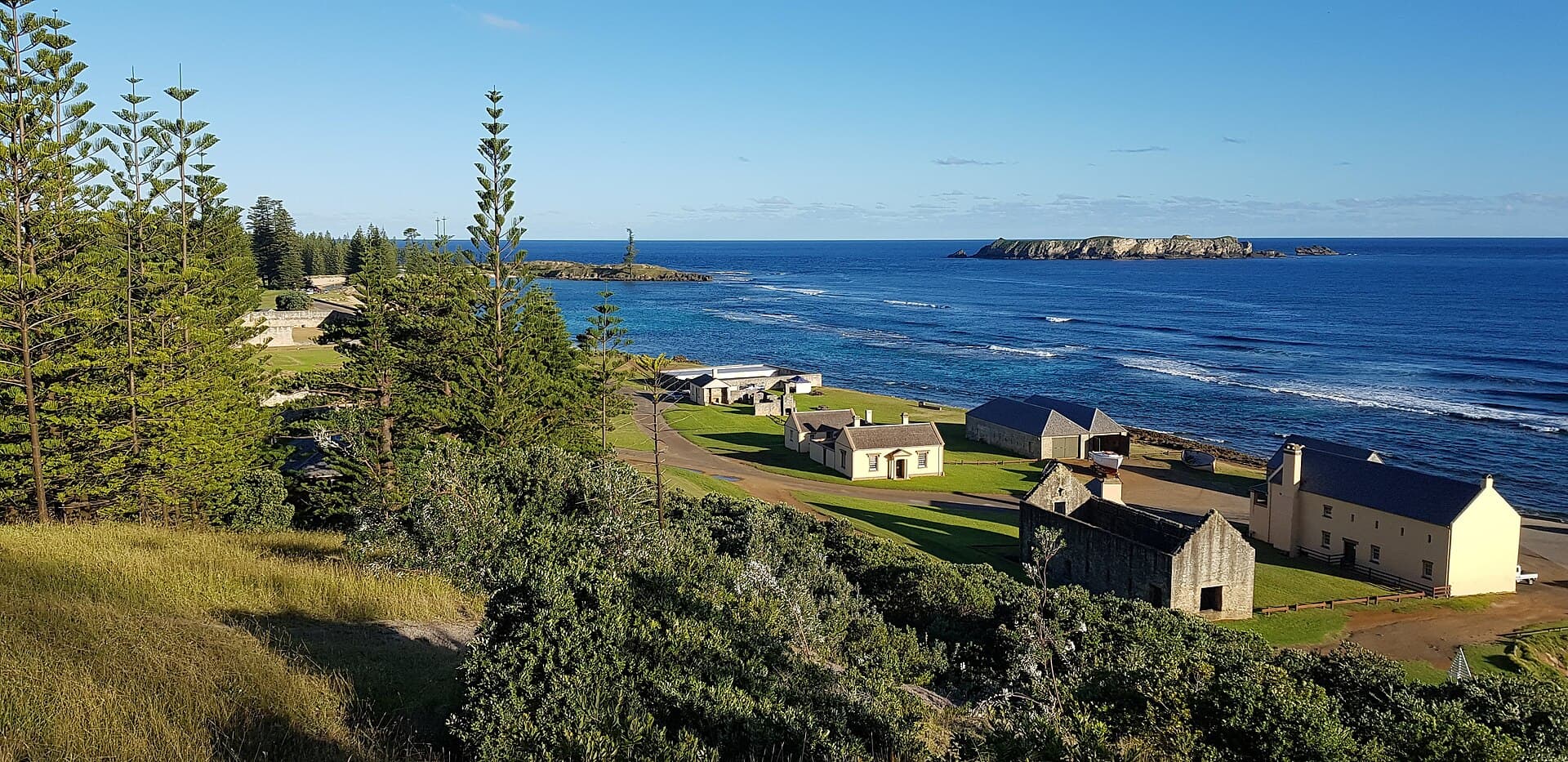
Norfolk Island holds three separate beginnings on one small volcanic plateau. East Polynesian voyagers reached it first, lived here for perhaps two or three centuries, and were gone long before any European saw the place. Britain came next and used the island twice for convicts, the second time deliberately as the harshest destination in the empire's penal system. Then in 1856 the whole population of Pitcairn, 194 people descended from the mutineers of HMS Bounty and the Tahitian women who sailed with them, was landed at Kingston pier and given the buildings the convicts had just left.
Most Norfolk Islanders today are descended from that third arrival, and they carry its surnames: Christian, Quintal, Adams, McCoy, Young, Nobbs, Buffett and Evans. They brought with them a language, Norf'k, that mixes eighteenth-century English with Tahitian, and a calendar built around 8 June, the day the Morayshire anchored offshore. The island's heritage is unusually layered for a place of about 2,200 people, and the layers sit almost on top of one another: the Polynesian ground at Emily Bay, the convict ruins and cemetery a few hundred metres away, and the living community that walks through both every week.
Norfolk Island is an Australian external territory of 34.6 square kilometres in the South Pacific, roughly 1,400 kilometres east of the Australian mainland and about 1,100 kilometres northwest of New Zealand, with Phillip Island and Nepean Island lying just offshore. It's the eroded remnant of a volcano, ringed by cliffs, with Mount Bates rising to 319 metres and a fringing reef enclosing the only two sheltered beaches, at Emily Bay and Slaughter Bay. The 2021 census counted 2,188 residents, down from 2,601 in 2001. Kingston, on the southern shore, is the seat of administration and the historic centre; Burnt Pine, on the ridge above, is where the shops, the school and most daily business are. English and Norf'k are both official. The economy runs mainly on tourism, small-scale agriculture and the export of Norfolk pine seed, and the island has no harbour, so ships still stand offshore while cargo is lightered in by whaleboat-style launches at Kingston or Cascade depending on the wind.
Kingston. The old settlement sits on a flat apron of ground between the ridge and the reef, and almost everything in it was built by convicts: Government House of 1829, the row of officers' quarters known as Quality Row, the Commissariat Store of 1835, the military barracks, the New Gaol, the crank mill and the great sea wall and landing pier built between 1839 and 1847. It is the administrative centre, the location of the Norfolk Island Museum's four buildings, and, as the Kingston and Arthur's Vale Historic Area, part of a UNESCO World Heritage Site. People still work in these buildings and picnic on the grass between them.
Burnt Pine. The island's commercial centre, on the higher ground in the middle of the island, holds the shops, the post office, the liquor bond, Norfolk Island Central School and the airport just to its west. Its name records the clearing of the pine forest that once covered the plateau.
Cascade and Anson Bay. Cascade, on the north coast, is the second landing place, used whenever the southerly swell closes Kingston. Anson Bay, on the northwest, is the island's other well-known shore, reached by a steep track, and both places belong to the working geography of an island where the sea decides the timetable.
Archaeological work at Emily Bay has recovered stone tools, adzes, imported basalt and the remains of a structure interpreted as a religious platform, with radiocarbon dates placing East Polynesian occupation somewhere between about AD 1200 and 1600. The settlers probably came from the Kermadecs or northern New Zealand. They left banana plants and the Polynesian rat behind them, and the island was empty when James Cook sighted it on 10 October 1774 and named it after the Duchess of Norfolk.
The first British settlement began on 6 March 1788, six weeks after the First Fleet reached Sydney, when Lieutenant Philip Gidley King landed with fifteen convicts and seven free men to test the island's flax and pines for naval use. Neither worked as hoped. The settlement grew, struggled with its lack of a harbour, and was wound up in 1814, its buildings deliberately destroyed so that no other power could use them.
The second settlement is the one the island is known for. In 1824 Governor Thomas Brisbane was instructed to reoccupy Norfolk Island for "the worst description of convicts", men who were to be, in his own phrase, forever excluded from all hope of return; convicts arrived from 1825, and for thirty years the island served as a place of secondary punishment for men already transported and convicted again, though a database study of 6,458 convicts sent there found that more than half had received no colonial conviction at all before being sent. Under Commandant James Morisset, in charge from 1829 to 1834, the average flogging recorded was 93 lashes. Convicts mutinied in January 1834; thirteen men were hanged, and the English Benedictine priest William Ullathorne, sent to prepare the condemned, recorded that those who were reprieved wept while those sentenced to die thanked God. Another rising came in July 1846 under Commandant John Price, remembered as the most feared of them all, and it too ended in executions. Bishop Robert Willson visited three times between 1846 and 1852 and reported the food, the housing and the floggings to the authorities in Hobart and London, blaming a system that left one man with absolute power over hundreds in total isolation. The settlement was wound down after 1847 and the last convicts left in May 1855.
On 8 June 1856 the Morayshire landed 194 Pitcairn Islanders, the entire population of that island, which had become too small to feed them. They were given the vacated buildings and the island's farmland. A minority later sailed back to Pitcairn in 1858 and 1863, and the two communities have kept in touch ever since. From 1867 the Church of England's Melanesian Mission made Norfolk its headquarters and training college, staying until 1920. Administration passed from New South Wales to the Commonwealth of Australia under the Norfolk Island Act 1913, effective 1 July 1914.
Norf'k is the language the Pitcairners brought with them in 1856. Its grammar and much of its vocabulary come from the English of the late eighteenth century, in the sailors' and West Country forms spoken by the Bounty men, overlaid with Tahitian words carried by the women who left Tahiti with them. It has its own pronouns for groups, its own idiom, and a habit of naming places in whole phrases. Speakers greet each other with "Watawieh yorlye?", meaning roughly "how are you all?"
Its legal position changed in 2004, when the Norfolk Island Legislative Assembly passed the Norfolk Island Language (Norf'k) Act, making it co-official with English and affirming the right to speak and write it without interference (Wikipedia). UNESCO listed it as endangered in 2007, and the census figures show why: 40.9 per cent of residents reported speaking Norf'k at home in 2016, and 30.5 per cent in 2021. Work to hold the line began earlier. The parliamentarian and linguist Alice Buffett, with the Australian National University linguist Donald Laycock, built a written orthography and grammar in the 1980s and published Speak Norfolk Today, and the language has been taught at Norfolk Island Central School as an elective since 2001 and now runs from kindergarten to Year 9.
The island's own name honours Mary Howard, Duchess of Norfolk, a patron of Cook's who had in fact died the year before he named it. Kingston commemorates Philip Gidley King. Against these imported names sit the family names of the Pitcairn descendants, so common on the island that nicknames do most of the work of telling people apart.
Norfolk identity rests on descent from the eight Pitcairn families and on the shared history that came with them. The clearest expression of it is Anniversary Day, better known as Bounty Day, held every 8 June. Islanders dress in period clothing kept in family "Bounty boxes" and handed down through generations, come ashore at Kingston pier in a re-enactment of the 1856 landing, march behind the flag to the cenotaph and then to the cemetery for wreath-laying and hymns, and finish with a long communal picnic on the grass at Kingston among the buildings their ancestors inherited. Visitors are welcome, though the day is unmistakably for the families themselves.
Food carries the same inheritance, with Tahitian and Polynesian roots showing through the English surface: pilhi, a baked pudding of banana or sweet potato; mudda, banana dumplings; and hihi, the periwinkles gathered off the reef. Hymn singing is close to a civic art, learned in childhood and used at every gathering that matters. Weaving, boatbuilding for the lighters that meet the ships, and the growing of Norfolk pine seed for export all continue as practical crafts rather than displays. The pine itself, Araucaria heterophylla, appears on the island's flag, and its straight ranks along the roads are the first thing most arrivals notice.
Christianity arrived with the Pitcairners, who had been taught from the Bounty's Bible, and it remains the island's majority religion, recorded by 56.0 per cent of residents in the 2021 census, with 35.7 per cent reporting no religion. Anglican, Uniting, Seventh-day Adventist and Roman Catholic congregations all worship on the island, and the Adventist presence traces back to missionaries who reached Pitcairn in the 1880s.
The most significant religious building is St Barnabas Chapel, above Kingston at the old Melanesian Mission site. It was built between 1875 and 1880 as a memorial to John Coleridge Patteson, the first Bishop of Melanesia, who was killed in the Solomon Islands in 1871, and it was consecrated on 7 December 1880 (Project Canterbury). The stained glass came from William Morris and Company, with the sanctuary windows designed by Edward Burne-Jones, and the marble floor, font and columns were shipped from Patteson's native Devon, while the interior woodwork carries inlaid shell worked by Melanesian students of the mission. A chapel of English Gothic proportions filled with Pacific craftsmanship, standing on ground that was Polynesian before it was British, is a fair summary of the island in one building.
The cemetery at Kingston, on the sand behind Cemetery Bay, is the island's central memory-place, and it's one of the most affecting burial grounds in the Pacific because it holds every phase of Norfolk's history in a few rows of ground. First-settlement graves lie near soldiers and officers of the second settlement, near convict headstones that record men who died under punishment or were hanged after the mutinies, near the Pitcairn families who buried their dead here from 1856 and are still burying them now. Some convict stones name the offence and the sentence. Others record only a name, a regiment and a date, and the plain wording of the second-settlement stones is more affecting than any monument, because the men commemorated were sent to Norfolk precisely so that they would be forgotten.
 Kingston was the harshest penal settlement in the Australian system, and it is now part of a World Heritage listing that asks a country to preserve the buildings of its own punishment. Public domain, via Wikimedia Commons.
Norfolk funerals are island events. A death is announced on the local radio and in the island's news, the community turns out, and the hymn singing that marks every gathering is at its strongest at a burial. The same ground is used for public remembrance: on Bounty Day the procession comes from the pier to the cenotaph and then into the cemetery, where wreaths are laid on the graves of the 1856 settlers and the Pitcairn Anthem is sung, before the families spread their picnic on the grass nearby. Eating lunch among the graves after honouring them is not treated as a contradiction here. It's the point of the day, and it makes Norfolk one of the few places where the calendar's biggest celebration is held in a cemetery.
Norfolk Island has three separate populations in its record and they barely overlap.
The first is Polynesian. People lived here before Europeans arrived and had gone by the time Cook landed in 1774, leaving archaeological traces and no names.
The second is convict. Norfolk was a penal settlement twice, from 1788 to 1814 and again from 1825 to 1855, and the second period was deliberately the harshest in the British system, reserved for men re-convicted in the colonies. The convict records, held by the National Archives of Australia and at Kew, name every man sent, with sentence, conduct and frequently death. The Kingston buildings they were made to construct are now a UNESCO site.
The third is Pitcairn. In 1856 the entire population of Pitcairn Island, 194 people descended from the Bounty mutineers and their Tahitian companions, was moved here when Pitcairn became too small. About a third returned; the rest stayed, and their descendants are the Norfolk Islanders. The register of that transfer names everybody, and Norfolk genealogy since is a closed and well-documented system of eight surnames.
Norf'k, the creole descended from Pitkern, is co-official with English.
The administrative record has changed hands repeatedly, and the loss of self-government in 2015 and 2016 was contested by islanders who argued their descent from the 1856 settlers gave them a distinct status.
The Kingston and Arthur's Vale Historic Area was inscribed on the UNESCO World Heritage List in 2010 as one of eleven places forming the Australian Convict Sites, recognised under criteria iv and vi as among the best surviving evidence of large-scale convict transportation (UNESCO). The listing covers about 225 hectares, taking in the Georgian buildings, the pier and sea wall, the ruins of the prisoners' barracks and the archaeological ground at Emily Bay, and it's managed jointly by the Australian Government and the island community.
The Norfolk Island Museum runs four buildings inside that area (Norfolk Island Museum). The Commissariat Store holds the KAVHA archaeological collection of more than 14,000 artefacts from the Polynesian, convict and Pitcairn periods. The former Protestant chapel houses material raised from HMS Sirius, the First Fleet flagship wrecked on the reef at Kingston in 1790, together with the Pitcairn gallery. No. 10 Quality Row is presented as the foreman of works would have known it in 1844, and the Research Centre at No. 9 keeps documents and photographs covering every settlement. Beyond Kingston, Norfolk Island National Park protects the remaining Mount Pitt rainforest and the native pine, and the language programme in the school does the preservation work that no building can.
For a place this small, a good deal of Norfolk's record is now searchable from anywhere. The museum's research centre has digitised individual files on convicts, civil officers, soldiers and settlers from all three settlement periods, and answers enquiries from family historians worldwide. The full site record for Kingston and Arthur's Vale, building by building with dates, uses and condition, is published and openly readable (Wikipedia). Convict records for the second settlement have been drawn into Australian academic databases, including the study of 6,458 Norfolk convicts that reshaped what historians thought they knew about who was actually sent there. The National Library of Australia's Trove holds digitised newspapers reporting the island from the 1830s onward, and the National Archives of Australia keeps the administrative files from 1914. Pitcairn and Norfolk genealogies, which for these families are the same document, circulate freely online, so a descendant in Sydney can follow a line back to the Bounty without leaving home.
The largest recent change on Norfolk was constitutional. The island had held limited self-government since 1979, with its own Legislative Assembly, its own revenue system and no Australian income tax. On 19 March 2015 the Australian Government announced that self-government would end, citing the island's finances, the cost of services and the sustainability of a separate system for about 2,000 people. The Assembly called a referendum, held on 8 May 2015, asking whether Norfolk Islanders should freely determine their political status and be consulted before changes were made; 68 per cent of the 912 who voted said yes (Wikipedia). The Assembly was abolished on 17 June 2015, and from 1 July 2016 Australian taxation, social security, immigration and health arrangements were extended to the island, with New South Wales delivering many services under contract and a Regional Council handling local government. Islanders now vote in the federal Division of Bean, based in Canberra.
Opposition to the change has continued. In April 2016 a petition was lodged with the United Nations in New York on behalf of Norfolk Island residents, seeking recognition of a right to self-determination, and campaigners have pressed the case with the UN decolonisation committee since. A 2019 survey by Norfolk Island People for Democracy found no majority for any single option: 37 per cent favoured free association with New Zealand, 35 per cent free association with Australia, 25 per cent full independence and 3 per cent full integration. The Regional Council was suspended in February 2021 and dismissed in December of that year, leaving an appointed administrator in charge while the Australian Government worked with the community on a new Norfolk Island Assembly. Alongside all this, tourism remains the main industry, the population continues to fall, and the descendants of 1856 keep turning out on 8 June.
A convict landscape given world standing. Kingston and Arthur's Vale was inscribed on the World Heritage List in 2010 as part of the Australian Convict Sites, which secured funding and a conservation framework for buildings that had spent a century as ordinary offices and houses.
A creole taught in school. Norf'k went from a home language with no written standard to a codified, co-official language taught from kindergarten to Year 9, after Alice Buffett and Donald Laycock built its orthography and grammar in the 1980s.
A First Fleet wreck recovered and displayed. Material from HMS Sirius, lost on the Kingston reef in 1790, was raised from the reef and conserved, and now anchors one of the four museum buildings a few hundred metres from where she struck.
One hundred and seventy years of Bounty Day. The re-enactment, the wreaths and the picnic have run since the nineteenth century, kept up by families who still own the period clothing, which makes it one of the longest-running community commemorations in the Pacific.
Kingston was the harshest penal settlement in the Australian system, and it is now part of a World Heritage listing that asks a country to preserve the buildings of its own punishment. Public domain, via Wikimedia Commons.
Norfolk funerals are island events. A death is announced on the local radio and in the island's news, the community turns out, and the hymn singing that marks every gathering is at its strongest at a burial. The same ground is used for public remembrance: on Bounty Day the procession comes from the pier to the cenotaph and then into the cemetery, where wreaths are laid on the graves of the 1856 settlers and the Pitcairn Anthem is sung, before the families spread their picnic on the grass nearby. Eating lunch among the graves after honouring them is not treated as a contradiction here. It's the point of the day, and it makes Norfolk one of the few places where the calendar's biggest celebration is held in a cemetery.
Norfolk Island has three separate populations in its record and they barely overlap.
The first is Polynesian. People lived here before Europeans arrived and had gone by the time Cook landed in 1774, leaving archaeological traces and no names.
The second is convict. Norfolk was a penal settlement twice, from 1788 to 1814 and again from 1825 to 1855, and the second period was deliberately the harshest in the British system, reserved for men re-convicted in the colonies. The convict records, held by the National Archives of Australia and at Kew, name every man sent, with sentence, conduct and frequently death. The Kingston buildings they were made to construct are now a UNESCO site.
The third is Pitcairn. In 1856 the entire population of Pitcairn Island, 194 people descended from the Bounty mutineers and their Tahitian companions, was moved here when Pitcairn became too small. About a third returned; the rest stayed, and their descendants are the Norfolk Islanders. The register of that transfer names everybody, and Norfolk genealogy since is a closed and well-documented system of eight surnames.
Norf'k, the creole descended from Pitkern, is co-official with English.
The administrative record has changed hands repeatedly, and the loss of self-government in 2015 and 2016 was contested by islanders who argued their descent from the 1856 settlers gave them a distinct status.
The Kingston and Arthur's Vale Historic Area was inscribed on the UNESCO World Heritage List in 2010 as one of eleven places forming the Australian Convict Sites, recognised under criteria iv and vi as among the best surviving evidence of large-scale convict transportation (UNESCO). The listing covers about 225 hectares, taking in the Georgian buildings, the pier and sea wall, the ruins of the prisoners' barracks and the archaeological ground at Emily Bay, and it's managed jointly by the Australian Government and the island community.
The Norfolk Island Museum runs four buildings inside that area (Norfolk Island Museum). The Commissariat Store holds the KAVHA archaeological collection of more than 14,000 artefacts from the Polynesian, convict and Pitcairn periods. The former Protestant chapel houses material raised from HMS Sirius, the First Fleet flagship wrecked on the reef at Kingston in 1790, together with the Pitcairn gallery. No. 10 Quality Row is presented as the foreman of works would have known it in 1844, and the Research Centre at No. 9 keeps documents and photographs covering every settlement. Beyond Kingston, Norfolk Island National Park protects the remaining Mount Pitt rainforest and the native pine, and the language programme in the school does the preservation work that no building can.
For a place this small, a good deal of Norfolk's record is now searchable from anywhere. The museum's research centre has digitised individual files on convicts, civil officers, soldiers and settlers from all three settlement periods, and answers enquiries from family historians worldwide. The full site record for Kingston and Arthur's Vale, building by building with dates, uses and condition, is published and openly readable (Wikipedia). Convict records for the second settlement have been drawn into Australian academic databases, including the study of 6,458 Norfolk convicts that reshaped what historians thought they knew about who was actually sent there. The National Library of Australia's Trove holds digitised newspapers reporting the island from the 1830s onward, and the National Archives of Australia keeps the administrative files from 1914. Pitcairn and Norfolk genealogies, which for these families are the same document, circulate freely online, so a descendant in Sydney can follow a line back to the Bounty without leaving home.
The largest recent change on Norfolk was constitutional. The island had held limited self-government since 1979, with its own Legislative Assembly, its own revenue system and no Australian income tax. On 19 March 2015 the Australian Government announced that self-government would end, citing the island's finances, the cost of services and the sustainability of a separate system for about 2,000 people. The Assembly called a referendum, held on 8 May 2015, asking whether Norfolk Islanders should freely determine their political status and be consulted before changes were made; 68 per cent of the 912 who voted said yes (Wikipedia). The Assembly was abolished on 17 June 2015, and from 1 July 2016 Australian taxation, social security, immigration and health arrangements were extended to the island, with New South Wales delivering many services under contract and a Regional Council handling local government. Islanders now vote in the federal Division of Bean, based in Canberra.
Opposition to the change has continued. In April 2016 a petition was lodged with the United Nations in New York on behalf of Norfolk Island residents, seeking recognition of a right to self-determination, and campaigners have pressed the case with the UN decolonisation committee since. A 2019 survey by Norfolk Island People for Democracy found no majority for any single option: 37 per cent favoured free association with New Zealand, 35 per cent free association with Australia, 25 per cent full independence and 3 per cent full integration. The Regional Council was suspended in February 2021 and dismissed in December of that year, leaving an appointed administrator in charge while the Australian Government worked with the community on a new Norfolk Island Assembly. Alongside all this, tourism remains the main industry, the population continues to fall, and the descendants of 1856 keep turning out on 8 June.
A convict landscape given world standing. Kingston and Arthur's Vale was inscribed on the World Heritage List in 2010 as part of the Australian Convict Sites, which secured funding and a conservation framework for buildings that had spent a century as ordinary offices and houses.
A creole taught in school. Norf'k went from a home language with no written standard to a codified, co-official language taught from kindergarten to Year 9, after Alice Buffett and Donald Laycock built its orthography and grammar in the 1980s.
A First Fleet wreck recovered and displayed. Material from HMS Sirius, lost on the Kingston reef in 1790, was raised from the reef and conserved, and now anchors one of the four museum buildings a few hundred metres from where she struck.
One hundred and seventy years of Bounty Day. The re-enactment, the wreaths and the picnic have run since the nineteenth century, kept up by families who still own the period clothing, which makes it one of the longest-running community commemorations in the Pacific.
National Overview
Notable Cities
Historical Foundations
Linguistic and Etymological Roots
Cultural Identity
Religion and Spirituality
Remembrance and Mourning Traditions
Tracing a Family in Norfolk Island
Heritage Preservation Efforts
Digital Heritage
Contemporary Cultural Influences
Success Stories
References and resources
- UNESCO, Australian Convict Sites: the 2010 serial inscription that includes Kingston and Arthur's Vale.
- Kingston and Arthur's Vale Historic Area, Wikipedia: the buildings, the Emily Bay archaeology and the three settlement phases.
- Norfolk Island Museum: the four museum buildings, the KAVHA collection and the research centre.
- Norfolk Island Museum, KAVHA collection: the 14,000-artefact archaeological collection from the historic area.
- Norfolk Island, Wikipedia: geography, census data, settlement history and governance.
- History of Norfolk Island, Wikipedia: the two convict settlements, the mutinies and the 1856 resettlement.
- Norfuk language, Wikipedia: origins, speaker numbers, the 2004 Act and revitalisation work.
- 2015 Norfolk Island status referendum, Wikipedia: the ballot, the result and the legislative changes that followed.
- Project Canterbury, Consecration of the Memorial Chapel, 1881: a contemporary account of St Barnabas and the Melanesian Mission.
- Bounty Day, Wikipedia: the 8 June commemoration on Norfolk and its Pitcairn counterpart.
- Encyclopaedia Britannica, Norfolk Island: overview of the territory, its history and its administration.
- Norfolk Island Regional Council, Wikipedia: the local government arrangements from 2016, the suspension and the dismissal.