Heritage · University
The University of Oslo: History and Overview
Founded in 1811 as the Royal Frederick University, the University of Oslo is Norway's oldest university and one of its most consequential institutions. Its Aula, lined with Edvard Munch's monumental murals, hosted the Nobel Peace Prize ceremony from 1947 to 1989, and its Museum of Cultural History keeps the Oseberg and Gokstad Viking ships.Written to last.
By Confinity Heritage Editorial · 2026-08-24 · 8-minute readQuiet tools, kept out of the way.
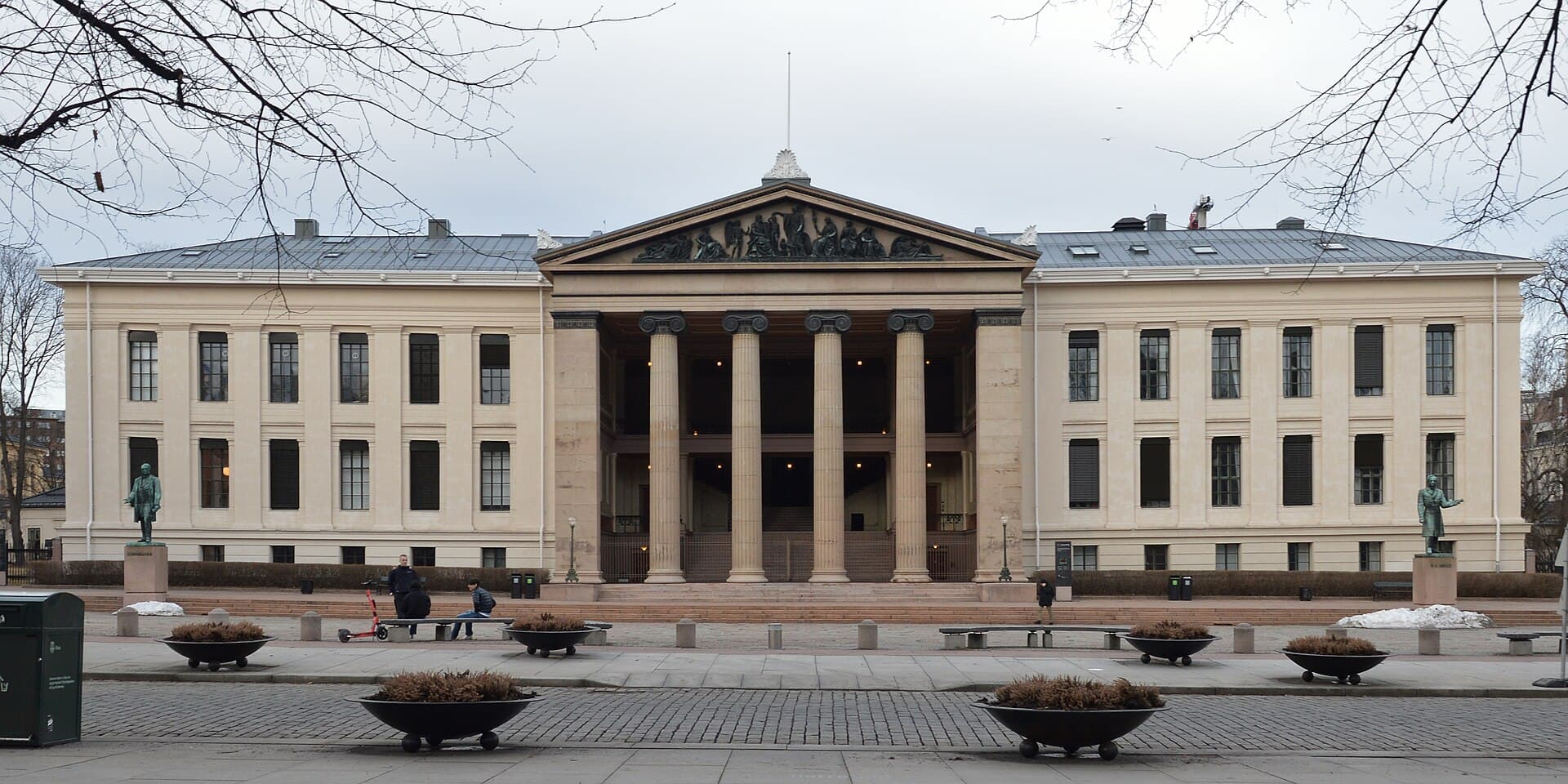
The University of Oslo is Norway's oldest university, founded in 1811 while the country was still governed from Copenhagen. For nearly two centuries before that, a Norwegian who wanted a degree had to cross the sea to the University of Copenhagen, the union's only seat of higher learning, and the campaign for a university at home was as much a political cause as an educational one. When King Frederick VI finally consented, the new foundation took his name, the Royal Frederick University, and kept it until 1939, when it became simply the University of Oslo.
Few universities carry so much of a nation's memory in a single room. The university's ceremonial hall, the Aula, is lined with monumental canvases by Edvard Munch, painted between 1909 and 1916, and beneath them the Nobel Peace Prize was handed to its laureates every December from 1947 to 1989. In the vaults of its Museum of Cultural History lie the Oseberg and Gokstad ships, the finest Viking vessels ever recovered from the ground.
The university was founded on 2 September 1811, the answer to decades of Norwegian petitioning for an institution of their own within the Dano-Norwegian union. The timing gave it a significance beyond scholarship. Three years later the union dissolved, and in the spring of 1814 an assembly at Eidsvoll wrote the constitution that still governs Norway. Men of the young university took part in that work: Georg Sverdrup, its professor of Greek, sat in the Eidsvoll assembly and served among its presiding officers. A university founded under a Danish king thus became, almost at once, an instrument of Norwegian self-government, training the clergy, lawyers and officials the new state needed.
Teaching began in rented rooms, and for its first decades the university had no proper home. That changed in the 1840s and 1850s, when a neoclassical ensemble rose on Karl Johans gate, the avenue running from the royal palace through the centre of Christiania, as Oslo was then called. The centrepiece, Domus Media, was flanked by Domus Academica and Domus Bibliotheca, and the three buildings gave the university a civic face to match the parliament and palace along the same street.
The darkest chapter came under German occupation. In November 1943, after a fire in the Aula gave the occupation authorities a pretext, they closed the university, arrested more than a thousand students, and deported several hundred of them to camps in Germany. The university did not resume normal work until the liberation in 1945. In the decades that followed it expanded onto the Blindern campus north of the city centre, which now holds most of its faculties, while the old buildings on Karl Johans gate remain in ceremonial and academic use.
The university today spans eight faculties covering theology, law, medicine, the humanities, mathematics and natural sciences, dentistry, social sciences and education, with around 27,000 students, and it is consistently placed first among Norwegian universities in the international rankings. The Faculty of Law still teaches in the nineteenth-century buildings downtown, so law students at Oslo take their examinations a few steps from the parliament whose statutes they study.
The university is also one of Norway's great museum keepers. Its Museum of Cultural History holds the national collections of archaeology and ethnography, and among them the most celebrated objects Norway owns: the ships of Oseberg and Gokstad. The Gokstad ship was excavated from a burial mound in 1880, and in 1904 university archaeologists under Professor Gabriel Gustafson unearthed the Oseberg ship, a richly carved vessel interred in the ninth century with two women and a cargo of sledges, textiles and carved animal heads. Both are products of the Viking ship burial, the practice of laying the dead in a full ship beneath a mound, and both were displayed for nearly a century in the university's museum on the Bygdøy peninsula. That building closed in 2021 so that a larger Museum of the Viking Age can be built around the fragile hulls, which are too delicate to move far. Through its museums the university is the keeper of Norway's deepest past, from Stone Age tools to medieval church art.
For the centenary of 1911 the university added a ceremonial hall, the Aula, behind the columns of Domus Media. The commission to decorate it went, after a long and quarrelsome competition begun in 1909, to Edvard Munch, then the most controversial painter in Norway. His designs divided the judging committees for years, and the eleven canvases were not finally installed until 1916. The central painting, The Sun, fills the wall behind the stage: a sun rising over the coastal rocks of Kragerø, its light drawn in radiating shafts of colour. On the side walls, History shows an old man telling stories to a boy beneath an oak, and Alma Mater a mother among children in a summer landscape. Munch called the series a wall of light, and it remains the largest work he ever completed.
For four decades that room held one of the most watched ceremonies on earth. From 1947 to 1989 the Norwegian Nobel Committee presented the Nobel Peace Prize in the Aula, and the world's most famous prize was handed over each December under Munch's rising sun. George Marshall received the prize there in 1953 for the plan that rebuilt Europe, and Martin Luther King Jr. stood on the Aula stage in December 1964, at thirty-five the youngest laureate to that date. Mother Teresa followed in 1979, Desmond Tutu in 1984, and the Dalai Lama in 1989, the last laureate honoured in the hall before the ceremony moved to the larger Oslo City Hall in 1990. The Aula is still used for the university's own ceremonies and for concerts, and the murals, restored in recent decades, remain in the room they were painted for.
The university's first great name arrived as a student. Niels Henrik Abel entered in 1821 and, in a career of astonishing brevity, proved that the general fifth-degree equation cannot be solved by a formula, founding whole territories of modern algebra and analysis before dying of tuberculosis in 1829 at twenty-six. Two centuries later the Norwegian government created the Abel Prize in his honour, awarded annually by the Norwegian Academy of Science and Letters and regarded as mathematics' counterpart to a Nobel.
The sciences at Oslo produced work of similar reach. Vilhelm Bjerknes, who held a chair in Kristiania in the early 1900s and returned to the university as professor in 1926, framed weather forecasting as a problem of physics, the insight on which all modern meteorology rests. Fridtjof Nansen, polar explorer and professor at the university, won the Nobel Peace Prize in 1922 for his refugee work with the League of Nations. In 1969 the university had a remarkable double: Odd Hassel shared the Nobel Prize in Chemistry for his work on the shapes of molecules, and Ragnar Frisch shared the first Nobel Memorial Prize in Economic Sciences ever awarded, for founding econometrics. Frisch's student Trygve Haavelmo, another Oslo professor, took the economics prize in his turn in 1989.
The University of Oslo remains Norway's leading research university and among the strongest in the Nordic countries, with particular depth in law, medicine, the humanities and the mathematical sciences. Most of its life is on the Blindern campus, with the medical faculty attached to the university hospitals and the law faculty downtown. Its research centres range from cancer medicine and extragalactic astronomy to the Ibsen archives, and it participates in the Guild of European research-intensive universities. The old buildings on Karl Johans gate, once the whole university, now serve as its ceremonial heart and as one of Oslo's defining pieces of architecture.
The historic ensemble stands on Karl Johans gate in the centre of Oslo, midway between the royal palace and the parliament, and the square in front of Domus Media is open to anyone. The Aula opens to the public on advertised occasions, for concerts and events and in the summer season, and seeing Munch's murals in place is worth planning around; the Munch Museum on the harbour holds his full-size studies for the same walls. The Museum of Cultural History near the cathedral shows the archaeological collections while the Museum of the Viking Age is rebuilt on Bygdøy. Blindern, a short metro ride away, is a working campus and open to walk through.