Heritage · University
University of Malaya: History and Overview
The University of Malaya in Kuala Lumpur is Malaysia's oldest university, descended from a Singapore medical school founded in 1905 and from Raffles College. Established in its present form in 1962, it educated the teachers, doctors, and leaders of the independence generation, and its Pantai Valley campus keeps a botanical garden and an Asian art museum.Written to last.
By Confinity Heritage Editorial · 2026-08-25 · 8-minute readQuiet tools, kept out of the way.
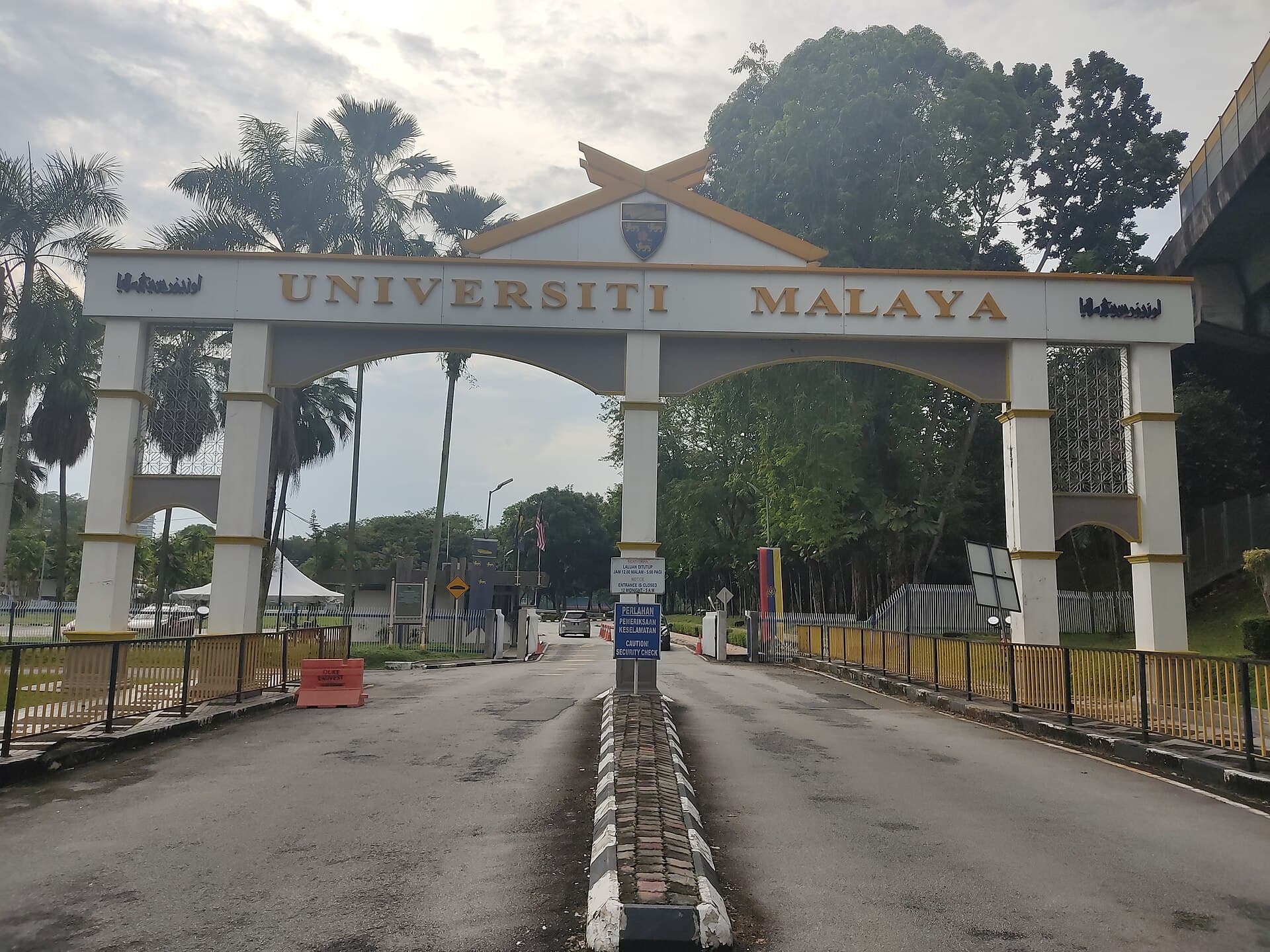
The University of Malaya, known at home as Universiti Malaya, is Malaysia's oldest university and still its most highly ranked. Its main gate on Jalan Universiti, a mid-century arch bearing the university's name, has become shorthand for higher learning in the country, photographed by generations of graduates on convocation day. Behind it spreads the Pantai Valley campus in the southwest of Kuala Lumpur, a green district of lecture halls, colleges, a forest garden, and a museum, laid out in the years around independence.
The university is younger than its history. Its lineage begins in colonial Singapore in 1905, runs through a merger in 1949, and divides in 1962, when one ancestral institution became the national flagship of two countries. To follow that thread is to follow the making of modern Malaysia itself, because the university trained a large share of the new nation's first teachers, doctors, and civil servants, and several of its prime ministers.
The story opens with a practical need. In 1905, the colonial government of the Straits Settlements founded a medical school in Singapore to train local practitioners; it was later named the King Edward VII College of Medicine, and it became the first institution of higher education in British Malaya. A second foundation followed in 1928, when Raffles College opened to teach the arts and sciences. For two decades the colleges ran side by side, the one producing doctors and the other teachers and administrators, until a post-war commission recommended joining them. On 8 October 1949 they merged as the University of Malaya, a single university in Singapore serving the whole peninsula, with a mission its founders described as serving the Malayan nation then coming into view.
The university grew quickly, and politics moved faster still. Malaya became independent in 1957, and demand for graduates on the mainland argued for a campus there. In 1959 the university reorganised into two autonomous divisions of equal standing, one in Singapore and one in Kuala Lumpur, where teaching began on new ground in the Pantai Valley. The arrangement lasted three years. In 1961 the governments of Malaya and Singapore legislated to make the divisions independent, and on 1 January 1962 the Kuala Lumpur division became the University of Malaya in its present form, the national university of a newly sovereign country. On 16 June that year it installed its first chancellor: Tunku Abdul Rahman Putra Al-Haj, Malaysia's first prime minister. He is sometimes confused with the first Yang di-Pertuan Agong, Tuanku Abdul Rahman of Negeri Sembilan, a different man with a near-identical name; it was the prime minister who held the university office.
The decades after 1962 made the university an engine of nation-building. Its faculties supplied the schoolteachers, physicians, engineers, and administrators of the young federation, and its graduation lists read like a register of the Malaysian establishment. The campus was also a political place. Student activism ran strong through the late 1960s and early 1970s, and the Universities and University Colleges Act of 1971 restricted student participation in party politics, a law that has shaped campus life and been debated ever since.
The main campus occupies former rubber and mining land in the Pantai Valley, a shallow bowl of hills between Kuala Lumpur and Petaling Jaya. Its ceremonial heart is the Dewan Tunku Canselor, the great hall named for the first chancellor, completed in the mid-1960s in the confident concrete style of the era and officially opened by the Tunku himself in 1966. Convocations have been held there since; the hall was gutted by fire in 2001 and carefully rebuilt. Around it stand the faculties, the residential colleges, a teaching hospital, and the mosque, connected by roads that carry the daily traffic of one of Southeast Asia's larger campuses.
Two corners of the campus work as memory institutions in their own right. Rimba Ilmu, the Forest of Knowledge, is a botanic garden of roughly 60 hectares established in 1974 on old plantation land. It is arranged as a living collection of the Malay world's flora rather than a formal flower garden: medicinal plants, palms, citrus relatives, timber trees, and a conservatory of rare species, grown under a regenerating forest canopy. The garden houses the university's herbarium, the oldest and largest university herbarium in Malaysia, with tens of thousands of pressed specimens recording the region's plant life. Nearby, the Museum of Asian Art keeps a collection of several thousand objects spanning some four millennia, with particular strength in Asian ceramics, from Malay earthenware to Chinese and Khmer wares.
Academically, the university spans medicine, law, engineering, science, economics, education, the arts, Islamic studies, and more, with tens of thousands of students across undergraduate and postgraduate programmes. Its medical faculty descends directly from the 1905 college, and its teaching hospital, opened in the 1960s, was the country's first university hospital.
The 1962 parting is the most distinctive fact in the university's story. When the two divisions went their separate ways, the Kuala Lumpur campus kept the name University of Malaya, while the Singapore campus became the University of Singapore, which merged with Nanyang University in 1980 to form the National University of Singapore. Both institutions therefore descend from the same medical school of 1905, the same Raffles College of 1928, and the same 1949 union, and both count the alumni of the joint decades in their rolls. A student who enrolled in Singapore in 1950 belongs to the shared ancestry of the two universities that today lead the rankings of their respective countries.
The split was amicable and administrative rather than bitter, driven by the practicalities of two governments funding one university across a border that was hardening into an international one. Its effect was to give two young nations flagship universities at the moment each needed one. Few pairs of universities anywhere share so complete a common origin.
The university's intellectual traditions begin with tropical medicine, the founding purpose of the 1905 school, which studied the diseases of the region, and continue through the social sciences that a developing country demanded. The commanding figure of the Kuala Lumpur decades was Ungku Abdul Aziz, an economist of rural poverty and the cooperative movement who became vice-chancellor in 1968, the first Malaysian to hold the post, and led the university for twenty years. In 1978 he became the first person in the country honoured with the title of Royal Professor.
The alumni rolls carry several of Malaysia's prime ministers. Mahathir Mohamad trained as a doctor in the Singapore line of the family tree, entering the King Edward VII College of Medicine in 1947 and taking his medical degree in 1953, by which time the college had become the University of Malaya's medical faculty. Abdullah Ahmad Badawi graduated in Islamic studies in Kuala Lumpur in 1964. Anwar Ibrahim read Malay studies, graduating in 1971, the year he helped found the Muslim Youth Movement of Malaysia, ABIM, which he later led. Beyond politics, the university has produced judges, writers, scientists, and central bankers across the region.
Universiti Malaya remains Malaysia's oldest and highest-ranked university, and in recent editions of the QS World University Rankings it has placed within the top 60 worldwide, the strongest position of any Malaysian institution. It is a designated research university, publishes across medicine, engineering, and the sciences, and draws students from across the country and abroad. The gate on Jalan Universiti still frames the graduation photographs, and the Dewan Tunku Canselor still hosts the convocations, more than sixty years after the first chancellor lent the hall his name.
The campus lies about five kilometres southwest of central Kuala Lumpur, beside the Federal Highway, and the Universiti station on the LRT's Kelana Jaya line stops close to its eastern edge. The grounds are open, and two attractions reward a visit: Rimba Ilmu, which welcomes the public on weekdays and offers one of the best introductions to Malaysian plant life anywhere in the capital, and the Museum of Asian Art, whose ceramics collection is among the region's finest. Opening hours vary with the academic calendar, so checking the university's pages before travelling is sensible. Teaching areas are best left alone in term; the Rimba Ilmu garden and the lake road are the parts worth the trip anyway.