Heritage · University
University of Hong Kong: History and Overview
Founded in 1911 and opened in 1912, the University of Hong Kong is the territory's oldest, built around a medical college dating to 1887 whose first graduating class included Sun Yat-sen. Its Edwardian Main Building, with its clock tower and arcaded courtyards, has watched the city change around it for over a century.Written to last.
By Confinity Heritage Editorial · 2026-08-24 · 8-minute readQuiet tools, kept out of the way.
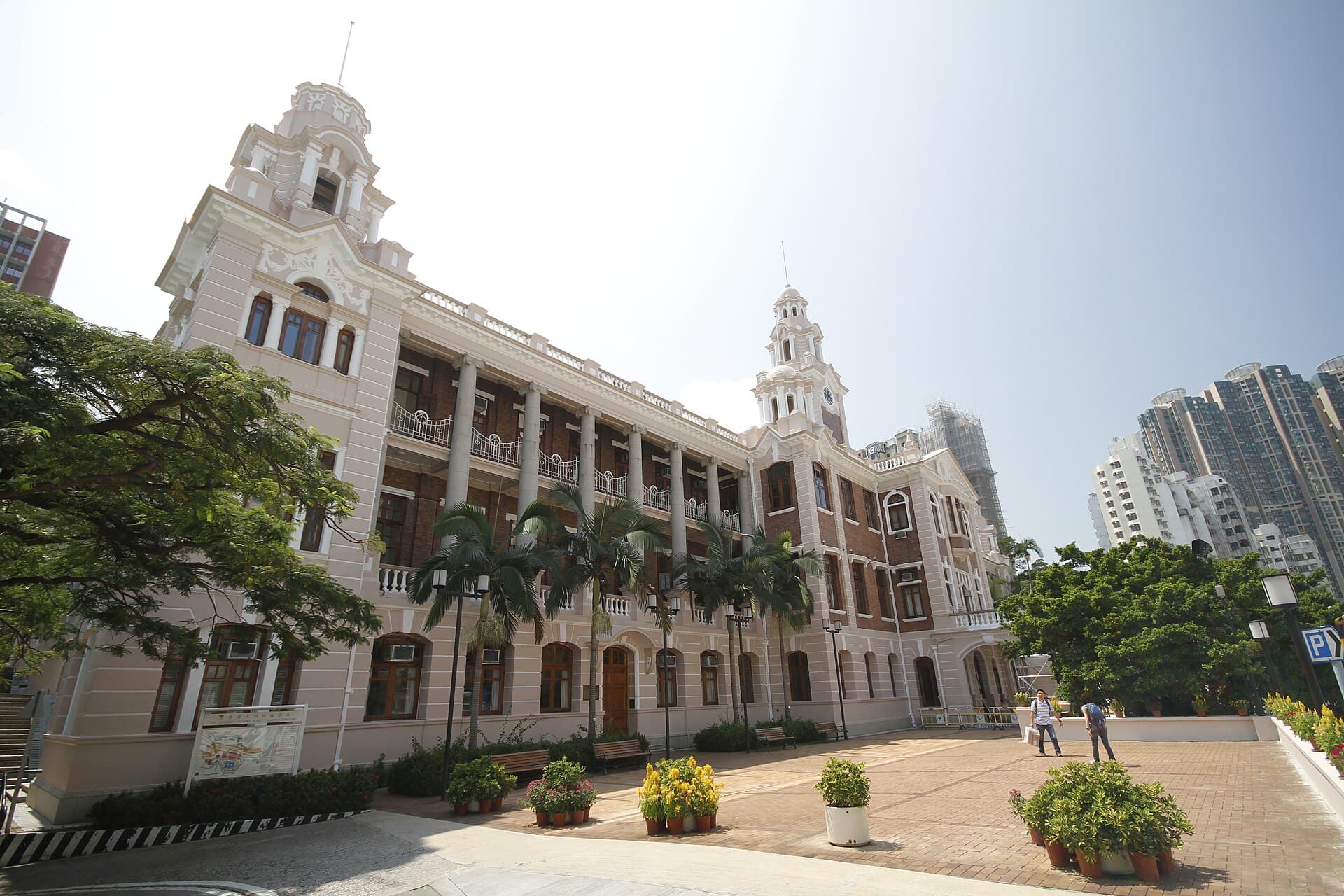
The University of Hong Kong is the oldest university in Hong Kong, incorporated in 1911 and opened to its first students in 1912. It stands on the steep western slopes of Hong Kong Island at Pok Fu Lam, where its granite Edwardian Main Building, crowned with a clock tower and cooled by arcaded courtyards, has looked out over the harbour through a century of the city's transformations. From the beginning it taught in English and understood itself as a meeting place, a university built at the point where China and the wider world faced each other.
Its deepest root is older than the university itself. The Hong Kong College of Medicine, founded in 1887, was folded into the new institution as its founding medical faculty, and that college's first graduating class of 1892 included Sun Yat-sen, the man who would lead the revolution of 1911 and become the founding figure of the Chinese republic. Few universities anywhere can trace their lineage to a classroom that trained the founder of a modern nation, and the coincidence of dates is striking: the republic and the university were born in the same year.
The university was the project of Frederick Lugard, the colonial governor, who argued from 1908 that Britain's principal port on the China coast should have a university of its own. The money that made it possible came largely from the Parsi businessman Sir Hormusjee Naorojee Mody, who paid for the Main Building, with further support from Chinese and expatriate merchants across the region. The foundation stone was laid in 1910, the University Ordinance passed in 1911, and teaching began in 1912 with faculties of medicine and engineering, joined shortly afterwards by arts. Medicine was the eldest limb because it was already a quarter of a century old: the Hong Kong College of Medicine simply became the university's medical school.
English was the language of instruction from the first, and the university's early decades gave it a distinctive role. It trained doctors, engineers and teachers not only for Hong Kong but for communities across southern China and Southeast Asia, in much the way that the colonial medical school in Singapore grew into the National University of Singapore. Students came from Canton, the Straits Settlements and beyond, and returned home carrying their training with them.
The Second World War nearly ended it. Hong Kong fell to Japan in December 1941 after eighteen days of fighting, during which university buildings served as relief hospitals. Under the occupation the university effectively ceased to exist: teaching stopped, students scattered, many continuing their studies at universities in unoccupied China, and staff were interned or dispersed. The campus was damaged and stripped, and members of the university community worked to hide and protect what books they could from the library's collections. When the war ended in 1945 the university was rebuilt from a low ebb, resuming teaching in the late 1940s and expanding steadily through the decades that followed.
The post-war university grew from a small colonial college into a major research institution. New faculties were added, the campus climbed further up the hillside, and by the century's end the university taught tens of thousands of students. The 1997 handover made it a university of the Hong Kong Special Administrative Region, and in recent years it has occupied its place in Hong Kong's changing civic landscape, as the city's institutions have adjusted to a new political era.
The heart of the campus is the Main Building, completed in 1912 in an Edwardian Baroque style of granite columns and red brick, with a central clock tower and open courtyards that let the sea air move through the classrooms in the years before air conditioning. It is the oldest structure of the university and a declared monument of Hong Kong. Its ceremonial chamber, the Great Hall, was renamed Loke Yew Hall in the 1950s in honour of Loke Yew, the Malayan magnate whose money helped carry the young university through its lean early years. Other benefactors are remembered across the campus in the same way, among them Sir Robert Ho Tung, whose name is borne by a hall of residence he endowed.
Below the Main Building on Bonham Road stands the former Fung Ping Shan Library building of 1932, which since 1953 has housed the University Museum and Art Gallery, the oldest museum in Hong Kong. Its collections of Chinese ceramics and bronzes include a celebrated group of small bronze crosses from the Yuan dynasty, evidence of the Nestorian Christian communities of medieval China and one of the largest such holdings anywhere.
The modern university spreads along the hillside from these older buildings, a dense vertical campus linked by escalators and walkways, with its own station on the MTR since 2014. It comprises ten faculties, spanning architecture, arts, business, dentistry, education, engineering, law, medicine, science and the social sciences, and enrols tens of thousands of students, a large share of them from outside Hong Kong. English remains the principal medium of teaching, a continuity with 1912 that still shapes the university's international character.
The Hong Kong College of Medicine for Chinese opened in 1887, attached to a mission hospital and staffed by doctors who believed Western medicine should be taught to Chinese students in China's doorway. Among its founders was the Scottish surgeon James Cantlie, and among its first intake was a young man from Guangdong named Sun Yat-sen. Sun graduated in 1892, one of the first two students to complete the course, and practised briefly as a doctor before politics consumed him entirely.
The college trained a physician and produced a revolutionary. Hong Kong gave Sun a vantage point from which the weakness of the Qing state was plainly visible, and the contrast between the orderly colonial city and the country across the border pressed on him throughout his student years. He said as much himself: returning to the university in 1923 to address students in the Great Hall, he told them that Hong Kong and its college were where his revolutionary ideas had come from, that the city had been, in effect, his intellectual birthplace. A colonial medical school had educated the founder of the Chinese republic, and the university that absorbed that school has carried the association ever since. Sun's statue stands on the campus today, and the 1892 class list remains the most consequential page in the institution's records.
Medicine has remained the university's signature. In March 2003, as an unexplained pneumonia spread through Hong Kong's hospitals, a university team led by the microbiologist Malik Peiris isolated the coronavirus responsible for SARS, one of the decisive findings of that epidemic. The same departments were at the front of the response to COVID-19 in 2020, among the first laboratories outside mainland China to isolate the new virus and a steady source of research on its transmission. The faculty of medicine, still carrying the lineage of 1887, ranks among the most productive in Asia.
The sciences reach beyond the clinic. The university's earth scientists and palaeontologists have made Hong Kong an unlikely centre for the study of dinosaurs, developing laser fluorescence imaging techniques that reveal soft tissue outlines in feathered dinosaur fossils and reshaping how the dinosaur-bird transition is studied.
The humanities have their own giants. The sinologist Jao Tsung-i, whose scholarship ranged across oracle bones, Dunhuang manuscripts, classical literature and painting, taught in the university's Chinese department for many years, and an academy at the university now bears his name. And the university keeps a poignant literary memory: the writer Eileen Chang enrolled to study literature in 1939, only to have her degree cut short by the Japanese attack of December 1941. She returned to Shanghai and wrote the stories that made her one of the great Chinese writers of the century, several of them set in the fallen Hong Kong she had lived through as a student.
The University of Hong Kong is consistently placed among the top five universities in Asia in the major international rankings and within the leading group worldwide. It remains the most international of Hong Kong's universities in staff and student body, with research strengths running from virology and dentistry to law, economics and Chinese studies. Its medical school still supplies a large part of Hong Kong's doctors, as it has since the college years of the 1890s.
The campus at Pok Fu Lam is open to visitors and easy to reach: the MTR's HKU station delivers passengers by lift almost directly into the university. The Main Building and its courtyards can be walked through when not in ceremonial use, and Sun Yat-sen's statue and the older buildings of the original campus are a short stroll apart. The University Museum and Art Gallery on Bonham Road is free to enter. Term-time visitors do best on the main campus's outdoor routes and in the University Museum and Art Gallery, letting the teaching go on around them.
History
Campus and academics
The College of Medicine and Sun Yat-sen
Scholarship
The university today
Visiting
References and resources
- University of Hong Kong: About HKU (official)
- University of Hong Kong: University History (official)
- University Museum and Art Gallery, HKU (official)
- Britannica: University of Hong Kong
- Wikipedia: University of Hong Kong
- Wikipedia: Hong Kong College of Medicine
- Wikipedia: Main Building, University of Hong Kong