Heritage · University
University of Auckland: History and Overview
Founded in 1883 as Auckland University College, the University of Auckland began teaching in a disused courthouse and jail and grew into New Zealand's largest university. Its 1926 ClockTower is a city landmark, and its scholars have kept the meaning of the Treaty of Waitangi alive in two languages.Written to last.
By Confinity Heritage Editorial · 2026-08-25 · 8-minute readQuiet tools, kept out of the way.
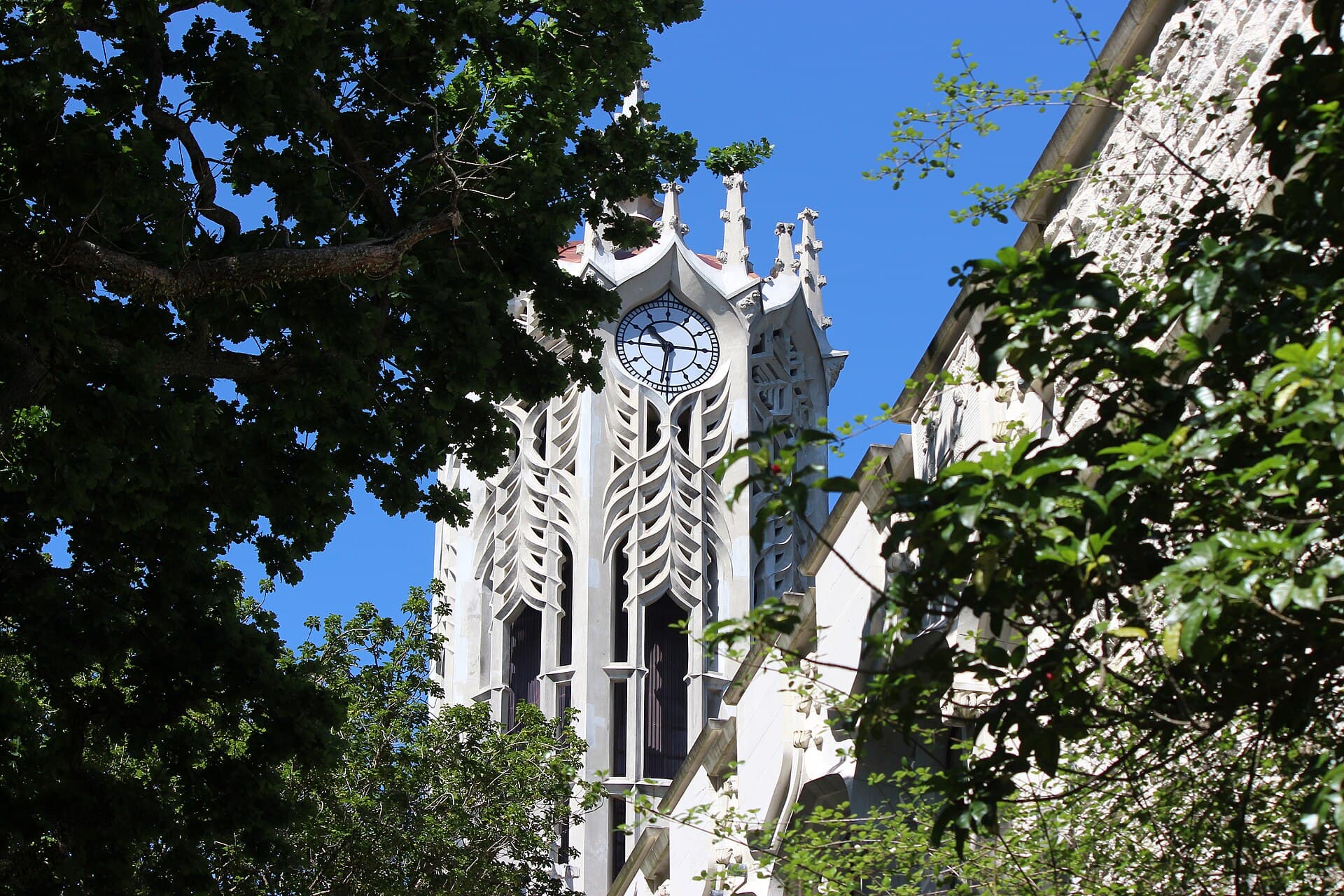
The University of Auckland is New Zealand's largest university, with more than forty thousand students on campuses spread through the country's largest city. It began in 1883 as Auckland University College, a constituent college of the federal University of New Zealand, holding its first lectures in a disused courthouse and jail. From that borrowed start it became the country's biggest research organization, its white ClockTower rising over Albert Park as one of Auckland's most recognized buildings.
For a site concerned with memory, Auckland offers a thread that few universities anywhere can match. New Zealand's founding document, the Treaty of Waitangi, exists in two languages that do not quite say the same thing, and the scholarly rendering that lets English readers hear what the Māori text actually promised was made by an Auckland professor who was also a paramount chief. A university is usually asked to keep knowledge. This one helped a nation keep the meaning of its founding agreement.
Auckland's college came third among the colonial foundations, after the University of Otago in 1869 and Canterbury College in 1873. When Auckland University College opened on 23 May 1883, it was a modest affair: 95 students and four teaching staff, lecturing in the city's old District Courthouse and the jail buildings beside it, because the new college had no buildings of its own. The setting was fitting in its way. Auckland had lost its status as capital to Wellington in 1865, and the disused courthouse was a leftover of the earlier town; the college moved into the shell of one institution and slowly became a larger one.
Like its southern siblings, the college taught but did not graduate. Degrees came from the University of New Zealand, the federal body that set examinations for the whole colony, with scripts long sent to examiners in Britain. That arrangement held for nearly eight decades, until the federal university was dissolved through legislation passed in 1961 and the college, empowered by the University of Auckland Act of that year, began conferring degrees in its own name as the University of Auckland from 1962.
The decades that followed transformed its scale. Auckland city grew faster than any other part of New Zealand, and the university grew with it. Under Sir Colin Maiden, vice-chancellor from 1971 to 1994, the campus expanded across Princes Street and Symonds Street, a medical school took its first students in 1968, and the college that had once fitted inside a courthouse became the largest university in the country.
The City Campus runs along a ridge at the edge of central Auckland, separated from the office towers of Queen Street by Albert Park, a Victorian garden square whose fountain and floral clock give students a green route into town. The wider setting is dramatic in a way easy to miss from ground level: the city is built across a field of some fifty small volcanoes, and the harbour it wraps around, the Waitematā, opens to the Hauraki Gulf a short walk downhill from the lecture theatres.
The university's emblem is the ClockTower, formally the Old Arts Building, completed in 1926. Its architect, Roy Lippincott, was an American trained in the Chicago of the Prairie School and a brother-in-law of Walter Burley Griffin, the designer of Canberra; he came to Australasia in Griffin's circle and won the Auckland competition with a design unlike anything the city had seen. The building reads as Perpendicular Gothic reimagined by an Arts and Crafts hand, its ornament drawn from New Zealand flora rather than European precedent, and its white openwork tower earned it the affectionate nickname of the wedding cake. Lippincott called the tower the culminating feature of the design, symbolic of university ideals, and defended his botanical ornament by arguing that a building in Auckland should belong to Auckland. Locals were unsure at first; the city has long since adopted it, and the building is protected as a Category 1 historic place.
Around that landmark the university teaches across the full range of disciplines: arts, science, engineering, law, business, education, creative arts, and the country's largest faculty of medical and health sciences. Its student body passed forty thousand, nearly a quarter of them postgraduates, and its research income makes it the largest research organization in New Zealand.
The Treaty of Waitangi, signed in 1840, was drafted in English and translated overnight into Māori, and nearly all the chiefs who signed put their names to the Māori text. The two versions differ at the exact points that matter most: what the chiefs ceded, and what they kept. For more than a century the English text dominated public life while the Māori text, Te Tiriti, carried the understanding of those who had actually signed. Bringing the two back into one conversation required a scholar fluent in both worlds.
The university had one. Sir Hugh Kāwharu was a leader and later paramount chief of Ngāti Whātua, the iwi whose lands include central Auckland, and from 1985 to 1993 he was professor of Māori Studies and head of anthropology at the university. His careful back-translation of the Māori text into English, showing that the chiefs had granted governance while retaining chieftainship over their lands and treasures, became the standard scholarly rendering, relied on by the Waitangi Tribunal and the courts as they worked out what the treaty requires of the modern state. It is a rare kind of scholarship: a translation that changed how a country reads its own founding document.
Kāwharu also directed the building of the university's marae. Waipapa Marae opened on the City Campus in 1988, its carved meeting house, Tāne-nui-a-Rangi, gathering ancestral figures from many iwi so that students of every whakapapa could stand there and be received. The marae operates by Māori protocol as a working space for teaching, welcome, and mourning, in the city with the largest Polynesian population in the world. In 2021 Ngāti Whātua Ōrākei deepened the relationship by gifting the university its Māori name, Waipapa Taumata Rau.
Auckland's humanities carry the encounter between Māori and European as a central subject. Dame Anne Salmond, an anthropologist and historian at the university, spent her career reconstructing the first meetings of the two peoples, ship by ship and beach by beach, and her books on those encounters made her one of New Zealand's most honoured scholars.
The sciences run just as deep. The Auckland Bioengineering Institute became known internationally for building mathematical models of the human body, including a virtual heart that beats in software, work at the centre of the worldwide effort to model human physiology in full. Distinguished Professor Dame Margaret Brimble, a chemist, led the laboratory whose peptide work produced trofinetide, a treatment for Rett syndrome approved by the United States Food and Drug Administration in 2023, a landmark for drug discovery in New Zealand. Sir Peter Gluckman, who founded the university's Liggins Institute for research on early human development, became in 2009 the first chief science advisor to a New Zealand prime minister and later led the International Science Council.
In public life, the university's best-known graduate is Helen Clark, who studied politics at Auckland, lectured there, and went on to serve as prime minister of New Zealand from 1999 to 2008 before running the United Nations Development Programme for eight years.
Auckland is consistently ranked first among New Zealand's universities and stands inside the top hundred of the main international league tables, the only university in the country to do so. Its campuses reach from the city centre to the Grafton medical precinct beside Auckland City Hospital, with sites in Newmarket, Epsom, and South Auckland. Nearly ten thousand students graduate each year, and the university's research spans the physiome models of the bioengineers, Pacific and Māori scholarship, and the health of a fast-growing, many-cultured city that now holds a third of the country's people.
The City Campus sits beside Albert Park, a few minutes uphill from Queen Street, and its grounds are open to walk through. The ClockTower is the classic photograph, best seen from the park side in the morning light, and Old Government House, the timber residence of New Zealand's colonial governors from 1856, stands within the campus grounds nearby. Waipapa Marae is a working marae rather than a visitor attraction, and entry is by invitation or arrangement, as marae protocol asks. Teaching weeks are busy and the lecture blocks are not for wandering, though the park benches with a view of the wedding cake tower are open to anyone.