Heritage · University
California Institute of Technology (Caltech): History and Overview
The California Institute of Technology began in 1891 as Throop University, a small vocational school, and was rebuilt in the early twentieth century into one of the most concentrated centres of scientific research anywhere. From a campus of barely more than two thousand students it has produced dozens of Nobel laureates and manages NASA's Jet Propulsion Laboratory.Written to last.
By Confinity Heritage Editorial · Updated 2026-07-31 · 8-minute readQuiet tools, kept out of the way.
Few universities have done so much with so little room. The California Institute of Technology occupies a compact campus of about 124 acres in Pasadena, roughly eleven miles northeast of downtown Los Angeles, and enrolls only around 2,400 students, split between some 987 undergraduates and about 1,443 graduate students (Wikipedia). Yet from that small population has come a run of scientific achievement out of all proportion to its size: the measurement of the electron's charge, the chemistry of the molecular bond, the theory of quarks, the reading of earthquakes, and the first direct detection of a gravitational wave. Caltech is a place built on a single conviction, that a handful of the ablest minds, given freedom and instruments, will change what the rest of us know.
That conviction was not there at the start. When the school opened in 1891 it was a local trade academy with no research ambitions at all. Its transformation into a research institute is one of the more deliberate acts of institution-building in American science, carried out by a small circle of people who wanted, in effect, to grow a European-style research academy among the orange groves of Southern California. To walk the campus today, past its tiled roofs and arcaded courtyards, is to move through the memory of that project and of the scientists who gave their working lives to it.
The institute traces its beginning to September 1891, when Amos G. Throop, a Pasadena businessman and philanthropist, founded a small coeducational school he called Throop University. It opened that November with 31 students and a faculty of six, teaching practical subjects from the sciences to the manual trades (Caltech). For its first years it was a modest polytechnic, later renamed Throop Polytechnic Institute, of a kind common in the growing towns of the American West.
The decisive change came with the arrival in Pasadena of the astronomer George Ellery Hale. Hale, the first director of the nearby Mount Wilson Observatory, joined Throop's board of trustees in 1907 and set about reshaping the school into a first-rank institution for scientific and engineering research (Caltech). He persuaded the trustees to drop the lower-level vocational programs and concentrate on advanced science, and he recruited two figures who would complete the transformation: the physical chemist Arthur Amos Noyes, drawn from the Massachusetts Institute of Technology, and the physicist Robert Andrews Millikan.
Renamed Throop College of Technology in 1913, the school took its present name, the California Institute of Technology, in 1920. By that point it counted 359 undergraduates and nine graduate students, with five buildings on a 22-acre campus and a faculty that already included Noyes and Millikan (Caltech). Millikan arrived in force in 1921 as head of the institute, chairman of its executive council, and more than anyone set its character. Two years later he won the 1923 Nobel Prize in Physics for measuring the charge of the electron in his celebrated oil-drop experiment and for his work on the photoelectric effect (Wikipedia). Under the trio of Hale, Noyes and Millikan, Caltech grew quickly through the 1920s and 1930s, adding a division of biology under the geneticist Thomas Hunt Morgan and building the laboratories and the endowment that let a very small school compete with far larger ones.
Caltech's Pasadena campus was given its enduring form by the architect Bertram Goodhue, who drew up a master plan in 1917 in a Spanish and Mediterranean idiom suited to the California climate (Wikipedia). Low buildings of pale stucco with red tile roofs are arranged around planted courtyards, pools and arcaded walkways, so that the working parts of a research institute are threaded through what feels like a quiet garden. Later landmarks were added in keeping with, or in counterpoint to, that scheme, among them the Athenaeum, the faculty club opened in 1930, and the round Beckman Auditorium. The result is a campus whose calm is a deliberate setting for concentrated work.
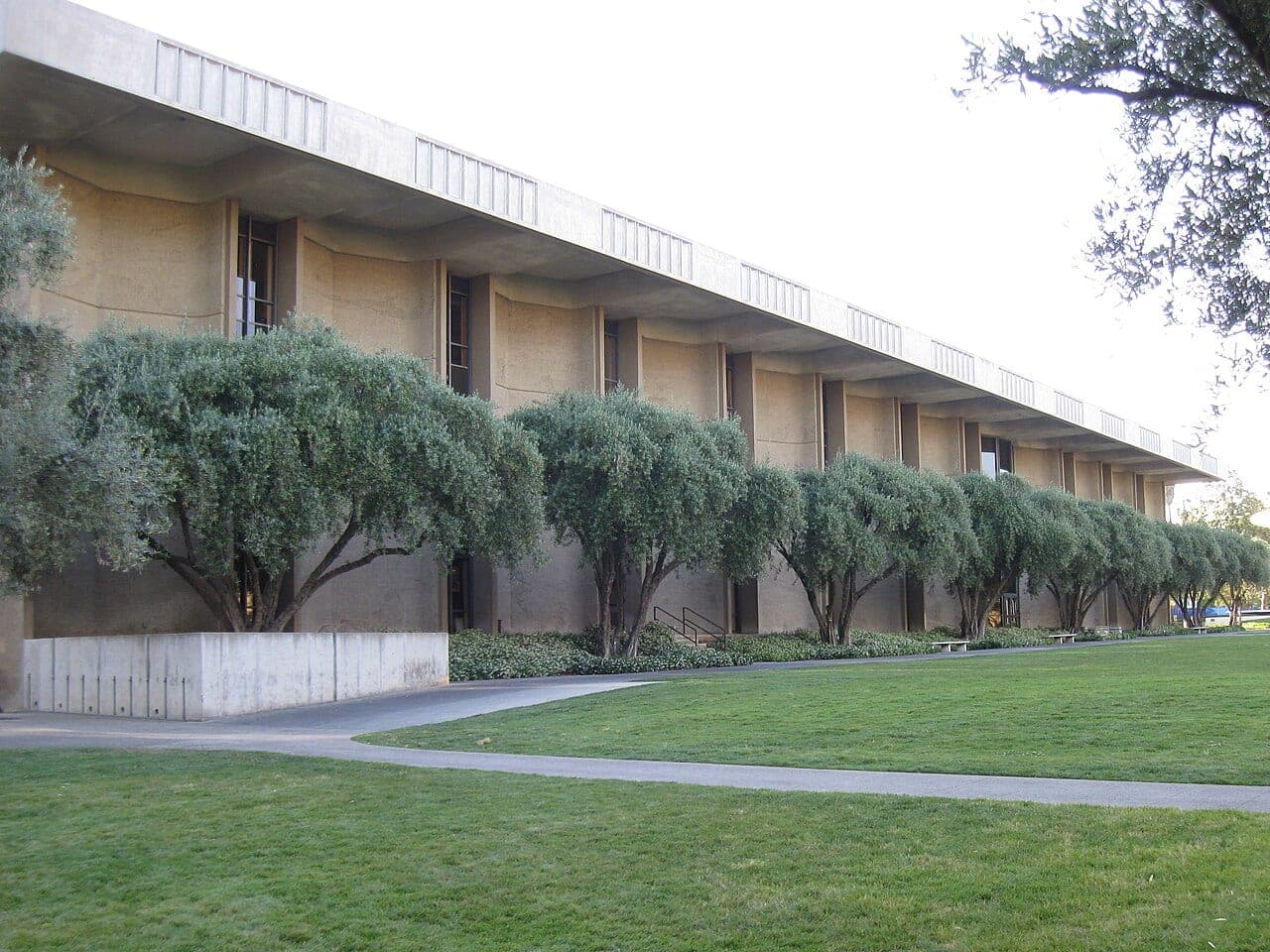
 Millikan Library is the tallest thing on campus at nine storeys, which on a campus of about a thousand undergraduates is a fair measure of the place: small, and not modest. Photograph by Canon.vs.nikon, CC BY-SA 3.0, via Wikimedia Commons.
For all its influence, Caltech remains deliberately small. It is organized into just six academic divisions: Biology and Biological Engineering; Chemistry and Chemical Engineering; Engineering and Applied Science; Geological and Planetary Sciences; Humanities and Social Sciences; and Physics, Mathematics and Astronomy (Wikipedia). Every undergraduate, whatever the eventual specialism, moves through a demanding common core of mathematics, physics, chemistry and biology, and the institute keeps a low ratio of students to faculty. That smallness is not incidental to its reputation; it is the strategy. By staying compact and highly selective, Caltech concentrates its resources on a limited number of fields and expects everyone in them to work at the frontier.
The list of scientists who have worked at Caltech reads like a syllabus of twentieth-century physical science. Millikan's electron measurement established the institute's early standing. The chemist Linus Pauling, who spent most of his career there, reshaped the understanding of the chemical bond and the structure of molecules, and remains the only person to have won two unshared Nobel Prizes, in Chemistry in 1954 and Peace in 1962 (Wikipedia). The physicist Richard Feynman, at Caltech from 1950 until his death in 1988, shared the 1965 Nobel Prize for quantum electrodynamics and, through his published lectures, changed how physics is taught. His colleague Murray Gell-Mann won the 1969 prize for the classification of elementary particles and proposed the quark as the building block of matter.
Caltech's reach extends far beyond its campus walls. It manages the Jet Propulsion Laboratory, the birthplace of American robotic space exploration, for the National Aeronautics and Space Administration. JPL grew out of rocket-motor experiments carried out in the dry bed of the Arroyo Seco by graduate students of the aeronautical engineer Theodore von Kármán, the first of which was fired on 31 October 1936; the operation took the name Jet Propulsion Laboratory in the early 1940s and is today a federally funded research centre owned by NASA and run as a division of Caltech (JPL). Its spacecraft have carried instruments to every planet in the solar system.
In astronomy the institute operates the Palomar Observatory, whose 200-inch Hale Telescope, named for George Ellery Hale, was dedicated in 1948 and remained the most powerful optical telescope in the world for more than four decades (Wikipedia). In the earth sciences, Caltech's Seismological Laboratory gave the world its most familiar measure of earthquakes: in 1935 the seismologist Charles Richter, working with his colleague Beno Gutenberg, devised the magnitude scale that still carries Richter's name (Britannica).
The institute's most recent landmark discovery came from the Laser Interferometer Gravitational-Wave Observatory, or LIGO, conceived and built jointly by Caltech and MIT. On 14 September 2015 LIGO recorded the first direct detection of a gravitational wave, a ripple in spacetime thrown off by two colliding black holes and predicted by Albert Einstein a century earlier. Caltech's Kip Thorne and Barry Barish shared the 2017 Nobel Prize in Physics for the achievement, together with MIT's Rainer Weiss (Wikipedia).
Set against its size, the honours are extraordinary. As of late 2024, 48 Caltech alumni and faculty members had been awarded Nobel Prizes, holding 49 prizes in all (Wikipedia), a density of recognition that few institutions of any size can match.
The magnitude scale came out of a record that was already being kept. The Seismological Laboratory, known on campus as the Seismo Lab, was set up by Harry O. Wood in 1921 under the Carnegie Institution of Washington, and responsibility for it, its programmes and most of its staff passed to Caltech in 1937 (Caltech Seismological Laboratory). In the early 1920s Wood and John Anderson built the Wood-Anderson torsion seismometer, which became the standard instrument for recording local earthquakes. From 1926 the lab worked with Caltech's new geology division to string a network of those machines across Southern California, and by 1932 six were running and a routine station bulletin had begun to appear. Charles Richter joined the staff in 1927 and took his Caltech doctorate the following year. When he and Beno Gutenberg fixed the magnitude scale in 1935, they calibrated it against the trace amplitude on the Wood-Anderson instruments, which is to say they devised a way of reading an archive the lab had already been accumulating for a decade (Wikipedia).
The bulletin never stopped. In 1974 the lab and the United States Geological Survey began the joint programme that grew into the Southern California Seismic Network, and its archive, the Southern California Earthquake Data Center at Caltech, now offers a searchable catalogue of Southern California earthquakes running from 1932 to the present day, together with the waveform data behind it (SCEDC). Richter's scale has since been superseded for larger events by the moment magnitude scale that Hiroo Kanamori developed at the lab in 1977, and the older readings remain usable because the instrument and the method were written down beside them. Most of that century of record is the memory of nothing happening, which is what makes the rest of it legible.
Caltech remains what its founders intended: a small, research-intensive institute where the boundary between teaching and discovery is thin. Its faculty and alumni continue to shape fields from planetary science and seismology to chemistry, quantum physics and the biological sciences, and its partnership with NASA through JPL keeps it at the centre of space exploration. The campus has grown from the 22 acres of 1920 to about 124 acres today, but the institute has resisted the temptation to expand its student body to match its fame (Wikipedia). It still enrolls only a few thousand people, admits them very selectively, and holds to the belief that scientific progress is made by individuals working closely together rather than by numbers alone.
That continuity is part of what a heritage archive is meant to hold. The names on the laboratory doors change, but the project begun by Hale, Noyes and Millikan, of building a place where the ablest can pursue the hardest questions, has carried on for more than a century.
Caltech's campus in Pasadena is open to visitors, and its architecture and gardens can be seen on self-guided or docent-led walking tours that take in the historic Goodhue buildings, the Athenaeum and the courtyards at the heart of the campus. Public lectures, among them the long-running Watson Lecture series, bring the institute's research to general audiences, and cultural events are held at Beckman Auditorium. The associated Palomar Observatory, in the mountains of northern San Diego County, maintains a visitor centre and offers public views of the dome that houses the Hale Telescope. Details of tours, opening hours and events are best confirmed through the institute's official website before a visit.
Millikan Library is the tallest thing on campus at nine storeys, which on a campus of about a thousand undergraduates is a fair measure of the place: small, and not modest. Photograph by Canon.vs.nikon, CC BY-SA 3.0, via Wikimedia Commons.
For all its influence, Caltech remains deliberately small. It is organized into just six academic divisions: Biology and Biological Engineering; Chemistry and Chemical Engineering; Engineering and Applied Science; Geological and Planetary Sciences; Humanities and Social Sciences; and Physics, Mathematics and Astronomy (Wikipedia). Every undergraduate, whatever the eventual specialism, moves through a demanding common core of mathematics, physics, chemistry and biology, and the institute keeps a low ratio of students to faculty. That smallness is not incidental to its reputation; it is the strategy. By staying compact and highly selective, Caltech concentrates its resources on a limited number of fields and expects everyone in them to work at the frontier.
The list of scientists who have worked at Caltech reads like a syllabus of twentieth-century physical science. Millikan's electron measurement established the institute's early standing. The chemist Linus Pauling, who spent most of his career there, reshaped the understanding of the chemical bond and the structure of molecules, and remains the only person to have won two unshared Nobel Prizes, in Chemistry in 1954 and Peace in 1962 (Wikipedia). The physicist Richard Feynman, at Caltech from 1950 until his death in 1988, shared the 1965 Nobel Prize for quantum electrodynamics and, through his published lectures, changed how physics is taught. His colleague Murray Gell-Mann won the 1969 prize for the classification of elementary particles and proposed the quark as the building block of matter.
Caltech's reach extends far beyond its campus walls. It manages the Jet Propulsion Laboratory, the birthplace of American robotic space exploration, for the National Aeronautics and Space Administration. JPL grew out of rocket-motor experiments carried out in the dry bed of the Arroyo Seco by graduate students of the aeronautical engineer Theodore von Kármán, the first of which was fired on 31 October 1936; the operation took the name Jet Propulsion Laboratory in the early 1940s and is today a federally funded research centre owned by NASA and run as a division of Caltech (JPL). Its spacecraft have carried instruments to every planet in the solar system.
In astronomy the institute operates the Palomar Observatory, whose 200-inch Hale Telescope, named for George Ellery Hale, was dedicated in 1948 and remained the most powerful optical telescope in the world for more than four decades (Wikipedia). In the earth sciences, Caltech's Seismological Laboratory gave the world its most familiar measure of earthquakes: in 1935 the seismologist Charles Richter, working with his colleague Beno Gutenberg, devised the magnitude scale that still carries Richter's name (Britannica).
The institute's most recent landmark discovery came from the Laser Interferometer Gravitational-Wave Observatory, or LIGO, conceived and built jointly by Caltech and MIT. On 14 September 2015 LIGO recorded the first direct detection of a gravitational wave, a ripple in spacetime thrown off by two colliding black holes and predicted by Albert Einstein a century earlier. Caltech's Kip Thorne and Barry Barish shared the 2017 Nobel Prize in Physics for the achievement, together with MIT's Rainer Weiss (Wikipedia).
Set against its size, the honours are extraordinary. As of late 2024, 48 Caltech alumni and faculty members had been awarded Nobel Prizes, holding 49 prizes in all (Wikipedia), a density of recognition that few institutions of any size can match.
The magnitude scale came out of a record that was already being kept. The Seismological Laboratory, known on campus as the Seismo Lab, was set up by Harry O. Wood in 1921 under the Carnegie Institution of Washington, and responsibility for it, its programmes and most of its staff passed to Caltech in 1937 (Caltech Seismological Laboratory). In the early 1920s Wood and John Anderson built the Wood-Anderson torsion seismometer, which became the standard instrument for recording local earthquakes. From 1926 the lab worked with Caltech's new geology division to string a network of those machines across Southern California, and by 1932 six were running and a routine station bulletin had begun to appear. Charles Richter joined the staff in 1927 and took his Caltech doctorate the following year. When he and Beno Gutenberg fixed the magnitude scale in 1935, they calibrated it against the trace amplitude on the Wood-Anderson instruments, which is to say they devised a way of reading an archive the lab had already been accumulating for a decade (Wikipedia).
The bulletin never stopped. In 1974 the lab and the United States Geological Survey began the joint programme that grew into the Southern California Seismic Network, and its archive, the Southern California Earthquake Data Center at Caltech, now offers a searchable catalogue of Southern California earthquakes running from 1932 to the present day, together with the waveform data behind it (SCEDC). Richter's scale has since been superseded for larger events by the moment magnitude scale that Hiroo Kanamori developed at the lab in 1977, and the older readings remain usable because the instrument and the method were written down beside them. Most of that century of record is the memory of nothing happening, which is what makes the rest of it legible.
Caltech remains what its founders intended: a small, research-intensive institute where the boundary between teaching and discovery is thin. Its faculty and alumni continue to shape fields from planetary science and seismology to chemistry, quantum physics and the biological sciences, and its partnership with NASA through JPL keeps it at the centre of space exploration. The campus has grown from the 22 acres of 1920 to about 124 acres today, but the institute has resisted the temptation to expand its student body to match its fame (Wikipedia). It still enrolls only a few thousand people, admits them very selectively, and holds to the belief that scientific progress is made by individuals working closely together rather than by numbers alone.
That continuity is part of what a heritage archive is meant to hold. The names on the laboratory doors change, but the project begun by Hale, Noyes and Millikan, of building a place where the ablest can pursue the hardest questions, has carried on for more than a century.
Caltech's campus in Pasadena is open to visitors, and its architecture and gardens can be seen on self-guided or docent-led walking tours that take in the historic Goodhue buildings, the Athenaeum and the courtyards at the heart of the campus. Public lectures, among them the long-running Watson Lecture series, bring the institute's research to general audiences, and cultural events are held at Beckman Auditorium. The associated Palomar Observatory, in the mountains of northern San Diego County, maintains a visitor centre and offers public views of the dome that houses the Hale Telescope. Details of tours, opening hours and events are best confirmed through the institute's official website before a visit.
History
Campus and academics