Heritage · Museum
The 9/11 Memorial and Museum: Reflecting Absence in New York
The National September 11 Memorial and Museum occupies the footprints of the twin towers in Lower Manhattan. Two sunken pools carry 2,983 names arranged by relationship rather than alphabet, and a museum descends seventy feet to the bedrock that held. This is how a city built a memorial while its mourners were still alive.Written to last.
By Confinity Heritage Editorial · 2026-08-23 · 7-minute readQuiet tools, kept out of the way.
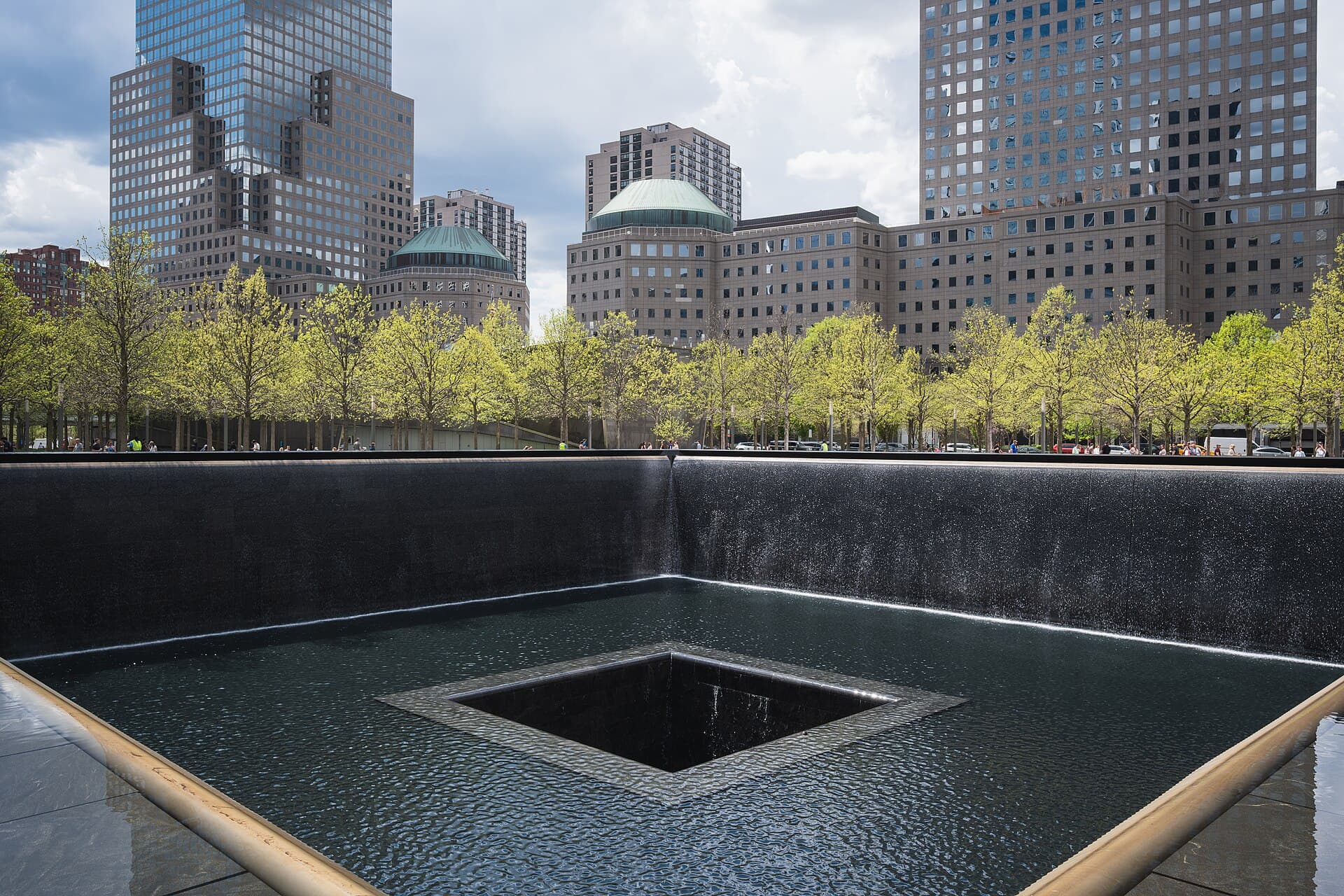
Where the twin towers of the World Trade Center stood, there are now two square voids. Water falls thirty feet down their granite walls, then vanishes into a smaller opening at the centre whose bottom cannot be seen from the edge. Around each void runs a bronze parapet carrying names, 2,983 of them, and the names are not in alphabetical order. They are arranged by who knew whom: colleagues beside colleagues, friends beside friends, brothers beside brothers. The National September 11 Memorial and Museum in New York is the United States' principal place of remembrance for the attacks of 11 September 2001, and it is unusual among the great memorials in being designed, argued over and built while its mourners were still alive.
This article covers how the memorial and museum came to be, what stands on the plaza and beneath it, and what its arrangement of names teaches about how people are remembered.
The attacks of 11 September 2001 killed 2,977 people at the World Trade Center, at the Pentagon, and aboard the four hijacked aircraft, including United Flight 93, forced down by its passengers in a Pennsylvania field. At the sixteen-acre site in Lower Manhattan the question of what should replace the towers began almost immediately, and it was contested from the start, with families, survivors, residents, developers and officials divided over how much of the site belonged to commerce and how much to memory.
In 2003 the Lower Manhattan Development Corporation opened an international design competition for the memorial. It drew 5,201 entries from 63 countries, one of the largest design competitions ever held. In January 2004 the jury chose Reflecting Absence, by the architect Michael Arad, refined with the landscape architect Peter Walker. Arad's idea was that the footprints of the towers themselves should remain open, two voids the city would never fill, set in a level plaza of trees.
The memorial opened to families on the tenth anniversary, 11 September 2011, and to the public the next day. The museum below it took longer, delayed by funding disputes and by Hurricane Sandy, which flooded the unfinished galleries in 2012. It was dedicated in May 2014, with a week of previews reserved for families, survivors and rescue workers before it opened to the public on 21 May 2014.
The museum's defining gesture is descent. From a glass pavilion on the plaza, visitors walk down a long ramp through the volume the towers once occupied, arriving at bedrock roughly seventy feet below the street. Alongside the ramp runs the Vesey Street stair, known as the Survivors' Stairs, a battered flight of concrete steps down which hundreds of people escaped that morning. The last above-ground remnant of the original plaza, it lets visitors descend beside the stairs that others once ran down.
At the bottom, in Foundation Hall, stand two of the museum's largest artefacts. The first is the slurry wall, part of the underground retaining wall built in the 1960s to hold back the Hudson River. It held through the collapse, sparing Lower Manhattan far worse flooding. The second is the Last Column, the final steel removed from the site in May 2002, carried out draped in black. Recovery workers, firefighters and families had covered it in inscriptions, photographs and unit insignia, and it is preserved with those tributes intact, a monument the recovery made for itself.
The In Memoriam gallery holds a portrait of every one of the 2,983 victims, the 2,977 killed in 2001 and the six killed in the bombing of the trade centre's garage in February 1993. Touch tables let visitors call up each person's story, and an inner chamber plays spoken remembrances, recorded by parents, spouses, children and friends, so that each of the dead is described in a voice that knew them.
The historical exhibition, set within the north tower's footprint, recounts the day itself, the events that led to it, and the years that followed, through recordings, photographs and recovered objects. Its curators faced a problem few museums have faced at this scale: how to exhibit an atrocity within living memory, for an audience that includes the bereaved. Some choices drew criticism. The repository of unidentified remains, kept by the city's medical examiner behind a wall at bedrock inscribed with a line from Virgil, was opposed by some families who felt remains should not rest within a ticketed museum; others took comfort that their dead lay at the site itself, behind a wall only families may pass. The gift shop, and an admission charge that began at 24 dollars, drew similar argument about commerce at a place of death. The museum answers that it receives no ongoing government funding; the debate, about where remembrance ends and the visitor economy begins, has never fully settled.
The work of identification is not finished. The medical examiner has identified about 1,650 of the 2,753 people killed at the World Trade Center, and continues to retest fragments as DNA techniques improve. New identifications were still being announced in 2025, more than two decades after the attacks.
The memorial plaza is an eight-acre grove of more than 400 swamp white oaks, level with the streets so that it reads as a public square as much as a shrine. Within it, the two memorial pools, each nearly an acre, occupy the footprints of the north and south towers. Their waterfalls are the largest human-made waterfalls in North America, and their sound screens out the surrounding streets, holding a pocket of quiet in the financial district.
The arrangement of the names is the memorial's most original piece of design. Arad resisted both alphabetical order, which he felt would read like a directory, and random placement. Instead the names are grouped by where each person was that morning, the towers, the four flights, the Pentagon, the first responders, the 1993 bombing, and within those groups they are placed by what the memorial calls meaningful adjacencies. Families were invited to ask that their dead be placed beside particular others, and about 1,200 such requests arrived: colleagues who died together, friends who commuted together, two men from rival firms who had been best friends since school. Honouring every request at once was a puzzle beyond hand-sorting, so the designers used a purpose-built algorithm to compute an arrangement that satisfied all of them, then refined it by hand into the final layout. The result looks effortless, and the effort it conceals is the point: the memorial records not just who was lost but how they were connected.
On the plaza grows the Survivor Tree, a Callery pear planted at the original trade centre in the 1970s. It was pulled from the rubble in October 2001, burned and snapped to a stump, nursed back to health for nine years in a city parks nursery, and replanted at the memorial in 2010. Each year its seedlings are sent to communities that have endured their own disasters. Nearby, the Memorial Glade, added in 2019, honours the rescue and recovery workers who have sickened or died from exposure to the site's toxic dust. Below ground, the museum was designed by Davis Brody Bond, with the glass entry pavilion by Snøhetta holding two steel tridents salvaged from the north tower's facade.
Most great memorials are built at a distance from their grief. This one was not. It was designed while families were still receiving remains, and every decision, the placement of names, the keeping of remains, the price of a ticket, was made in negotiation with the living. It is a study in how a democracy remembers under argument, and its compromises are part of its record.
Its name arrangement is a landmark of memorial information design. Memorials to the missing, from the Tomb of the Unknown Soldier to the walls of names raised after the world wars, have usually answered mass death with ordered lists. The 9/11 memorial's parapets suggest a different possibility: that a list can carry relationships, that a name means more beside the right neighbour, and that the dead can be recorded as members of one another's lives rather than entries in a registry. Each 11 September relatives read the names aloud over several hours, enacting the same idea, while the twin beams of the Tribute in Light rise over the skyline through the night.
At its core the site preserves three kinds of things. It preserves evidence: the slurry wall, the stairs, the crushed fire trucks and recovered objects that establish physically what happened. It preserves persons: a face, a voice and a story for each of the 2,983, gathered from the people who loved them. And it preserves relationships, cut into bronze, so that the connections between the dead outlast the generation that remembered them firsthand. Long after the last eyewitness is gone, the parapets will still show who stood beside whom.
The memorial and museum stand at 180 Greenwich Street in Lower Manhattan, near the WTC Cortlandt subway station and the Oculus PATH terminal. The memorial plaza is free and open to all daily. The museum is ticketed, with free admission for victims' families and for rescue and recovery workers, and free public entry on Monday evenings; current hours and prices are on the official site. Allow around two hours. The historical exhibition is unsparing, and the museum advises discretion for younger children; the plaza above is a gentler place to end. Come early in the morning for the memorial at its quietest, when the waterfalls are the loudest thing on it.