Heritage · Landmark
Rila Monastery: the mountain that kept Bulgaria
High in a forested valley of the Rila Mountains, a fortress of stone opens into a courtyard of striped arcades, painted galleries and a church glowing with gold. Founded around a hermit's cave in the tenth century, Rila Monastery spent five centuries of Ottoman rule guarding the language, records and memory of an entire nation.Written to last.
By Confinity Heritage Editorial · 2026-08-23 · 7-minute readQuiet tools, kept out of the way.
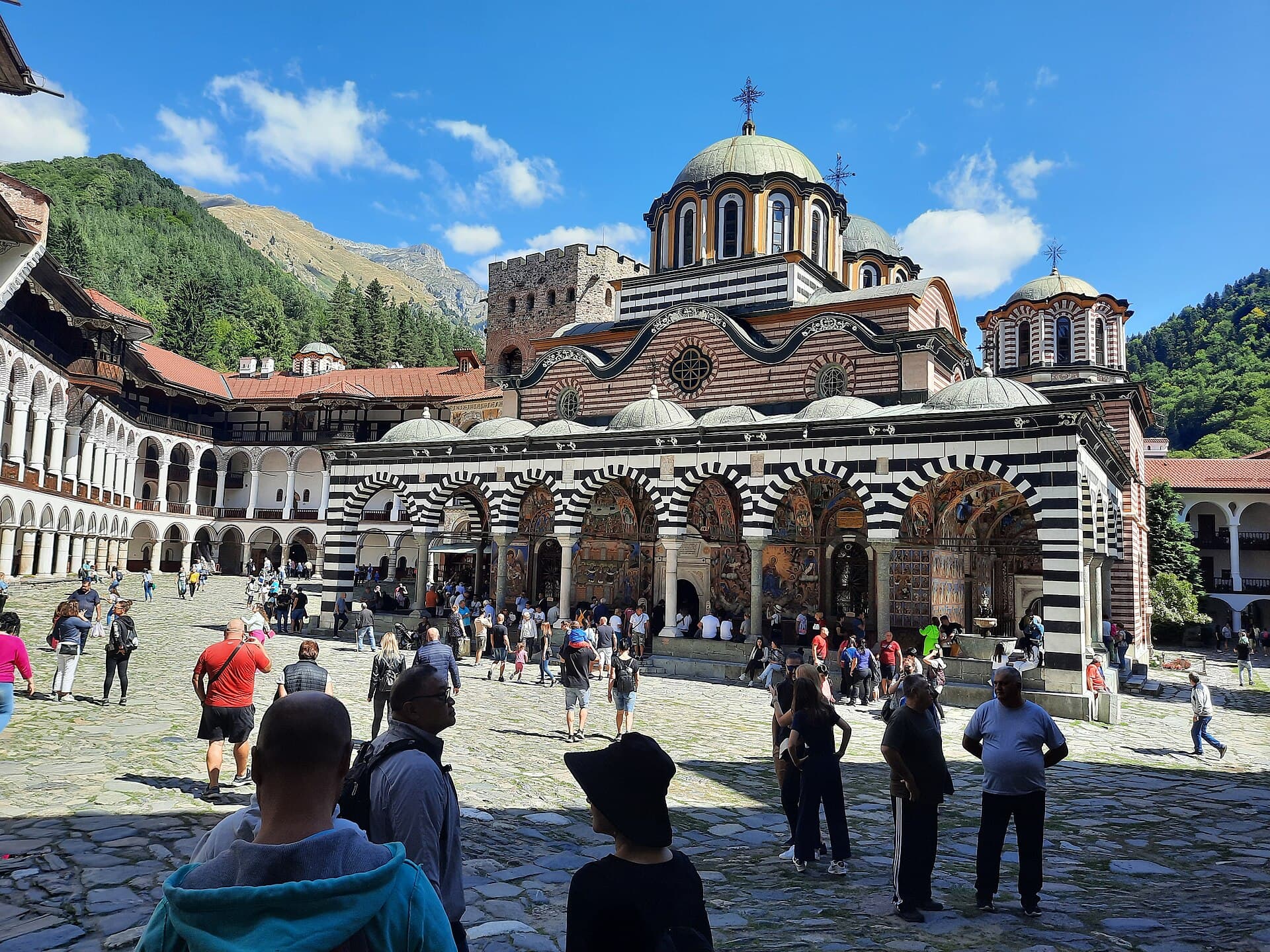
Deep in the Rila Mountains of southwestern Bulgaria, where the Rilska river runs through forests of spruce and beech at 1,147 metres above the sea, a ring of high stone walls stands against the slope like a fortress. From outside it gives almost nothing away: bare masonry, small windows, a gate. Step through that gate and the building turns itself inside out. Four storeys of arcaded galleries, their arches striped in black, white and red, curve around a broad courtyard, and at its centre rises the Church of the Nativity of the Virgin, its porticoes covered in some of the most vivid frescoes in the Orthodox world. This is Rila Monastery, the largest and most revered monastery in Bulgaria, inscribed on the UNESCO World Heritage List in 1983.
The contrast between the closed exterior and the painted world within is not an accident of style. It is the building's biography. Rila was founded in the tenth century around the hermitage of a saint, grew rich under the medieval Bulgarian tsars, and then spent nearly five hundred years as a Christian institution inside the Ottoman Empire, keeping its treasures, its library and its schools behind defensive walls. When fire destroyed almost everything in 1833, ordinary Bulgarians across the empire paid to rebuild it, and the monastery that rose from the ashes became a monument of the Bulgarian National Revival. What looks like architecture is also an argument: that a nation without a state could still keep its memory, if it had somewhere to put it.
The story begins not with a building but with a man walking away from buildings altogether. Ivan of Rila, born around 876 in the village of Skrino, gave away his possessions, took monastic vows and withdrew into the Rila range, living in hollow trees and finally in a high mountain cave where he spent years in prayer and fasting. His reputation travelled further than he did. Disciples climbed the valley to find him, and by the 930s a community had gathered near his cave; Tsar Peter I is said to have sought him out, and by tradition the hermit declined to meet the ruler face to face. Ivan died in 946 and was canonized soon after, becoming the patron saint of the Bulgarian people.
The monastery his followers built stood a little apart from the hermitage, and moved to its present site in the fourteenth century. But the cave remained part of the institution's identity, and it still is. A few kilometres up the valley, pilgrims can enter the narrow cleft where the saint lived, and custom holds that only those free of grave sin can squeeze through the tight opening in the rock. The monastery began as one man's refusal of the world; everything it later accumulated, land, gold, books, was gathered around the memory of a man who owned nothing.
Few relics in Europe have had a more restless afterlife than Ivan's. His remains were moved from the mountain to Sredets, today's Sofia, in the tenth century, where miracles were reported at his shrine. In 1183 the Hungarian king Béla III, campaigning in the region, carried the relics off to Esztergom; they were returned to Sredets in 1187. In 1195 Tsar Ivan Asen I translated them in solemn procession to Tarnovo, the capital of the restored Bulgarian empire, where they remained through the medieval centuries.
The most defiant journey came last. In 1469, less than a lifetime after the Ottoman conquest had extinguished the Bulgarian state, monks obtained permission to carry the saint home. The procession from Tarnovo back to Rila took weeks, and crowds of Bulgarian Christians came out to venerate the relics as they passed, an event recorded in detail by the writer Vladislav the Grammarian, who accompanied it. Under foreign rule, with no tsar and no patriarch, the return of the national saint to his mountain was as close to a state ceremony as Bulgarians could have. The relics rest in the monastery church today, and the pilgrimage to them has never stopped.
The oldest surviving structure at Rila is a survivor twice over. Hrelyo's Tower, a five-storey stone keep 23 metres high, was built in 1335 by the local lord Hrelyo, a powerful magnate of the crumbling Balkan order, who fortified the monastery and endowed it before ending his life as a monk within its walls. The tower held a chapel of the Transfiguration at its top, painted with fourteenth-century frescoes, and it was built for defence: in troubled times the monks could withdraw into it with their valuables. It outlasted the medieval kingdom, the conquest, and the disaster that consumed everything around it.
That disaster came in January 1833, when fire destroyed most of the monastery's buildings. What followed is the reason Rila looks the way it does, and the reason Bulgarians speak of it the way they do. The monastery was rebuilt between 1834 and 1862 almost entirely with donations gathered from Bulgarian communities across the Ottoman Empire, from merchants and guilds and villagers who had no state to speak for them and chose to speak through a building instead. Master builders led by Alexi Rilets raised the great residential wings with their striped arcades and roughly three hundred cells; the master Pavel of Krimin directed the new Church of the Nativity of the Virgin, finished in 1837 with five domes and a triple apse. Carvers and painters of the Samokov and Bansko schools filled it: the gilded walnut iconostasis took years of workshop labour, and the frescoes of the church and its porticoes were painted in the 1840s by a team that included Zahari Zograf, the most celebrated Bulgarian painter of the age. His crowded, brilliantly coloured scenes of judgment, temptation and salvation were something new: religious painting with the energy of a national awakening in it.
Behind the galleries, Rila kept something harder to rebuild than walls: an unbroken written record. The monastery library holds around 16,000 volumes, among them some 250 manuscripts from the eleventh to the nineteenth centuries, along with charters, icons and archives, including the Rila Charter of Tsar Ivan Shishman from 1378, one of the most important surviving documents of the medieval Bulgarian state. Through the Ottoman centuries, when Bulgarian had no printing press and no official standing, monks in the Rila scriptorium copied gospels, chronicles and saints' lives by hand, keeping the literary language alive one manuscript at a time.
That quiet work became the seedbed of a revival. In 1762 the monk Paisius of Hilendar, writing on Mount Athos in the monasteries of Hilendar and Zograf, completed his Slavonic-Bulgarian History, the little book that called Bulgarians to remember their tsars and their language. Rila did not produce the history, but it did what archives do: its monks copied it, kept it and passed it on, and the monastery became one of the centres through which such texts and the ideas inside them circulated. In the nineteenth century Rila ran a school in the old tradition, and the great teacher and grammarian Neofit Rilski, author of the first published Bulgarian grammar in 1835, taught, worked and eventually died within its walls in 1881. Revolutionaries of the liberation movement found shelter behind the same walls that had sheltered manuscripts. When Bulgarians say the monastery kept the nation, they are compressing five centuries of copying, teaching and hiding into a single sentence, and the sentence is fair.
The twentieth century tested the institution in a new way. In 1943 Tsar Boris III was buried at Rila at his own wish; after the communist takeover his remains were removed, and only his heart was returned to the monastery grave in 1993. In 1961 the state nationalized the complex and declared it a national museum, and for three decades Rila was administered as a monument of culture with only a token monastic presence. It was during this period, in 1983, that UNESCO inscribed it on the World Heritage List, citing its place in the Slavic cultural identity and its role in the National Revival. In 1991, after the end of communist rule, the monastery was returned to the Bulgarian Orthodox Church, and monks once again govern the house that Ivan's disciples founded.
Some of its oldest customs continued through every change of regime. In the monastery's burial ground stands its ossuary church, where by long Orthodox practice the bones of monks are exhumed after a period in the earth and kept together, so that even in death the community stays assembled. Up the valley, the saint's cave still receives its daily file of pilgrims, and around a million visitors now come to Rila each year, absorbed behind walls that have learned to hold both silence and crowds.
Every country keeps its memory somewhere. Most keep it in national libraries and state archives, buildings created by governments for the purpose. Bulgaria's circumstance was harsher: for five centuries there was no Bulgarian government to build them. What there was instead was a walled compound in a mountain valley, holding the relics of the national saint, the charters of vanished tsars, thousands of hand-copied books, a school, and a community that understood its work as remembering. When the fire of 1833 took the buildings, people who had never seen the monastery sent money to raise it again, because they understood what was stored there. Rila Monastery is what an archive looks like when it has to survive without a state: painted like a celebration, built like a fortress, and kept, hand to hand, for more than a thousand years.
The hermit in the mountain
The travelling relics of a patron saint
A tower, a fire, and a nation of donors
The library that kept a language
Museum by decree, monastery by right
An archive disguised as a monastery
References and resources
- UNESCO World Heritage Centre. "Rila Monastery." World Heritage List, property no. 216, inscribed 1983. whc.unesco.org/en/list/216.
- Encyclopaedia Britannica. "Rila Monastery" and "St. John of Rila." britannica.com.
- Rila Monastery, official site. rilskimanastir.org.
- Wikipedia. "Rila Monastery," "John of Rila," "Hrelyo's Tower," "Zahari Zograf," and "Neofit Rilski." Retrieved 2026.
- Bulgarian National Committee of ICOMOS. Documentation on the Rila Monastery World Heritage property.