Heritage · Landmark
Meteora: monasteries in the air
Six Eastern Orthodox monasteries hold their place atop sheer sandstone towers above the plain of Thessaly, reached for most of six centuries only by rope ladder and net. Founded by hermits who climbed toward silence, Meteora keeps its prayer, its frescoes, and its names in the air.Written to last.
By Confinity Heritage Editorial · Updated 2026-07-31 · 7-minute readQuiet tools, kept out of the way.
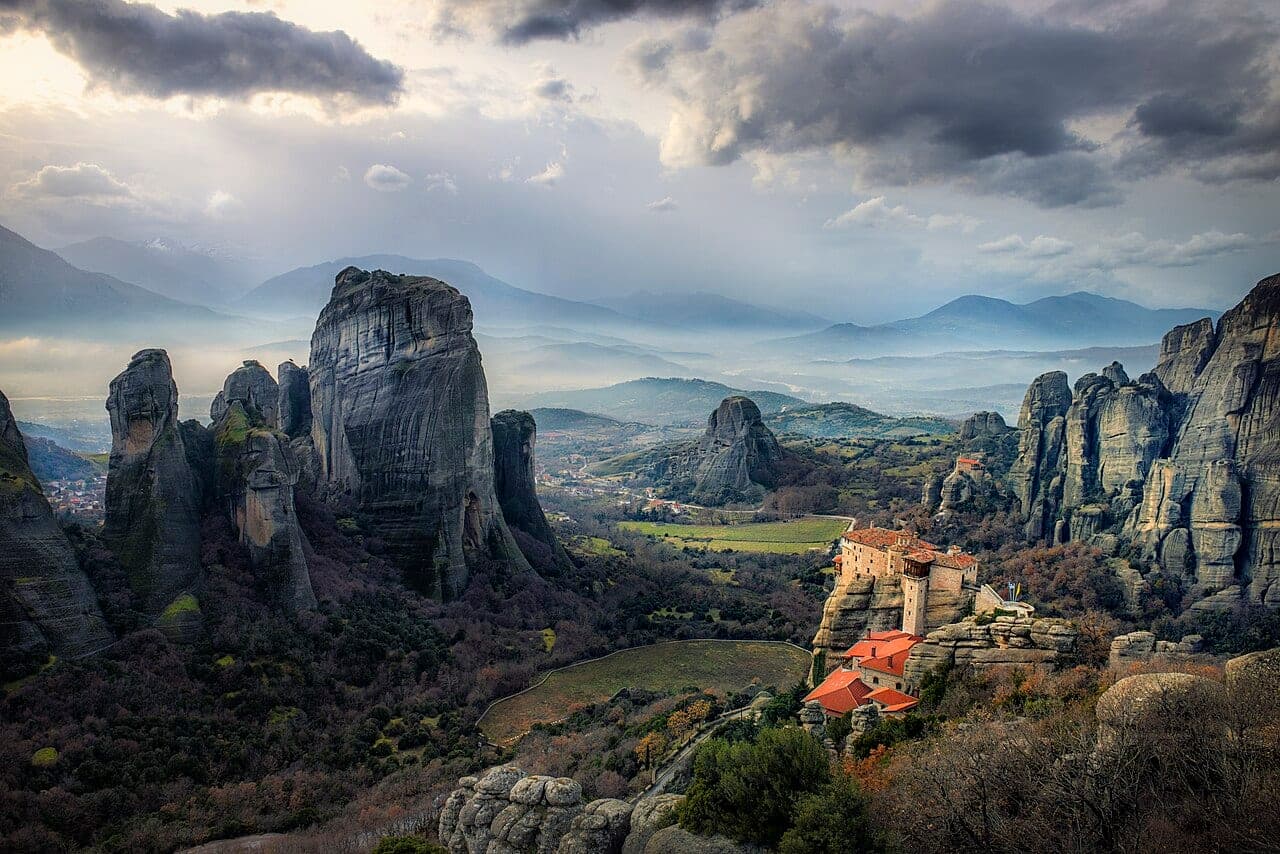
On the western edge of the Thessalian plain, near the town of Kalambaka, a forest of grey rock towers lifts straight out of the ground. The tallest reach more than three hundred metres, their sides sheer and rounded, their summits flat enough to hold a building. On several of them sit monasteries: walls, red-tiled roofs, and slender towers that from below appear to belong to the sky rather than the earth. The Greek word that names the place, meteora, carries the sense of things lifted up, suspended, hovering in the air (Britannica).
Meteora is one of the few sites recognised by UNESCO for both its cultural and its natural worth, inscribed on the World Heritage List in 1988 as a mixed property (UNESCO). What draws the eye is the strangeness of the setting; what holds the attention is the human answer to it. For roughly six centuries, Eastern Orthodox monks have kept prayer, study, and craft on these summits, reached for most of that time only by rope ladder, removable stair, and the swing of a net. Of the two dozen or more communities once founded here, six remain active. This is an account of how they came to be, what they hold, and why the place still asks to be remembered.
The rock of Meteora began as sediment. Over millions of years, rivers carried sand, pebbles, and mud into a body of water that once covered the region, laying down thick beds of sandstone and conglomerate. Earth movements in the Paleogene, roughly sixty million years ago, lifted that floor into a plateau, and the long work of water, wind, and frost cut the mass along its vertical faults until the pillars stood free (Wikipedia: Meteora). The result is a landscape without close parallel: dark, smooth columns, some joined at the base, others isolated, riddled with caves and fissures.
Those caves came first into human use. Ascetics are recorded in the hollows of the rocks well before any monastery was built, living alone or in small groups and gathering for worship at a shared church below. By the fourteenth century, the pressures of the age, including raids across Thessaly, pushed the hermits to seek higher and safer ground on the summits themselves (Wikipedia: Meteora). The decisive figure was a monk named Athanasios, who had come from the monastic republic of Mount Athos. He settled on the broad rock he called the Meteoron and, around the middle of the fourteenth century, gathered the first organised community there, the house that became the Great Meteoron, or Monastery of the Transfiguration (Britannica). Athanasios gave the place both its rule and, in effect, its name. A later companion, a man who had been a ruler in the Serbian and Byzantine world before taking monastic vows as Ioasaph, helped enlarge the foundation, so that a king's final years were spent as a brother among monks.
Building on a summit that could only be reached by climbing was a slow and dangerous labour. Every beam, stone, barrel of water, and sack of lime had to be brought up the cliff. The monks used ladders lashed from wood and rope, footholds and stakes driven into the fissures, and, above all, nets: a large net or basket was fixed to a rope and raised by a hand-turned windlass at the top, carrying supplies and, when needed, people (Wikipedia: Meteora). A visitor sat folded in the netting while the brothers above worked the wheel and the rock face passed slowly by.
 Until steps were cut into the rock in the 1920s, everything and everyone reached these buildings by rope, net and windlass. Photograph by Stathis Floros, CC BY-SA 4.0, via Wikimedia Commons.
The arrangement was also a defence. A rope ladder could be drawn up and a net left idle, leaving a monastery sealed against anyone below. For centuries this was simply how one arrived; there was no stair. Travellers' accounts describe the unease of the ascent and the trust it demanded, a trust placed at once in old rope and in providence. Access by carved steps did not come until the modern era. At the Monastery of the Holy Trinity, for instance, stone steps were cut into the rock in the 1920s, and comparable stairs and bridges opened the other houses over the same period (Wikipedia: Holy Trinity, Meteora). Until then, the net and the windlass were the ordinary road to the door.
At the heart of each monastery is its katholikon, the main church, built to the cross-in-square plan of Byzantine tradition and often crowned with a dome. Around it stand the refectory, the cells, storerooms, a kitchen, and, on several rocks, an ossuary where the bones of former brothers are kept and remembered. Within the churches, the walls are covered in fresco, and it is here that Meteora holds a place in the history of art.
In 1527, the painter Theophanes the Cretan worked in the small Monastery of St. Nicholas Anapausas, and his frescoes there became a reference point for the style now called post-Byzantine, drawing on the Palaiologan inheritance while shaping the Cretan school that would spread across the Orthodox world (Visit Greece). Two decades later, the painter Frangos Katelanos decorated the katholikon of Varlaam, dedicated to All Saints, in a related and confident hand (Wikipedia: Frangos Katelanos). The sixteenth-century frescoes of Meteora, taken together, mark an important stage in the development of Orthodox religious painting (UNESCO). The monasteries also kept, and in part still keep, icons, illuminated manuscripts, embroidered vestments, and liturgical objects gathered over generations, the working furniture of a life of worship rather than a collection assembled for display.
At their height in the sixteenth century, the rocks of Meteora carried a great many monastic houses; sources commonly count around twenty-four communities of varying size (UNESCO). The scale reflected both the appeal of the place and the gifts it attracted. Decline set in from the seventeenth century onward, under the strains of Ottoman rule, poverty, and a falling number of vocations, and the smaller houses were abandoned one by one. Today their remains can still be read on the summits: a fragment of wall, a cistern, a doorway opening onto nothing (Wikipedia: Meteora).
Six monasteries remain active. The Great Meteoron, or Transfiguration, is the oldest and largest. Varlaam, on its neighbouring rock, is the second in size. St. Nicholas Anapausas holds the frescoes of Theophanes; the Holy Trinity, or Agia Triada, sits on one of the most vertiginous pillars; and two houses are now women's communities, Rousanou, dedicated to St. Barbara, and St. Stephen (UNESCO). Four are inhabited by monks and two by nuns, each with a small number of resident religious. The daily round of prayer continues in all six.
The steps and bridges cut in the twentieth century changed Meteora. They made the monasteries reachable on foot and, in time, by road, and the place became one of the most visited in Greece. Coaches climb the winding route between the rocks, and the churches that once admitted a rare pilgrim in a net now receive many thousands of visitors a year. The monasteries meet this with set opening hours, entrance fees that support their upkeep, and a dress code of covered shoulders and knees, with long skirts offered to those who need them, in keeping with the sanctity of the churches.
Conservation is constant. The frescoes are vulnerable to damp, smoke, and time; the buildings are exposed on their summits to wind, rain, and the slow movement of the rock itself. Meteora's inscription as a World Heritage site brings both scrutiny and support for this work, and the property is managed with attention to the balance between access and preservation (UNESCO). Through all of it, the essential fact is that these are not museums. Monks and nuns live here, keep the offices, tend the churches, and receive guests. The visitor walks, for an hour, through a working house of prayer.
Meteora has always been, among other things, a keeper of memory. The ossuaries on the rocks hold the names and remains of brothers who lived and died on the summits, set where the living may pray for them; the frescoes carry the faces of saints and the stories of a faith across the centuries; the manuscripts and icons pass from one generation of the community to the next. To build so high was itself an act of remembrance, a way of holding a fixed point above a plain that had seen invasion, empire, and change.
For those who come from outside that tradition, the appeal is quieter but related. The rocks make plain how much care it takes to preserve anything at height: how each beam was raised, each fresco kept, each name written down and repeated. A monastery of Meteora is a long answer to the question of what a community chooses to carry forward and how it guards it. That is a question anyone can recognise. The monasteries in the air endure not because the rock is kind, but because, for six hundred years, people have decided again and again that what they held there was worth the climb (UNESCO).
Until steps were cut into the rock in the 1920s, everything and everyone reached these buildings by rope, net and windlass. Photograph by Stathis Floros, CC BY-SA 4.0, via Wikimedia Commons.
The arrangement was also a defence. A rope ladder could be drawn up and a net left idle, leaving a monastery sealed against anyone below. For centuries this was simply how one arrived; there was no stair. Travellers' accounts describe the unease of the ascent and the trust it demanded, a trust placed at once in old rope and in providence. Access by carved steps did not come until the modern era. At the Monastery of the Holy Trinity, for instance, stone steps were cut into the rock in the 1920s, and comparable stairs and bridges opened the other houses over the same period (Wikipedia: Holy Trinity, Meteora). Until then, the net and the windlass were the ordinary road to the door.
At the heart of each monastery is its katholikon, the main church, built to the cross-in-square plan of Byzantine tradition and often crowned with a dome. Around it stand the refectory, the cells, storerooms, a kitchen, and, on several rocks, an ossuary where the bones of former brothers are kept and remembered. Within the churches, the walls are covered in fresco, and it is here that Meteora holds a place in the history of art.
In 1527, the painter Theophanes the Cretan worked in the small Monastery of St. Nicholas Anapausas, and his frescoes there became a reference point for the style now called post-Byzantine, drawing on the Palaiologan inheritance while shaping the Cretan school that would spread across the Orthodox world (Visit Greece). Two decades later, the painter Frangos Katelanos decorated the katholikon of Varlaam, dedicated to All Saints, in a related and confident hand (Wikipedia: Frangos Katelanos). The sixteenth-century frescoes of Meteora, taken together, mark an important stage in the development of Orthodox religious painting (UNESCO). The monasteries also kept, and in part still keep, icons, illuminated manuscripts, embroidered vestments, and liturgical objects gathered over generations, the working furniture of a life of worship rather than a collection assembled for display.
At their height in the sixteenth century, the rocks of Meteora carried a great many monastic houses; sources commonly count around twenty-four communities of varying size (UNESCO). The scale reflected both the appeal of the place and the gifts it attracted. Decline set in from the seventeenth century onward, under the strains of Ottoman rule, poverty, and a falling number of vocations, and the smaller houses were abandoned one by one. Today their remains can still be read on the summits: a fragment of wall, a cistern, a doorway opening onto nothing (Wikipedia: Meteora).
Six monasteries remain active. The Great Meteoron, or Transfiguration, is the oldest and largest. Varlaam, on its neighbouring rock, is the second in size. St. Nicholas Anapausas holds the frescoes of Theophanes; the Holy Trinity, or Agia Triada, sits on one of the most vertiginous pillars; and two houses are now women's communities, Rousanou, dedicated to St. Barbara, and St. Stephen (UNESCO). Four are inhabited by monks and two by nuns, each with a small number of resident religious. The daily round of prayer continues in all six.
The steps and bridges cut in the twentieth century changed Meteora. They made the monasteries reachable on foot and, in time, by road, and the place became one of the most visited in Greece. Coaches climb the winding route between the rocks, and the churches that once admitted a rare pilgrim in a net now receive many thousands of visitors a year. The monasteries meet this with set opening hours, entrance fees that support their upkeep, and a dress code of covered shoulders and knees, with long skirts offered to those who need them, in keeping with the sanctity of the churches.
Conservation is constant. The frescoes are vulnerable to damp, smoke, and time; the buildings are exposed on their summits to wind, rain, and the slow movement of the rock itself. Meteora's inscription as a World Heritage site brings both scrutiny and support for this work, and the property is managed with attention to the balance between access and preservation (UNESCO). Through all of it, the essential fact is that these are not museums. Monks and nuns live here, keep the offices, tend the churches, and receive guests. The visitor walks, for an hour, through a working house of prayer.
Meteora has always been, among other things, a keeper of memory. The ossuaries on the rocks hold the names and remains of brothers who lived and died on the summits, set where the living may pray for them; the frescoes carry the faces of saints and the stories of a faith across the centuries; the manuscripts and icons pass from one generation of the community to the next. To build so high was itself an act of remembrance, a way of holding a fixed point above a plain that had seen invasion, empire, and change.
For those who come from outside that tradition, the appeal is quieter but related. The rocks make plain how much care it takes to preserve anything at height: how each beam was raised, each fresco kept, each name written down and repeated. A monastery of Meteora is a long answer to the question of what a community chooses to carry forward and how it guards it. That is a question anyone can recognise. The monasteries in the air endure not because the rock is kind, but because, for six hundred years, people have decided again and again that what they held there was worth the climb (UNESCO).
Pillars raised from an old sea, and the first to climb them
Built on the rock, hauled up by net