Heritage · Landmark
Kinkaku-ji: Kyoto's Golden Pavilion
Kinkaku-ji is the gold-leafed Zen pavilion in Kyoto that a shogun raised as his retirement villa and left to become a temple. Burned down by a novice monk in 1950 and faithfully rebuilt in 1955, its gold reflection on the Mirror Pond is among the most recognised images of Japan.Written to last.
By Confinity Heritage Editorial · Updated 2026-07-31 · 7-minute readQuiet tools, kept out of the way.
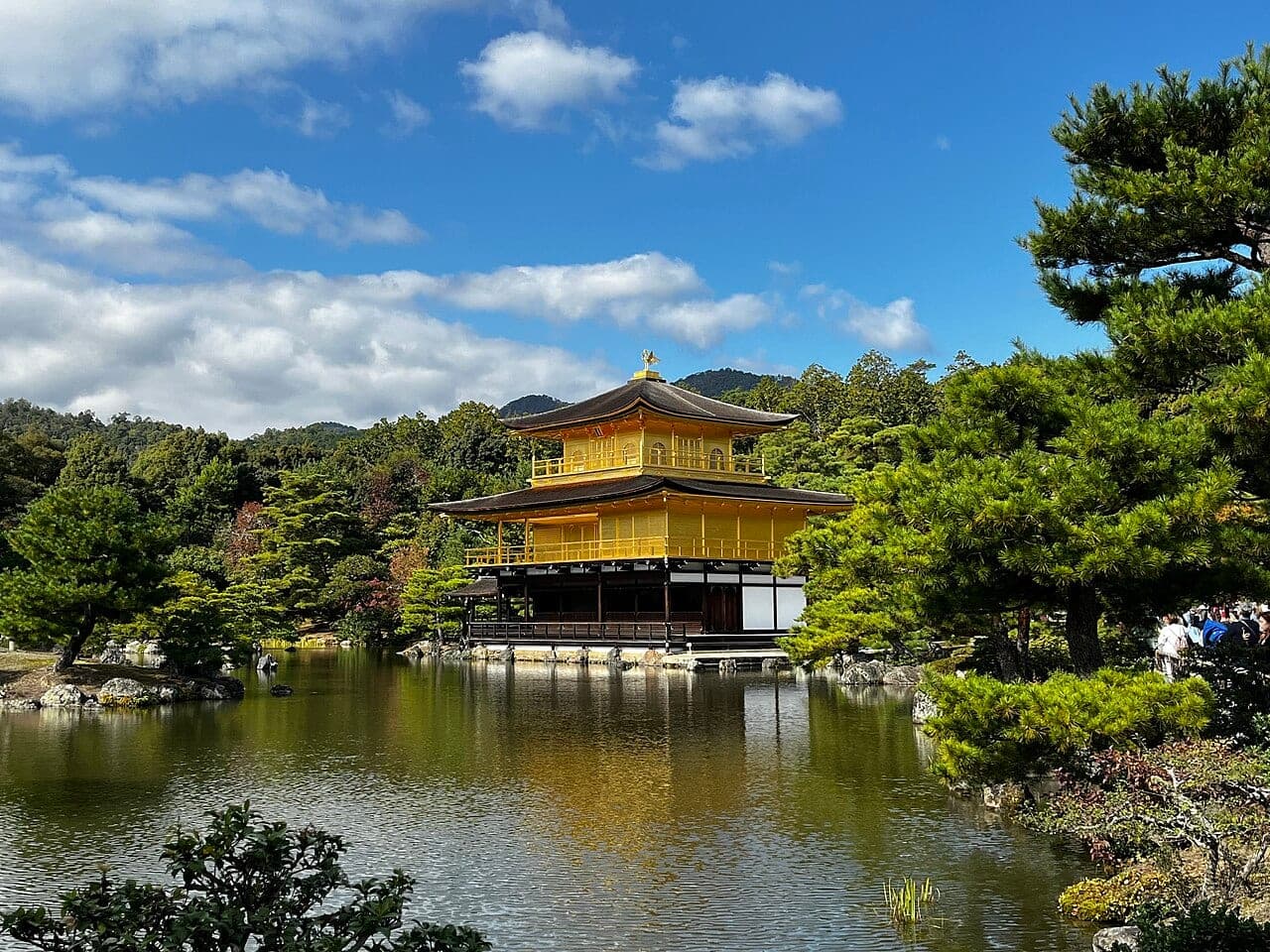
On the northern edge of Kyoto, a three-storey pavilion sheathed in gold leaf sits at the edge of a still pond, its reflection doubling the building on the water. This is Kinkaku-ji, the Golden Pavilion, though its formal name is Rokuon-ji, a temple of the Rinzai school of Zen Buddhism. It is one of the buildings that make up the Historic Monuments of Ancient Kyoto, inscribed on the UNESCO World Heritage List in 1994, and among the most photographed sights in Japan (UNESCO).
The pavilion carries an unusual weight of memory for a building so admired, because the structure a visitor sees today is not the one that stood here for most of its history. The original burned to the ground in 1950, set alight by a young monk who lived at the temple, and what stands now is a careful reconstruction completed in 1955 (Wikipedia). Its survival is therefore a story about how a culture chooses to keep what it values, rebuilding a lost thing from records, memory and craft rather than letting the loss be final.
The site began as private ground long before the temple existed. In the thirteenth century it held a villa belonging to the powerful Saionji family, set beside a pond long admired for its beauty (Rokuon-ji). In 1397 the retired shogun Ashikaga Yoshimitsu acquired the land and built there a lavish retreat known as Kitayama-dono, the Northern Mountain villa, at the height of the Muromachi shogunate's power (World History Encyclopedia). Yoshimitsu had stepped back from formal office but still governed in practice, and the estate became a centre of the refined court and Zen culture of the age. The gilded pavilion, then called the Shariden or relic hall, was its centrepiece.
Yoshimitsu died in 1408. In accordance with his wishes, the villa was converted into a Rinzai Zen temple, and it took the name Rokuon-ji from Rokuon-in, the shogun's posthumous Buddhist title (World History Encyclopedia). The eminent Zen master Muso Soseki was honoured as its founding abbot. For the following centuries Rokuon-ji belonged to the Shokoku-ji branch of Rinzai Zen, to which it still answers today. The temple passed through the upheavals that repeatedly scarred Kyoto, including the Onin War of the late fifteenth century that destroyed much of the city, yet the golden pavilion itself came through the medieval period intact, one of the few original buildings of the Kitayama estate to survive into the modern age (Wikipedia).
The pavilion's distinction lies in the way it combines three different architectural manners in a single small building, one for each floor. The ground floor, called the Chamber of Dharma Waters, is built in the shinden-zukuri style of Heian-period aristocratic residences, with natural wood pillars and white plaster walls left ungilded (Britannica). The second floor, the Tower of Sound Waves, follows the buke or samurai-house style and holds a seated image of the bodhisattva Kannon. The third and smallest floor is built as a Chinese Chan (Zen) hall, in the manner known as karayo, and is gilded inside and out (Wikipedia).
 Each of the three storeys is built in a different style, and only the upper two are gilded. Photograph by Kendall Henderson, CC0, via Wikimedia Commons.
It is the top two floors that give the building its name, both covered in pure gold leaf laid over lacquer. A golden phoenix, the mythical hoo, perches with wings folded on the shingled roof. In Buddhist thought the gold was not mere display; it was associated with purity and with the Pure Land, and the reflected brilliance was meant to suggest a paradise made visible (World History Encyclopedia).
The pavilion cannot be separated from the water and garden around it. It sits at the edge of Kyoko-chi, the Mirror Pond, whose surface was designed to hold the building's reflection, and which is dotted with small islands and carefully placed rocks given by feudal lords of Yoshimitsu's day (Wikipedia). The wider grounds form a stroll garden, a landscape meant to be walked through and revealed in sequence rather than viewed from one fixed point, and they preserve much of their original Muromachi design. The garden is recognised in Japan as a Special Place of Scenic Beauty, a mark of national protection (Rokuon-ji).
In the early hours of 2 July 1950 the pavilion was destroyed by fire. It had been set deliberately by Hayashi Yoken, a twenty-two-year-old novice monk who lived and trained at the temple; he attempted to take his own life on the hillside behind the grounds afterward and survived (Wikipedia). He was arrested, tried and sentenced to prison, and died a few years later after his release on grounds of illness. The building of 1397, together with several statues and a wooden image of Yoshimitsu that it housed, was lost.
The response was to rebuild the pavilion as faithfully as the record allowed. Working from surviving drawings, measurements and photographs, master carpenters, lacquer artisans and gold-leaf specialists reconstructed the Shariden between 1952 and 1955, and the restored pavilion was dedicated at a ceremony in October 1955 (Wikipedia). Later work went further than the original had. During the major restoration of 1986–87 the gold leaf was renewed with a thicker application, using roughly twenty kilograms of gold, so that the finish is now more brilliant than the building had been within living memory (Wikipedia). The reconstruction follows the lost building closely enough that most visitors experience it as the historic pavilion, while the temple is candid that the fabric itself is modern.
Kinkaku-ji holds a particular place in Japanese aesthetics. Together with the later Ginkaku-ji, the Silver Pavilion raised by Yoshimitsu's grandson, it represents the Kitayama and Higashiyama cultures of the Muromachi period, when Zen taste, the tea ceremony, ink painting and garden design took forms that still shape ideas of Japanese beauty. The pavilion's balance of restraint and splendour, a plain lower storey beneath gilded upper floors, is often read as an expression of that sensibility.
The 1950 fire also entered literature. In 1956 the novelist Yukio Mishima published The Temple of the Golden Pavilion, a work of fiction drawn closely from the case, which follows a troubled young acolyte consumed by the building's beauty until he destroys it (Wikipedia). Translated into English and many other languages, the novel is among the best known works of modern Japanese fiction and has carried the pavilion's name far beyond Japan. For the city of Kyoto, which escaped the wartime bombing that levelled other Japanese cities, Kinkaku-ji is one of the anchors of a landscape of temples, shrines and gardens that together preserve the old capital's memory, and it draws several million visitors each year.
Rokuon-ji sits in the Kita ward in the north-west of Kyoto, reached most easily by city bus from Kyoto Station or from the Kitaoji subway station. It is open daily, generally from 9 a.m. to 5 p.m., and charges a modest admission; because opening times and fees are adjusted from time to time, the temple's own website is the most reliable source before a visit (Rokuon-ji).
The grounds are laid out as a one-way path that leads visitors first to the classic view of the pavilion across the Mirror Pond, then around the water and up through the garden past smaller features, a tea house and a waterfall, before returning to the exit. The most famous view, of the gold building doubled in still water, is best in the calm of early morning or under snow, and the site is at its busiest in the cherry blossom and autumn colour seasons. The pavilion interior is not open to the public; it is admired from the garden paths.
Each of the three storeys is built in a different style, and only the upper two are gilded. Photograph by Kendall Henderson, CC0, via Wikimedia Commons.
It is the top two floors that give the building its name, both covered in pure gold leaf laid over lacquer. A golden phoenix, the mythical hoo, perches with wings folded on the shingled roof. In Buddhist thought the gold was not mere display; it was associated with purity and with the Pure Land, and the reflected brilliance was meant to suggest a paradise made visible (World History Encyclopedia).
The pavilion cannot be separated from the water and garden around it. It sits at the edge of Kyoko-chi, the Mirror Pond, whose surface was designed to hold the building's reflection, and which is dotted with small islands and carefully placed rocks given by feudal lords of Yoshimitsu's day (Wikipedia). The wider grounds form a stroll garden, a landscape meant to be walked through and revealed in sequence rather than viewed from one fixed point, and they preserve much of their original Muromachi design. The garden is recognised in Japan as a Special Place of Scenic Beauty, a mark of national protection (Rokuon-ji).
In the early hours of 2 July 1950 the pavilion was destroyed by fire. It had been set deliberately by Hayashi Yoken, a twenty-two-year-old novice monk who lived and trained at the temple; he attempted to take his own life on the hillside behind the grounds afterward and survived (Wikipedia). He was arrested, tried and sentenced to prison, and died a few years later after his release on grounds of illness. The building of 1397, together with several statues and a wooden image of Yoshimitsu that it housed, was lost.
The response was to rebuild the pavilion as faithfully as the record allowed. Working from surviving drawings, measurements and photographs, master carpenters, lacquer artisans and gold-leaf specialists reconstructed the Shariden between 1952 and 1955, and the restored pavilion was dedicated at a ceremony in October 1955 (Wikipedia). Later work went further than the original had. During the major restoration of 1986–87 the gold leaf was renewed with a thicker application, using roughly twenty kilograms of gold, so that the finish is now more brilliant than the building had been within living memory (Wikipedia). The reconstruction follows the lost building closely enough that most visitors experience it as the historic pavilion, while the temple is candid that the fabric itself is modern.
Kinkaku-ji holds a particular place in Japanese aesthetics. Together with the later Ginkaku-ji, the Silver Pavilion raised by Yoshimitsu's grandson, it represents the Kitayama and Higashiyama cultures of the Muromachi period, when Zen taste, the tea ceremony, ink painting and garden design took forms that still shape ideas of Japanese beauty. The pavilion's balance of restraint and splendour, a plain lower storey beneath gilded upper floors, is often read as an expression of that sensibility.
The 1950 fire also entered literature. In 1956 the novelist Yukio Mishima published The Temple of the Golden Pavilion, a work of fiction drawn closely from the case, which follows a troubled young acolyte consumed by the building's beauty until he destroys it (Wikipedia). Translated into English and many other languages, the novel is among the best known works of modern Japanese fiction and has carried the pavilion's name far beyond Japan. For the city of Kyoto, which escaped the wartime bombing that levelled other Japanese cities, Kinkaku-ji is one of the anchors of a landscape of temples, shrines and gardens that together preserve the old capital's memory, and it draws several million visitors each year.
Rokuon-ji sits in the Kita ward in the north-west of Kyoto, reached most easily by city bus from Kyoto Station or from the Kitaoji subway station. It is open daily, generally from 9 a.m. to 5 p.m., and charges a modest admission; because opening times and fees are adjusted from time to time, the temple's own website is the most reliable source before a visit (Rokuon-ji).
The grounds are laid out as a one-way path that leads visitors first to the classic view of the pavilion across the Mirror Pond, then around the water and up through the garden past smaller features, a tea house and a waterfall, before returning to the exit. The most famous view, of the gold building doubled in still water, is best in the calm of early morning or under snow, and the site is at its busiest in the cherry blossom and autumn colour seasons. The pavilion interior is not open to the public; it is admired from the garden paths.
History
Architecture and garden
The 1950 fire and reconstruction
Cultural significance
Visiting
References and resources
- Rokuon-ji (Kinkaku-ji), official temple site: history, architecture and the temple's own account of the grounds.
- UNESCO World Heritage: Historic Monuments of Ancient Kyoto: the 1994 inscription that includes Rokuon-ji.
- Encyclopaedia Britannica: Kinkaku-ji: concise overview of the pavilion and its three floors.
- Wikipedia: Kinkaku-ji: architecture, gold leaf, garden and reconstruction.
- Wikipedia: Kinkaku-ji arson: the 1950 fire and its place in Mishima's novel.
- World History Encyclopedia: Kinkakuji: Yoshimitsu's villa and the conversion to a Zen temple.