Heritage · Country
French Polynesia Culture and Heritage
Five archipelagos scattered across an expanse of ocean the size of Europe, where navigators once sailed by stars and swell and families still bury their dead in the garden. This guide follows Māʻohi heritage from the marae of Taputapuātea to the memory of thirty years of nuclear testing.Written to last.
By Confinity Heritage Editorial · Updated 2026-08-17 · 8-minute readQuiet tools, kept out of the way.
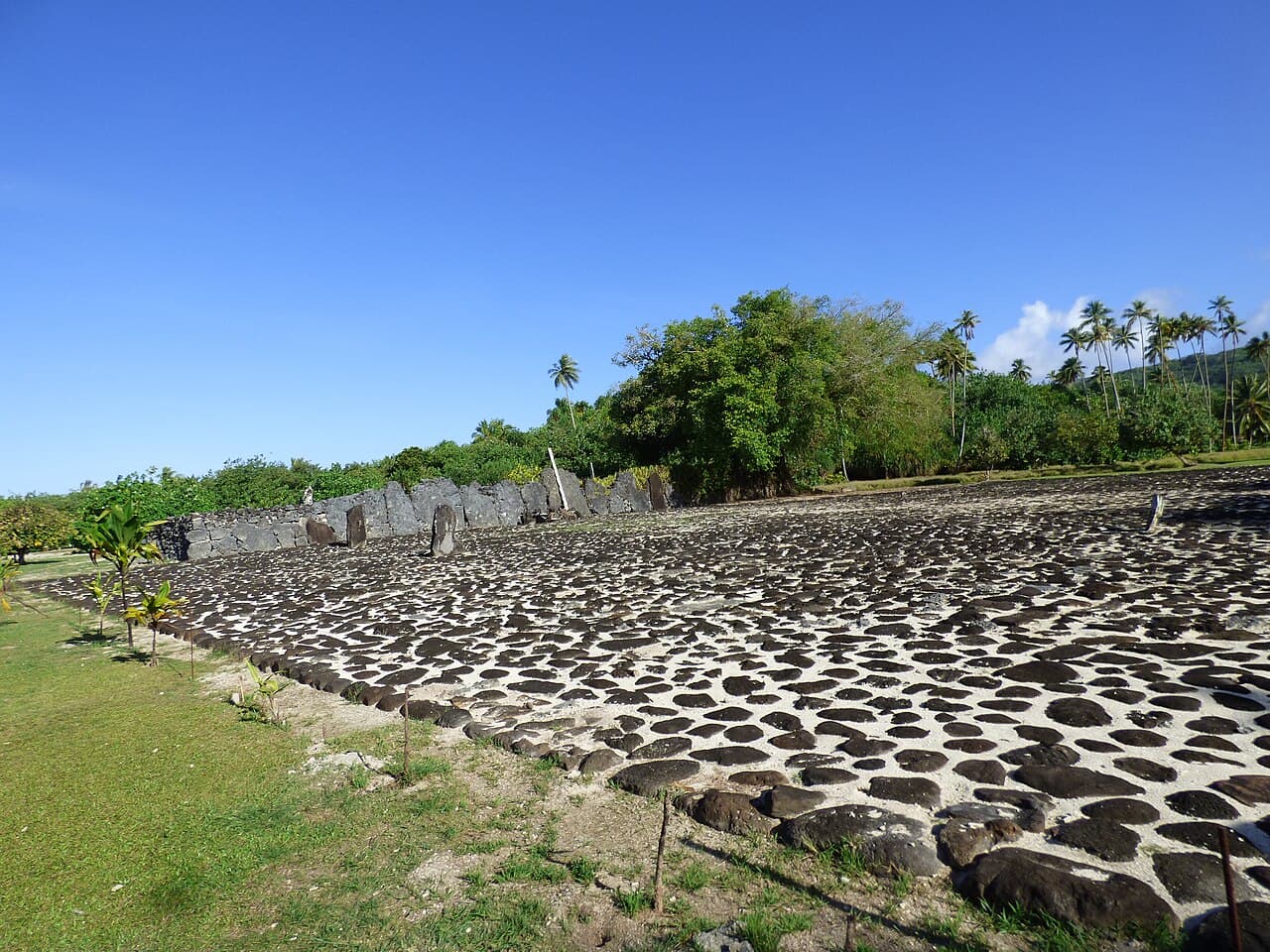
On the island of Raiatea, on a point of land where a pass cuts through the reef, a rectangle of coral rubble is edged with slabs of black basalt set upright like broken teeth. This is Taputapuātea, and for centuries it was the ceremonial centre of eastern Polynesia. Priests and chiefs sailed to it from Hawaii, from Aotearoa, from the Cook Islands and the Tuamotus; when a new marae was founded elsewhere, a stone was carried away from this one to seed it. The pass beside it is called Te Ava Moʻa, the sacred pass, and canoes entered it only from the open sea.
Everything about French Polynesia is shaped by distance. Its 118 islands hold barely 3,500 square kilometres of land, scattered across roughly five million square kilometres of ocean, an area comparable to Europe; and the people who found and settled them did it by reading stars, swells, birds and cloud without instruments. What followed the arrival of European ships in the 1760s was a compressed and often brutal transformation: epidemic disease, missionary rule, the collapse of the Pōmare kingdom into a French protectorate, the near-loss of the Tahitian language in schools, and then, from 1966 to 1996, thirty years of nuclear weapons testing at two atolls in the Tuamotus.
French Polynesia is an overseas collectivity of France made up of five archipelagos: the Society Islands, split into the Windward group around Tahiti and Moorea and the Leeward group around Raiatea, Huahine and Bora Bora; the low coral atolls of the Tuamotus, the largest atoll chain on earth; the Gambier Islands in the far southeast; the Austral Islands to the south; and the high, cliff-walled Marquesas to the northeast. About 280,000 people live there, roughly three quarters of them on Tahiti alone, and the population is overwhelmingly Polynesian with French, Chinese and mixed communities among it. The territory has its own assembly, president and government, with France retaining defence, justice, currency and foreign affairs, and it holds two World Heritage inscriptions: the marae complex of Taputapuātea on Raiatea, listed in 2017, and the Marquesas Islands, listed as Te Henua Enata in 2024 (UNESCO). Pearl farming, tourism and transfers from France carry the economy.
Papeete. The capital and only real city grew around a harbour on Tahiti's northwest coast that missionaries and traders found convenient in the 1820s. It holds the assembly, the cathedral, the market where flowers, fish and monoi are sold on two floors, and the waterfront where the roulottes set up their kitchens at dusk. Te Fare Tauhiti Nui, the cultural centre, hosts the Heiva competitions each July, and the neighbouring commune of Punaauia holds the Museum of Tahiti and Her Islands, reopened in 2023 after a long rebuilding.
Uturoa and Taputapuātea. Uturoa on Raiatea is the second town of the Leeward Islands and the port for the island that Polynesian tradition calls Havaiʻi, the ancestral homeland. The commune of Taputapuātea to its southeast takes its name from the marae, and the community there has been closely involved in the site's management since the World Heritage listing.
Taiohaʻe. The administrative centre of the Marquesas sits in a deep bay on Nuku Hiva under near-vertical ridges. The Marquesan revival of the past forty years, in carving, tattooing, language and the Matavaʻa festival held every four years, has been organised largely from here and from Atuona on Hiva Oa, where Paul Gauguin and Jacques Brel are buried in the hillside cemetery.
Rikitea. The single village of the Gambier Islands is dominated by St Michael's Cathedral, built of coral lime in the 1840s under the missionary Honoré Laval and inlaid with mother-of-pearl, a monument to a conversion so total, and so costly in lives, that it is still argued about.
Polynesians reached these islands late in the settlement of the Pacific. Radiocarbon work published in 2011 places the arrival of voyagers in the Society Islands at roughly 1025 to 1120 AD, with the more remote archipelagos, including the Marquesas and eventually Hawaii, Rapa Nui and New Zealand, settled in a rapid expansion over the following two centuries (PNAS). The voyaging was deliberate and provisioned, in double-hulled canoes carrying plants, pigs and people, and it was navigated by a body of knowledge that held star paths, ocean swells, bird behaviour and cloud formations in memory. Ashore, society organised itself around chiefly lines and the marae, open-air stone precincts where rank, genealogy and the gods were made visible. Taputapuātea served the international end of that system, and was linked to the god ʻOro and to the ariʻoi, a society of travelling performers and priests.
European ships arrived within three years of each other: Samuel Wallis in 1767, Louis Antoine de Bougainville in 1768, and James Cook in 1769 to observe the transit of Venus from the point on Matavai Bay that still carries the name. Bougainville's account of an island of ease and beauty, published in Paris, fixed Tahiti in the European imagination as an earthly paradise, an image that flattered nobody who actually lived there and that has proved almost impossible to dislodge. Cook sailed on with Tupaia, a Raiatean priest and navigator whose chart of some seventy islands, drawn from memory, is one of the great documents of Pacific knowledge (Wikipedia). Introduced diseases then killed a large part of the population within two generations.
Missionaries of the London Missionary Society landed at Matavai Bay in March 1797. Their first fifteen years produced almost nothing, but the chief Pōmare II, who used European muskets and alliances to make himself paramount, converted, won the decisive battle of Feiʻi Pi in 1815, and was baptised in 1819. The Pōmare Code that followed banned dancing, tattooing and the old religion together. The kingdom passed to Pōmare IV, who reigned for fifty years and resisted French pressure until an admiral's ultimatum imposed a protectorate in 1842; a war of resistance ran until 1847, and in 1880 her son Pōmare V ceded the islands outright, making them a French colony (Wikipedia). The Leeward Islands, never party to that cession, were conquered separately by 1897.
The decision that shapes contemporary memory came in the 1960s. After Algerian independence closed the Sahara test sites, France established the Pacific Experimentation Centre and, between July 1966 and January 1996, carried out 193 nuclear tests at the atolls of Moruroa and Fangataufa, 41 of them atmospheric before testing moved underground in 1974 (Wikipedia). The programme reorganised the whole territory, drawing thousands of Polynesians from the outer islands into wage work at the sites and around Papeete. It ended after a final, internationally condemned series in 1995 and 1996, and it left a long argument over what it did to the people underneath the fallout.
French is the official language, but Reo Tahiti, Tahitian, is spoken by a large share of the population and is one of a family of related Polynesian languages that includes Marquesan, Paʻumotu of the Tuamotus, Mangarevan and the Austral languages (Wikipedia). Its sound system is famously spare, with a handful of consonants, the glottal stop written as an ʻeta, and vowel length that changes meaning. Missionaries gave it an alphabet in the 1800s and translated the Bible into it, which preserved the language and reshaped it at once.
Then the schools turned against it. Under French education policy Tahitian was excluded from the classroom, and children caught speaking it were punished, in some schools by being made to carry an object passed to the next offender, a method used across the French empire. The reversal came slowly: Tahitian was recognised for teaching from 1980, the Académie Tahitienne, Fare Vānaʻa, was set up in 1972 to fix orthography and vocabulary, and ʻōrero, the formal art of oratory, was reintroduced into primary schools in the 2000s (Wikipedia). The statute of 2004 nonetheless keeps French as the official language, and court rulings have restricted the use of Tahitian in the assembly, so the position of the language remains contested.
Two words from this region travelled further than most. Tatau, the Polynesian word for the marking of skin, entered English as tattoo through eighteenth-century sailors. Tapu, restriction under sacred sanction, became taboo. Māʻohi, the term Polynesians here use for themselves, gives the name Māʻohi Nui, increasingly used in place of the administrative one.
Dance is the most visible inheritance and the one that came closest to being lost. ʻOri Tahiti was banned outright under the Pōmare Code and only partially tolerated afterwards; the modern revival is usually dated to 1956, when Madeleine Moua, a schoolteacher, founded the troupe Pupu Heiva and put researched, disciplined choreography back on a public stage (Wikipedia). The Heiva i Tahiti, whose July competitions descend from festivities first held in 1881, is now the largest cultural event in the Pacific, judged on choreography, costume made from plant fibre, orchestral drumming and the sung himene (Heiva).
Tattooing followed the same arc. The practice was central to Marquesan and Society Islands society, marking rank, lineage and passage, and it was suppressed by missionaries in Tahiti from 1819 and banned in the Marquesas under French administration. It survived in fragments and in museum drawings, and from the early 1980s Marquesan and Samoan practitioners rebuilt it, working from the old motifs; today it is one of the strongest markers of Māʻohi identity and a global export. Alongside these run the ahimāʻa, the earth oven of hot stones in which pork, breadfruit and fish are cooked under leaves for Sunday meals; tīfaifai, the large appliqué and patchwork covers made by women, given at births and weddings and laid over coffins; and the woven pandanus, monoi oil and pearl work of the outer islands.
The old religion was hierarchical and territorial. Gods including Taʻaroa the creator, Tāne and ʻOro were served on marae by a trained priesthood, and mana, spiritual power carried in genealogy, ran through chiefs and sacred objects. The system was policed by tapu, and it collapsed quickly once Pōmare II converted, with the marae abandoned or dismantled and their stones sometimes reused in churches.
 Raiatea holds Taputapuatea, the marae from which navigators set out and to which they returned, and which Polynesians from across the ocean still recognise as a common origin point. Photograph by Michel-Georges Bernard, CC BY-SA 3.0, via Wikimedia Commons.
French Polynesia today is strongly Christian and unusually Protestant for a French territory, a direct result of the London Missionary Society getting there first. The Māʻohi Protestant Church is the largest denomination, with a Catholic minority concentrated in the Marquesas, Gambiers and Tuamotus, where French missions worked, and smaller Mormon and Adventist communities. Sunday himene singing, in dense harmonies that no European tradition quite explains, is one of the durable pleasures of village life. The marae are treated now with a care that sits somewhere between religious and civic: ceremonies have returned to Taputapuātea, and the sites are approached with protocol even by people who attend church every week.
The most striking Polynesian mourning practice is visible from any road on Tahiti or Moorea. Families bury their dead beside the house, in the garden, in whitewashed or tiled tombs that stand a few metres from the kitchen door. The custom grew out of an older attachment to burial on ancestral land, was tolerated by the administration, and survives because it says something people here believe: that the dead remain part of the household and should be within reach. Tombs are cleaned, repainted and covered with flowers, and on All Saints' Day in November families gather in the evening for the Toussaint, lighting candles at the graves and singing himene until late, so that whole hillsides and gardens flicker at once.
The funeral itself is a community obligation. Kin arrive with food, mats and tīfaifai, the quilt that a woman may have made years earlier being laid over the coffin, and the wake runs through the night with hymns. In the Marquesas and the Tuamotus the older practice of returning to the ancestral valley for burial is still followed where families can manage it.
Set against these domestic rites is a national grief that has no grave. The 193 nuclear tests exposed workers and communities across the territory, and for decades France maintained that the programme was clean. The Morin Law of 2010 opened a compensation route, though its early application rejected the overwhelming majority of claims, and later amendments have moved the threshold back and forth. In March 2021 the Moruroa Files, an investigation by the French newsroom Disclose with the research group Interprt and Princeton's Science and Global Security programme, reconstructed the fallout from declassified documents and modelling and concluded that around 110,000 people, close to the entire population of the time, may have received doses that would qualify them for compensation (Disclose). The association Moruroa e tatou, founded by former test-site workers in 2001, and the annual commemoration on 2 July, the date of the first test, keep the count of the dead in public view; and the claims files, the medical records and the testimony gathered from ageing workers now function as a form of archive in themselves (Science).
Records here are French in form and Polynesian in what they are actually about.
Civil registration on the French model was introduced during the nineteenth century as the Établissements français de l'Océanie took shape, and the état civil is continuous from that point, held in Papeete with duplicates in France. Protestant mission registers, from the London Missionary Society's arrival in 1797, and Catholic ones from the 1830s, carry the earlier vital events, and they are the record of an extraordinary demographic collapse: introduced disease reduced the population of the Society Islands by something like nine tenths in the century after contact.
The Tahitian record before that is genealogical and it is chanted. The 'ārii lines were recited to establish rank, and the marae, the stone ceremonial platforms, were tied to specific descent groups; knowing which marae a family belongs to is knowing its line. The Tuamotu and Marquesas islands kept their own traditions, and Marquesan genealogies were recorded by ethnographers in the early twentieth century when the population had fallen to a few thousand.
Land is where genealogy and paperwork meet, painfully. French Polynesian land is frequently held in undivided indivision by hundreds of co-heirs descended from a nineteenth-century registrant, and settling a title means assembling a complete descent chart from the état civil. Whole practices exist to do it.
The nuclear tests between 1966 and 1996 produced their own files, and the compensation claims that followed depend on proving where a family was living and when.
Taputapuātea was inscribed on the World Heritage List in 2017 as a cultural landscape, the first such listing in French Polynesia, recognising the marae complex, the Te Ava Moʻa pass, the forested valley behind it and the site's role as the ceremonial centre of the Polynesian Triangle (UNESCO). The nomination was driven locally and the management arrangements give the Taputapuātea community a central role, which matters at a site where the distinction between monument and living place is not one anyone wants drawn. In July 2024 the Marquesas were inscribed as Te Henua Enata, a mixed cultural and natural property covering valleys, archaeological sites and marine areas across several islands, after a campaign the Marquesan communities pursued for nearly two decades (UNESCO).
The Museum of Tahiti and Her Islands at Punaauia, Te Fare Manaha, holds the principal collections of Māʻohi material culture and reopened in 2023 after a full rebuild of its permanent galleries (Musée de Tahiti et des Îles). Archaeological restoration has cleared and stabilised marae on Raiatea, Huahine and Moorea, and the tiki and paepae platforms of the Marquesas have been progressively documented. Voyaging is its own preservation project: the double-hulled canoe Faʻafaite, launched in 2009 and sailed by the association Faʻafaite i te ao Māʻohi, is navigated without instruments and has carried crews across the Pacific, part of the revival that began when Hōkūleʻa sailed from Hawaii to Tahiti in 1976 and was met at Papeete by a crowd of thousands (Wikipedia).
The Académie Tahitienne publishes its dictionary and orthographic decisions in digital form, which is what allows Tahitian to be written consistently on phones and in schools. Tahiti Heritage, a territorial heritage inventory, maps and photographs marae, tiki, colonial buildings and natural sites island by island and makes the record freely searchable (Tahiti Heritage). The territorial archive service holds and progressively digitises administrative records, photographs and audiovisual material, including recordings of Heiva performances that are now the main evidence of how choreography and drumming changed across half a century. The most consequential digital heritage project, though, is the nuclear archive: the declassified defence documents released after 2013, and the reconstructions built on them by Disclose and its partners, are published online with maps and dose models, which has moved a decades-old dispute out of ministerial files and into public view.
Polynesian music, from the ukulele and the guitar to the pahu and toʻere drums, carries far beyond the territory, and Tahitian dance is taught and competed in Japan, California and Mexico, with foreign troupes now travelling to the Heiva. Tattooing has become one of the most widely borrowed visual languages in the world, which raises steady arguments here about who may wear which motif. Gauguin remains the awkward guest: his paintings shaped how millions imagine these islands, they were made during years in which he took teenage girls as partners and traded on a fantasy he had helped to sell, and Polynesian curators and writers have spent the past two decades reframing him as a subject of history rather than a hero of it (Wikipedia). Politics keeps the nuclear question live, through compensation cases, parliamentary inquiries and a pro-independence movement for which the tests are the central grievance.
The ancestral marae recognised. Taputapuātea's inscription in 2017 gave international standing to the ceremonial centre of eastern Polynesia, and put its management in the hands of the community that lives beside it.
Te Henua Enata listed. The Marquesas were inscribed in 2024 after nearly twenty years of local campaigning, protecting valleys, archaeological sites and marine areas together rather than separately.
Navigation recovered. From Hōkūleʻa's 1976 landfall at Papeete to the voyages of Faʻafaite, instrument-free wayfinding has been rebuilt as a living practice, taught to young crews across the archipelagos.
A punished language back in school. Tahitian, once excluded from the classroom, is taught, standardised by the Académie Tahitienne, and carried into a new generation through the ʻōrero programme in primary schools.
Raiatea holds Taputapuatea, the marae from which navigators set out and to which they returned, and which Polynesians from across the ocean still recognise as a common origin point. Photograph by Michel-Georges Bernard, CC BY-SA 3.0, via Wikimedia Commons.
French Polynesia today is strongly Christian and unusually Protestant for a French territory, a direct result of the London Missionary Society getting there first. The Māʻohi Protestant Church is the largest denomination, with a Catholic minority concentrated in the Marquesas, Gambiers and Tuamotus, where French missions worked, and smaller Mormon and Adventist communities. Sunday himene singing, in dense harmonies that no European tradition quite explains, is one of the durable pleasures of village life. The marae are treated now with a care that sits somewhere between religious and civic: ceremonies have returned to Taputapuātea, and the sites are approached with protocol even by people who attend church every week.
The most striking Polynesian mourning practice is visible from any road on Tahiti or Moorea. Families bury their dead beside the house, in the garden, in whitewashed or tiled tombs that stand a few metres from the kitchen door. The custom grew out of an older attachment to burial on ancestral land, was tolerated by the administration, and survives because it says something people here believe: that the dead remain part of the household and should be within reach. Tombs are cleaned, repainted and covered with flowers, and on All Saints' Day in November families gather in the evening for the Toussaint, lighting candles at the graves and singing himene until late, so that whole hillsides and gardens flicker at once.
The funeral itself is a community obligation. Kin arrive with food, mats and tīfaifai, the quilt that a woman may have made years earlier being laid over the coffin, and the wake runs through the night with hymns. In the Marquesas and the Tuamotus the older practice of returning to the ancestral valley for burial is still followed where families can manage it.
Set against these domestic rites is a national grief that has no grave. The 193 nuclear tests exposed workers and communities across the territory, and for decades France maintained that the programme was clean. The Morin Law of 2010 opened a compensation route, though its early application rejected the overwhelming majority of claims, and later amendments have moved the threshold back and forth. In March 2021 the Moruroa Files, an investigation by the French newsroom Disclose with the research group Interprt and Princeton's Science and Global Security programme, reconstructed the fallout from declassified documents and modelling and concluded that around 110,000 people, close to the entire population of the time, may have received doses that would qualify them for compensation (Disclose). The association Moruroa e tatou, founded by former test-site workers in 2001, and the annual commemoration on 2 July, the date of the first test, keep the count of the dead in public view; and the claims files, the medical records and the testimony gathered from ageing workers now function as a form of archive in themselves (Science).
Records here are French in form and Polynesian in what they are actually about.
Civil registration on the French model was introduced during the nineteenth century as the Établissements français de l'Océanie took shape, and the état civil is continuous from that point, held in Papeete with duplicates in France. Protestant mission registers, from the London Missionary Society's arrival in 1797, and Catholic ones from the 1830s, carry the earlier vital events, and they are the record of an extraordinary demographic collapse: introduced disease reduced the population of the Society Islands by something like nine tenths in the century after contact.
The Tahitian record before that is genealogical and it is chanted. The 'ārii lines were recited to establish rank, and the marae, the stone ceremonial platforms, were tied to specific descent groups; knowing which marae a family belongs to is knowing its line. The Tuamotu and Marquesas islands kept their own traditions, and Marquesan genealogies were recorded by ethnographers in the early twentieth century when the population had fallen to a few thousand.
Land is where genealogy and paperwork meet, painfully. French Polynesian land is frequently held in undivided indivision by hundreds of co-heirs descended from a nineteenth-century registrant, and settling a title means assembling a complete descent chart from the état civil. Whole practices exist to do it.
The nuclear tests between 1966 and 1996 produced their own files, and the compensation claims that followed depend on proving where a family was living and when.
Taputapuātea was inscribed on the World Heritage List in 2017 as a cultural landscape, the first such listing in French Polynesia, recognising the marae complex, the Te Ava Moʻa pass, the forested valley behind it and the site's role as the ceremonial centre of the Polynesian Triangle (UNESCO). The nomination was driven locally and the management arrangements give the Taputapuātea community a central role, which matters at a site where the distinction between monument and living place is not one anyone wants drawn. In July 2024 the Marquesas were inscribed as Te Henua Enata, a mixed cultural and natural property covering valleys, archaeological sites and marine areas across several islands, after a campaign the Marquesan communities pursued for nearly two decades (UNESCO).
The Museum of Tahiti and Her Islands at Punaauia, Te Fare Manaha, holds the principal collections of Māʻohi material culture and reopened in 2023 after a full rebuild of its permanent galleries (Musée de Tahiti et des Îles). Archaeological restoration has cleared and stabilised marae on Raiatea, Huahine and Moorea, and the tiki and paepae platforms of the Marquesas have been progressively documented. Voyaging is its own preservation project: the double-hulled canoe Faʻafaite, launched in 2009 and sailed by the association Faʻafaite i te ao Māʻohi, is navigated without instruments and has carried crews across the Pacific, part of the revival that began when Hōkūleʻa sailed from Hawaii to Tahiti in 1976 and was met at Papeete by a crowd of thousands (Wikipedia).
The Académie Tahitienne publishes its dictionary and orthographic decisions in digital form, which is what allows Tahitian to be written consistently on phones and in schools. Tahiti Heritage, a territorial heritage inventory, maps and photographs marae, tiki, colonial buildings and natural sites island by island and makes the record freely searchable (Tahiti Heritage). The territorial archive service holds and progressively digitises administrative records, photographs and audiovisual material, including recordings of Heiva performances that are now the main evidence of how choreography and drumming changed across half a century. The most consequential digital heritage project, though, is the nuclear archive: the declassified defence documents released after 2013, and the reconstructions built on them by Disclose and its partners, are published online with maps and dose models, which has moved a decades-old dispute out of ministerial files and into public view.
Polynesian music, from the ukulele and the guitar to the pahu and toʻere drums, carries far beyond the territory, and Tahitian dance is taught and competed in Japan, California and Mexico, with foreign troupes now travelling to the Heiva. Tattooing has become one of the most widely borrowed visual languages in the world, which raises steady arguments here about who may wear which motif. Gauguin remains the awkward guest: his paintings shaped how millions imagine these islands, they were made during years in which he took teenage girls as partners and traded on a fantasy he had helped to sell, and Polynesian curators and writers have spent the past two decades reframing him as a subject of history rather than a hero of it (Wikipedia). Politics keeps the nuclear question live, through compensation cases, parliamentary inquiries and a pro-independence movement for which the tests are the central grievance.
The ancestral marae recognised. Taputapuātea's inscription in 2017 gave international standing to the ceremonial centre of eastern Polynesia, and put its management in the hands of the community that lives beside it.
Te Henua Enata listed. The Marquesas were inscribed in 2024 after nearly twenty years of local campaigning, protecting valleys, archaeological sites and marine areas together rather than separately.
Navigation recovered. From Hōkūleʻa's 1976 landfall at Papeete to the voyages of Faʻafaite, instrument-free wayfinding has been rebuilt as a living practice, taught to young crews across the archipelagos.
A punished language back in school. Tahitian, once excluded from the classroom, is taught, standardised by the Académie Tahitienne, and carried into a new generation through the ʻōrero programme in primary schools.
National Overview
Notable Cities
Historical Foundations
Linguistic and Etymological Roots
Cultural Identity
Religion and Spirituality
Remembrance and Mourning Traditions
Tracing a Family in French Polynesia
Heritage Preservation Efforts
Digital Heritage
Contemporary Cultural Influences
Success Stories
References and resources
- UNESCO, Taputapuātea: the 2017 cultural landscape inscription on Raiatea.
- UNESCO, Te Henua Enata, the Marquesas Islands: the mixed inscription of 2024.
- Musée de Tahiti et des Îles: the principal collection of Māʻohi material culture.
- Tahiti Heritage: the searchable inventory of marae, tiki and historic sites.
- Tahitian language, Wikipedia: sounds, orthography and speaker numbers.
- Tahitian Academy, Wikipedia: Fare Vānaʻa and its work on the written language.
- Heiva i Tahiti: the festival's descent from the celebrations of 1881.
- Madeleine Moua, Wikipedia: the 1956 revival of ʻori Tahiti.
- Pōmare dynasty, Wikipedia: the kingdom, the protectorate of 1842 and the cession of 1880.
- Tupaia, Wikipedia: the Raiatean priest-navigator and his chart.
- Moruroa, Wikipedia: the test site and the 193 detonations of 1966 to 1996.
- Disclose, Moruroa Files: the 2021 investigation into fallout and compensation.
- Science, on the Moruroa fallout study: scientific coverage of the dose reconstruction.
- Hōkūleʻa, Wikipedia: the 1976 voyage and the wayfinding revival.