Heritage · Country
Moldova Culture and Heritage
In the limestone cliffs above the Raut river, monks still keep a church cut into the rock, while beneath the vineyards a hundred kilometres of cellars hold one of the largest wine collections on earth. This is a guide to Moldova's heritage, and to a people who carry food to their dead each spring and eat beside the graves.Written to last.
By Confinity Heritage Editorial · Updated 2026-07-31 · 8-minute readQuiet tools, kept out of the way.
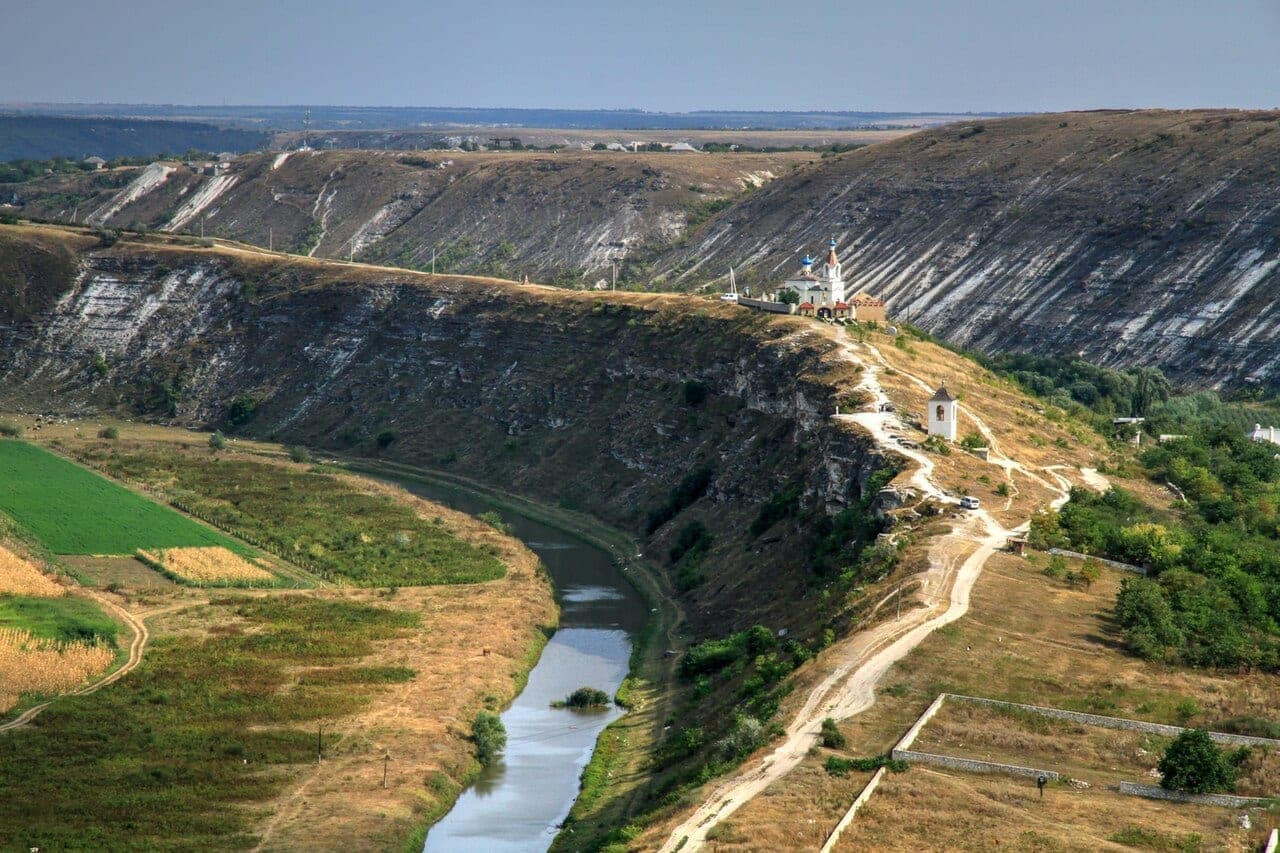
Moldova is a small country of hills, forests and vineyards set between two rivers, the Prut on the border with Romania and the Dniester to the east. Landlocked and low-lying, it holds some of Europe's quieter wonders: at Orheiul Vechi, a bend of the Raut river cuts a gorge through pale limestone, and into that rock, centuries ago, monks dug a church that is still used today. Above ground the plateau rolls away in wheat and sunflower and grape, and beneath it, near the capital, the cellars of Milestii Mici run for kilometre after kilometre through old mine galleries, holding more than a million and a half bottles.
To understand Moldova, though, you have to look at how its people keep their dead. Each spring, on the Monday after Orthodox Easter, families across the country carry food and wine to the cemeteries, lay tables among the graves and eat with the departed at a feast called Pastele Blajinilor, the Easter of the gentle souls. Moldova shares its language, its Latin roots and much of its folklore with neighbouring Romania, and it carries the weight of a Soviet century still visible in its buildings and its borders.
The Republic of Moldova covers about 33,850 square kilometres, a little larger than Belgium, in the historical region of Bessarabia between the Prut and the Dniester (Nistru). It is one of Europe's most rural countries, a land of low hills, ravines and river valleys, with the ancient hardwood forests of the Codru at its centre and open farmland spreading north and south. The 2024 census counted 2.4 million usual residents, down almost fourteen per cent in ten years, because a very large share of Moldovans now work abroad, and remittances and the diaspora shape almost every family (National Bureau of Statistics).
Moldovans form the large majority of the population, alongside Ukrainian, Russian, Gagauz and Bulgarian communities. In the south, the Gagauz, a Turkic-speaking people who are Orthodox Christian, govern themselves through the Autonomous Territorial Unit of Gagauzia, formed in 1995. On the east bank of the Dniester, the narrow strip of Transnistria has been outside the government's control since a brief war in 1992; it is not recognised as a separate state by any United Nations member, and the situation is generally described as a frozen conflict. Romanian is the official language, the leu is the currency, and Moldova holds one inscribed UNESCO World Heritage property, a survey marker of the Struve Geodetic Arc, with several further sites on the country's tentative list.
Chisinau. First recorded in 1436, the capital grew from a monastery village on the Bic river into the political and cultural heart of the country. It was rebuilt twice in the twentieth century, after wartime destruction and the severe 1940 earthquake, which gives its centre a mix of leafy nineteenth-century streets and broad Soviet avenues. The Nativity Cathedral and its free-standing bell tower anchor the central park, where a monument to Stephen the Great watches over the city, and the National Museum of History of Moldova gathers the country's archaeology and story under one roof.
Balti. The largest city in the north, Balti is often called the capital of the north. Set on the Raut, it serves the surrounding farming districts and keeps a strong Russian and Ukrainian-speaking character alongside its Moldovan majority.
Orhei. A district town on the Raut about forty kilometres north of the capital, modern Orhei is the gateway to the far older site of Orheiul Vechi, roughly fifteen kilometres downstream, where the cave monastery and the ruins of successive settlements sit in the gorge. The living town and the archaeological landscape share a name but stand apart.
Tiraspol. On the east bank of the Dniester, Tiraspol is the administrative centre of the Transnistria region. Founded as a Russian fortress town in 1792, it retains a strongly Soviet-era streetscape and remains outside the effective control of the Moldovan government.
The land between the rivers has been settled since deep antiquity. In the Iron Age it belonged to the world of the Geto-Dacians, whose fortified sites, including one on the promontory at Old Orhei, guarded the river crossings; to the west the Romans built the province of Dacia, and the long meeting of Dacian and Latin left its mark on the people and their speech. Waves of migration followed across the centuries, and in the fourteenth century a new state took shape. The Principality of Moldavia emerged around 1359, and folklore ties its founding to the voivode Dragos and a hunt along a river said to have taken the name Moldova.
Moldavia reached its height under Stephen the Great, who reigned from 1457 to 1504, held off Ottoman and other armies in a long series of campaigns, and endowed dozens of churches and monasteries; he remains the country's central historical figure. From 1538 the principality became a tributary vassal of the Ottoman Empire. After a run of Russian-Turkish wars, the Treaty of Bucharest of 1812 transferred the eastern half of Moldavia, Bessarabia, to the Russian Empire, cutting the region off from the rest of the historic principality for more than a century.
In 1918, as empires fell at the close of the First World War, the assembly known as Sfatul Tarii voted for Bessarabia to unite with Romania, and the region spent the interwar decades within Romania. That union was undone in 1940, when the Soviet Union annexed Bessarabia under the secret terms of the Molotov-Ribbentrop Pact and created the Moldavian Soviet Socialist Republic, joining most of Bessarabia to a strip of land east of the Dniester. Soviet rule brought industry, Russification and, in the postwar years, deportations and a devastating famine. Moldova declared independence on 27 August 1991 as the Soviet Union broke apart. Tensions over language and identity in the mainly Russian-speaking east led the Transnistria region to break away, and a short war in 1992 ended in a ceasefire that has broadly held since; the dispute remains unresolved.
The language of Moldova is Romanian, an Eastern Romance language descended from the Latin carried into the region by Rome and shaped over centuries by a Dacian substrate and by Slavic, Turkish and other neighbours. It is the only Romance language spoken widely in this part of Europe, binding Moldova closely to Romania, with which it shares its literature and its poets. Under Soviet rule the language was written in the Cyrillic alphabet and officially called Moldovan; the Latin script was restored in 1989, and in 2023 the Moldovan parliament confirmed that the state language is named Romanian throughout the constitution and the laws.
Alongside Romanian, the country is genuinely multilingual. Russian remains widely spoken and long served as a language of administration; Ukrainian is spoken in the north and east; and in the south the Gagauz keep their Turkic language, unusual as the mother tongue of an Orthodox Christian people, alongside small Bulgarian-speaking communities. The name Moldova itself comes from the Moldova river in the older heartland of the principality across the modern border, and its origin is wrapped in the founding legend of Dragos, whose hunting hound Molda is said in folklore to have given the river and then the country its name.
Wine is the first thread of Moldovan identity. Grapes have been grown here for thousands of years, vineyards cover much of the farmland, and cellars run under the limestone near the capital. Cricova and Milestii Mici are underground cities of wine, their galleries measured in scores of kilometres, and the Milestii Mici collection has been recognised by Guinness World Records as the largest in the world. The first weekend of October brings the National Wine Day to Chisinau, when the whole country celebrates the harvest.
Music carries the second thread. The doina, a slow, improvised solo lament, is the deep root of the folk tradition shared with Romania, sung with or without the fluier flute, the cimpoi bagpipe or the nai panpipe. From this tradition rose modern voices, from the soprano Maria Biesu to the composer Eugen Doga. Weaving is the third thread: the geometric wool wall carpets known as scoarta, hung in homes, given in a bride's dowry and laid at funerals as a passage for the soul, are woven by women and passed from grandmother to granddaughter. At the table the culture speaks again, in mamaliga, the cornmeal staple, in placinte pastries and sarmale cabbage rolls, in sheep's cheese, in the sour soup called zeama, and always in wine and must.
Moldova is overwhelmingly Orthodox Christian, and the faith runs through the calendar, the family and the landscape. The largest body is the Moldovan Orthodox Church, under the Moscow Patriarchate, while the Metropolis of Bessarabia is tied to the Romanian Patriarchate; the split reflects the country's wider pull between east and west. Monasteries mark the land, from Capriana and Curchi to the cliffside houses of prayer at Saharna and Tipova, and at Old Orhei a small cave church cut into the rock still holds services, one of the oldest continuous places of Christian worship in the country.
 Monks cut cells into the limestone at Orheiul Vechi, and the site holds Geto-Dacian, Mongol, Moldavian and Orthodox layers in one bend of the river. Photograph by Guttorm Flatabo, CC BY 2.0, via Wikimedia Commons.
Other faiths have left their own memory. Chisinau was once a major centre of Jewish life, and the city's name carries a heavy weight in that history: the pogroms of 1903 and 1905 shocked the world and drove waves of emigration, and the surviving synagogues and cemeteries are cared for as heritage of a community much reduced by the twentieth century. Small Protestant and other communities also worship here. Across all of them, popular belief keeps older layers alive, in the blessing of water, the keeping of saints' days, and the folk customs that the Orthodox calendar has gathered around itself.
Moldovan mourning is patient and communal. When someone dies, the family holds a wake, the priveghi, watching over the body at home through the night before burial, which usually follows within a few days. Grief is then marked in a long sequence of memorial meals, the pomeni or pomana, at which food and wine are shared and given away in the name of the dead: the boiled sweet wheat called coliva is prepared, and the household observes the commemorations at nine days, forty days and one year, in the belief that the soul's passage is accompanied by the prayers and the generosity of the living.
The most striking custom comes after Easter. On the Monday following St Thomas Sunday, the week after Orthodox Easter, Moldovans keep Pastele Blajinilor, the Easter of the Blajini, the gentle or kind-hearted souls. Families gather at the cemeteries, clean and decorate the graves, and lay out tables of food and wine among them; a priest moves through the graveyard blessing each grave and its offerings, and then the living eat their meal beside the dead. In folklore the Blajini are a gentle people who live at the edge of the world and learn that Easter has come only when eggshells, floated downstream from the villages of the living, reach them along the water. The custom joins a pre-Christian cult of the ancestors to the Orthodox feast of the Resurrection, so that the country's holiest season ends not in church but in the cemetery, at a shared table. In Moldova, remembrance is not a private sorrow kept indoors; it is a meal set for the departed, in the open air, once a year.
Moldovan records are layered by empire, and which layer a family sits in depends on the decade.
Bessarabia passed from the Ottomans to Russia in 1812, so the nineteenth-century sources are the Orthodox metrical books required of parishes from 1722 and the revision lists taken as tax censuses. Those are held at the National Archives in Chișinău and a good deal has been digitised. Between 1918 and 1940 the region was part of Romania, so the interwar record is Romanian in language and form. From 1940, with a break during the war, it was Soviet, and vital events were registered by ZAGS offices.
Jewish records are a substantial part of the Bessarabian archive and a substantial absence. The pre-war Jewish population was large, the metrical books for many communities survive at Chișinău, and the community itself was largely destroyed in 1941 and after.
Two Soviet deportations shaped many families directly. In June 1941 and again in July 1949 tens of thousands of people were deported to Siberia and Kazakhstan, and the NKVD files listing them by household are now among the most consulted records in the country, because they name people the family lost and say where they went.
Transnistria, east of the river, has run its own administration since 1992, and its records are held separately by an authority no state recognises, which makes documents from there difficult to use anywhere else.
Moldova's built and living heritage is protected through a national register, a cultural landscape reserve at Old Orhei, and its work with UNESCO. The country's single inscribed World Heritage property is the Rudi station of the Struve Geodetic Arc, one point in a chain of survey markers running from Norway to the Black Sea that recorded the first accurate measurement of a long meridian between 1816 and 1855; the Moldovan point was set in 1847. On the tentative list, the country has proposed both the Orheiul Vechi archaeological landscape, with its Dacian fortress, medieval town and cave monastery layered above the Raut, and the underground wineries of Cricova and Milestii Mici, treated as cultural monuments in their own right.
The country's living heritage is recognised on UNESCO's Representative List of the Intangible Cultural Heritage of Humanity. The doina, the improvised song at the heart of the folk tradition Moldova shares with Romania, was inscribed in 2009 as Romanian heritage; the Christmas ritual of men's group Colindat was inscribed jointly by Romania and the Republic of Moldova in 2013; and the traditional wall-carpet craftsmanship of the two countries was inscribed in 2016. The National Museum of Ethnography and Natural History in Chisinau, the oldest in the country, and the National Museum of History carry the daily work of conservation and teaching.
Moldova has quietly become one of the more digitised states of the post-Soviet region, and that has begun to reach its heritage. The National Archive of the Republic of Moldova and the National Library hold the written record of the country, and digitisation programmes are moving catalogues, manuscripts and photographs online for researchers and families abroad. Under the Wine of Moldova brand, the great cellars of Cricova and Milestii Mici can now be toured virtually from a screen.
The diaspora gives this work particular urgency. With so many Moldovans living outside the country, family memory is increasingly kept across borders, through photographs, recordings and messages rather than only at the graveside. Digital archives and shared family collections let a grandchild abroad visit a grave, hear a doina or read a name that would otherwise stay behind in the village, extending the country's habit of remembrance into new tools.
Moldovan culture reaches the wider world through music above all. The folk-rock band Zdob si Zdub carried Moldovan sound to the Eurovision stage, placing near the top in 2005 and returning in 2022 with the Advahov Brothers and a folk-driven song loved across the continent. In letters, the writer Ion Druta and the poet Grigore Vieru gave voice to national feeling in the late Soviet decades, within the shared Romanian tradition of which Mihai Eminescu remains the towering ancestor.
Beyond the arts, Moldova is increasingly known for wine tourism, and for a national conversation about identity held between ties to Romania and the European Union on one side and Russian influence on the other. The diaspora is itself a cultural force, sending home not only remittances but tastes, ideas and connections.
The world's largest wine collection. The golden collection at Milestii Mici, more than a million and a half bottles held in tens of kilometres of underground galleries, was recognised by Guinness World Records as the largest in the world, turning a Soviet-era mine into a national emblem visited by travellers from across the globe.
A survey marker saved for humanity. The Struve Geodetic Arc point near Rudi, lost for generations, was rediscovered in 2003, confirmed as authentic, and marked with an obelisk in 2006, giving Moldova its place on the UNESCO World Heritage List as part of a scientific achievement shared by ten countries.
A church that never closed. In the gorge at Old Orhei, the cave church cut into the limestone above the Raut has returned to monastic use, part of an archaeological landscape now proposed for World Heritage status.
Living traditions on the world list. The doina in 2009, men's group Colindat in 2013 and wall-carpet craftsmanship in 2016 all entered UNESCO's list of intangible heritage, recognition that much of Moldova's most valuable heritage is sung, woven and kept alive rather than only built.
Monks cut cells into the limestone at Orheiul Vechi, and the site holds Geto-Dacian, Mongol, Moldavian and Orthodox layers in one bend of the river. Photograph by Guttorm Flatabo, CC BY 2.0, via Wikimedia Commons.
Other faiths have left their own memory. Chisinau was once a major centre of Jewish life, and the city's name carries a heavy weight in that history: the pogroms of 1903 and 1905 shocked the world and drove waves of emigration, and the surviving synagogues and cemeteries are cared for as heritage of a community much reduced by the twentieth century. Small Protestant and other communities also worship here. Across all of them, popular belief keeps older layers alive, in the blessing of water, the keeping of saints' days, and the folk customs that the Orthodox calendar has gathered around itself.
Moldovan mourning is patient and communal. When someone dies, the family holds a wake, the priveghi, watching over the body at home through the night before burial, which usually follows within a few days. Grief is then marked in a long sequence of memorial meals, the pomeni or pomana, at which food and wine are shared and given away in the name of the dead: the boiled sweet wheat called coliva is prepared, and the household observes the commemorations at nine days, forty days and one year, in the belief that the soul's passage is accompanied by the prayers and the generosity of the living.
The most striking custom comes after Easter. On the Monday following St Thomas Sunday, the week after Orthodox Easter, Moldovans keep Pastele Blajinilor, the Easter of the Blajini, the gentle or kind-hearted souls. Families gather at the cemeteries, clean and decorate the graves, and lay out tables of food and wine among them; a priest moves through the graveyard blessing each grave and its offerings, and then the living eat their meal beside the dead. In folklore the Blajini are a gentle people who live at the edge of the world and learn that Easter has come only when eggshells, floated downstream from the villages of the living, reach them along the water. The custom joins a pre-Christian cult of the ancestors to the Orthodox feast of the Resurrection, so that the country's holiest season ends not in church but in the cemetery, at a shared table. In Moldova, remembrance is not a private sorrow kept indoors; it is a meal set for the departed, in the open air, once a year.
Moldovan records are layered by empire, and which layer a family sits in depends on the decade.
Bessarabia passed from the Ottomans to Russia in 1812, so the nineteenth-century sources are the Orthodox metrical books required of parishes from 1722 and the revision lists taken as tax censuses. Those are held at the National Archives in Chișinău and a good deal has been digitised. Between 1918 and 1940 the region was part of Romania, so the interwar record is Romanian in language and form. From 1940, with a break during the war, it was Soviet, and vital events were registered by ZAGS offices.
Jewish records are a substantial part of the Bessarabian archive and a substantial absence. The pre-war Jewish population was large, the metrical books for many communities survive at Chișinău, and the community itself was largely destroyed in 1941 and after.
Two Soviet deportations shaped many families directly. In June 1941 and again in July 1949 tens of thousands of people were deported to Siberia and Kazakhstan, and the NKVD files listing them by household are now among the most consulted records in the country, because they name people the family lost and say where they went.
Transnistria, east of the river, has run its own administration since 1992, and its records are held separately by an authority no state recognises, which makes documents from there difficult to use anywhere else.
Moldova's built and living heritage is protected through a national register, a cultural landscape reserve at Old Orhei, and its work with UNESCO. The country's single inscribed World Heritage property is the Rudi station of the Struve Geodetic Arc, one point in a chain of survey markers running from Norway to the Black Sea that recorded the first accurate measurement of a long meridian between 1816 and 1855; the Moldovan point was set in 1847. On the tentative list, the country has proposed both the Orheiul Vechi archaeological landscape, with its Dacian fortress, medieval town and cave monastery layered above the Raut, and the underground wineries of Cricova and Milestii Mici, treated as cultural monuments in their own right.
The country's living heritage is recognised on UNESCO's Representative List of the Intangible Cultural Heritage of Humanity. The doina, the improvised song at the heart of the folk tradition Moldova shares with Romania, was inscribed in 2009 as Romanian heritage; the Christmas ritual of men's group Colindat was inscribed jointly by Romania and the Republic of Moldova in 2013; and the traditional wall-carpet craftsmanship of the two countries was inscribed in 2016. The National Museum of Ethnography and Natural History in Chisinau, the oldest in the country, and the National Museum of History carry the daily work of conservation and teaching.
Moldova has quietly become one of the more digitised states of the post-Soviet region, and that has begun to reach its heritage. The National Archive of the Republic of Moldova and the National Library hold the written record of the country, and digitisation programmes are moving catalogues, manuscripts and photographs online for researchers and families abroad. Under the Wine of Moldova brand, the great cellars of Cricova and Milestii Mici can now be toured virtually from a screen.
The diaspora gives this work particular urgency. With so many Moldovans living outside the country, family memory is increasingly kept across borders, through photographs, recordings and messages rather than only at the graveside. Digital archives and shared family collections let a grandchild abroad visit a grave, hear a doina or read a name that would otherwise stay behind in the village, extending the country's habit of remembrance into new tools.
Moldovan culture reaches the wider world through music above all. The folk-rock band Zdob si Zdub carried Moldovan sound to the Eurovision stage, placing near the top in 2005 and returning in 2022 with the Advahov Brothers and a folk-driven song loved across the continent. In letters, the writer Ion Druta and the poet Grigore Vieru gave voice to national feeling in the late Soviet decades, within the shared Romanian tradition of which Mihai Eminescu remains the towering ancestor.
Beyond the arts, Moldova is increasingly known for wine tourism, and for a national conversation about identity held between ties to Romania and the European Union on one side and Russian influence on the other. The diaspora is itself a cultural force, sending home not only remittances but tastes, ideas and connections.
The world's largest wine collection. The golden collection at Milestii Mici, more than a million and a half bottles held in tens of kilometres of underground galleries, was recognised by Guinness World Records as the largest in the world, turning a Soviet-era mine into a national emblem visited by travellers from across the globe.
A survey marker saved for humanity. The Struve Geodetic Arc point near Rudi, lost for generations, was rediscovered in 2003, confirmed as authentic, and marked with an obelisk in 2006, giving Moldova its place on the UNESCO World Heritage List as part of a scientific achievement shared by ten countries.
A church that never closed. In the gorge at Old Orhei, the cave church cut into the limestone above the Raut has returned to monastic use, part of an archaeological landscape now proposed for World Heritage status.
Living traditions on the world list. The doina in 2009, men's group Colindat in 2013 and wall-carpet craftsmanship in 2016 all entered UNESCO's list of intangible heritage, recognition that much of Moldova's most valuable heritage is sung, woven and kept alive rather than only built.
National Overview
Notable Cities
Historical Foundations
Linguistic and Etymological Roots
Cultural Identity
Religion and Spirituality
Remembrance and Mourning Traditions
Tracing a Family in Moldova
Heritage Preservation Efforts
Digital Heritage
Contemporary Cultural Influences
Success Stories
References and resources
- Struve Geodetic Arc (UNESCO World Heritage Centre). The ten-country inscription that includes Moldova's Rudi station point.
- Orheiul Vechi Archaeological Landscape, tentative list (UNESCO World Heritage Centre). The cave monastery, Dacian fortress and medieval town above the Raut.
- The Underground Wineries of Moldova, tentative list (UNESCO World Heritage Centre). Cricova and Milestii Mici treated as cultural monuments.
- Doina (UNESCO Intangible Cultural Heritage). The improvised song inscribed in 2009.
- Traditional wall-carpet craftsmanship in Romania and the Republic of Moldova (UNESCO Intangible Cultural Heritage). The scoarta weaving tradition inscribed in 2016.
- Moldova (Encyclopaedia Britannica). Geography, population and political background.
- Moldova: History (Encyclopaedia Britannica). The principality, Bessarabia, the Soviet republic and independence.
- At Easter of the Kind-Hearted, Moldovans remember their dead (IPN). The cemetery observance of Pastele Blajinilor.
- The World's Largest Wine Cellar in Moldova (National Geographic). The Milestii Mici galleries and Guinness record.
- Moldova establishes Romanian as the state language (Library of Congress). The 2023 law on the name of the language.