Heritage · Country
Slovakia Culture and Heritage
On the first days of November, Slovak cemeteries fill with candlelight as families gather at the graves of their dead, a custom older than the borders drawn around it. This is a guide to the country's heritage, from the ruined ramparts of Spis Castle and the wooden churches of the Carpathians to the deep song of the fujara and the graveside rituals that keep memory alight.Written to last.
By Confinity Heritage Editorial · Updated 2026-07-31 · 8-minute readQuiet tools, kept out of the way.
Slovakia is a small country that has spent most of its history inside larger ones, and it learned early to keep its identity in things that could not be confiscated: a language, a melody, a way of laying flowers on a grave. For roughly a thousand years the Slovak lands were the upper counties of the Kingdom of Hungary, then a partner in Czechoslovakia, and only since 1993 an independent republic. Through all of it the country held onto a folk culture of unusual depth, the log villages of the Carpathian valleys, the overtone flute called the fujara, the wooden churches raised without a single iron nail, and a calendar of remembrance in which the living still keep close company with the dead.
That inheritance is now among the best guarded in Central Europe. Slovakia counts seven UNESCO World Heritage sites and more than a hundred castles, one of them, Spis Castle, among the largest fortified complexes on the continent. Every autumn the cemeteries of the whole country glow with hundreds of thousands of candles for the feast the Slovaks call Dusicky, the Little Souls.
Slovakia is a landlocked country in the heart of Central Europe, bordered by the Czech Republic and Austria to the west, Poland to the north, Ukraine to the east and Hungary to the south. Its territory of about 49,000 square kilometres is dominated by the Carpathian arc, which rises in the north to the High Tatras, the only truly alpine peaks in the whole Carpathian system. The highest summit, Gerlachovsky stit, reaches 2,655 metres, though the Slovaks reserve their deepest affection for the pyramid of Krivan, long treated as the national mountain (High Tatras). To the south the land falls to the fertile Danubian lowland.
The population is around 5.4 million, most of them Slovaks, with a substantial Hungarian minority in the south and Roma communities across the east. The capital, Bratislava, sits where Slovakia, Austria and Hungary almost meet, the only national capital in the world to border two other countries. Slovakia became an independent republic on 1 January 1993, joined the European Union in 2004 and adopted the euro in 2009 (European Union).
Bratislava. The capital rises along the Danube beneath a four-towered castle first fortified in the ninth century. Known for centuries as Pressburg in German and Pozsony in Hungarian, the city was for more than two hundred years the coronation seat of the Kingdom of Hungary, its Gothic St Martin's Cathedral witnessing the crowning of Habsburg monarchs including Maria Theresa. Its old town of baroque palaces and narrow lanes remains the country's political and cultural centre.
Kosice. The metropolis of the east and Slovakia's second city guards the largest church in the country, the Cathedral of St Elisabeth, the easternmost Gothic cathedral in Europe, begun around 1380 (Slovakia.travel). In 1369 the town received the earliest municipal coat of arms granted anywhere in Europe, and it served as a European Capital of Culture in 2013.
Banska Stiavnica. Cradled in the crater of an extinct volcano, this was one of Europe's great mining towns, its silver and gold enriching the Hungarian crown for centuries. Renaissance houses, two castles and a network of artificial reservoirs climb the slopes, and its mining academy, established in 1762, was among the earliest technical schools of its kind in Europe (UNESCO).
Levoca. A walled town in the Spis region, Levoca keeps an almost complete medieval townscape around a broad market square. Its Church of St James holds the tallest wooden Gothic altar in the world, carved between 1508 and 1517 in the workshop of Master Paul of Levoca and rising 18.6 metres (Slovakia.travel).
The first great chapter of Slovak history belongs to Great Moravia, the Slavic realm that rose in the ninth century with its heartland in what is now Slovakia and Moravia. Its prince Rastislav, seeking to free his church from Frankish influence, appealed to Byzantium, and in 863 the emperor sent the brothers Constantine, later Saint Cyril, and Methodius, scholars from Thessalonica who devised the Glagolitic alphabet, the first script created for a Slavic tongue, and translated the liturgy into Old Church Slavonic (Britannica). Nitra, the oldest seat of Slovak power, was a centre of that awakening, and the brothers are honoured today as co-patrons of Europe, their feast on 5 July a national holiday.
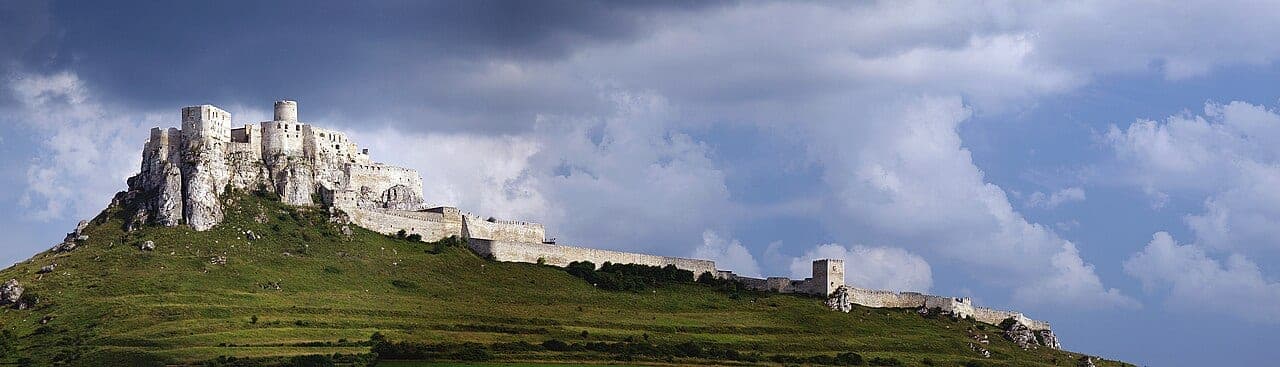
 Spis is among the largest castle sites in central Europe, and it has been a ruin since a fire in 1780, which is roughly why so much of its medieval fabric survives unaltered. Photograph by Jakub Halun, CC BY-SA 4.0, via Wikimedia Commons.
Great Moravia fell to the Magyars in the early tenth century, and the Slovak lands were absorbed into the Kingdom of Hungary, where they would remain, as the region long called Upper Hungary, for roughly a thousand years. That attachment gave Bratislava a remarkable role. After the Ottoman victory at Mohacs in 1526 and the fall of the coronation city of Szekesfehervar, the Habsburgs made Pressburg the capital of royal Hungary in 1536, and for nearly three centuries Hungarian kings were crowned there. Nineteen royal coronations took place in St Martin's Cathedral between 1563 and 1830, among them that of Maria Theresa in 1741 (Visit Bratislava).
Under the later Habsburg centuries a Slovak national awakening took shape, and in 1843, in Pressburg, Ludovit Stur and his circle codified standard Slovak on the basis of the central dialects (Wikipedia). When Austria-Hungary collapsed after the First World War, the Slovaks joined the Czechs in the new republic of Czechoslovakia in 1918. A wartime Slovak state and communist rule after 1948 followed, ending with the Velvet Revolution of 1989. Then, on 1 January 1993, Czechoslovakia divided peacefully into two sovereign states, a settlement negotiated by political leaders and carried out without violence, which the world came to call the Velvet Divorce (Britannica).
Slovak is a West Slavic language, closely related to Czech and Polish and so near to Czech that the two are mutually intelligible. It is written in the Latin alphabet fitted with diacritical marks that capture the sounds of Slavic speech. For much of its history the region's written language was Latin, then German and Hungarian in official life, while Slovak survived in the mouths of villagers and in folk song. An earlier standard shaped by Anton Bernolak in the 1780s drew on western dialects, but it was Stur's central-dialect codification of 1843 that became the enduring basis of the modern literary tongue.
The country's name carries an old Slavic idea about belonging. The words Slovak, Sloven and Slovan descend from the Proto-Slavic self-designation for the Slavs, which philologists connect to the root slovo, meaning word or speech (Etymonline). By this reading the Slavs named themselves the people of the word, those whose speech one could understand. Slovensko, the Slovak name for the country, thus reaches back to the earliest way the Slavs described themselves.
No object expresses Slovak folk culture more completely than the fujara, the tall overtone flute of the central highlands. Its main tube runs from 160 to 200 centimetres, and with only three finger holes it yields deep, murmuring tones and soaring overtones. UNESCO proclaimed the fujara and its music a Masterpiece of the Oral and Intangible Heritage of Humanity in 2005, and it was inscribed on the Representative List in 2008 (UNESCO). Around it lives a wider world of folk song and dance kept alive by hundreds of village ensembles.
Spis is among the largest castle sites in central Europe, and it has been a ruin since a fire in 1780, which is roughly why so much of its medieval fabric survives unaltered. Photograph by Jakub Halun, CC BY-SA 4.0, via Wikimedia Commons.
Great Moravia fell to the Magyars in the early tenth century, and the Slovak lands were absorbed into the Kingdom of Hungary, where they would remain, as the region long called Upper Hungary, for roughly a thousand years. That attachment gave Bratislava a remarkable role. After the Ottoman victory at Mohacs in 1526 and the fall of the coronation city of Szekesfehervar, the Habsburgs made Pressburg the capital of royal Hungary in 1536, and for nearly three centuries Hungarian kings were crowned there. Nineteen royal coronations took place in St Martin's Cathedral between 1563 and 1830, among them that of Maria Theresa in 1741 (Visit Bratislava).
Under the later Habsburg centuries a Slovak national awakening took shape, and in 1843, in Pressburg, Ludovit Stur and his circle codified standard Slovak on the basis of the central dialects (Wikipedia). When Austria-Hungary collapsed after the First World War, the Slovaks joined the Czechs in the new republic of Czechoslovakia in 1918. A wartime Slovak state and communist rule after 1948 followed, ending with the Velvet Revolution of 1989. Then, on 1 January 1993, Czechoslovakia divided peacefully into two sovereign states, a settlement negotiated by political leaders and carried out without violence, which the world came to call the Velvet Divorce (Britannica).
Slovak is a West Slavic language, closely related to Czech and Polish and so near to Czech that the two are mutually intelligible. It is written in the Latin alphabet fitted with diacritical marks that capture the sounds of Slavic speech. For much of its history the region's written language was Latin, then German and Hungarian in official life, while Slovak survived in the mouths of villagers and in folk song. An earlier standard shaped by Anton Bernolak in the 1780s drew on western dialects, but it was Stur's central-dialect codification of 1843 that became the enduring basis of the modern literary tongue.
The country's name carries an old Slavic idea about belonging. The words Slovak, Sloven and Slovan descend from the Proto-Slavic self-designation for the Slavs, which philologists connect to the root slovo, meaning word or speech (Etymonline). By this reading the Slavs named themselves the people of the word, those whose speech one could understand. Slovensko, the Slovak name for the country, thus reaches back to the earliest way the Slavs described themselves.
No object expresses Slovak folk culture more completely than the fujara, the tall overtone flute of the central highlands. Its main tube runs from 160 to 200 centimetres, and with only three finger holes it yields deep, murmuring tones and soaring overtones. UNESCO proclaimed the fujara and its music a Masterpiece of the Oral and Intangible Heritage of Humanity in 2005, and it was inscribed on the Representative List in 2008 (UNESCO). Around it lives a wider world of folk song and dance kept alive by hundreds of village ensembles.
 Vlkolinec is a working village of log houses that was never modernised, and it is protected as a settlement rather than as a museum. Photograph by Bhu z Crecelu, CC BY 3.0, via Wikimedia Commons.
Folk architecture is a second signature. In the mountain valleys the traditional house was built of squared logs; the village of Cicmany is famous for the white geometric designs painted directly onto its dark timber, motifs later borrowed by designers. Handcraft runs deep too, in the blue-and-white majolica of Modra, the wireworking tradition of drotarstvo by which tinkers once mended pots across Europe, and regional embroidery and lacemaking. Slovak cooking centres on sheep's milk, above all in bryndzove halusky, potato dumplings with sharp bryndza cheese and bacon, widely regarded as the national dish.
Slovakia is among the more religious countries of Central Europe, and Roman Catholicism is by far the largest faith. The Reformation left a lasting Lutheran, or Evangelical, minority, whose timber articular churches are among the country's architectural marvels. In the east, where the Latin and Byzantine worlds meet, sizeable Greek Catholic and Orthodox communities worship in the Eastern rite, and it is here that the wooden churches of the Carpathians were raised. Smaller communities of Calvinists and a historic Jewish presence, devastated in the Holocaust, complete the picture.
The mission of Cyril and Methodius is remembered as the foundation of Slovak Christianity, and Marian devotion is strong: the basilica at Sastin houses the venerated image of Our Lady of the Seven Sorrows, patroness of Slovakia. Faith remains woven into the ordinary landscape, in wayside crosses and shrines, in village patron-saint festivals, and above all in the way Slovaks tend the graves of their families.
Slovak mourning custom blends Christian rite with older folk belief, and in the villages the two were long inseparable. Traditionally, when a death occurred the mirrors were covered and the clocks stopped, and the body was washed, dressed and laid in a coffin ringed with burning candles, a cup of holy water beside it (Vlkolinec). Through the night before the burial neighbours kept a vigil, praying and singing over the departed, and after the funeral the community gathered for a memorial meal known as the kar. Beneath it ran a folk conviction that the soul lingered near the living for a time and had to be seen off with respect.
A Christian funeral commits the dead to God with a Mass, the coffin is carried to the churchyard, and the priest blesses the grave. What is distinctive in Slovakia is the intensity of the remembrance that follows, above all the two days at the start of November: All Saints, Vsetkych svatych, on the first, and All Souls on the second, formally Pamiatka zosnulych and known affectionately as Dusicky, the Little Souls (Study in Slovakia).
On these days families travel, often long distances, to the cemeteries where their dead lie, clean the graves and cover them with fresh flowers and wreaths of chrysanthemums. Then, as dusk falls, they light candles, so many that whole graveyards seem to burn with a soft collective light, each flame a sign of a soul remembered. The burning of candles for the departed is the most widely observed custom in the country at that season, kept even by those who think of themselves as having little religion (China-CEE Institute). It is one of the plainest expressions anywhere of a nation's refusal to let its dead be forgotten.
Slovak records are Hungarian until 1918, and that is the first thing to establish.
Slovakia was part of the Kingdom of Hungary for a thousand years, so parish registers are in Latin, Hungarian and German as well as Slovak, place names are the Hungarian ones, and civil registration began on 1 October 1895 under Hungarian law. The Slovak National Archives and the regional state archives hold the registers, and a substantial part has been digitised and published free.
Catholic, Lutheran, Greek Catholic, Calvinist and Jewish communities each kept their own books, and confessional variety in Slovakia is high, so identifying which register a family belongs in matters.
The urbaria, the land registers compiled under Maria Theresa in the eighteenth century, list peasant households village by village with their obligations, and are the best pre-register source for ordinary families.
Emigration is the largest movement in the record. Something like a fifth of the Slovak population left for the United States between 1880 and 1914, chiefly to Pennsylvania, Ohio and New Jersey, and the ship manifests, naturalisation papers and fraternal society records there are frequently better than anything at home.
The Jewish record ends in 1942. The Slovak state deported around 58,000 Jews that year, paying Germany for each one, and most were murdered; the deportation lists and the property confiscation files survive in the archives, which means the names are recoverable.
Slovakia protects seven UNESCO World Heritage sites, five cultural and two natural, a large number for so small a country (UNESCO). Three were inscribed together in 1993. The first is Levoca, Spis Castle and the associated cultural monuments, centred on Spisky hrad, whose ruined walls spread across more than four hectares and rank among the largest castle complexes in Central Europe; the site was extended in 2009 to take in the town of Levoca. The second is the historic mining town of Banska Stiavnica with the technical monuments of its landscape. The third is Vlkolinec, a mountain hamlet of fifty-five traditional log buildings that survives as the most complete reserve of Central European folk architecture (UNESCO).
Bardejov followed in 2000, an exceptionally well preserved fortified medieval town in the north-east, its market square lined with burghers' houses and holding a small Jewish quarter around a fine eighteenth-century synagogue. In 2008 UNESCO inscribed the wooden churches of the Slovak part of the Carpathian mountain area, eight timber churches built between the sixteenth and eighteenth centuries, two Roman Catholic, three Evangelical and three of the Eastern rite, several raised without a single iron nail (Slovakia.travel). The two natural sites are transboundary: the Caves of Aggtelek Karst and Slovak Karst, inscribed in 1995 and shared with Hungary, with more than seven hundred caves; and the primeval beech forests of the Carpathians, inscribed in 2007, ancient eastern woodland that forms part of a serial site spread across many European countries.
Slovakia has moved steadily to bring its heritage online. The national portal Slovakiana gathers digitised objects from museums, galleries, libraries and archives, and Slovak institutions contribute to Europeana, the European Union's shared digital library. The Slovak National Library at Martin has digitised books, periodicals and manuscripts on a large scale, opening fragile originals to readers everywhere.
One project speaks directly to the country's culture of remembrance. The Virtualny cintorin, or virtual cemetery, is an online register that photographs and records the graves of Slovak cemeteries, mapping burial places and preserving inscriptions so that descendants at home and abroad can find an ancestor's grave from a screen (Virtualny cintorin). For a diaspora scattered by a century of emigration, it extends the country's deep custom of grave-tending across oceans.
Folk tradition remains the living root of Slovak cultural life. The state ensembles SLUK and Lucnica have carried Slovak music and dance around the world for decades, and each summer the folklore festival at Vychodna gathers performers from across the country.
The country's reach extends into art in unexpected ways. Andy Warhol, the defining figure of American Pop art, was the son of Rusyn emigrants from Mikova in north-eastern Slovakia, honoured today at the Andy Warhol Museum of Modern Art in nearby Medzilaborce. Slovak literature, film and design continue to draw on the national past, and pride in folk roots runs strong among a younger generation.
The fujara reaches the world. In 2005 the fujara became one of the first Slovak traditions proclaimed by UNESCO as a Masterpiece of intangible heritage, inscribed on the Representative List in 2008. Recognition brought new makers, players and schools, ensuring the flute will sound for generations (UNESCO).
Bardejov saved. The conservation of Bardejov's medieval square and fortifications, rewarded with World Heritage status in 2000, made a small north-eastern town a model of keeping a complete historic townscape intact rather than lost to rebuilding (UNESCO).
A separation without a shot. The peaceful division of Czechoslovakia on 1 January 1993 gave Slovakia its independence without bloodshed, and the Velvet Divorce is still cited as a rare example of a country splitting by negotiation rather than conflict (Britannica).
Memory carried online. The Virtualny cintorin has digitised the graves of Slovak cemeteries, letting emigrant families reconnect with their ancestors' graves and carrying grave-tending into the digital age (Virtualny cintorin).
Vlkolinec is a working village of log houses that was never modernised, and it is protected as a settlement rather than as a museum. Photograph by Bhu z Crecelu, CC BY 3.0, via Wikimedia Commons.
Folk architecture is a second signature. In the mountain valleys the traditional house was built of squared logs; the village of Cicmany is famous for the white geometric designs painted directly onto its dark timber, motifs later borrowed by designers. Handcraft runs deep too, in the blue-and-white majolica of Modra, the wireworking tradition of drotarstvo by which tinkers once mended pots across Europe, and regional embroidery and lacemaking. Slovak cooking centres on sheep's milk, above all in bryndzove halusky, potato dumplings with sharp bryndza cheese and bacon, widely regarded as the national dish.
Slovakia is among the more religious countries of Central Europe, and Roman Catholicism is by far the largest faith. The Reformation left a lasting Lutheran, or Evangelical, minority, whose timber articular churches are among the country's architectural marvels. In the east, where the Latin and Byzantine worlds meet, sizeable Greek Catholic and Orthodox communities worship in the Eastern rite, and it is here that the wooden churches of the Carpathians were raised. Smaller communities of Calvinists and a historic Jewish presence, devastated in the Holocaust, complete the picture.
The mission of Cyril and Methodius is remembered as the foundation of Slovak Christianity, and Marian devotion is strong: the basilica at Sastin houses the venerated image of Our Lady of the Seven Sorrows, patroness of Slovakia. Faith remains woven into the ordinary landscape, in wayside crosses and shrines, in village patron-saint festivals, and above all in the way Slovaks tend the graves of their families.
Slovak mourning custom blends Christian rite with older folk belief, and in the villages the two were long inseparable. Traditionally, when a death occurred the mirrors were covered and the clocks stopped, and the body was washed, dressed and laid in a coffin ringed with burning candles, a cup of holy water beside it (Vlkolinec). Through the night before the burial neighbours kept a vigil, praying and singing over the departed, and after the funeral the community gathered for a memorial meal known as the kar. Beneath it ran a folk conviction that the soul lingered near the living for a time and had to be seen off with respect.
A Christian funeral commits the dead to God with a Mass, the coffin is carried to the churchyard, and the priest blesses the grave. What is distinctive in Slovakia is the intensity of the remembrance that follows, above all the two days at the start of November: All Saints, Vsetkych svatych, on the first, and All Souls on the second, formally Pamiatka zosnulych and known affectionately as Dusicky, the Little Souls (Study in Slovakia).
On these days families travel, often long distances, to the cemeteries where their dead lie, clean the graves and cover them with fresh flowers and wreaths of chrysanthemums. Then, as dusk falls, they light candles, so many that whole graveyards seem to burn with a soft collective light, each flame a sign of a soul remembered. The burning of candles for the departed is the most widely observed custom in the country at that season, kept even by those who think of themselves as having little religion (China-CEE Institute). It is one of the plainest expressions anywhere of a nation's refusal to let its dead be forgotten.
Slovak records are Hungarian until 1918, and that is the first thing to establish.
Slovakia was part of the Kingdom of Hungary for a thousand years, so parish registers are in Latin, Hungarian and German as well as Slovak, place names are the Hungarian ones, and civil registration began on 1 October 1895 under Hungarian law. The Slovak National Archives and the regional state archives hold the registers, and a substantial part has been digitised and published free.
Catholic, Lutheran, Greek Catholic, Calvinist and Jewish communities each kept their own books, and confessional variety in Slovakia is high, so identifying which register a family belongs in matters.
The urbaria, the land registers compiled under Maria Theresa in the eighteenth century, list peasant households village by village with their obligations, and are the best pre-register source for ordinary families.
Emigration is the largest movement in the record. Something like a fifth of the Slovak population left for the United States between 1880 and 1914, chiefly to Pennsylvania, Ohio and New Jersey, and the ship manifests, naturalisation papers and fraternal society records there are frequently better than anything at home.
The Jewish record ends in 1942. The Slovak state deported around 58,000 Jews that year, paying Germany for each one, and most were murdered; the deportation lists and the property confiscation files survive in the archives, which means the names are recoverable.
Slovakia protects seven UNESCO World Heritage sites, five cultural and two natural, a large number for so small a country (UNESCO). Three were inscribed together in 1993. The first is Levoca, Spis Castle and the associated cultural monuments, centred on Spisky hrad, whose ruined walls spread across more than four hectares and rank among the largest castle complexes in Central Europe; the site was extended in 2009 to take in the town of Levoca. The second is the historic mining town of Banska Stiavnica with the technical monuments of its landscape. The third is Vlkolinec, a mountain hamlet of fifty-five traditional log buildings that survives as the most complete reserve of Central European folk architecture (UNESCO).
Bardejov followed in 2000, an exceptionally well preserved fortified medieval town in the north-east, its market square lined with burghers' houses and holding a small Jewish quarter around a fine eighteenth-century synagogue. In 2008 UNESCO inscribed the wooden churches of the Slovak part of the Carpathian mountain area, eight timber churches built between the sixteenth and eighteenth centuries, two Roman Catholic, three Evangelical and three of the Eastern rite, several raised without a single iron nail (Slovakia.travel). The two natural sites are transboundary: the Caves of Aggtelek Karst and Slovak Karst, inscribed in 1995 and shared with Hungary, with more than seven hundred caves; and the primeval beech forests of the Carpathians, inscribed in 2007, ancient eastern woodland that forms part of a serial site spread across many European countries.
Slovakia has moved steadily to bring its heritage online. The national portal Slovakiana gathers digitised objects from museums, galleries, libraries and archives, and Slovak institutions contribute to Europeana, the European Union's shared digital library. The Slovak National Library at Martin has digitised books, periodicals and manuscripts on a large scale, opening fragile originals to readers everywhere.
One project speaks directly to the country's culture of remembrance. The Virtualny cintorin, or virtual cemetery, is an online register that photographs and records the graves of Slovak cemeteries, mapping burial places and preserving inscriptions so that descendants at home and abroad can find an ancestor's grave from a screen (Virtualny cintorin). For a diaspora scattered by a century of emigration, it extends the country's deep custom of grave-tending across oceans.
Folk tradition remains the living root of Slovak cultural life. The state ensembles SLUK and Lucnica have carried Slovak music and dance around the world for decades, and each summer the folklore festival at Vychodna gathers performers from across the country.
The country's reach extends into art in unexpected ways. Andy Warhol, the defining figure of American Pop art, was the son of Rusyn emigrants from Mikova in north-eastern Slovakia, honoured today at the Andy Warhol Museum of Modern Art in nearby Medzilaborce. Slovak literature, film and design continue to draw on the national past, and pride in folk roots runs strong among a younger generation.
The fujara reaches the world. In 2005 the fujara became one of the first Slovak traditions proclaimed by UNESCO as a Masterpiece of intangible heritage, inscribed on the Representative List in 2008. Recognition brought new makers, players and schools, ensuring the flute will sound for generations (UNESCO).
Bardejov saved. The conservation of Bardejov's medieval square and fortifications, rewarded with World Heritage status in 2000, made a small north-eastern town a model of keeping a complete historic townscape intact rather than lost to rebuilding (UNESCO).
A separation without a shot. The peaceful division of Czechoslovakia on 1 January 1993 gave Slovakia its independence without bloodshed, and the Velvet Divorce is still cited as a rare example of a country splitting by negotiation rather than conflict (Britannica).
Memory carried online. The Virtualny cintorin has digitised the graves of Slovak cemeteries, letting emigrant families reconnect with their ancestors' graves and carrying grave-tending into the digital age (Virtualny cintorin).
National Overview
Notable Cities
Historical Foundations
Linguistic and Etymological Roots
Cultural Identity
Religion and Spirituality
Remembrance and Mourning Traditions
Tracing a Family in Slovakia
Heritage Preservation Efforts
Digital Heritage
Contemporary Cultural Influences
Success Stories
References and resources
- UNESCO World Heritage Centre, Slovakia: all seven Slovak World Heritage sites.
- UNESCO, Levoca, Spis Castle and the Associated Cultural Monuments: the 1993 inscription and 2009 extension.
- UNESCO, Historic Town of Banska Stiavnica: the mining town and its technical landscape.
- UNESCO, Vlkolinec: the folk-architecture village reserve.
- UNESCO, Wooden Churches of the Slovak Part of the Carpathian Mountain Area: the eight timber churches.
- UNESCO, Fujara and its Music: the overtone flute's listing.
- Britannica, Great Moravia: the ninth-century realm and Cyril and Methodius.
- Britannica, Velvet Divorce: the 1993 division of Czechoslovakia.
- Visit Bratislava, About Coronations: Bratislava as coronation city.
- Slovakia.travel, UNESCO Cultural Heritage: the country's inscribed monuments.
- Study in Slovakia, All Saints' Day: the November remembrance customs.
- Vlkolinec, Funeral Customs: traditional folk mourning practices.