Heritage · Country
Corsica Culture and Heritage
For fourteen years Corsica governed itself under a written constitution drafted in 1755, then lost its independence and gained Napoleon in the same year. This guide covers the island's heritage: its endangered language, its three-voice polyphony, and a mourning culture built on the improvised funeral lament.Written to last.
By Confinity Heritage Editorial · Updated 2026-08-17 · 8-minute readQuiet tools, kept out of the way.
In November 1755 a general assembly of Corsicans meeting at Corte adopted a written constitution for an island that had just thrown off the Republic of Genoa. It set out an elected executive under Pasquale Paoli, a separate judiciary and a legislature chosen by village consultation, and it held for fourteen years while foreign visitors, James Boswell among them, came to look at a self-governing people in the middle of the Mediterranean. France bought Genoa's claim in 1768 and took the island by force the next spring. Napoleon Bonaparte was born at Ajaccio months later, into a family that had backed Paoli.
Corsica is 8,722 square kilometres of granite and limestone mountain closer to Tuscany than to France, and its heritage sits in that gap. The language is Italo-Romance and endangered, the polyphonic singing is on a UNESCO list for traditions at risk of disappearing, and the island keeps practices around death, the improvised funeral lament, the family tombs built in the scrub like small houses, and the belief in dream-hunters who foresee who will die, that ethnographers have documented for two centuries.
Corsica lies about 90 kilometres west of Tuscany, 170 from mainland France and 12 from Sardinia across the Strait of Bonifacio, and had roughly 366,000 inhabitants at the start of 2026 (Wikipedia). It is the most mountainous island in the Mediterranean, a granite spine rising to Monte Cinto at 2,706 metres, with a limestone south and a coast of gulfs and inlets; roughly two-fifths of it lies inside the Parc naturel régional de Corse, crossed by the GR20 walking route. The interior scrub, the maquis, named the French resistance of the Second World War.
Politically Corsica is a single territorial collectivity of France, created on 1 January 2018 by merging the regional council with the two departments of Corse-du-Sud and Haute-Corse (Wikipedia). Its assembly has had a nationalist majority since 2015, and the island's relationship with Paris has been the central question of island politics for fifty years. Corsican is taught in schools and used in public life without official status.
Ajaccio. The largest town and the seat of the collectivity, founded as a Genoese colony in 1492 and best known as Napoleon's birthplace, where the family house is now a national museum. The Palais Fesch, endowed by Napoleon's uncle Cardinal Joseph Fesch, holds the largest collection of Italian painting in France outside the Louvre.
 Bonifacio was Genoese for five centuries and still speaks a Ligurian dialect rather than Corsican. Photograph by Einaz80, CC BY-SA 4.0, via Wikimedia Commons.
Bastia. The Genoese administrative capital from the fourteenth century, named for the bastiglia above the harbour, Bastia keeps the old quarter of Terra Vecchia around its fishing port and a baroque church interior tradition brought from Liguria.
Corte. Set on a rock in the centre of the island, Corte was Paoli's capital between 1755 and 1769 and remains the symbolic seat of Corsican nationhood. Its citadel houses the Musée de la Corse, the island's ethnographic museum, and the Università di Corsica Pasquale Paoli, founded by Paoli in 1765, closed by France in 1769 and reopened in 1981 after 212 years (University of Corsica).
Bonifacio. The old town stands on a limestone headland undercut by the sea, its houses built to the edge of a white cliff. Below the citadel a walled marine cemetery holds rows of family chapel-tombs facing the water.
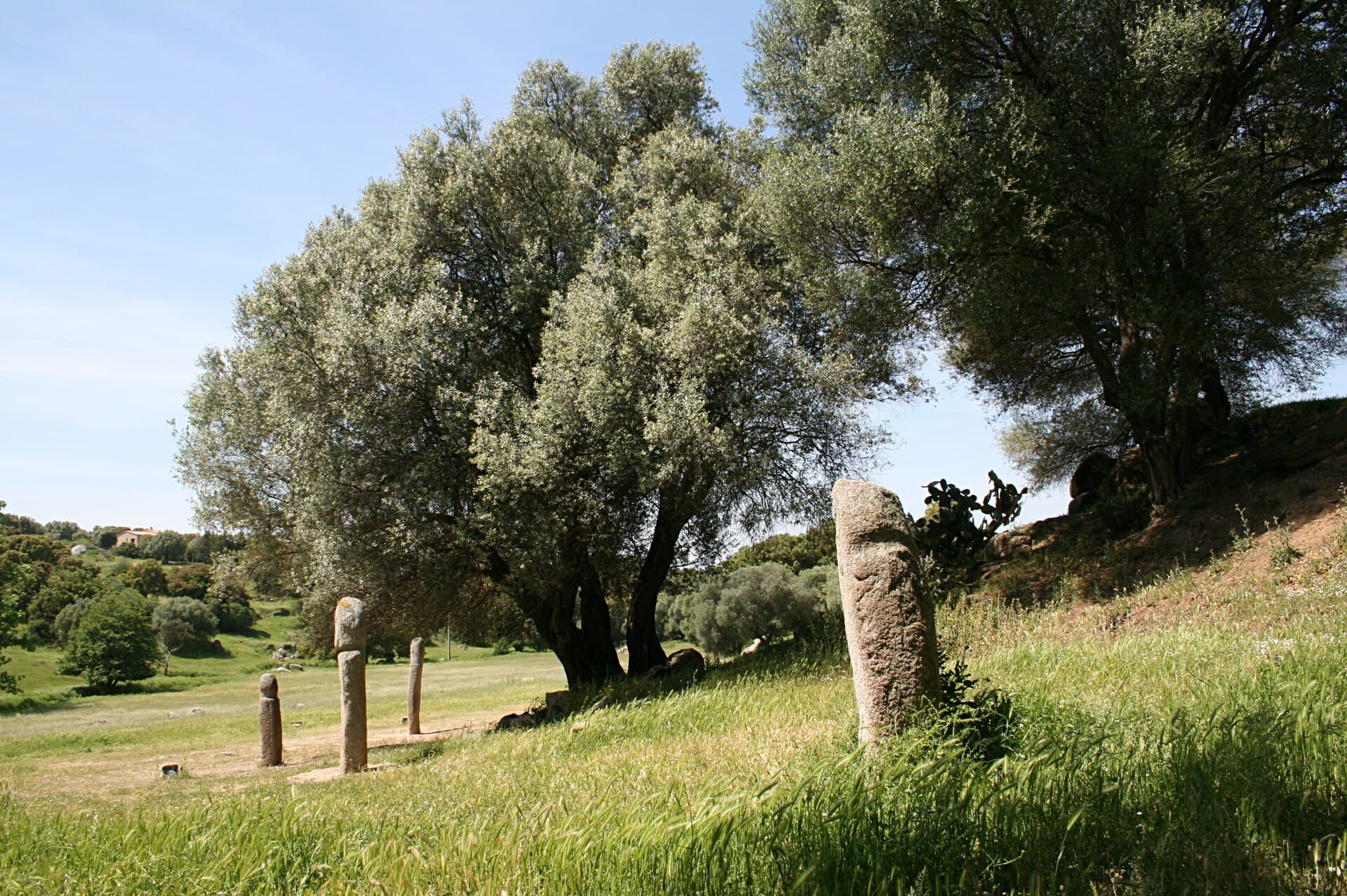
Corsica's prehistory is written in stone figures. At Filitosa in the south, recognised in 1946 by the landowner Charles-Antoine Cesari and excavated from 1954 by Roger Grosjean, granite statue-menhirs stand in an olive grove with faces, spines and, on several, carved swords and daggers (Wikipedia). They belong to a megalithic tradition of the third and second millennia BC later overlaid by the Torrean culture, named for the drystone towers, torri, that in places have broken statue-menhirs built into their walls (Wikipedia).
Bonifacio was Genoese for five centuries and still speaks a Ligurian dialect rather than Corsican. Photograph by Einaz80, CC BY-SA 4.0, via Wikimedia Commons.
Bastia. The Genoese administrative capital from the fourteenth century, named for the bastiglia above the harbour, Bastia keeps the old quarter of Terra Vecchia around its fishing port and a baroque church interior tradition brought from Liguria.
Corte. Set on a rock in the centre of the island, Corte was Paoli's capital between 1755 and 1769 and remains the symbolic seat of Corsican nationhood. Its citadel houses the Musée de la Corse, the island's ethnographic museum, and the Università di Corsica Pasquale Paoli, founded by Paoli in 1765, closed by France in 1769 and reopened in 1981 after 212 years (University of Corsica).
Bonifacio. The old town stands on a limestone headland undercut by the sea, its houses built to the edge of a white cliff. Below the citadel a walled marine cemetery holds rows of family chapel-tombs facing the water.
Corsica's prehistory is written in stone figures. At Filitosa in the south, recognised in 1946 by the landowner Charles-Antoine Cesari and excavated from 1954 by Roger Grosjean, granite statue-menhirs stand in an olive grove with faces, spines and, on several, carved swords and daggers (Wikipedia). They belong to a megalithic tradition of the third and second millennia BC later overlaid by the Torrean culture, named for the drystone towers, torri, that in places have broken statue-menhirs built into their walls (Wikipedia).
 The statue-menhirs at Filitosa carry faces, and some carry weapons, which is unusual: most European standing stones do not show a person at all. Photograph by Jean-Pol Grandmont, CC BY-SA 3.0, via Wikimedia Commons.
Phocaean Greeks founded Alalia on the east coast around 565 BC, and the sea battle fought off it against Carthaginians and Etruscans about twenty-five years later helped fix the balance of the western Mediterranean (Wikipedia). Rome took the island in 259 BC and made Aleria its capital. Pisan rule from the eleventh century left small Romanesque churches of banded stone such as the Canonica at Mariana and La Trinité at Aregno, and Genoa took over after beating Pisa at Meloria in 1284 and held the island for most of five centuries. The Genoese ringed the coast with watchtowers against Barbary raiders in the sixteenth century, of which around 85 of some 120 still stand, and built the citadels at Bastia, Calvi, Bonifacio, Ajaccio and Corte (Wikipedia).
Revolt against Genoa broke out in 1729 and hardened into a war of independence. In 1755 Paoli was made general of the nation and the constitution adopted; it separated powers, vested sovereignty in an elected diet, and was drafted in an Enlightenment idiom that drew Rousseau's admiration and Boswell's, whose 1768 account made Paoli famous across Europe (Britannica). Historians have described it as among the earliest modern democratic constitutions, and its franchise is frequently said to have included women who headed households, meaning widows and unmarried women over 25; the claim rests on the reading of the communal consultation records set out by Dorothy Carrington in her 1973 study of the constitution, and it is repeated more often than it is examined (Wikipedia). Genoa sold its rights to France by the Treaty of Versailles in May 1768, French troops broke the Corsican army at Ponte Novu on 8 May 1769, and Napoleon was born at Ajaccio on 15 August of the same year.
Corsican, corsu, is an Italo-Romance language whose northern varieties are close enough to standard Italian to be largely mutually intelligible, while the southern ones keep older features shared with Sardinian; the whole language resembles the Tuscan of Dante's century, a result of long Pisan and Genoese contact (Wikipedia). Italian stayed the language of Corsican administration until 1859, ninety years after the French conquest.
Estimates put speakers at about 105,000 on the island and some 125,000 in all, and UNESCO classes the language as definitely endangered. It is taught roughly three hours a week in primary schools, offered through secondary, and required at the University of Corsica, but it has no official status. Article 2 of the French constitution names French as the language of the Republic, and attempts to give Corsican co-official standing have repeatedly run into that clause; in 2023 an administrative court, ruling on a challenge brought by the state prefect, held that Corsican could not be used in the deliberations of the island's assembly. Supporters of co-officiality treat that as an argument for constitutional change, and the French state has treated it as settled law.
The island's name reaches back before either language: the Greeks called it Kyrnos and the Romans Corsica, and neither origin is securely explained. Place names carry the Genoese and Tuscan layer plainly, with Bastia from bastiglia, a fortress, Bonifacio for the ninth-century marquis said to have founded it, and Portivechju, Porto-Vecchio, the old port.
The clearest marker of Corsican identity is a way of singing. Paghjella is a secular and liturgical polyphony for three male voices that enter in a fixed order: a segonda begins and carries the melody, u bassu comes under it, and a terza sits above and ornaments. UNESCO inscribed cantu in paghjella on the List of Intangible Cultural Heritage in Need of Urgent Safeguarding in 2009, citing broken transmission between generations, emigration by the young, a shrinking repertoire and the risk that the singing would survive only as entertainment for visitors (UNESCO).
That the tradition survived at all owes much to the riacquistu, the reacquisition, a cultural movement of the 1970s that set out to recover the language, the songs and the oral repertoire before the last singers died. Canta u Populu Corsu, formed in 1973, went village to village collecting and performing; A Filetta and I Muvrini followed, and by the 1990s Corsican polyphony was touring internationally and being written into film scores. The related practice of chjam'è rispondi, call and response, is a sung duel in which two improvisers trade rhymed sestets on a set subject, judged by an audience that knows the form; it is still contested at fairs and festivals in the interior.
The rest of the inventory is village-scaled. The cetera, a sixteen-string cittern, has been revived after nearly vanishing. Charcuterie from chestnut-fed pigs and brocciu, a whey cheese eaten fresh, are protected products, and the chestnut groves of the Castagniccia fed the interior for centuries as flour rather than fruit. Above all there is the village, often perched and often half-empty, to which families return for August and for funerals.
Corsica is Catholic in an old and organised way, and much of the practice runs through the cunfraterni, lay brotherhoods that in many villages still manage the Holy Week liturgy, the processions and the care of the dead. The hooded brothers walk in the Granitula, a procession that coils into a tight spiral and then unwinds, found at Calvi, Erbalunga and elsewhere and usually read as a figure of death and return.
The most striking of these rituals is the Catenacciu at Sartène on Good Friday. A penitent chosen by the parish priest, hooded in red so nobody can identify him, drags a heavy wooden cross through the town with a chain shackled to one ankle, falling three times on the route, followed by a second penitent in white and by the brotherhoods carrying a black-draped Christ (Wikipedia). The names of past penitents are not published, and the waiting list runs for years.
Older material sits alongside all this. The Marian hymn Dio vi Salvi Regina is said to have been adopted at the consulta of Corte in 1735, though no archive of that decision survives, and has served as the Corsican anthem ever since, sung at matches and funerals as readily as in church (Wikipedia). At Cargèse, whose Greek community descends from refugees who reached Corsica from the Mani in 1676, a Greek Catholic church and a Latin one face each other across one square (Wikipedia).
Corsican mourning has a public form that outsiders have written about since the eighteenth century and often misunderstood. When a death occurred the body was laid out at home for the veghja, the wake, and the women of the family and village gathered round it. One of them, the voceratrice, improvised the voceru, a sung lament in verse addressed to the dead person, praising them, reproaching the living, telling the story of the death. Where the death was a killing, the voceru could name the killer and call on the men of the family to answer for it, and the sung text became part of what the family acted on. Collectors in the nineteenth century wrote down large numbers of these laments, and the related lamentu and ballata survive in the repertoire of the polyphonic groups, so a form once improvised over a body is now also a concert piece.
The vendetta belongs in that context. It was self-help justice in a society where courts were foreign, distant and distrusted, and it ran by rules rather than impulse: an injury created an obligation on a kin group, and the obligation was enforced socially by the rimbeccu, the public reproach thrown at a man who had failed to act. It could be ended, and often was, by mediation through priests and elders and by a formal peace, the paci, sworn in church between the families. The widely repeated figure of around 30,000 vendetta deaths between 1683 and 1715 comes from Genoese administrative records and should be read as an estimate by an interested administration rather than a count. From the 1840s Prosper Mérimée's novella Colomba made the vendetta a literary property and fixed a picturesque version of it in the European imagination that Corsicans have argued with ever since (Wikipedia).
The mazzeri are the least familiar of these traditions. Ethnographers record that in many villages certain men and women, the mazzeri, were held to hunt at night in dream or trance; they killed an animal, saw a neighbour's face in it, and named that person on waking as one who would die within the year. The role was understood as involuntary, often inherited, and carried no blame, and some accounts describe mazzeri from rival villages meeting at the boundary on the night of 31 July. The fullest record was made by the British scholar Dorothy Carrington, who gathered testimony in the 1950s and published it as The Dream-Hunters of Corsica in 1995, and by the Corsican folklorist Roccu Multedo (Wikipedia). What is documented is a belief reported by informants and the role built around it; by the late twentieth century both were fading.
The dead are also housed. Corsican families have long built their tombs above ground on their own land, small stone buildings with pitched roofs, doors and sometimes windows, standing alone in the maquis or in clusters along a road, so that a drive through the interior passes house-sized graves belonging to families within sight of the villages they came from. The practice outlasted the imperial decree of 1804 ordering burial in communal cemeteries. At Bonifacio the same instinct produced a walled marine cemetery of chapel-tombs above the cliff. On 1 and 2 November, i Morti, families return to clean and light them.
Corsican records are Genoese, then French, and the family structures underneath them are older than either.
Parish registers begin in the sixteenth and seventeenth centuries and are held by the departmental archives at Ajaccio and Bastia, which have digitised them and the civil registers and publish both free. French civil registration applies from the Revolution, and the notarial records from Genoese rule are in Italian.
The distinctive Corsican unit is not the household but the clan. Corsican society was organised around extended kin groups attached to villages, and the vendetta, which ran into the twentieth century, was conducted between them, so knowing who is related to whom was a matter of survival and is recorded in the judicial archives as well as in memory. The nickname, the soprannome, attached to a branch of a family, distinguishes households that share one of the island's small pool of surnames.
The Corsican diaspora is documented elsewhere: Corsicans left for the French colonial service in North Africa and Indochina, for Marseille, and for Puerto Rico and Venezuela in the nineteenth century, where Corsican surnames are still common.
Two archives are peculiar to the island. The records of the short-lived Corsican Republic of 1755 to 1769, with its constitution, sit in Corte. And the voceru, the improvised funeral lament sung by women over the dead, was collected by folklorists in the nineteenth century, so a number of individual Corsican deaths are recorded in the form of the poems made about them.
Corsica's single UNESCO World Heritage Site is natural: the Gulf of Porto, taking in the red porphyry Calanche of Piana, the Gulf of Girolata and the Scandola marine reserve, inscribed in 1983 (UNESCO). Its cultural heritage is listed through the French monument historique system, which protects Filitosa, the Pisan churches, the citadels and many of the Genoese towers, a number of them consolidated in recent decades by the collectivity and the Conservatoire du littoral. The Parc naturel régional de Corse, created in 1972, covers much of the interior and works on the pastoral and chestnut economies as well as the landscape (Parc naturel régional de Corse).
The central institution for the island's own record is the Musée de la Corse at Corte, opened inside the citadel in June 1997 around the ethnographic collection assembled by Father Louis Doazan (Musée de la Corse). The UNESCO inscription of cantu in paghjella carried a safeguarding plan, and the practical work of transmission is done by singing schools, village groups and the university at Corte.
Corsican has an unusually good digital infrastructure for a language of its size. INFCOR, the database maintained by the cultural association ADECEC at Cervioni, is a free online dictionary and terminology bank of well over 100,000 entries, with regional variants recorded rather than flattened (INFCOR). ADECEC has published lexicons of trades, plants and rural practice since before the riacquistu (ADECEC). The collectivity and the university run a shared digital media library that brings together manuscripts, photographs and sound recordings of polyphony, laments and oral testimony which would otherwise exist only on tape, so recorded voceri and paghjelle are now reachable in a way they never were when they lived in the memories of particular singers.
Corsican polyphony is the island's most visible export. A Filetta and I Muvrini have recorded and toured for decades, and Corsican voices have carried into international film scores, bringing a repertoire once sung at wakes and in village churches to audiences with no connection to either (Wikipedia).
The island's politics are equally present in its public life, and the sequence matters. The FLNC was founded on 5 May 1976, after a siege at Aleria the previous year in which two gendarmes were killed, and conducted a bombing campaign against state and commercial targets for nearly four decades; the main faction announced an end to armed action on 25 June 2014 (Wikipedia). The prefect Claude Érignac was shot dead in Ajaccio on 6 February 1998, and Yvan Colonna was convicted of the killing in a case he contested to the end; he was attacked by another inmate in prison at Arles in March 2022 and died three weeks later, and the island saw weeks of demonstrations and rioting (Wikipedia). Talks between Paris and the assembly followed. A constitutional bill recognising Corsica within the Republic and allowing it to adapt certain laws and regulations was passed by the National Assembly on 23 June 2026 by 300 votes to 202; it still requires the Senate, a three-fifths majority of both chambers meeting in Congress, and a referendum in Corsica (ConstitutionNet). Opinion on the island is divided about how far it goes.
A singing tradition pulled back from the edge. Cantu in paghjella was close to being lost when the riacquistu began collecting it in the 1970s; it now has a UNESCO safeguarding plan, a teaching structure and a generation of singers born long after the collectors started.
A university reopened after 212 years. Paoli founded a university at Corte in 1765 and France closed it in 1769. It reopened in 1981 and now teaches Corsican language, music and history in the town Paoli governed from.
A prehistory recovered. Filitosa was unrecognised farmland until 1946, and excavation from 1954 gave Corsica a documented megalithic and Torrean past; the statue-menhirs are now the island's best-known ancient images.
A language back in the classroom. Corsican went from being discouraged in schools to being taught to almost all primary pupils and to holding a full department at the island's university, even without official status.
The statue-menhirs at Filitosa carry faces, and some carry weapons, which is unusual: most European standing stones do not show a person at all. Photograph by Jean-Pol Grandmont, CC BY-SA 3.0, via Wikimedia Commons.
Phocaean Greeks founded Alalia on the east coast around 565 BC, and the sea battle fought off it against Carthaginians and Etruscans about twenty-five years later helped fix the balance of the western Mediterranean (Wikipedia). Rome took the island in 259 BC and made Aleria its capital. Pisan rule from the eleventh century left small Romanesque churches of banded stone such as the Canonica at Mariana and La Trinité at Aregno, and Genoa took over after beating Pisa at Meloria in 1284 and held the island for most of five centuries. The Genoese ringed the coast with watchtowers against Barbary raiders in the sixteenth century, of which around 85 of some 120 still stand, and built the citadels at Bastia, Calvi, Bonifacio, Ajaccio and Corte (Wikipedia).
Revolt against Genoa broke out in 1729 and hardened into a war of independence. In 1755 Paoli was made general of the nation and the constitution adopted; it separated powers, vested sovereignty in an elected diet, and was drafted in an Enlightenment idiom that drew Rousseau's admiration and Boswell's, whose 1768 account made Paoli famous across Europe (Britannica). Historians have described it as among the earliest modern democratic constitutions, and its franchise is frequently said to have included women who headed households, meaning widows and unmarried women over 25; the claim rests on the reading of the communal consultation records set out by Dorothy Carrington in her 1973 study of the constitution, and it is repeated more often than it is examined (Wikipedia). Genoa sold its rights to France by the Treaty of Versailles in May 1768, French troops broke the Corsican army at Ponte Novu on 8 May 1769, and Napoleon was born at Ajaccio on 15 August of the same year.
Corsican, corsu, is an Italo-Romance language whose northern varieties are close enough to standard Italian to be largely mutually intelligible, while the southern ones keep older features shared with Sardinian; the whole language resembles the Tuscan of Dante's century, a result of long Pisan and Genoese contact (Wikipedia). Italian stayed the language of Corsican administration until 1859, ninety years after the French conquest.
Estimates put speakers at about 105,000 on the island and some 125,000 in all, and UNESCO classes the language as definitely endangered. It is taught roughly three hours a week in primary schools, offered through secondary, and required at the University of Corsica, but it has no official status. Article 2 of the French constitution names French as the language of the Republic, and attempts to give Corsican co-official standing have repeatedly run into that clause; in 2023 an administrative court, ruling on a challenge brought by the state prefect, held that Corsican could not be used in the deliberations of the island's assembly. Supporters of co-officiality treat that as an argument for constitutional change, and the French state has treated it as settled law.
The island's name reaches back before either language: the Greeks called it Kyrnos and the Romans Corsica, and neither origin is securely explained. Place names carry the Genoese and Tuscan layer plainly, with Bastia from bastiglia, a fortress, Bonifacio for the ninth-century marquis said to have founded it, and Portivechju, Porto-Vecchio, the old port.
The clearest marker of Corsican identity is a way of singing. Paghjella is a secular and liturgical polyphony for three male voices that enter in a fixed order: a segonda begins and carries the melody, u bassu comes under it, and a terza sits above and ornaments. UNESCO inscribed cantu in paghjella on the List of Intangible Cultural Heritage in Need of Urgent Safeguarding in 2009, citing broken transmission between generations, emigration by the young, a shrinking repertoire and the risk that the singing would survive only as entertainment for visitors (UNESCO).
That the tradition survived at all owes much to the riacquistu, the reacquisition, a cultural movement of the 1970s that set out to recover the language, the songs and the oral repertoire before the last singers died. Canta u Populu Corsu, formed in 1973, went village to village collecting and performing; A Filetta and I Muvrini followed, and by the 1990s Corsican polyphony was touring internationally and being written into film scores. The related practice of chjam'è rispondi, call and response, is a sung duel in which two improvisers trade rhymed sestets on a set subject, judged by an audience that knows the form; it is still contested at fairs and festivals in the interior.
The rest of the inventory is village-scaled. The cetera, a sixteen-string cittern, has been revived after nearly vanishing. Charcuterie from chestnut-fed pigs and brocciu, a whey cheese eaten fresh, are protected products, and the chestnut groves of the Castagniccia fed the interior for centuries as flour rather than fruit. Above all there is the village, often perched and often half-empty, to which families return for August and for funerals.
Corsica is Catholic in an old and organised way, and much of the practice runs through the cunfraterni, lay brotherhoods that in many villages still manage the Holy Week liturgy, the processions and the care of the dead. The hooded brothers walk in the Granitula, a procession that coils into a tight spiral and then unwinds, found at Calvi, Erbalunga and elsewhere and usually read as a figure of death and return.
The most striking of these rituals is the Catenacciu at Sartène on Good Friday. A penitent chosen by the parish priest, hooded in red so nobody can identify him, drags a heavy wooden cross through the town with a chain shackled to one ankle, falling three times on the route, followed by a second penitent in white and by the brotherhoods carrying a black-draped Christ (Wikipedia). The names of past penitents are not published, and the waiting list runs for years.
Older material sits alongside all this. The Marian hymn Dio vi Salvi Regina is said to have been adopted at the consulta of Corte in 1735, though no archive of that decision survives, and has served as the Corsican anthem ever since, sung at matches and funerals as readily as in church (Wikipedia). At Cargèse, whose Greek community descends from refugees who reached Corsica from the Mani in 1676, a Greek Catholic church and a Latin one face each other across one square (Wikipedia).
Corsican mourning has a public form that outsiders have written about since the eighteenth century and often misunderstood. When a death occurred the body was laid out at home for the veghja, the wake, and the women of the family and village gathered round it. One of them, the voceratrice, improvised the voceru, a sung lament in verse addressed to the dead person, praising them, reproaching the living, telling the story of the death. Where the death was a killing, the voceru could name the killer and call on the men of the family to answer for it, and the sung text became part of what the family acted on. Collectors in the nineteenth century wrote down large numbers of these laments, and the related lamentu and ballata survive in the repertoire of the polyphonic groups, so a form once improvised over a body is now also a concert piece.
The vendetta belongs in that context. It was self-help justice in a society where courts were foreign, distant and distrusted, and it ran by rules rather than impulse: an injury created an obligation on a kin group, and the obligation was enforced socially by the rimbeccu, the public reproach thrown at a man who had failed to act. It could be ended, and often was, by mediation through priests and elders and by a formal peace, the paci, sworn in church between the families. The widely repeated figure of around 30,000 vendetta deaths between 1683 and 1715 comes from Genoese administrative records and should be read as an estimate by an interested administration rather than a count. From the 1840s Prosper Mérimée's novella Colomba made the vendetta a literary property and fixed a picturesque version of it in the European imagination that Corsicans have argued with ever since (Wikipedia).
The mazzeri are the least familiar of these traditions. Ethnographers record that in many villages certain men and women, the mazzeri, were held to hunt at night in dream or trance; they killed an animal, saw a neighbour's face in it, and named that person on waking as one who would die within the year. The role was understood as involuntary, often inherited, and carried no blame, and some accounts describe mazzeri from rival villages meeting at the boundary on the night of 31 July. The fullest record was made by the British scholar Dorothy Carrington, who gathered testimony in the 1950s and published it as The Dream-Hunters of Corsica in 1995, and by the Corsican folklorist Roccu Multedo (Wikipedia). What is documented is a belief reported by informants and the role built around it; by the late twentieth century both were fading.
The dead are also housed. Corsican families have long built their tombs above ground on their own land, small stone buildings with pitched roofs, doors and sometimes windows, standing alone in the maquis or in clusters along a road, so that a drive through the interior passes house-sized graves belonging to families within sight of the villages they came from. The practice outlasted the imperial decree of 1804 ordering burial in communal cemeteries. At Bonifacio the same instinct produced a walled marine cemetery of chapel-tombs above the cliff. On 1 and 2 November, i Morti, families return to clean and light them.
Corsican records are Genoese, then French, and the family structures underneath them are older than either.
Parish registers begin in the sixteenth and seventeenth centuries and are held by the departmental archives at Ajaccio and Bastia, which have digitised them and the civil registers and publish both free. French civil registration applies from the Revolution, and the notarial records from Genoese rule are in Italian.
The distinctive Corsican unit is not the household but the clan. Corsican society was organised around extended kin groups attached to villages, and the vendetta, which ran into the twentieth century, was conducted between them, so knowing who is related to whom was a matter of survival and is recorded in the judicial archives as well as in memory. The nickname, the soprannome, attached to a branch of a family, distinguishes households that share one of the island's small pool of surnames.
The Corsican diaspora is documented elsewhere: Corsicans left for the French colonial service in North Africa and Indochina, for Marseille, and for Puerto Rico and Venezuela in the nineteenth century, where Corsican surnames are still common.
Two archives are peculiar to the island. The records of the short-lived Corsican Republic of 1755 to 1769, with its constitution, sit in Corte. And the voceru, the improvised funeral lament sung by women over the dead, was collected by folklorists in the nineteenth century, so a number of individual Corsican deaths are recorded in the form of the poems made about them.
Corsica's single UNESCO World Heritage Site is natural: the Gulf of Porto, taking in the red porphyry Calanche of Piana, the Gulf of Girolata and the Scandola marine reserve, inscribed in 1983 (UNESCO). Its cultural heritage is listed through the French monument historique system, which protects Filitosa, the Pisan churches, the citadels and many of the Genoese towers, a number of them consolidated in recent decades by the collectivity and the Conservatoire du littoral. The Parc naturel régional de Corse, created in 1972, covers much of the interior and works on the pastoral and chestnut economies as well as the landscape (Parc naturel régional de Corse).
The central institution for the island's own record is the Musée de la Corse at Corte, opened inside the citadel in June 1997 around the ethnographic collection assembled by Father Louis Doazan (Musée de la Corse). The UNESCO inscription of cantu in paghjella carried a safeguarding plan, and the practical work of transmission is done by singing schools, village groups and the university at Corte.
Corsican has an unusually good digital infrastructure for a language of its size. INFCOR, the database maintained by the cultural association ADECEC at Cervioni, is a free online dictionary and terminology bank of well over 100,000 entries, with regional variants recorded rather than flattened (INFCOR). ADECEC has published lexicons of trades, plants and rural practice since before the riacquistu (ADECEC). The collectivity and the university run a shared digital media library that brings together manuscripts, photographs and sound recordings of polyphony, laments and oral testimony which would otherwise exist only on tape, so recorded voceri and paghjelle are now reachable in a way they never were when they lived in the memories of particular singers.
Corsican polyphony is the island's most visible export. A Filetta and I Muvrini have recorded and toured for decades, and Corsican voices have carried into international film scores, bringing a repertoire once sung at wakes and in village churches to audiences with no connection to either (Wikipedia).
The island's politics are equally present in its public life, and the sequence matters. The FLNC was founded on 5 May 1976, after a siege at Aleria the previous year in which two gendarmes were killed, and conducted a bombing campaign against state and commercial targets for nearly four decades; the main faction announced an end to armed action on 25 June 2014 (Wikipedia). The prefect Claude Érignac was shot dead in Ajaccio on 6 February 1998, and Yvan Colonna was convicted of the killing in a case he contested to the end; he was attacked by another inmate in prison at Arles in March 2022 and died three weeks later, and the island saw weeks of demonstrations and rioting (Wikipedia). Talks between Paris and the assembly followed. A constitutional bill recognising Corsica within the Republic and allowing it to adapt certain laws and regulations was passed by the National Assembly on 23 June 2026 by 300 votes to 202; it still requires the Senate, a three-fifths majority of both chambers meeting in Congress, and a referendum in Corsica (ConstitutionNet). Opinion on the island is divided about how far it goes.
A singing tradition pulled back from the edge. Cantu in paghjella was close to being lost when the riacquistu began collecting it in the 1970s; it now has a UNESCO safeguarding plan, a teaching structure and a generation of singers born long after the collectors started.
A university reopened after 212 years. Paoli founded a university at Corte in 1765 and France closed it in 1769. It reopened in 1981 and now teaches Corsican language, music and history in the town Paoli governed from.
A prehistory recovered. Filitosa was unrecognised farmland until 1946, and excavation from 1954 gave Corsica a documented megalithic and Torrean past; the statue-menhirs are now the island's best-known ancient images.
A language back in the classroom. Corsican went from being discouraged in schools to being taught to almost all primary pupils and to holding a full department at the island's university, even without official status.
National Overview
Notable Cities
Historical Foundations
Linguistic and Etymological Roots
Cultural Identity
Religion and Spirituality
Remembrance and Mourning Traditions
Tracing a Family in Corsica
Heritage Preservation Efforts
Digital Heritage
Contemporary Cultural Influences
Success Stories
References and resources
- UNESCO, Cantu in paghjella: the 2009 Urgent Safeguarding inscription and its reasoning.
- UNESCO, Gulf of Porto: Calanche of Piana, Girolata and Scandola, inscribed 1983.
- Encyclopaedia Britannica, Pasquale Paoli: the Corsican Republic and its general.
- Corsican Constitution, Wikipedia: the 1755 text, its franchise and the scholarship on it.
- Corsican language, Wikipedia: speaker numbers, classification and legal status.
- Filitosa, Wikipedia: the statue-menhirs and Grosjean's excavation.
- Musée de la Corse: the ethnographic museum in the citadel at Corte.
- INFCOR, ADECEC: the online Corsican language database.
- Parc naturel régional de Corse: the regional park covering much of the interior.
- Corsican autonomy, Wikipedia: the negotiations and the constitutional process.