Heritage · Country
Pitcairn Islands Culture and Heritage
Four islands, one of them inhabited by around forty people, make this the smallest jurisdiction on earth by population. This guide covers the Bounty mutineers and the Polynesian women taken with them in 1790, the Pitkern creole, Henderson Island, and the trials of 2004.Written to last.
By Confinity Heritage Editorial · Updated 2026-08-17 · 8-minute readQuiet tools, kept out of the way.
The whole population of the Pitcairn Islands could sit in a school classroom. Around forty people live at Adamstown on Pitcairn Island, the only inhabited land in a group of four, which for years has made this the smallest jurisdiction on earth by permanent residents. They are mostly descended from nine mutineers of HMAV Bounty and the Polynesians who came ashore with them in January 1790, and from the families who returned after the community left for Norfolk Island in 1856. Four or five surnames cover nearly everybody.
That descent has made Pitcairn one of the most written-about small places on earth, and almost none of the writing is about the islanders. The mutiny has carried three major films and a shelf of novels, while the community that came out of it speaks its own creole, keeps a Saturday sabbath inherited from American missionaries in 1890, and has spent two decades living with the consequences of a criminal investigation that reached a third of its adult men.
The group holds about 47 square kilometres of land across several hundred kilometres of the South Pacific. Pitcairn is a volcanic island of 4.6 square kilometres, cliff-bound on every side, with no reef and no harbour. Henderson, uninhabited and by far the largest at 37.3 square kilometres, is a raised coral island 190 kilometres northeast; Oeno and Ducie are small atolls. The nearest inhabited land is Mangareva, 540 kilometres away, and the supply vessel Claymore II runs from there on a schedule measured in weeks.
The islands are a British Overseas Territory. The governor is the British High Commissioner to New Zealand in Wellington, day-to-day government is by an elected mayor and an Island Council, and the United Kingdom funds most of the budget. Population figures vary because the number is so small: the 2021 count reached 47, recent summaries give 35 to 40 for 2023, and the territory's own site describes a population of around fifty (Government of the Pitcairn Islands). In 2015 Britain declared a marine reserve of about 834,000 square kilometres, then the largest protected area of ocean anywhere.
There is one settlement and it is a village.
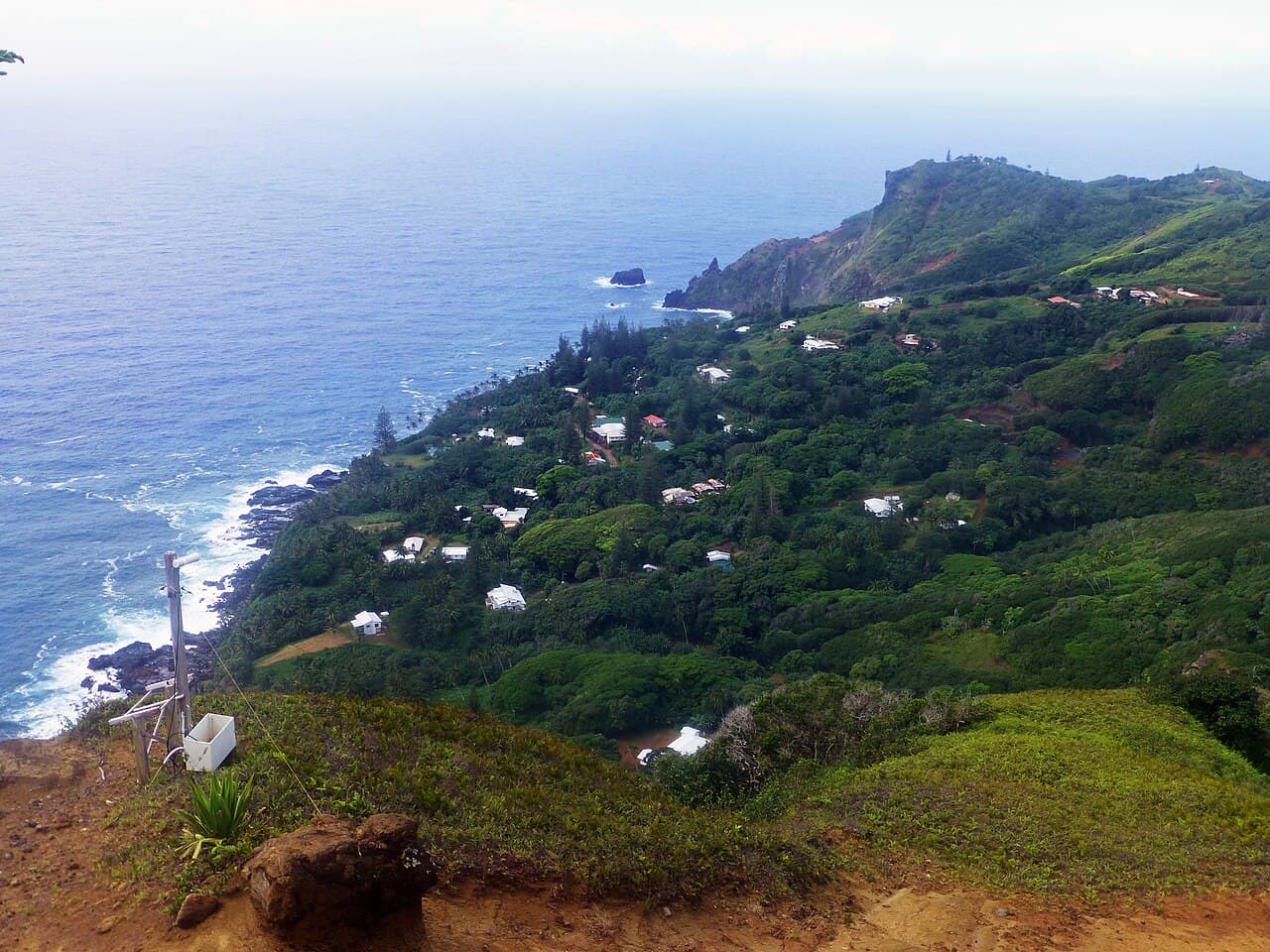 Adamstown is the only settlement, named for the last surviving mutineer, and the population has been in the low dozens for years. Photograph by doublecnz, CC BY 2.0, via Wikimedia Commons.
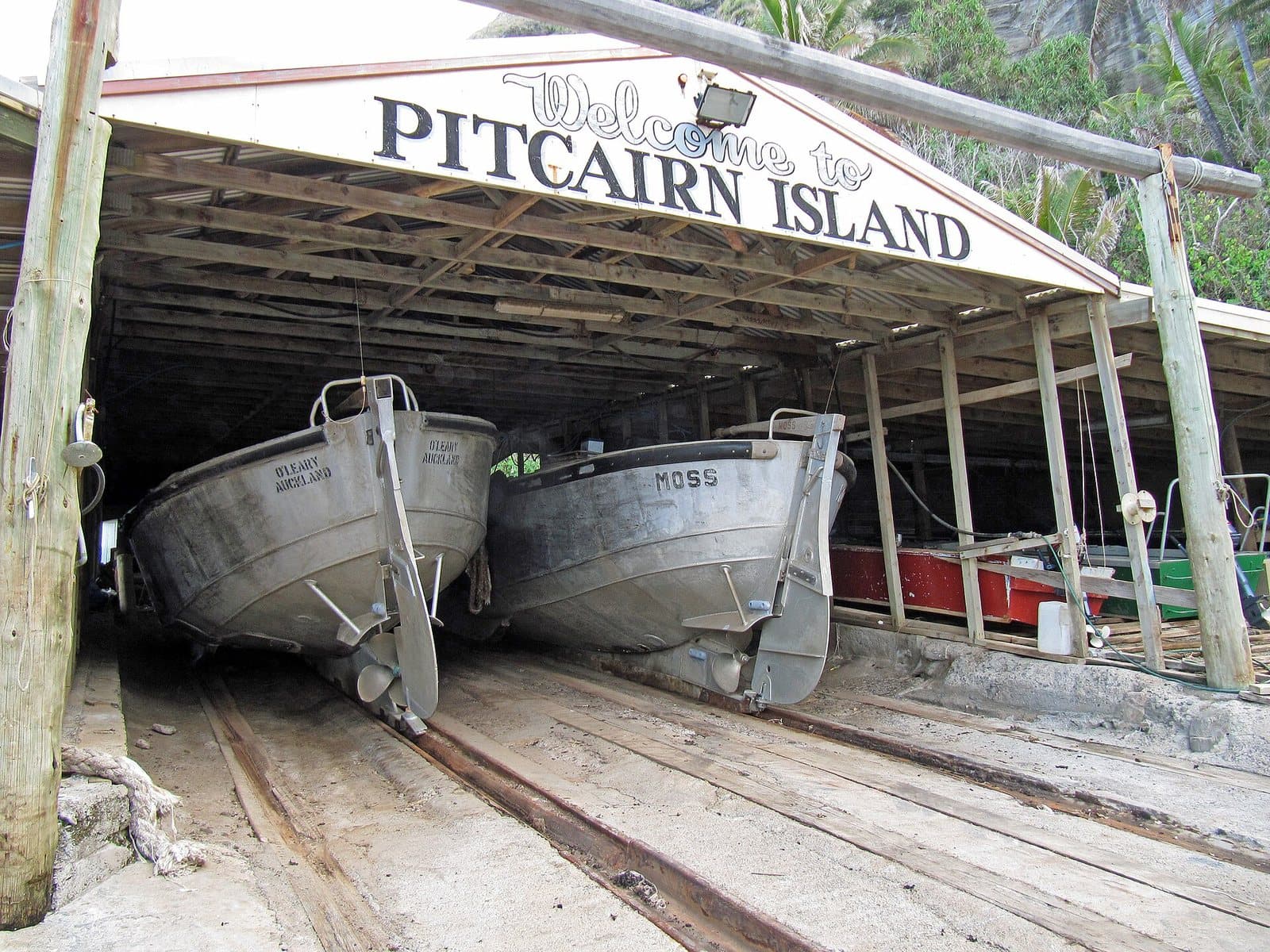
Adamstown. Named for John Adams, the last surviving mutineer, it sits on a shelf above the north coast and holds everything the territory has: church, public hall, courthouse, post office, school and museum, arranged around a square where the Bounty's anchor stands in the open. From there the Hill of Difficulty drops to Bounty Bay, whose jetty, slipway and open-fronted shed hold the longboats that are still the only way ashore.
Bounty Bay. Not a harbour, just a landing where the swell allows. The Bounty was burned here on 23 January 1790 and the wreck lies in shallow water below.
Henderson, Oeno and Ducie. No one lives on any of them. Islanders visit Oeno in summer and Henderson for miro wood, a journey of a day or more each way.
Pitcairn was inhabited long before the Bounty. Polynesians settled here and on Henderson from around 800 AD, leaving adzes, burials and petroglyphs at Down Rope, and had gone by about 1600, most likely as the Mangarevan community that supplied them collapsed. The island Fletcher Christian chose was empty because an earlier society had failed there.
The mutiny took place on 28 April 1789 near Tofua. Christian set Lieutenant William Bligh and eighteen loyal men adrift in the launch, and after a failed settlement at Tubuai the mutineers returned to Tahiti, where most chose to stay. Christian and eight others took the ship, and they did not sail alone. At Tahiti they induced Polynesians aboard, most accounts agreeing on six men, eleven women and a baby girl, and put to sea while they were below. The women were taken. They were not passengers, they had not agreed to leave, and several were separated from husbands and children; the popular retelling of Pitcairn as a romance between mutineers and island brides obscures an abduction. The party reached Pitcairn on 15 January 1790, and the Bounty was burned in the bay eight days later, ending any possibility of leaving.
What followed was not a peaceful settlement. The mutineers divided the land among themselves, gave none to the Polynesian men, whom they treated as labourers, and the killing began. On 20 September 1793, remembered as Massacre Day, Christian and four other mutineers were killed; the Polynesian men were dead soon afterwards, some killed by the women, and spirit distilled from ti root took others. By about 1800 John Adams was the only man left, with nine or ten Polynesian women and a growing number of children, and he raised them on the Bounty's Bible. When the American sealer Topaz called in 1808 the outside world found a settled, literate, church-going village of about thirty-five, which is why Adams was left in peace and eventually pardoned; he died in 1829.
The nineteenth century brought a constitution ahead of its time: the code adopted in 1838 gave the vote to women, decades before any independent state did, and made schooling compulsory. It also brought a crisis of space. In 1856 the British government moved the entire population, 193 people, aboard the transport Morayshire, and they landed at Kingston on Norfolk Island on 8 June. Homesickness set in almost at once. Seventeen returned in 1859 and four more families followed in 1864, leaving 43 people in five families to restart the settlement, while the majority stayed on Norfolk Island, where their descendants form a distinct community with a related language.
The most difficult chapter is recent, and it has to be told plainly. In 1999 a Kent police officer, Gail Cox, posted to the island, uncovered allegations of sexual abuse; when a fifteen-year-old girl made a complaint, an investigation called Operation Unique interviewed effectively every woman who had lived on Pitcairn in recent decades and gathered over a hundred allegations. Seven men then living on the island were charged with 55 offences of rape and indecent assault, some against girls as young as ten, and further charges were laid against men abroad.
The trial was held on Pitcairn between 30 September and 24 October 2004, before New Zealand judges sitting as the Pitcairn Supreme Court. Six were convicted on 35 charges, including Steve Christian, then the island's mayor; Jay Warren was acquitted. Sentences on 29 October ranged from community work to six years' imprisonment. The defence had argued that Britain held no lawful sovereignty because the mutineers renounced their allegiance in 1789, and that English criminal law had never properly been extended here; the Supreme Court and the Court of Appeal rejected this in 2004, and the Privy Council upheld the convictions in Christian v The Queen in October 2006 (2004 Pitcairn Islands sexual assault trial, Wikipedia). A prison was built on the island because there was nowhere else to hold the men, and prisoners were let out to work, including to crew the longboats, since a settlement of fifty could not launch a boat without them.
Britain afterwards stationed a resident police officer and a social worker and legislated for child protection, and the island has operated under external scrutiny ever since.
Pitkern is what happens when eighteenth-century English sailors and Tahitian speakers make a household together and never leave. It is a creole built on the English of the 1780s, including West Country, Scots and West Indian speech from the Bounty's crew, with Tahitian vocabulary and structure through it, formed in one generation on an island of a few dozen people (Pitkern, Wikipedia). Fewer than fifty people speak it on Pitcairn, a number falling since the 1970s, and UNESCO classes it as vulnerable. It is official alongside English and taught at the school.
Its closest relative is Norfuk, carried to Norfolk Island by the emigrants of 1856; the two remain close enough that speakers can follow one another, and the combined speaker population is estimated at a few hundred. The island's place names are the clearest surviving Pitkern text: Down Rope, Where Dan Fall, Bang on Iron, Oh Dear and McCoy's Drop each record an event or a person in a phrase.
The territory's name comes from a British midshipman, Robert Pitcairn, who sighted the island from HMS Swallow in 1767. The position his captain Philip Carteret recorded was wrong by about three degrees of longitude, which is one reason the mutineers thought it a good place to disappear.
The longboats are the centre of practical life. Pitcairn has no harbour, so ships stand off and everything and everyone comes ashore through the surf at Bounty Bay in boats crewed by islanders, and an arrival suspends other work across the village. The boats sit on rails in a shed at the head of the slipway, and the ability to launch them is the practical measure of whether the settlement is still viable.
Around that runs a culture of shared labour, with public work days set by the council to maintain the roads, the landing and the buildings. Households grow breadfruit, bananas, taro and sugar cane on plots outside the village, keep bees for a honey with an unusually clean disease profile, and carve miro wood into models of the Bounty and birds, sold to ship passengers with the territory's stamps. Local dishes such as pilhi, a baked pudding of grated root vegetables or banana, and pota, cooked greens, carry Polynesian technique under English names. Bounty Day on 23 January marks the burning of the ship, kept with a model set alight in the bay.
The mutineers' community formed around a book. John Adams taught the children from the Bounty's Bible, and the island was Anglican in character for most of the nineteenth century. That changed in 1886, when an American Seventh-day Adventist layman, John Tay, spent five weeks on Pitcairn and persuaded most of the population of the seventh-day sabbath. Tay could not baptise, so the denomination built a missionary schooner, funded by Sabbath School collections and named Pitcairn, which sailed from Oakland in October 1890 and arrived that November with ordained ministers. The island has been Adventist ever since (Pitcairn Island, Adventist Encyclopedia).
The consequences ran through everyday life for a century. Saturday was the sabbath, with work and boat launches avoided; Adventist teaching discouraged pork and shellfish and favoured vegetarian cooking; and alcohol was banned outright, in a community that remembered what home-distilled spirit had done to the first generation. Prohibition ended in 2009 after a vote.
The faith itself has thinned dramatically. Reporting in the past decade has described a handful of people, at times as few as three, attending services regularly, with a visiting pastor often the main link to the wider church. The Saturday rhythm persists in the calendar more than in the pews.
Pitcairn's dead are close at hand. The small cemetery sits above Adamstown, and the graves of a community that has never numbered more than a couple of hundred people record nearly every family that has lived here. John Adams has the only marked grave of a Bounty mutineer anywhere in the world, on a rise above the village, its wooden marker replaced with stone after 1856. Fletcher Christian has no grave anyone can point to. He was killed in 1793 and buried where he fell, and the absence has kept a small industry of speculation going, including persistent stories that he returned to England.
The island's most important memorial object is a book. The Pitcairn Island Register recorded births, marriages and deaths from 1790 to 1854 and is the founding genealogical document of both the Pitcairn and Norfolk communities; it is held by Royal Museums Greenwich and has been digitised. Where nearly everyone shares a handful of surnames, Christian, Young, Warren and Brown among them, genealogy is simply how you know who someone is.
The question hanging over all of this is one Pitcairners ask themselves. A community of forty, with few children and a median age well into middle life, has to consider who will bury the last generation and who will keep the graves. A diaspora survey reported in 2014 projected that on then-current trends only three people of working age would remain by 2045, and found little appetite among those who had left to return. Islanders discuss the possibility that the settlement ends, openly and without much sentimentality, which is itself a form of remembrance: people planning what happens to a place after them.
Pitcairn's genealogy is unusually complete and unusually small, because everybody descends from the same eighteen people.
Nine Bounty mutineers and the Polynesian men and women who came with them from Tahiti landed here in 1790, and the island was not found by the outside world until 1808. The founding population is therefore known by name, and the descent of every Pitcairner from them is documented. Surnames are Christian, Young, Warren and Brown, and the population has been under a hundred for most of the last century.
The records are British and are held on the island and at Kew, along with the Pitcairn register kept from the nineteenth century. Adventist mission records date from 1886, when the whole island converted.
The complication is the arithmetic. With a founding group that size, everyone is related to everyone, and Pitcairn genealogy is about tracking how closely rather than whether.
Norfolk Island is part of the same record. In 1856 the entire Pitcairn population, then 194 people, was moved to Norfolk Island by the British government; about a third later came back. So Pitcairn and Norfolk families share ancestors and their registers cross-reference.
Pitkern, the creole of English and Tahitian that the founders' children made, is spoken by a few dozen people and is one of the smallest living languages in the world.
The territory's own institution is the Museum of Bounty, opened on the Adamstown square in 2005. It holds a cannon raised from Bounty Bay in 1997, fittings and a rudder pin recovered from the wreck by the diver Luis Marden in 1957, Polynesian stone tools predating the mutineers, and the Bounty Bible. That Bible had a long journey home: taken from the island in the nineteenth century, it passed to the Connecticut Historical Society in 1896, was handed to the British ambassador in Washington in 1949 after a request from the island's schoolteacher, and came back to Pitcairn in February 1950.
The larger collection is in California. The Pitcairn Islands Study Center at Pacific Union College in Angwin, founded by Herbert Ford in 1977, holds what is generally described as the largest collection anywhere of material on the mutiny, Bligh, the Bounty and the Pitcairn and Norfolk communities (Pitcairn Islands Study Center). Official records sit at The National Archives in Britain, the Register at Greenwich, and further material in New Zealand and Australian collections. Very little documentary heritage is on the island, which is a vulnerability and also, given the climate and the shipping, sensible.
Natural heritage is better resourced. Henderson Island was inscribed on the UNESCO World Heritage List in 1988 as one of the few raised coral islands whose habitats remain largely intact, with ten endemic flowering plants, four endemic land birds and many endemic insects and snails (UNESCO, Henderson Island). A 2011 attempt by the RSPB and the Pitcairn government to remove the introduced Pacific rat failed, with rats confirmed again in 2012.
Henderson is also, awkwardly for a World Heritage site thousands of kilometres from the nearest industry, among the most polluted beaches on earth. A survey published in 2017 by Jennifer Lavers and Alexander Bond estimated some 37.7 million pieces of plastic debris weighing about 17.6 tonnes on its shores, with 17 to 268 new items washing up daily on a ten-metre stretch of North Beach (Henderson Island, Wikipedia). It receives whatever the South Pacific gyre delivers, and has become a reference point in the measurement of ocean plastic.
Pitcairn's most visible digital asset is its internet suffix. The .pn domain gives the island a presence out of proportion to its size, used by government.pn, visitpitcairn.pn and miscellany.pn. The Pitcairn Miscellany, the island newsletter published since 1959, carries ship arrivals, birthdays, trips to Oeno and Henderson and council business, and its back numbers are the closest thing to a continuous chronicle of daily life here.
Digitisation of the older record has mostly happened abroad. The Pitcairn Island Register is freely readable online, the Study Center has published hundreds of photographs and postcards through Digital Pasifik, and colonial files at Kew are catalogued. Islanders sell honey, carvings and stamps through the territory's web shop, and satellite links let a resident answer an order the same day.
What does not exist is a Pitkern-language digital archive of any depth. The standard linguistic description dates from the 1960s, and recordings of ordinary speech, the island's most perishable heritage, are few.
The Bounty story is the island's largest export and its heaviest inheritance. Nordhoff and Hall's trilogy, and the films of 1935, 1962 and 1984, fixed the mutiny in popular memory and made Pitcairn shorthand for escape from authority. Almost none of that attention concerns the people who live there, and the version of the settlement it carries is the one the record contradicts.
The 2004 trials changed the island's external relationships permanently. Safeguarding structures, a resident police presence and closer oversight from Wellington and London followed, along with the difficulty of a village of a few dozen people in which convicted men and their victims' families went on living side by side. Reporting since has been intermittent and often sensational, and the islanders' own accounts are harder to find.
Repopulation is the standing policy problem. Since 2013 the territory has offered free land and eventual residency to settlers, and take-up has been close to nil, largely because applicants must fund themselves through a probation period in which they may not take paid work, and the council may still decline them at the end.
An ocean protected. The Pitcairn Islands Marine Reserve, declared in 2015 and covering about 834,000 square kilometres, was the largest single marine protected area in the world when created.
A World Heritage island. Henderson's inscription in 1988 recognised one of the last raised coral islands whose habitats remain largely intact, and conservation work by the RSPB and the island government has continued despite the failure of the 2011 rat eradication.
The Bible came back. The Bounty's Bible, carried away in the nineteenth century, was returned from Connecticut through diplomatic channels and presented to the islanders in 1950.
A creole still taught. Pitkern, spoken by fewer than fifty people, holds official status and a place on the school timetable, more than most languages of its size can claim.
Adamstown is the only settlement, named for the last surviving mutineer, and the population has been in the low dozens for years. Photograph by doublecnz, CC BY 2.0, via Wikimedia Commons.
Adamstown. Named for John Adams, the last surviving mutineer, it sits on a shelf above the north coast and holds everything the territory has: church, public hall, courthouse, post office, school and museum, arranged around a square where the Bounty's anchor stands in the open. From there the Hill of Difficulty drops to Bounty Bay, whose jetty, slipway and open-fronted shed hold the longboats that are still the only way ashore.
Bounty Bay. Not a harbour, just a landing where the swell allows. The Bounty was burned here on 23 January 1790 and the wreck lies in shallow water below.
Henderson, Oeno and Ducie. No one lives on any of them. Islanders visit Oeno in summer and Henderson for miro wood, a journey of a day or more each way.
Pitcairn was inhabited long before the Bounty. Polynesians settled here and on Henderson from around 800 AD, leaving adzes, burials and petroglyphs at Down Rope, and had gone by about 1600, most likely as the Mangarevan community that supplied them collapsed. The island Fletcher Christian chose was empty because an earlier society had failed there.
The mutiny took place on 28 April 1789 near Tofua. Christian set Lieutenant William Bligh and eighteen loyal men adrift in the launch, and after a failed settlement at Tubuai the mutineers returned to Tahiti, where most chose to stay. Christian and eight others took the ship, and they did not sail alone. At Tahiti they induced Polynesians aboard, most accounts agreeing on six men, eleven women and a baby girl, and put to sea while they were below. The women were taken. They were not passengers, they had not agreed to leave, and several were separated from husbands and children; the popular retelling of Pitcairn as a romance between mutineers and island brides obscures an abduction. The party reached Pitcairn on 15 January 1790, and the Bounty was burned in the bay eight days later, ending any possibility of leaving.
What followed was not a peaceful settlement. The mutineers divided the land among themselves, gave none to the Polynesian men, whom they treated as labourers, and the killing began. On 20 September 1793, remembered as Massacre Day, Christian and four other mutineers were killed; the Polynesian men were dead soon afterwards, some killed by the women, and spirit distilled from ti root took others. By about 1800 John Adams was the only man left, with nine or ten Polynesian women and a growing number of children, and he raised them on the Bounty's Bible. When the American sealer Topaz called in 1808 the outside world found a settled, literate, church-going village of about thirty-five, which is why Adams was left in peace and eventually pardoned; he died in 1829.
The nineteenth century brought a constitution ahead of its time: the code adopted in 1838 gave the vote to women, decades before any independent state did, and made schooling compulsory. It also brought a crisis of space. In 1856 the British government moved the entire population, 193 people, aboard the transport Morayshire, and they landed at Kingston on Norfolk Island on 8 June. Homesickness set in almost at once. Seventeen returned in 1859 and four more families followed in 1864, leaving 43 people in five families to restart the settlement, while the majority stayed on Norfolk Island, where their descendants form a distinct community with a related language.
The most difficult chapter is recent, and it has to be told plainly. In 1999 a Kent police officer, Gail Cox, posted to the island, uncovered allegations of sexual abuse; when a fifteen-year-old girl made a complaint, an investigation called Operation Unique interviewed effectively every woman who had lived on Pitcairn in recent decades and gathered over a hundred allegations. Seven men then living on the island were charged with 55 offences of rape and indecent assault, some against girls as young as ten, and further charges were laid against men abroad.
The trial was held on Pitcairn between 30 September and 24 October 2004, before New Zealand judges sitting as the Pitcairn Supreme Court. Six were convicted on 35 charges, including Steve Christian, then the island's mayor; Jay Warren was acquitted. Sentences on 29 October ranged from community work to six years' imprisonment. The defence had argued that Britain held no lawful sovereignty because the mutineers renounced their allegiance in 1789, and that English criminal law had never properly been extended here; the Supreme Court and the Court of Appeal rejected this in 2004, and the Privy Council upheld the convictions in Christian v The Queen in October 2006 (2004 Pitcairn Islands sexual assault trial, Wikipedia). A prison was built on the island because there was nowhere else to hold the men, and prisoners were let out to work, including to crew the longboats, since a settlement of fifty could not launch a boat without them.
Britain afterwards stationed a resident police officer and a social worker and legislated for child protection, and the island has operated under external scrutiny ever since.
Pitkern is what happens when eighteenth-century English sailors and Tahitian speakers make a household together and never leave. It is a creole built on the English of the 1780s, including West Country, Scots and West Indian speech from the Bounty's crew, with Tahitian vocabulary and structure through it, formed in one generation on an island of a few dozen people (Pitkern, Wikipedia). Fewer than fifty people speak it on Pitcairn, a number falling since the 1970s, and UNESCO classes it as vulnerable. It is official alongside English and taught at the school.
Its closest relative is Norfuk, carried to Norfolk Island by the emigrants of 1856; the two remain close enough that speakers can follow one another, and the combined speaker population is estimated at a few hundred. The island's place names are the clearest surviving Pitkern text: Down Rope, Where Dan Fall, Bang on Iron, Oh Dear and McCoy's Drop each record an event or a person in a phrase.
The territory's name comes from a British midshipman, Robert Pitcairn, who sighted the island from HMS Swallow in 1767. The position his captain Philip Carteret recorded was wrong by about three degrees of longitude, which is one reason the mutineers thought it a good place to disappear.
The longboats are the centre of practical life. Pitcairn has no harbour, so ships stand off and everything and everyone comes ashore through the surf at Bounty Bay in boats crewed by islanders, and an arrival suspends other work across the village. The boats sit on rails in a shed at the head of the slipway, and the ability to launch them is the practical measure of whether the settlement is still viable.
Around that runs a culture of shared labour, with public work days set by the council to maintain the roads, the landing and the buildings. Households grow breadfruit, bananas, taro and sugar cane on plots outside the village, keep bees for a honey with an unusually clean disease profile, and carve miro wood into models of the Bounty and birds, sold to ship passengers with the territory's stamps. Local dishes such as pilhi, a baked pudding of grated root vegetables or banana, and pota, cooked greens, carry Polynesian technique under English names. Bounty Day on 23 January marks the burning of the ship, kept with a model set alight in the bay.
The mutineers' community formed around a book. John Adams taught the children from the Bounty's Bible, and the island was Anglican in character for most of the nineteenth century. That changed in 1886, when an American Seventh-day Adventist layman, John Tay, spent five weeks on Pitcairn and persuaded most of the population of the seventh-day sabbath. Tay could not baptise, so the denomination built a missionary schooner, funded by Sabbath School collections and named Pitcairn, which sailed from Oakland in October 1890 and arrived that November with ordained ministers. The island has been Adventist ever since (Pitcairn Island, Adventist Encyclopedia).
The consequences ran through everyday life for a century. Saturday was the sabbath, with work and boat launches avoided; Adventist teaching discouraged pork and shellfish and favoured vegetarian cooking; and alcohol was banned outright, in a community that remembered what home-distilled spirit had done to the first generation. Prohibition ended in 2009 after a vote.
The faith itself has thinned dramatically. Reporting in the past decade has described a handful of people, at times as few as three, attending services regularly, with a visiting pastor often the main link to the wider church. The Saturday rhythm persists in the calendar more than in the pews.
Pitcairn's dead are close at hand. The small cemetery sits above Adamstown, and the graves of a community that has never numbered more than a couple of hundred people record nearly every family that has lived here. John Adams has the only marked grave of a Bounty mutineer anywhere in the world, on a rise above the village, its wooden marker replaced with stone after 1856. Fletcher Christian has no grave anyone can point to. He was killed in 1793 and buried where he fell, and the absence has kept a small industry of speculation going, including persistent stories that he returned to England.
The island's most important memorial object is a book. The Pitcairn Island Register recorded births, marriages and deaths from 1790 to 1854 and is the founding genealogical document of both the Pitcairn and Norfolk communities; it is held by Royal Museums Greenwich and has been digitised. Where nearly everyone shares a handful of surnames, Christian, Young, Warren and Brown among them, genealogy is simply how you know who someone is.
The question hanging over all of this is one Pitcairners ask themselves. A community of forty, with few children and a median age well into middle life, has to consider who will bury the last generation and who will keep the graves. A diaspora survey reported in 2014 projected that on then-current trends only three people of working age would remain by 2045, and found little appetite among those who had left to return. Islanders discuss the possibility that the settlement ends, openly and without much sentimentality, which is itself a form of remembrance: people planning what happens to a place after them.
Pitcairn's genealogy is unusually complete and unusually small, because everybody descends from the same eighteen people.
Nine Bounty mutineers and the Polynesian men and women who came with them from Tahiti landed here in 1790, and the island was not found by the outside world until 1808. The founding population is therefore known by name, and the descent of every Pitcairner from them is documented. Surnames are Christian, Young, Warren and Brown, and the population has been under a hundred for most of the last century.
The records are British and are held on the island and at Kew, along with the Pitcairn register kept from the nineteenth century. Adventist mission records date from 1886, when the whole island converted.
The complication is the arithmetic. With a founding group that size, everyone is related to everyone, and Pitcairn genealogy is about tracking how closely rather than whether.
Norfolk Island is part of the same record. In 1856 the entire Pitcairn population, then 194 people, was moved to Norfolk Island by the British government; about a third later came back. So Pitcairn and Norfolk families share ancestors and their registers cross-reference.
Pitkern, the creole of English and Tahitian that the founders' children made, is spoken by a few dozen people and is one of the smallest living languages in the world.
The territory's own institution is the Museum of Bounty, opened on the Adamstown square in 2005. It holds a cannon raised from Bounty Bay in 1997, fittings and a rudder pin recovered from the wreck by the diver Luis Marden in 1957, Polynesian stone tools predating the mutineers, and the Bounty Bible. That Bible had a long journey home: taken from the island in the nineteenth century, it passed to the Connecticut Historical Society in 1896, was handed to the British ambassador in Washington in 1949 after a request from the island's schoolteacher, and came back to Pitcairn in February 1950.
The larger collection is in California. The Pitcairn Islands Study Center at Pacific Union College in Angwin, founded by Herbert Ford in 1977, holds what is generally described as the largest collection anywhere of material on the mutiny, Bligh, the Bounty and the Pitcairn and Norfolk communities (Pitcairn Islands Study Center). Official records sit at The National Archives in Britain, the Register at Greenwich, and further material in New Zealand and Australian collections. Very little documentary heritage is on the island, which is a vulnerability and also, given the climate and the shipping, sensible.
Natural heritage is better resourced. Henderson Island was inscribed on the UNESCO World Heritage List in 1988 as one of the few raised coral islands whose habitats remain largely intact, with ten endemic flowering plants, four endemic land birds and many endemic insects and snails (UNESCO, Henderson Island). A 2011 attempt by the RSPB and the Pitcairn government to remove the introduced Pacific rat failed, with rats confirmed again in 2012.
Henderson is also, awkwardly for a World Heritage site thousands of kilometres from the nearest industry, among the most polluted beaches on earth. A survey published in 2017 by Jennifer Lavers and Alexander Bond estimated some 37.7 million pieces of plastic debris weighing about 17.6 tonnes on its shores, with 17 to 268 new items washing up daily on a ten-metre stretch of North Beach (Henderson Island, Wikipedia). It receives whatever the South Pacific gyre delivers, and has become a reference point in the measurement of ocean plastic.
Pitcairn's most visible digital asset is its internet suffix. The .pn domain gives the island a presence out of proportion to its size, used by government.pn, visitpitcairn.pn and miscellany.pn. The Pitcairn Miscellany, the island newsletter published since 1959, carries ship arrivals, birthdays, trips to Oeno and Henderson and council business, and its back numbers are the closest thing to a continuous chronicle of daily life here.
Digitisation of the older record has mostly happened abroad. The Pitcairn Island Register is freely readable online, the Study Center has published hundreds of photographs and postcards through Digital Pasifik, and colonial files at Kew are catalogued. Islanders sell honey, carvings and stamps through the territory's web shop, and satellite links let a resident answer an order the same day.
What does not exist is a Pitkern-language digital archive of any depth. The standard linguistic description dates from the 1960s, and recordings of ordinary speech, the island's most perishable heritage, are few.
The Bounty story is the island's largest export and its heaviest inheritance. Nordhoff and Hall's trilogy, and the films of 1935, 1962 and 1984, fixed the mutiny in popular memory and made Pitcairn shorthand for escape from authority. Almost none of that attention concerns the people who live there, and the version of the settlement it carries is the one the record contradicts.
The 2004 trials changed the island's external relationships permanently. Safeguarding structures, a resident police presence and closer oversight from Wellington and London followed, along with the difficulty of a village of a few dozen people in which convicted men and their victims' families went on living side by side. Reporting since has been intermittent and often sensational, and the islanders' own accounts are harder to find.
Repopulation is the standing policy problem. Since 2013 the territory has offered free land and eventual residency to settlers, and take-up has been close to nil, largely because applicants must fund themselves through a probation period in which they may not take paid work, and the council may still decline them at the end.
An ocean protected. The Pitcairn Islands Marine Reserve, declared in 2015 and covering about 834,000 square kilometres, was the largest single marine protected area in the world when created.
A World Heritage island. Henderson's inscription in 1988 recognised one of the last raised coral islands whose habitats remain largely intact, and conservation work by the RSPB and the island government has continued despite the failure of the 2011 rat eradication.
The Bible came back. The Bounty's Bible, carried away in the nineteenth century, was returned from Connecticut through diplomatic channels and presented to the islanders in 1950.
A creole still taught. Pitkern, spoken by fewer than fifty people, holds official status and a place on the school timetable, more than most languages of its size can claim.
National Overview
Notable Cities
Historical Foundations
Linguistic and Etymological Roots
Cultural Identity
Religion and Spirituality
Remembrance and Mourning Traditions
Tracing a Family in Pitcairn Islands
Heritage Preservation Efforts
Digital Heritage
Contemporary Cultural Influences
Success Stories
References and resources
- Pitcairn Islands, Wikipedia: geography, population, governance and settlement history.
- Government of the Pitcairn Islands: the official site, population and council.
- 2004 Pitcairn Islands sexual assault trial, Wikipedia: Operation Unique, the charges, verdicts and appeals.
- Pitkern, Wikipedia: the creole's origins, speakers and relation to Norfuk.
- UNESCO, Henderson Island: the 1988 inscription and the island's endemic species.
- Henderson Island, Wikipedia: settlement, the plastic surveys and rat eradication.
- Pitcairn Islands Study Center: the largest Bounty and Pitcairn collection.
- Bounty Bible, Wikipedia: its years in Connecticut and its return in 1950.
- Pitcairn Island, Adventist Encyclopedia: John Tay and the schooner Pitcairn.
- BBC News, Pitcairn Islands get huge marine reserve: the 2015 declaration.