Heritage · Country
Navajo Nation Culture and Heritage
The Navajo Nation is the largest Native American territory in the United States, and its traditional teaching about death is to release rather than to keep: four days of mourning, and the name of the dead not spoken. This is a guide to Diné heritage, and to how a people preserve a past when the rule about the dead is to let them go.Written to last.
By Confinity Heritage Editorial · Updated 2026-08-20 · 8-minute readQuiet tools, kept out of the way.
Most of the heritage traditions described in this series work by holding on. A tomb is visited, a stool is fed, a name is read aloud on an anniversary. Diné teaching runs the other way. The mourning period is four days, the dead person's name is generally not spoken afterwards, and the emphasis falls on restoring balance among the living rather than on maintaining a relationship with the one who has gone.
That does not make this a place without memory. It makes it a place where memory is carried by other things: by a language that is still the most widely spoken Indigenous language in the United States, by four mountains that mark the boundaries of the world, by a treaty kept as an object, and by institutions the Nation built itself when nobody else was going to.
The Navajo Nation covers roughly 27,000 square miles, about 71,000 square kilometres, across northeastern Arizona, southeastern Utah and northwestern New Mexico. It is the largest Native American reservation in the United States, comparable in size to West Virginia or to the Republic of Ireland. More than 399,000 people are enrolled citizens, of whom something under half live on the Nation itself.
It is a government, not a district. The Navajo Nation has an executive branch under an elected president, a legislative Navajo Nation Council of twenty-four delegates meeting at Window Rock, and its own judiciary applying Diné bi beenahazʼáanii, Navajo common law, alongside statute. It maintains its own police, its own historic preservation department, its own museum and its own college. The land is high desert and mesa, between about 1,500 and 3,000 metres, and it is beautiful and hard: a substantial share of households have gone without piped water or mains electricity, a fact that determined how badly the Nation was hit when the pandemic arrived.
Window Rock, Arizona. The seat of government, named for the sandstone arch above it, and the site of the Navajo Nation Council Chamber, the Navajo Nation Museum and the Navajo Code Talker Memorial.
Shiprock, New Mexico. The largest community on the Nation, named in English for the volcanic neck that rises nearby, called Tsé Bitʼaʼí, the winged rock, in Navajo. The Northern Navajo Nation Fair, held here since 1924, is among the oldest.
Tuba City, Arizona. The western administrative centre, close to the Hopi reservation which the Navajo Nation entirely surrounds, and to the dinosaur trackways that draw visitors off the highway.
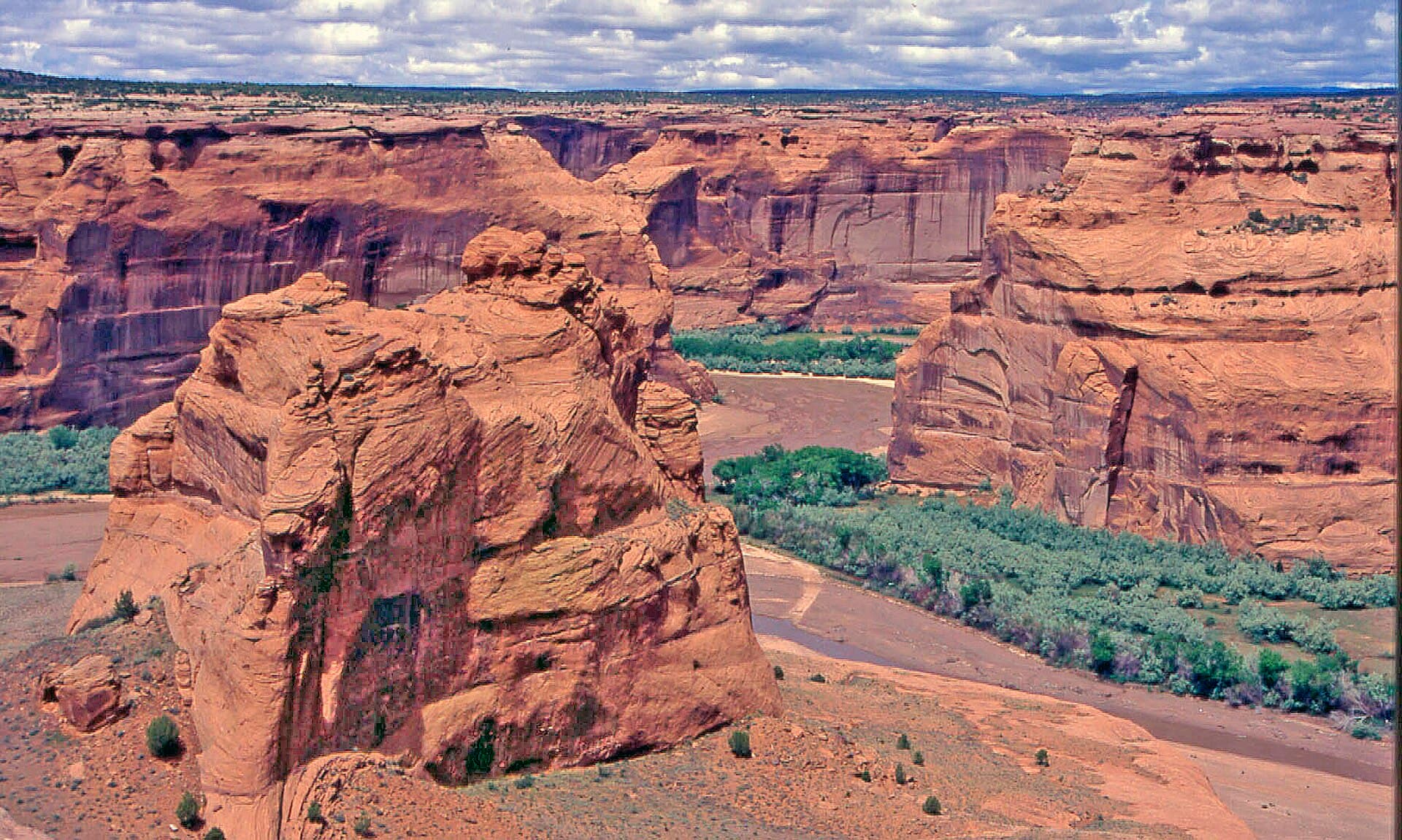
Chinle, Arizona. The gateway to Canyon de Chelly, and the base for the guides without whom most of the canyon floor cannot legally be visited, since people still live and farm there.
Tsaile, Arizona. Small, but the main campus of Diné College sits here, its hogan-shaped Ned Hatathli Center built to face east as a dwelling should.
The Diné are Athabaskan speakers, and their language is closely related to those of the interior of Alaska and northwestern Canada, which places their origins far to the north and their arrival in the Southwest within roughly the last thousand years. What they made there was distinct: a pastoral and agricultural society organised around sheep, corn and matrilineal clans, absorbing crops, weaving and ceremony from Puebloan neighbours and, after Spanish contact, horses and sheep that reshaped the economy entirely.
The founding wound is the Long Walk. Between 1863 and 1866, following a campaign led by Kit Carson that destroyed crops, orchards and flocks including those in Canyon de Chelly, more than ten thousand Diné were forcibly removed to Bosque Redondo at Fort Sumner in eastern New Mexico, marched between 250 and 450 miles. The place is remembered in Navajo as Hwéeldi. People died on the march and in the camp, of exposure, hunger and disease, over four years in which the land could not support them.
It ended, unusually, in a negotiated return. The Treaty of 1868, signed on 1 June on paper torn from an army ledger, allowed the Diné to go home to a portion of their own country rather than be relocated to Indian Territory. It is known as Naaltsoos Sání, the old paper, and it is treated as a founding document in a literal sense: its original has travelled to the Nation for public display, and people queue to see it. That the return was homewards, to the land between the four sacred mountains, is the reason Diné heritage is so strongly attached to specific ground.
The twentieth century brought two further collective injuries that shape current politics. The federal livestock reduction programme of the 1930s destroyed hundreds of thousands of sheep, goats and horses in front of their owners, and remains one of the bitterest memories on the Nation. And uranium mining from the 1940s left more than five hundred abandoned mines on Navajo land, with a legacy of contamination and disease, compounded in July 1979 when a tailings dam failed at Church Rock and released more radioactive material than the accident at Three Mile Island.
Diné bizaad is the most widely spoken Indigenous language in the United States. UNESCO's atlas records roughly 120,000 speakers and classifies it as vulnerable, which for a language of the Americas is a comparatively strong position and still a warning: the speakers skew old, and transmission to children has fallen sharply within living memory.
The language is verb-centred and highly inflected, with tone and a system of classificatory verb stems in which the verb for handling an object changes according to the object's shape and rigidity. It is difficult for adult learners and was, for a period, actively punished. Children taken to federal and mission boarding schools from the late nineteenth century were forbidden to speak it and were beaten for doing so, a policy explicitly aimed at the language itself.
Which makes what happened next the sharpest irony in the Nation's history. From 1942 the United States Marine Corps recruited Diné speakers to build a battlefield code on their language, beginning with an original group of twenty-nine and growing to around four hundred code talkers. The code was never broken. Men whose schooling had been designed to remove their language were sent to war because of it, and the programme stayed classified until 1968, so they could not speak about it for a generation.
Kinship is the organising system, and it is matrilineal. A Diné person introduces themselves by four clans: born to their mother's, born for their father's, and then the maternal and paternal grandfathers' clans. This is not a formality. It establishes how two strangers are related and therefore how they must behave toward each other, and it governs whom a person may marry. There are more than sixty clans.
 Tse Bit'a'i, the rock with wings, is sacred and climbing it has been prohibited by the Navajo Nation since 1970. Photograph by PLBechly, CC BY-SA 4.0, via Wikimedia Commons.
The hogan is the traditional dwelling and the ceremonial building: earth and timber, the door facing east to the sunrise, the interior organised by direction. Many families now live in houses and keep a hogan for ceremony. Sheep remain central well beyond their economic value, and the Navajo-Churro breed, brought by the Spanish and nearly destroyed in the reduction programme, has been deliberately brought back.
Weaving is the best known Diné art and one of the few that is unambiguously theirs in origin and development. Regional styles such as Two Grey Hills, Ganado and Teec Nos Pos are recognised by pattern and palette, and the work is understood as carrying the weaver's thought rather than simply reproducing a design. Silversmithing, learned in the mid nineteenth century and made distinctively Diné with turquoise, is the other major tradition, and both have long been entangled with a trading post economy that made them famous and frequently underpaid.
The organising concept is hózhó, usually translated as beauty, harmony or balance, and better understood as the correct condition of things. Illness and misfortune are understood as balance disturbed, and the purpose of ceremony is to restore it. Ceremonies are conducted by hataałii, singers, who hold long memorised chantways such as the Blessingway and the Night Chant, running for days, and who use drypainting made of coloured sand that is destroyed at the end of the rite.
The world is bounded by four sacred mountains: Sisnaajiní in the east, Tsoodził in the south, Dookʼoʼoosłííd in the west and Dibé Nitsaa in the north. To live between them is the condition of being Diné, and this is why the return of 1868 mattered so much more than the acreage involved. Several of these mountains lie outside the Nation's legal boundary, which has produced sustained disputes over development on them, most persistently over the San Francisco Peaks.
Diné people today are variously traditional practitioners, Christians of several denominations, members of the Native American Church, or some combination, and combination is common rather than contradictory. It should also be said plainly that a good deal of ceremonial knowledge is restricted: it is held by particular practitioners, taught in particular circumstances, and not intended for publication. Accounts written for outsiders, including this one, are working with the part that Diné people have chosen to make public.
Traditional Diné teaching treats death as genuinely dangerous to the living. What is left behind at death is the chindi, understood as the part of a person that could not go with them, everything that was out of balance in their life. Contact with it is thought to cause illness. The response is separation rather than commemoration.
In practice this shaped a set of practices that outsiders often misread as coldness. The mourning period is four days, after which normal life is expected to resume. The dead person's name is generally not spoken again. A hogan in which a death had occurred was traditionally abandoned, and often broken open on the north side so that people would know not to enter. Those who handled the body underwent purification and a period of separation before rejoining the community. The purpose throughout is to return the living to hózhó, not to maintain a bond with the person who has died.
The result is a heritage tradition with almost no monuments to individuals, and this is a positive choice rather than an absence. Where there is no name spoken and no grave visited, what remains is the clan, the land, the language and the ceremony, and it is those that carry a person forward. A Diné family's continuity runs through kinship rather than through a marked place.
Two qualifications matter. First, practice varies widely and always has, and the arrival of Christianity, of the Native American Church, of hospitals, funeral homes and cemeteries has produced families who hold funerals, mark graves and use their dead relatives' names. Second, collective remembrance is a different matter from individual remembrance, and the Nation does it strongly: the Long Walk is commemorated publicly, memorial rides retrace the route, the treaty is displayed, and the Code Talkers are honoured with a memorial at Window Rock, a national day on 14 August and, in 2000 and 2001, Congressional Gold and Silver Medals. What Diné tradition avoids is dwelling on a particular death, not remembering a shared history.
Diné genealogy is recited before anything else happens, and it is matrilineal.
A Navajo introduces themselves by four clans: mother's clan, father's clan, maternal grandfather's clan and paternal grandfather's clan, in that order. It establishes immediately who a person may and may not marry, and who they are related to across a nation of hundreds of thousands. There are more than sixty clans, and the system is the genealogy: precise, universal, and carried by everyone rather than by specialists.
The written record was made by the federal government and it is uncomfortable. The Navajo Census Rolls, taken from the early twentieth century, and the census cards of the Bureau of Indian Affairs list individuals with family relationships and are the standard source for Diné family research, held by the National Archives. Enrolment in the Navajo Nation requires documenting descent through them, so a bureaucratic record made for administration is now the proof of belonging.
Earlier still are the Fort Sumner records. Around ten thousand Diné were marched to Bosque Redondo in 1864 and held for four years, and the army's ration rolls and censuses from that captivity name people, which makes the Long Walk one of the better documented atrocities of the period.
Traditional practice avoids speaking the names of the dead and does not encourage visiting graves, so the family record lives in the clans and in the ceremonies rather than in a cemetery.
The Navajo Nation runs its own Historic Preservation Department, which administers cultural resource review across the reservation and operates with the standing of a state historic preservation office, so that archaeological and cultural clearance for development on Navajo land is a Navajo decision. This is an unusual degree of self-administration and it is the single most consequential preservation fact about the Nation.
Canyon de Chelly is jointly managed, held in trust by the Navajo Nation and administered with the National Park Service, and it remains inhabited and farmed, so visitors are restricted to the rim and to one trail unless accompanied by a Navajo guide. It has been continuously occupied for thousands of years, holds Ancestral Puebloan cliff dwellings alongside Diné farms, and carries the memory of the 1864 campaign in the same landscape.
Diné College at Tsaile, founded in 1968 as Navajo Community College, was the first tribally controlled college in the United States and set the pattern for the tribal college movement nationally. Its founding purpose was explicitly to teach Navajo language, history and philosophy at a time when no other institution would, and language and culture remain built into its curriculum rather than offered beside it. The Navajo Nation Museum at Window Rock holds the Nation's collections and exhibitions, and the Nation has been active under federal repatriation law in recovering ancestral remains and funerary objects from museums, an area where the traditional reluctance to disturb the dead and the legal machinery of repatriation intersect awkwardly and are worked through case by case.
Language work is where the digital effort concentrates, and it is comparatively advanced. Diné bizaad has dictionaries, teaching materials, keyboard and font support for its diacritics, online courses and a body of recorded speech, produced by Diné College, by Navajo Nation programmes and by university linguists. Navajo has an unusually visible presence in software localisation and in media for a language of its size.
Broadcast and press give the Nation a documentary record most Indigenous nations lack. The Navajo Times has published since 1959 and is one of the few Native newspapers independent of the government it covers, and Navajo-language radio has carried news, ceremony announcements and public health information for decades, which proved decisive during the pandemic.
Oral history is collected and increasingly published, with Long Walk testimony, boarding school accounts and Code Talker interviews held in Nation, university and Library of Congress collections. Here again the limit is deliberate rather than technical: material that touches restricted ceremonial knowledge, or that names the dead, is handled according to Diné protocols, and a number of archives now operate under access agreements that let the originating community set the terms. That is a model other institutions have adopted.
Navajo weaving and silverwork are among the most recognisable Native American art forms in the world, with the corresponding problem of imitation; federal law restricts who may market goods as Indian-made, and enforcement is a continuing effort. The landscape has its own separate fame, since Monument Valley, a Navajo Tribal Park, supplied the visual grammar of the American Western, an image made largely without Diné control over how their country was used.
The Nation has become a significant presence in contemporary American writing, film and public life, and Diné artists and writers now work with material that was previously described about them rather than by them. Code Talker recognition has moved from classified to central, and the story is now among the best known episodes of the Second World War in American public memory.
Two contemporary struggles define the Nation's external relations. Water rights across the Colorado River basin remain unsettled and are existential for a territory where many households still haul water. And the uranium legacy continues, with clean-up of the abandoned mines proceeding slowly under federal agreements and compensation for miners and their families repeatedly amended and repeatedly contested. In 2020 the Nation recorded one of the highest per-capita rates of coronavirus infection in the United States, a result that public health researchers traced directly to housing density, water access and the distance to health facilities, and the response, organised largely by the Nation itself, is now studied as an example of Indigenous public health capacity.
A language that became a weapon and then a subject. Diné bizaad was punished in boarding schools, used to build an unbroken military code by around four hundred Code Talkers, and is now taught from primary school to degree level at the Nation's own college.
The first tribally controlled college. Diné College opened in 1968 to teach Navajo language, history and philosophy on Navajo terms, and the tribal college movement across the United States followed from it.
Preservation decided at Window Rock. The Navajo Nation Historic Preservation Department reviews cultural resources across the reservation with the standing of a state office, so clearance on Navajo land is a Navajo decision.
A canyon still lived in. Canyon de Chelly is held in trust by the Nation and co-managed with the National Park Service, with access to the canyon floor controlled by Navajo guides because families still farm there.
Tse Bit'a'i, the rock with wings, is sacred and climbing it has been prohibited by the Navajo Nation since 1970. Photograph by PLBechly, CC BY-SA 4.0, via Wikimedia Commons.
The hogan is the traditional dwelling and the ceremonial building: earth and timber, the door facing east to the sunrise, the interior organised by direction. Many families now live in houses and keep a hogan for ceremony. Sheep remain central well beyond their economic value, and the Navajo-Churro breed, brought by the Spanish and nearly destroyed in the reduction programme, has been deliberately brought back.
Weaving is the best known Diné art and one of the few that is unambiguously theirs in origin and development. Regional styles such as Two Grey Hills, Ganado and Teec Nos Pos are recognised by pattern and palette, and the work is understood as carrying the weaver's thought rather than simply reproducing a design. Silversmithing, learned in the mid nineteenth century and made distinctively Diné with turquoise, is the other major tradition, and both have long been entangled with a trading post economy that made them famous and frequently underpaid.
The organising concept is hózhó, usually translated as beauty, harmony or balance, and better understood as the correct condition of things. Illness and misfortune are understood as balance disturbed, and the purpose of ceremony is to restore it. Ceremonies are conducted by hataałii, singers, who hold long memorised chantways such as the Blessingway and the Night Chant, running for days, and who use drypainting made of coloured sand that is destroyed at the end of the rite.
The world is bounded by four sacred mountains: Sisnaajiní in the east, Tsoodził in the south, Dookʼoʼoosłííd in the west and Dibé Nitsaa in the north. To live between them is the condition of being Diné, and this is why the return of 1868 mattered so much more than the acreage involved. Several of these mountains lie outside the Nation's legal boundary, which has produced sustained disputes over development on them, most persistently over the San Francisco Peaks.
Diné people today are variously traditional practitioners, Christians of several denominations, members of the Native American Church, or some combination, and combination is common rather than contradictory. It should also be said plainly that a good deal of ceremonial knowledge is restricted: it is held by particular practitioners, taught in particular circumstances, and not intended for publication. Accounts written for outsiders, including this one, are working with the part that Diné people have chosen to make public.
Traditional Diné teaching treats death as genuinely dangerous to the living. What is left behind at death is the chindi, understood as the part of a person that could not go with them, everything that was out of balance in their life. Contact with it is thought to cause illness. The response is separation rather than commemoration.
In practice this shaped a set of practices that outsiders often misread as coldness. The mourning period is four days, after which normal life is expected to resume. The dead person's name is generally not spoken again. A hogan in which a death had occurred was traditionally abandoned, and often broken open on the north side so that people would know not to enter. Those who handled the body underwent purification and a period of separation before rejoining the community. The purpose throughout is to return the living to hózhó, not to maintain a bond with the person who has died.
The result is a heritage tradition with almost no monuments to individuals, and this is a positive choice rather than an absence. Where there is no name spoken and no grave visited, what remains is the clan, the land, the language and the ceremony, and it is those that carry a person forward. A Diné family's continuity runs through kinship rather than through a marked place.
Two qualifications matter. First, practice varies widely and always has, and the arrival of Christianity, of the Native American Church, of hospitals, funeral homes and cemeteries has produced families who hold funerals, mark graves and use their dead relatives' names. Second, collective remembrance is a different matter from individual remembrance, and the Nation does it strongly: the Long Walk is commemorated publicly, memorial rides retrace the route, the treaty is displayed, and the Code Talkers are honoured with a memorial at Window Rock, a national day on 14 August and, in 2000 and 2001, Congressional Gold and Silver Medals. What Diné tradition avoids is dwelling on a particular death, not remembering a shared history.
Diné genealogy is recited before anything else happens, and it is matrilineal.
A Navajo introduces themselves by four clans: mother's clan, father's clan, maternal grandfather's clan and paternal grandfather's clan, in that order. It establishes immediately who a person may and may not marry, and who they are related to across a nation of hundreds of thousands. There are more than sixty clans, and the system is the genealogy: precise, universal, and carried by everyone rather than by specialists.
The written record was made by the federal government and it is uncomfortable. The Navajo Census Rolls, taken from the early twentieth century, and the census cards of the Bureau of Indian Affairs list individuals with family relationships and are the standard source for Diné family research, held by the National Archives. Enrolment in the Navajo Nation requires documenting descent through them, so a bureaucratic record made for administration is now the proof of belonging.
Earlier still are the Fort Sumner records. Around ten thousand Diné were marched to Bosque Redondo in 1864 and held for four years, and the army's ration rolls and censuses from that captivity name people, which makes the Long Walk one of the better documented atrocities of the period.
Traditional practice avoids speaking the names of the dead and does not encourage visiting graves, so the family record lives in the clans and in the ceremonies rather than in a cemetery.
The Navajo Nation runs its own Historic Preservation Department, which administers cultural resource review across the reservation and operates with the standing of a state historic preservation office, so that archaeological and cultural clearance for development on Navajo land is a Navajo decision. This is an unusual degree of self-administration and it is the single most consequential preservation fact about the Nation.
Canyon de Chelly is jointly managed, held in trust by the Navajo Nation and administered with the National Park Service, and it remains inhabited and farmed, so visitors are restricted to the rim and to one trail unless accompanied by a Navajo guide. It has been continuously occupied for thousands of years, holds Ancestral Puebloan cliff dwellings alongside Diné farms, and carries the memory of the 1864 campaign in the same landscape.
Diné College at Tsaile, founded in 1968 as Navajo Community College, was the first tribally controlled college in the United States and set the pattern for the tribal college movement nationally. Its founding purpose was explicitly to teach Navajo language, history and philosophy at a time when no other institution would, and language and culture remain built into its curriculum rather than offered beside it. The Navajo Nation Museum at Window Rock holds the Nation's collections and exhibitions, and the Nation has been active under federal repatriation law in recovering ancestral remains and funerary objects from museums, an area where the traditional reluctance to disturb the dead and the legal machinery of repatriation intersect awkwardly and are worked through case by case.
Language work is where the digital effort concentrates, and it is comparatively advanced. Diné bizaad has dictionaries, teaching materials, keyboard and font support for its diacritics, online courses and a body of recorded speech, produced by Diné College, by Navajo Nation programmes and by university linguists. Navajo has an unusually visible presence in software localisation and in media for a language of its size.
Broadcast and press give the Nation a documentary record most Indigenous nations lack. The Navajo Times has published since 1959 and is one of the few Native newspapers independent of the government it covers, and Navajo-language radio has carried news, ceremony announcements and public health information for decades, which proved decisive during the pandemic.
Oral history is collected and increasingly published, with Long Walk testimony, boarding school accounts and Code Talker interviews held in Nation, university and Library of Congress collections. Here again the limit is deliberate rather than technical: material that touches restricted ceremonial knowledge, or that names the dead, is handled according to Diné protocols, and a number of archives now operate under access agreements that let the originating community set the terms. That is a model other institutions have adopted.
Navajo weaving and silverwork are among the most recognisable Native American art forms in the world, with the corresponding problem of imitation; federal law restricts who may market goods as Indian-made, and enforcement is a continuing effort. The landscape has its own separate fame, since Monument Valley, a Navajo Tribal Park, supplied the visual grammar of the American Western, an image made largely without Diné control over how their country was used.
The Nation has become a significant presence in contemporary American writing, film and public life, and Diné artists and writers now work with material that was previously described about them rather than by them. Code Talker recognition has moved from classified to central, and the story is now among the best known episodes of the Second World War in American public memory.
Two contemporary struggles define the Nation's external relations. Water rights across the Colorado River basin remain unsettled and are existential for a territory where many households still haul water. And the uranium legacy continues, with clean-up of the abandoned mines proceeding slowly under federal agreements and compensation for miners and their families repeatedly amended and repeatedly contested. In 2020 the Nation recorded one of the highest per-capita rates of coronavirus infection in the United States, a result that public health researchers traced directly to housing density, water access and the distance to health facilities, and the response, organised largely by the Nation itself, is now studied as an example of Indigenous public health capacity.
A language that became a weapon and then a subject. Diné bizaad was punished in boarding schools, used to build an unbroken military code by around four hundred Code Talkers, and is now taught from primary school to degree level at the Nation's own college.
The first tribally controlled college. Diné College opened in 1968 to teach Navajo language, history and philosophy on Navajo terms, and the tribal college movement across the United States followed from it.
Preservation decided at Window Rock. The Navajo Nation Historic Preservation Department reviews cultural resources across the reservation with the standing of a state office, so clearance on Navajo land is a Navajo decision.
A canyon still lived in. Canyon de Chelly is held in trust by the Nation and co-managed with the National Park Service, with access to the canyon floor controlled by Navajo guides because families still farm there.
National Overview
Notable Cities
Historical Foundations
Linguistic and Etymological Roots
Cultural Identity
Religion and Spirituality
Remembrance and Mourning Traditions
Tracing a Family in Navajo Nation
Heritage Preservation Efforts
Digital Heritage
Contemporary Cultural Influences
Success Stories
References and resources
- Navajo Nation, Wikipedia: territory, government, population and history.
- Treaty of Bosque Redondo, Smithsonian NMAI: Naaltsoos Sání and the 1868 return.
- Long Walk of the Navajo, Wikipedia: the removal to Bosque Redondo and its scale.
- Navajo code talkers, Wikipedia: the original recruits, the code and its declassification.
- Navajo language, Wikipedia: speaker numbers, structure and revitalisation.
- Chindi, Wikipedia: the traditional understanding of what death leaves behind.
- Diné College, Wikipedia: the founding in 1968 as the first tribally controlled college.
- Canyon de Chelly National Monument, National Park Service: joint management and continued Navajo residence.
- Navajo Nation Museum, Wikipedia: collections and exhibitions at Window Rock.
- Church Rock uranium mill spill, Wikipedia: the 1979 release and its scale.