Heritage · Country
Jeju Culture and Heritage
For forty years it was dangerous on Jeju to say out loud how a relative had died, and in April 2025 UNESCO inscribed the archive of those deaths on its Memory of the World Register. This is a guide to Jeju heritage, from women who dive without air to an island of eighteen thousand gods and one very long silence.Written to last.
By Confinity Heritage Editorial · Updated 2026-08-20 · 8-minute readQuiet tools, kept out of the way.
At Bukchon, on Jeju's north coast, there is a burial ground where the dead of one day in January 1949 were put into the ground together because nobody could tell which body belonged to which family. The graves were tended quietly for decades by people who could not say publicly what had happened, because under successive South Korean governments to describe the killings was to invite the accusation of communist sympathy, and that accusation could be fatal.
On 3 April 1948 an uprising began on Jeju, and the suppression that followed ran until 1954 and killed an estimated 25,000 to 30,000 people, something close to a tenth of the island's population. The silence afterwards lasted roughly forty years. In April 2025 UNESCO added the archive of that period, 14,673 documents, to its Memory of the World Register under the title Revealing Truth.
Jeju is a volcanic island about 85 kilometres off the southern coast of the Korean peninsula, roughly 1,850 square kilometres, with a population approaching 700,000. Since 2006 it has been the Jeju Special Self-Governing Province, with a degree of autonomy no other Korean province holds.
The island is a single shield volcano. Hallasan, at 1,947 metres, is the highest mountain in South Korea, and around it stand some 360 oreum, the small parasitic cones that give the landscape its texture. There is almost no surface water, because the basalt drains it, which shaped where people could live and what they could grow.
Jeju is warmer than the mainland, grows tangerines, and has been South Korea's principal holiday destination for two generations. That is the version most visitors meet. The older island is a place of stone, wind and emigration, historically poor, historically used by Korean states as somewhere to send exiles, and culturally distinct enough that mainlanders needed an interpreter.
Jeju City. The provincial capital on the north coast, with the Jeju National Museum, the Jeju 4.3 Peace Park a short distance inland, and the Chilmeoridang shrine on the shore at Sarabong where the wind goddess ritual is performed.
Seogwipo. The southern city, below Hallasan, close to the waterfalls and to Seongsan Ilchulbong, the tuff cone rising out of the sea that is one of the three components of the World Heritage inscription.
Seongeup. A preserved folk village on the eastern plateau, the seat of one of the island's old administrative districts, where the thatched houses, stone walls and gates are maintained as a living settlement rather than a museum.
Bukchon. A coastal village in Jocheon, the site of one of the worst single episodes of the 1948 to 1954 killings and, later, of the novella that broke the public silence about them.
Gangjeong. A village on the south coast, and since the late 2000s the site of a long-running protest against the construction of a naval base, which has become part of the island's contemporary political identity.
Jeju was not originally Korean in any administrative sense. Its founding story describes three demigods emerging from holes in the ground at Samseonghyeol in what is now Jeju City, and its historical polity was Tamna, an independent kingdom that traded with the Korean states, China and Japan and sent tribute rather than taxes. Tamna was absorbed into Goryeo in the early twelfth century and lost the last of its separate status later.
 Seongsan Ilchulbong erupted out of shallow water some five thousand years ago and is one of the three components of Jeju's World Heritage inscription. Photograph by Basile Morin, CC BY-SA 4.0, via Wikimedia Commons.
In 1273 the Mongols took the island and held it for roughly a century, using it as a horse pasture, which is why Jeju has its own breed of pony and why the island's material culture carries traces from that period. When Mongol power collapsed the garrison here resisted longer than almost anywhere.
Under the Joseon dynasty Jeju was a place of exile for scholars and officials who had lost at court, and from 1629 a travel ban prevented islanders from leaving for around two hundred years. Poverty and isolation set the conditions for much of what is described below, including the emigration of large numbers of islanders to Japan under colonial rule in the twentieth century.
Then 1948. The island was under the United States Army Military Government following the end of Japanese rule, and in the disputed run-up to elections that would establish a separate southern state, an armed uprising began on 3 April. The counter-insurgency that followed lasted into 1954, burned a large proportion of the island's mid-mountain villages, and killed a number the South Korean government's own truth commission put in the tens of thousands, a very large share of them civilians. President Roh Moo-hyun issued a formal state apology in 2003, the first by a South Korean head of state, following a Special Act passed in 2000 and the commission's report.
Jejueo, the Jeju language, is the strongest evidence that the island is culturally its own place. It is Koreanic, but it separated early enough that mainland Korean speakers cannot follow it, and linguists now generally treat it as a distinct language rather than a dialect, a classification the Korean government has been slower to adopt.
UNESCO listed it as critically endangered in 2010. The commonly cited figure is a few thousand elderly fluent speakers, and specialists who have worked on the island argue the real number of fully fluent speakers is well under a thousand. Everyone under about seventy speaks standard Korean; the language survives in fragments, in the vocabulary of diving and farming, and in the ritual speech of shamans, which has preserved older forms because the texts must be said correctly.
The decline had specific causes. Standard-language education, the mainland's treatment of Jeju speech as rustic, and the migration of young people off the island all played a part, and so did 1948, since a generation of speakers was killed or displaced. Revitalisation now runs through a provincial ordinance, a research centre, dictionaries and school materials, and through the recorded speech of the remaining fluent speakers, which is realistically the form in which most of the language will continue to exist.
Jeju is described locally as the island of three abundances, stone, wind and women, and of three absences, thieves, beggars and gates. The stone is everywhere: the dolhareubang, the carved basalt grandfathers that stood at village entrances, of which a few dozen originals survive; and the batdam, the drystone field walls built without mortar so that wind passes through rather than pushing them over. There are around 22,000 kilometres of them, built over a thousand years, and the FAO designated the Jeju Batdam Agricultural System a Globally Important Agricultural Heritage System in 2014.
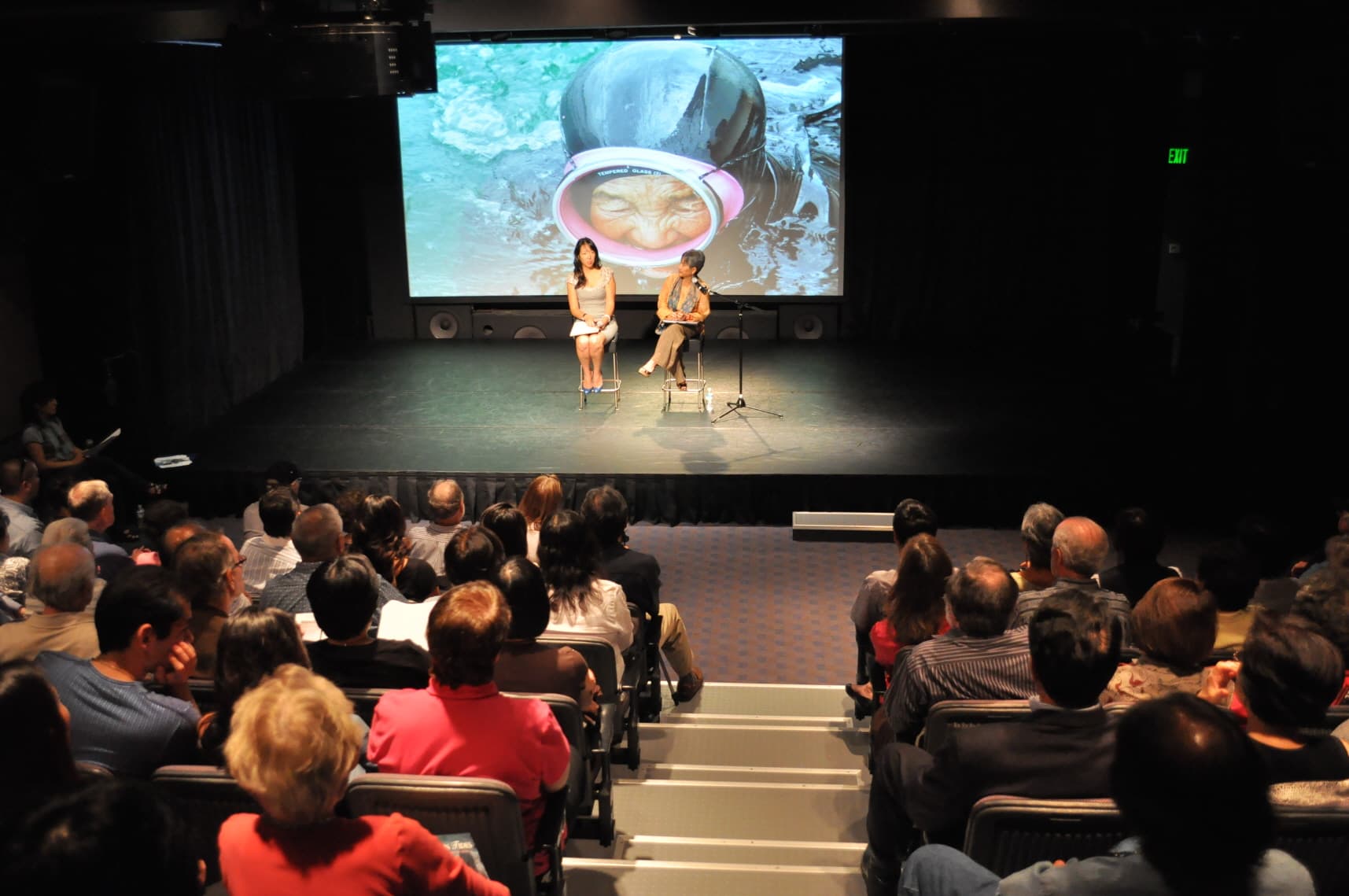
The women are the haenyeo. They dive without breathing apparatus, holding their breath for a minute or more and working to depths of several metres and beyond, harvesting abalone, conch, sea urchin and seaweed, for hours at a time and for much of the year. They surface with a whistling exhalation called sumbisori, work in groups with a strict seniority, and gather at the bulteok, the stone fire-shelters where they change and warm up and where the rules of the collective are decided. Diving was the household's cash income on an island with poor soil, which gave Jeju women an economic standing unusual in Korea.
The haenyeo were also politically formidable. In 1932 they organised the largest women-led demonstration of the Japanese colonial period, against the exploitative pricing of their catch. Their number has fallen from tens of thousands to a few thousand, and most are now over sixty, which is the fact behind the 2016 UNESCO inscription.
Jeju is often called the island of eighteen thousand gods, and the number is a way of saying that everything has one: each village, each shrine, the sea, the wind, individual households, particular trades. The specialists are the simbang, shamans who are usually born into the role and who perform the gut, ceremonies that can run for days and consist of long chanted narratives, dance and offerings.
Jeju shamanism preserves an unusually complete body of myth. The chanted texts of the gut are effectively the island's scripture, recording the origins of gods and villages, and because they must be delivered accurately they have carried archaic language and stories that exist nowhere else in Korea.
The best known ceremony is the Jeju Chilmeoridang Yeongdeunggut, performed in the second lunar month at the Chilmeoridang shrine in Jeju City to welcome and then send off Yeongdeung, the goddess of the winds, and to ask her and the Dragon King for calm seas and a good harvest from land and water. It is a haenyeo and fishing-village ritual at heart. UNESCO inscribed it on the Representative List in 2009.
Buddhism and Christianity are both present, and the relationship between Christian congregations and shamanic practice has at times been openly hostile. Shamanism was also suppressed directly under the mid-century modernisation campaigns, so what exists now has come through a period of official disapproval.
Jeju's most visible burial custom is that the dead are buried in the fields. Graves sit among farmland and pasture as low mounds, and around each one the family builds a rectangular drystone enclosure in the same technique as the field walls, called sandam, which keeps livestock and fire off the grave and marks it as belonging to someone. The result is a landscape in which the dead are distributed through the working land rather than gathered in a churchyard, and in which tending a grave is part of the same round of work as tending a field.
Confucian ancestral rites, jesa, are performed on the anniversary of a death and at the major festivals, with food set out and the household bowing in order of seniority. On Jeju these coexist with the shamanic system, so a family may hold a jesa for its own dead and call a simbang for the village gods, and see no conflict in it.
Then there is the part that has no ordinary form. The killings of 1948 to 1954 left thousands of families without a body, without a date, and without permission to ask. Some villages lost so many people on a single day that the survivors could not identify individual remains, and buried them together in collective graves. Others hold graves that contain nothing, raised for people whose bodies were never found. Because whole households were killed, some of the dead have no descendant left to perform the annual rite for them, and neighbouring families or village associations have taken on those rites instead.
The silence was enforced. Under South Korea's anti-communist governments, publicly mourning a relative killed as an alleged insurgent was itself dangerous, and families were subject to guilt-by-association restrictions on employment and travel. It broke in 1978, when the writer Hyun Ki-young published the novella Sun-i Samchon, based on the Bukchon killings, and was arrested and tortured for it. Public commemoration became possible only through the democratisation of the late 1980s and after.
What followed is one of the more complete reckonings anywhere: a Special Act in 2000, a national truth commission, a state apology from President Roh Moo-hyun in 2003, the opening of the Jeju 4.3 Peace Park in 2008 with its memorial hall and its hall of the missing, and 3 April as a national memorial day. Reparations legislation and the retrial and exoneration of people convicted in the summary courts of 1948 and 1949 have continued into the 2020s. The island now performs collectively, and in public, the mourning that individual families were prevented from performing for two generations.
Jeju family research is Korean in form and carries one particular silence at the centre of it.
Korean clan genealogies, the jokbo, apply here as on the mainland, and Jeju families identify by surname and bon-gwan; several clans have their origin on the island, and the founding myth of the three demigods at Samseonghyeol is the genealogical charter for three of them. Household registers under Joseon, then the Japanese colonial koseki from 1909, then the South Korean system carry the state record.
The silence is the period from 3 April 1948 to 1954. The uprising and its suppression killed something between 25,000 and 30,000 people, close to a tenth of the island, and to say publicly how a relative had died was to risk being accused of communist sympathy, which was dangerous for forty years afterwards. Families kept their dead quietly. Some had their household registers altered, deaths recorded as something else or not at all, and children were registered under uncles because a father's record would follow them.
The archive that has undone this is recent. The Special Act of 2000 created a truth commission that took statements from survivors, the state apologised in 2003, and in April 2025 UNESCO added the archive of the period, 14,673 documents under the title Revealing Truth, to the Memory of the World Register.
Bukchon and the other village burial grounds hold the graves of people buried together because nobody could tell which body was whose.
Jeju holds an unusual concentration of international designations. Jeju Volcanic Island and Lava Tubes was inscribed as a natural World Heritage site in 2007, covering the Hallasan reserve, the Geomunoreum lava tube system and Seongsan Ilchulbong, and it was the first natural World Heritage site in Korea. The island is also a UNESCO Biosphere Reserve and a UNESCO Global Geopark, and it holds two intangible heritage inscriptions, the Chilmeoridang Yeongdeunggut in 2009 and the culture of the haenyeo in 2016.
The Memory of the World inscription in April 2025 is the one that matters most to the island's own account of itself. Revealing Truth: Jeju 4.3 Archives comprises 14,673 items, including court records, investigation reports, press material, photographs and the testimony of survivors, produced by the Korean state, the United States military government, the insurgent side and the victims, and by the later truth-finding process. Documenting a massacre from the papers of everyone involved in it, including the perpetrators, is a specific and deliberate approach to what an archive is for.
Practical preservation problems are ordinary by comparison and still serious. The haenyeo are ageing and recruitment is difficult despite provincial support, the batdam are lost to land consolidation and construction, Jejueo is losing its last fluent speakers, and the volume of tourism strains the World Heritage sites and the island's water.
The 4.3 archive is the flagship. Digitisation and cataloguing of the material, carried out by the Jeju 4.3 Peace Foundation and partners, is what made the Memory of the World nomination possible, and it has also served a practical purpose: a searchable record of who was taken, tried and killed is what families and lawyers have used to pursue exoneration and reparation. The archive is a legal instrument as much as a historical one.
Language documentation is the second effort. Talking dictionaries, recorded interviews with elderly speakers, and academic corpora of Jejueo have been built by Korean and international researchers, and a substantial part of the recorded material comes from shamanic ritual, where the older language survives best.
Shamanic texts themselves have been transcribed and published over decades, turning an oral scripture into a readable corpus, and haenyeo diving knowledge, the underwater geography of particular villages, the seasons, the rules, has been recorded as part of the UNESCO safeguarding measures, because it is knowledge held by a few thousand people almost all of whom are old.
Tourism is the island's economy and its principal heritage problem. Jeju receives many millions of visitors a year against a resident population under 700,000, and the resulting development pressure, water demand and waste have produced sustained local argument, sharpened by proposals for a second airport. The island's marketing image, honeymoons and tangerines and coastal walks, sits uneasily beside the history described above, and Jeju writers have been pointed about the mismatch.
The 4.3 events now have a substantial cultural presence, in fiction, film, poetry and visual art, including work that has reached international audiences. That represents a complete reversal within one lifetime, from a subject that could not be named to one of the defining themes of the island's literature.
The haenyeo have become the island's emblem, appearing in tourism campaigns, documentaries and international press. Divers themselves have noted the irony that the profession is celebrated as it disappears, and provincial programmes now pay for training, equipment and medical care to keep it viable, which is a form of preservation that treats a job rather than an object as the heritage.
An archive of a massacre recognised as world heritage. UNESCO added Revealing Truth: Jeju 4.3 Archives, 14,673 documents, to the Memory of the World Register in April 2025, decades after describing the events publicly was itself dangerous.
A state apology and a continuing legal remedy. The Special Act of 2000, the truth commission, President Roh Moo-hyun's apology in 2003 and the later retrials and exonerations have made this one of the more thorough public reckonings with a twentieth-century state killing anywhere.
A profession listed rather than an object. The 2016 inscription of haenyeo culture recognises a working practice, and provincial support is directed at keeping people diving rather than at displaying equipment.
Field walls recognised as an agricultural system. The FAO designated the Jeju Batdam Agricultural System in 2014, protecting some 22,000 kilometres of drystone wall as functioning infrastructure rather than as scenery.
Seongsan Ilchulbong erupted out of shallow water some five thousand years ago and is one of the three components of Jeju's World Heritage inscription. Photograph by Basile Morin, CC BY-SA 4.0, via Wikimedia Commons.
In 1273 the Mongols took the island and held it for roughly a century, using it as a horse pasture, which is why Jeju has its own breed of pony and why the island's material culture carries traces from that period. When Mongol power collapsed the garrison here resisted longer than almost anywhere.
Under the Joseon dynasty Jeju was a place of exile for scholars and officials who had lost at court, and from 1629 a travel ban prevented islanders from leaving for around two hundred years. Poverty and isolation set the conditions for much of what is described below, including the emigration of large numbers of islanders to Japan under colonial rule in the twentieth century.
Then 1948. The island was under the United States Army Military Government following the end of Japanese rule, and in the disputed run-up to elections that would establish a separate southern state, an armed uprising began on 3 April. The counter-insurgency that followed lasted into 1954, burned a large proportion of the island's mid-mountain villages, and killed a number the South Korean government's own truth commission put in the tens of thousands, a very large share of them civilians. President Roh Moo-hyun issued a formal state apology in 2003, the first by a South Korean head of state, following a Special Act passed in 2000 and the commission's report.
Jejueo, the Jeju language, is the strongest evidence that the island is culturally its own place. It is Koreanic, but it separated early enough that mainland Korean speakers cannot follow it, and linguists now generally treat it as a distinct language rather than a dialect, a classification the Korean government has been slower to adopt.
UNESCO listed it as critically endangered in 2010. The commonly cited figure is a few thousand elderly fluent speakers, and specialists who have worked on the island argue the real number of fully fluent speakers is well under a thousand. Everyone under about seventy speaks standard Korean; the language survives in fragments, in the vocabulary of diving and farming, and in the ritual speech of shamans, which has preserved older forms because the texts must be said correctly.
The decline had specific causes. Standard-language education, the mainland's treatment of Jeju speech as rustic, and the migration of young people off the island all played a part, and so did 1948, since a generation of speakers was killed or displaced. Revitalisation now runs through a provincial ordinance, a research centre, dictionaries and school materials, and through the recorded speech of the remaining fluent speakers, which is realistically the form in which most of the language will continue to exist.
Jeju is described locally as the island of three abundances, stone, wind and women, and of three absences, thieves, beggars and gates. The stone is everywhere: the dolhareubang, the carved basalt grandfathers that stood at village entrances, of which a few dozen originals survive; and the batdam, the drystone field walls built without mortar so that wind passes through rather than pushing them over. There are around 22,000 kilometres of them, built over a thousand years, and the FAO designated the Jeju Batdam Agricultural System a Globally Important Agricultural Heritage System in 2014.
The women are the haenyeo. They dive without breathing apparatus, holding their breath for a minute or more and working to depths of several metres and beyond, harvesting abalone, conch, sea urchin and seaweed, for hours at a time and for much of the year. They surface with a whistling exhalation called sumbisori, work in groups with a strict seniority, and gather at the bulteok, the stone fire-shelters where they change and warm up and where the rules of the collective are decided. Diving was the household's cash income on an island with poor soil, which gave Jeju women an economic standing unusual in Korea.
The haenyeo were also politically formidable. In 1932 they organised the largest women-led demonstration of the Japanese colonial period, against the exploitative pricing of their catch. Their number has fallen from tens of thousands to a few thousand, and most are now over sixty, which is the fact behind the 2016 UNESCO inscription.
Jeju is often called the island of eighteen thousand gods, and the number is a way of saying that everything has one: each village, each shrine, the sea, the wind, individual households, particular trades. The specialists are the simbang, shamans who are usually born into the role and who perform the gut, ceremonies that can run for days and consist of long chanted narratives, dance and offerings.
Jeju shamanism preserves an unusually complete body of myth. The chanted texts of the gut are effectively the island's scripture, recording the origins of gods and villages, and because they must be delivered accurately they have carried archaic language and stories that exist nowhere else in Korea.
The best known ceremony is the Jeju Chilmeoridang Yeongdeunggut, performed in the second lunar month at the Chilmeoridang shrine in Jeju City to welcome and then send off Yeongdeung, the goddess of the winds, and to ask her and the Dragon King for calm seas and a good harvest from land and water. It is a haenyeo and fishing-village ritual at heart. UNESCO inscribed it on the Representative List in 2009.
Buddhism and Christianity are both present, and the relationship between Christian congregations and shamanic practice has at times been openly hostile. Shamanism was also suppressed directly under the mid-century modernisation campaigns, so what exists now has come through a period of official disapproval.
Jeju's most visible burial custom is that the dead are buried in the fields. Graves sit among farmland and pasture as low mounds, and around each one the family builds a rectangular drystone enclosure in the same technique as the field walls, called sandam, which keeps livestock and fire off the grave and marks it as belonging to someone. The result is a landscape in which the dead are distributed through the working land rather than gathered in a churchyard, and in which tending a grave is part of the same round of work as tending a field.
Confucian ancestral rites, jesa, are performed on the anniversary of a death and at the major festivals, with food set out and the household bowing in order of seniority. On Jeju these coexist with the shamanic system, so a family may hold a jesa for its own dead and call a simbang for the village gods, and see no conflict in it.
Then there is the part that has no ordinary form. The killings of 1948 to 1954 left thousands of families without a body, without a date, and without permission to ask. Some villages lost so many people on a single day that the survivors could not identify individual remains, and buried them together in collective graves. Others hold graves that contain nothing, raised for people whose bodies were never found. Because whole households were killed, some of the dead have no descendant left to perform the annual rite for them, and neighbouring families or village associations have taken on those rites instead.
The silence was enforced. Under South Korea's anti-communist governments, publicly mourning a relative killed as an alleged insurgent was itself dangerous, and families were subject to guilt-by-association restrictions on employment and travel. It broke in 1978, when the writer Hyun Ki-young published the novella Sun-i Samchon, based on the Bukchon killings, and was arrested and tortured for it. Public commemoration became possible only through the democratisation of the late 1980s and after.
What followed is one of the more complete reckonings anywhere: a Special Act in 2000, a national truth commission, a state apology from President Roh Moo-hyun in 2003, the opening of the Jeju 4.3 Peace Park in 2008 with its memorial hall and its hall of the missing, and 3 April as a national memorial day. Reparations legislation and the retrial and exoneration of people convicted in the summary courts of 1948 and 1949 have continued into the 2020s. The island now performs collectively, and in public, the mourning that individual families were prevented from performing for two generations.
Jeju family research is Korean in form and carries one particular silence at the centre of it.
Korean clan genealogies, the jokbo, apply here as on the mainland, and Jeju families identify by surname and bon-gwan; several clans have their origin on the island, and the founding myth of the three demigods at Samseonghyeol is the genealogical charter for three of them. Household registers under Joseon, then the Japanese colonial koseki from 1909, then the South Korean system carry the state record.
The silence is the period from 3 April 1948 to 1954. The uprising and its suppression killed something between 25,000 and 30,000 people, close to a tenth of the island, and to say publicly how a relative had died was to risk being accused of communist sympathy, which was dangerous for forty years afterwards. Families kept their dead quietly. Some had their household registers altered, deaths recorded as something else or not at all, and children were registered under uncles because a father's record would follow them.
The archive that has undone this is recent. The Special Act of 2000 created a truth commission that took statements from survivors, the state apologised in 2003, and in April 2025 UNESCO added the archive of the period, 14,673 documents under the title Revealing Truth, to the Memory of the World Register.
Bukchon and the other village burial grounds hold the graves of people buried together because nobody could tell which body was whose.
Jeju holds an unusual concentration of international designations. Jeju Volcanic Island and Lava Tubes was inscribed as a natural World Heritage site in 2007, covering the Hallasan reserve, the Geomunoreum lava tube system and Seongsan Ilchulbong, and it was the first natural World Heritage site in Korea. The island is also a UNESCO Biosphere Reserve and a UNESCO Global Geopark, and it holds two intangible heritage inscriptions, the Chilmeoridang Yeongdeunggut in 2009 and the culture of the haenyeo in 2016.
The Memory of the World inscription in April 2025 is the one that matters most to the island's own account of itself. Revealing Truth: Jeju 4.3 Archives comprises 14,673 items, including court records, investigation reports, press material, photographs and the testimony of survivors, produced by the Korean state, the United States military government, the insurgent side and the victims, and by the later truth-finding process. Documenting a massacre from the papers of everyone involved in it, including the perpetrators, is a specific and deliberate approach to what an archive is for.
Practical preservation problems are ordinary by comparison and still serious. The haenyeo are ageing and recruitment is difficult despite provincial support, the batdam are lost to land consolidation and construction, Jejueo is losing its last fluent speakers, and the volume of tourism strains the World Heritage sites and the island's water.
The 4.3 archive is the flagship. Digitisation and cataloguing of the material, carried out by the Jeju 4.3 Peace Foundation and partners, is what made the Memory of the World nomination possible, and it has also served a practical purpose: a searchable record of who was taken, tried and killed is what families and lawyers have used to pursue exoneration and reparation. The archive is a legal instrument as much as a historical one.
Language documentation is the second effort. Talking dictionaries, recorded interviews with elderly speakers, and academic corpora of Jejueo have been built by Korean and international researchers, and a substantial part of the recorded material comes from shamanic ritual, where the older language survives best.
Shamanic texts themselves have been transcribed and published over decades, turning an oral scripture into a readable corpus, and haenyeo diving knowledge, the underwater geography of particular villages, the seasons, the rules, has been recorded as part of the UNESCO safeguarding measures, because it is knowledge held by a few thousand people almost all of whom are old.
Tourism is the island's economy and its principal heritage problem. Jeju receives many millions of visitors a year against a resident population under 700,000, and the resulting development pressure, water demand and waste have produced sustained local argument, sharpened by proposals for a second airport. The island's marketing image, honeymoons and tangerines and coastal walks, sits uneasily beside the history described above, and Jeju writers have been pointed about the mismatch.
The 4.3 events now have a substantial cultural presence, in fiction, film, poetry and visual art, including work that has reached international audiences. That represents a complete reversal within one lifetime, from a subject that could not be named to one of the defining themes of the island's literature.
The haenyeo have become the island's emblem, appearing in tourism campaigns, documentaries and international press. Divers themselves have noted the irony that the profession is celebrated as it disappears, and provincial programmes now pay for training, equipment and medical care to keep it viable, which is a form of preservation that treats a job rather than an object as the heritage.
An archive of a massacre recognised as world heritage. UNESCO added Revealing Truth: Jeju 4.3 Archives, 14,673 documents, to the Memory of the World Register in April 2025, decades after describing the events publicly was itself dangerous.
A state apology and a continuing legal remedy. The Special Act of 2000, the truth commission, President Roh Moo-hyun's apology in 2003 and the later retrials and exonerations have made this one of the more thorough public reckonings with a twentieth-century state killing anywhere.
A profession listed rather than an object. The 2016 inscription of haenyeo culture recognises a working practice, and provincial support is directed at keeping people diving rather than at displaying equipment.
Field walls recognised as an agricultural system. The FAO designated the Jeju Batdam Agricultural System in 2014, protecting some 22,000 kilometres of drystone wall as functioning infrastructure rather than as scenery.
National Overview
Notable Cities
Historical Foundations
Linguistic and Etymological Roots
Cultural Identity
Religion and Spirituality
Remembrance and Mourning Traditions
Tracing a Family in Jeju
Heritage Preservation Efforts
Digital Heritage
Contemporary Cultural Influences
Success Stories
References and resources
- UNESCO, Revealing Truth: Jeju 4.3 Archives: the 2025 Memory of the World inscription.
- UNESCO, Jeju Volcanic Island and Lava Tubes: the 2007 natural World Heritage inscription.
- UNESCO, Culture of Jeju Haenyeo, women divers: the 2016 inscription.
- UNESCO, Jeju Chilmeoridang Yeongdeunggut: the 2009 inscription and the wind goddess ritual.
- FAO, Jeju Batdam Agricultural System: the 2014 designation and the stone walls.
- Jeju uprising, Wikipedia: the events of 1948 to 1954 and the estimates of the dead.
- Jeju 4.3 Peace Park, Wikipedia: the memorial park and its opening.
- Jeju language, Wikipedia: the classification, speaker numbers and endangerment.
- Haenyeo, Wikipedia: the divers, the bulteok and the 1932 protest.
- Jeju Province, Wikipedia: geography, population and administration.