Heritage · Country
Bahamas Culture and Heritage
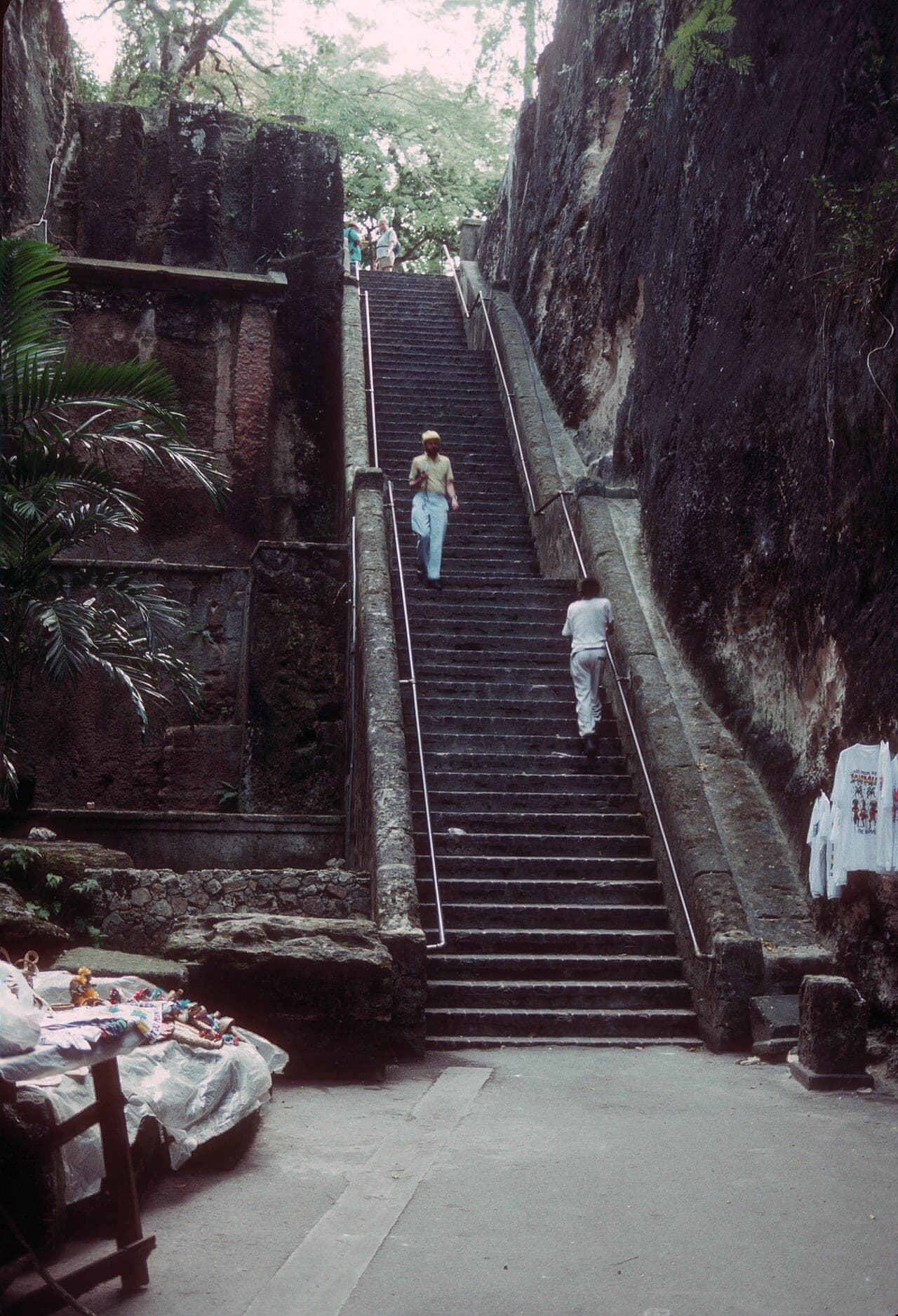
Sixty-six steps cut by hand from solid limestone climb from old Nassau to the ring of harbour forts, and off a low cay to the south the Atlantic still washes the shore where Columbus first came ashore in 1492. From the vanished Lucayans to the pre-dawn drums of Junkanoo and the Nine Night wakes held for the dead, the Bahamas keeps its memory across seven hundred islands.Written to last.
By Confinity Heritage Editorial · Updated 2026-07-31 · 8-minute readQuiet tools, kept out of the way.
The Bahamas is an archipelago of roughly 700 islands and more than 2,500 cays strung across some 13,880 square kilometres of the western Atlantic, of which only about 30 are inhabited and the greatest number of people live in the capital, Nassau, on the island of New Providence (Britannica; Wikipedia). It is also the place where the histories of the Americas, Africa and Europe first ran together: on 12 October 1492 an island the Lucayan people called Guanahani became the first American land Christopher Columbus set foot upon, and the encounter that began there reshaped two hemispheres (National Geographic).
The centuries since have layered people upon these low limestone islands, and each layer left its dead and its memory. The Lucayans were gone within a lifetime of Columbus; English dissenters came seeking freedom of worship; pirates ran Nassau as a lawless republic; American Loyalists arrived with the people they held in bondage; and the Afro-Bahamian majority they brought built, in time, the nation that raised its own flag on 10 July 1973 (BlackPast).
The Bahamas lies not in the Caribbean Sea but in the Atlantic, north of Cuba and Hispaniola and south-east of Florida, forming the larger part of the Lucayan Archipelago. Its low islands cover a small land area but a vast stretch of shallow, banked ocean, and the highest point in the country, Mount Alvernia on Cat Island, rises only about 64 metres (Wikipedia). The 2022 census counted 398,165 residents, most of them of African descent and most living on New Providence, around Nassau, the capital and chief port (Wikipedia).
The country is a constitutional monarchy within the Commonwealth, with King Charles III as head of state; the Bahamian dollar trades at par with the United States dollar, on which much of the economy depends. Two industries carry that economy: tourism and offshore financial services. English is the official language, Christianity the faith of the large majority, and the West Indian flamingo, protected in its tens of thousands on Great Inagua, is the national bird (Government of the Bahamas). The low islands sit squarely in the hurricane belt.
Nassau. The capital on New Providence holds the great majority of the national population and most of its history. Founded by the English in the seventeenth century as Charles Town, it was burned by the Spanish in 1684 and rebuilt, then renamed Nassau in 1695 in honour of William III of the House of Orange-Nassau (Wikipedia). Its harbour front of pastel colonial buildings, Parliament Square and Bay Street sits beneath a ring of hillside forts, and the old town remains the working seat of Bahamian government and commerce.
 Nassau's colonial core was built by Loyalists who arrived after the American Revolution, bringing enslaved people with them and roughly tripling the population. Photograph by Guldem Ustun, CC BY 2.0, via Wikimedia Commons.
Freeport. The second city, on Grand Bahama, is a modern creation. It grew from the Hawksbill Creek Agreement of 1955, under which the financier Wallace Groves was granted land and tax concessions to build a planned free-trade port and industrial city out of pine forest. Freeport and its resort suburb of Lucaya became a centre of shipping, tourism and industry.
The Family Islands. Bahamians call the scattered outer islands the Family Islands, and each keeps its own character. Eleuthera, where the Eleutheran Adventurers landed in the 1640s, once grew the pineapples that made it famous; off its northern tip lies Harbour Island, whose Dunmore Town fronts a celebrated stretch of pink sand. Cat Island holds Mount Alvernia, the heartland of rake-and-scrape music and the birthplace of Sir Sidney Poitier (bahamas.com). Andros, the largest island, is a wilderness of creeks, blue holes and the folklore of the birdlike chickcharney; Abaco keeps its Loyalist settlements and boatbuilding tradition at Hope Town and New Plymouth; and Great Inagua in the far south shelters the largest breeding colony of West Indian flamingos on earth.
The first Bahamians were the Lucayans, an Arawakan-speaking Taino people who reached the islands from Hispaniola and Cuba between roughly 700 and 800 AD and lived by fishing, farming and trade across the archipelago (History of the Bahamas). When Columbus made landfall at Guanahani on 12 October 1492 and renamed it San Salvador, he met these people first; within a few decades Spanish slaving raids and imported disease had emptied the islands almost entirely of them, and the Lucayans were effectively gone by the 1520s (Guanahani). For more than a century afterwards the Bahamas lay largely unpeopled.
Permanent English settlement began with the Eleutheran Adventurers, a company of Puritans and religious independents who sailed from Bermuda under William Sayle around 1648, seeking a place to worship freely; they named their island Eleutheria, from the Greek word for freedom (Wikipedia). Their colony was poor, but it opened the islands to English settlement. Nassau grew on New Providence as the seat of a struggling proprietary colony, and in the early eighteenth century, with government weak, it became the base of the so-called Republic of Pirates. From about 1706 to 1718 captains including Edward Teach (Blackbeard), Charles Vane, Anne Bonny and John "Calico Jack" Rackham used the harbour as a haven, until the Crown sent Woodes Rogers as royal governor in 1718 under the motto Expulsis Piratis, Restituta Commercia, "pirates expelled, commerce restored"; Rogers offered pardons and the gallows in equal measure and broke the pirates' hold (Golden Age of Piracy).
The event that most shaped modern Bahamian society came after the American Revolution. Between 1783 and 1785 several thousand Loyalists left the newly independent United States for the Bahamas, bringing with them the enslaved Africans they claimed as property and roughly trebling the colony's population (University of Central Florida). They laid out cotton plantations on Cat Island, the Exumas, Long Island, Crooked Island and elsewhere, but the thin soil and insect damage ruined the crop within a generation. What endured was a society built on slavery, in which the enslaved majority suffered forced labour, the separation of families and routine violence, and in which they resisted. On the Rolle estates of Exuma an enslaved man named Pompey led a celebrated act of defiance in 1830 (Pompey Museum). The British Parliament abolished slavery from 1 August 1834, though most freed people were bound to further years of unpaid "apprenticeship" that ended only on 1 August 1838 (Tourism Today). Some former owners, notably Lord Rolle, left their land to the people they had held, and the Rolle commonages of Exuma remain community land to this day.
The freed population and their descendants formed the Afro-Bahamian majority, yet political power stayed with a white merchant elite, the "Bay Street Boys", into the twentieth century. Change came with the Progressive Liberal Party under Lynden Pindling, which won Majority Rule on 10 January 1967, still marked as a national holiday, and led the country to full independence within the Commonwealth on 10 July 1973, with Pindling as first prime minister (BlackPast; History Central).
English is the official language of the Bahamas and the medium of school, law and government, a legacy of more than three centuries of English and British rule. Alongside it Bahamians speak Bahamian Creole, sometimes called the Bahamian dialect, an English-based creole shaped by the West African languages of the enslaved and heard, in varying forms, from Nassau to the Family Islands.
The country's name is usually traced to Spanish. Early navigators described the shallow, banked seas around the northern islands as baja mar, "low sea" or "shallow sea", and the phrase is thought to have attached itself to the whole archipelago (Bahamas etymology). Scholars caution that this is at least partly a folk etymology, and note that the Lucayans had their own names for the islands well before the Spanish arrived: the word Bahama, applied to what is now Grand Bahama, may render a Lucayan term meaning something like "large upper middle island" (The Tribune). Either way, the sea itself is written into the nation's name.
Bahamian identity is expressed most fully in Junkanoo, the masquerade festival that fills the streets of Nassau before dawn on Boxing Day and again on New Year's morning. Its roots reach back to the Christmas holidays that enslaved Africans were granted, when they took to the streets in costume and music, and its name is generally linked to the West African "John Canoe" masquerade (bahamas.com). Organised groups such as the Saxons and the Valley Boys spend most of the year building costumes of cardboard and crepe paper, then compete in a roaring parade of goatskin drums, cowbells, whistles and brass (TIME).
The islands' older folk music is rake-and-scrape, played on a carpenter's saw stroked with a screwdriver, a goatskin drum and a concertina or accordion, and danced as a quadrille (Wikipedia). Cat Island is its heartland and hosts an annual festival that has helped keep the form alive. Craft traditions run just as deep: Bahamian women plait the fronds of the silver-top palm into hats, bags and baskets, a skill on daily display at the Nassau Straw Market. And the table is unmistakably Bahamian, built on the queen conch, served as fritters, cracked conch or a raw, citrus-dressed conch salad, alongside rock lobster, pigeon peas and rice, boil fish and johnnycake, guava duff, and the coconut drink sky juice (everyculture).
The Bahamas is among the most churchgoing countries in the world. Christianity claims close to 88 per cent of the population, with Baptists the largest single group, followed by Anglicans, Roman Catholics, Pentecostals and many smaller congregations; churches anchor community life on every island (Wikipedia).
Beneath and alongside the churches runs a body of Afro-Bahamian belief carried from West Africa and reshaped in the islands. Obeah, a set of spiritual and healing practices drawing on West African, especially Yoruba, tradition mixed with European and Christian elements, survives quietly; it remains formally prohibited by law, and its rituals are private, but many Bahamians still consult its practitioners and keep the practices of "bush medicine" (everyculture; The Tribune). Folklore fills the same world: the Anansi spider stories brought from West Africa, and island spirits such as the birdlike chickcharney said to haunt the pine forests of Andros, bringing luck or ruin according to how a traveller treats it.
Death in the Bahamas is met first by the church and then by the community. The dead are traditionally laid in a simple coffin and waked at home, with a funeral in church and burial in a churchyard or public cemetery; the funeral is solemn but far from silent, marked by hymn-singing, scripture and the gathering of a wide family (everyculture; Frazer Consultants).
Older Afro-Bahamian custom surrounds the burial with the wake known across the region as Nine Night, kept on the ninth night after a death. It rests on the belief that the spirit of the dead lingers among the living for a set number of nights before departing, and the gathering, with food, drink, hymns, drumming and storytelling, both comforts the bereaved and sends the spirit on its way; the Anansi tales reserved for such occasions are told to bring laughter into the house of grief (Nine Nights; Frazer Consultants). The same impulse to keep the dead present runs through Junkanoo itself, whose costumes and rush-outs carry the memory of the enslaved ancestors who first claimed the Christmas streets, and through the Emancipation Day and Fox Hill Day celebrations of early August, when communities descended from the freed remember 1834 and 1838 with church services, food and song (Tourism Today).
Bahamian records are Anglican and then they are American, and the pivot is the American Revolution.
Parish registers for the Church of England begin in the eighteenth century and are the earliest vital records here. Civil registration was introduced in the nineteenth century and is held by the Registrar General in Nassau, and the Department of Archives holds the colonial series.
The loyalist migration is the event that made the modern population. After 1783 several thousand loyalists left the American colonies for the Bahamas and brought with them a larger number of enslaved people, roughly tripling the population and shifting it from a small maritime society to a plantation one. Loyalist claims records, held in Britain, name individuals and property in detail, and they connect Bahamian families directly to the Carolinas, Georgia and New York.
The slave registers of 1822 to 1834 are the key genealogical source, as they are across the British Caribbean: individuals named with age, origin and often the mother, updated across successive returns, followed by the compensation records of 1834 that name the owners.
Two other groups have their own paperwork. The Africans landed here from slave ships intercepted by the Royal Navy after 1808 were registered separately as liberated Africans. And Haitian migration since the twentieth century, and the citizenship difficulties of Bahamian-born people of Haitian descent, have made documentation a live and painful question for a substantial minority.
The most visited monument to Bahamian memory is the Queen's Staircase in Nassau, a flight of steps cut by hand from solid limestone in the 1790s to link Fort Fincastle above with the town below; long attributed to the labour of enslaved and freed workers, its 66 steps were later named in honour of Queen Victoria, in whose reign slavery was abolished (Wikipedia). Above it rises Fort Fincastle, built in 1793 by the royal governor Lord Dunmore in the shape of a ship's bow, one of a ring of harbour forts that includes the larger Fort Charlotte and Fort Montagu (Wikipedia).
The most searching act of preservation is the Pompey Museum of Slavery and Emancipation, housed in Vendue House on Bay Street, a building where enslaved people were once sold at auction. Named for the Exuma man who led the 1830 resistance on the Rolle estates, it opened as a museum in 1992; after a fire in 2011 it was restored with its charred walls deliberately left visible, so that the building itself testifies to what happened there (bahamas.com). The government body responsible for such sites is the Antiquities, Monuments and Museums Corporation, which manages the forts, historic buildings and archaeological heritage of the islands, while the Bahamas National Trust, created by Act of Parliament in 1959, protects natural heritage, most famously the flamingos of the Inagua National Park (Wikipedia).
The keeper of the documentary record is the Department of Archives in Nassau, established in 1971, which preserves government records from the colonial period onward, mounts public exhibitions and works to widen electronic access to its holdings (National Archives of the Bahamas). For a scattered people and a large diaspora, digitised registers, wills and land records increasingly let families trace descent from the freed and the enslaved. The Antiquities, Monuments and Museums Corporation and the Bahamas National Trust both publish collections online. The Educulture Junkanoo Museum in Nassau, the work of the cultural educator Arlene Nash Ferguson, records the festival's costumes and history and shares them with schools and visitors (Nassau Paradise Island).
Bahamian culture reaches far beyond the islands' size. Sir Sidney Poitier, who grew up on Cat Island, became in 1964 the first Black man to win the Academy Award for Best Actor and later served his country as a diplomat (bahamas.com). In music, artists from Ronnie Butler to the folklorist and performer Exuma, "the Obeah Man", carried Bahamian sound abroad, and the Nassau group Baha Men reached a global audience with "Who Let the Dogs Out". Bahamian writers and the National Art Gallery of the Bahamas, opened in Nassau in 2003, have given the country a contemporary voice in letters and the visual arts.
Tourism sustains the economy but also pressures heritage, packaging island culture for cruise passengers even as it funds its upkeep. And the islands face the Atlantic: Hurricane Dorian in 2019 destroyed communities and records on Abaco and Grand Bahama, a reminder that in a low archipelago the work of remembrance is also a race against the sea.
The flamingos of Inagua. Hunted almost to disappearance, the West Indian flamingo was brought back through the Bahamas National Trust; the Inagua National Park now holds the largest breeding colony in the world, tens of thousands of birds strong, and the flamingo has become a national emblem (Bahamas National Trust).
Vendue House restored. After the 2011 fire that gutted the Pompey Museum, the slave-auction house on Bay Street reopened as a museum of slavery and emancipation, its scorched walls left in place so the site keeps its testimony (bahamas.com).
Rake-and-scrape survives on Cat Island. Once fading before Junkanoo and imported pop, the saw-and-drum tradition has been sustained by an annual Cat Island festival and by museum and school programmes, and is now taught to a new generation (Wikipedia).
Junkanoo carried forward. Through competing groups, government support and the Educulture Junkanoo Museum, the masquerade that began as an enslaved people's holiday has become the defining public art of the independent Bahamas, documented and taught as heritage rather than left to chance (Nassau Paradise Island).
Nassau's colonial core was built by Loyalists who arrived after the American Revolution, bringing enslaved people with them and roughly tripling the population. Photograph by Guldem Ustun, CC BY 2.0, via Wikimedia Commons.
Freeport. The second city, on Grand Bahama, is a modern creation. It grew from the Hawksbill Creek Agreement of 1955, under which the financier Wallace Groves was granted land and tax concessions to build a planned free-trade port and industrial city out of pine forest. Freeport and its resort suburb of Lucaya became a centre of shipping, tourism and industry.
The Family Islands. Bahamians call the scattered outer islands the Family Islands, and each keeps its own character. Eleuthera, where the Eleutheran Adventurers landed in the 1640s, once grew the pineapples that made it famous; off its northern tip lies Harbour Island, whose Dunmore Town fronts a celebrated stretch of pink sand. Cat Island holds Mount Alvernia, the heartland of rake-and-scrape music and the birthplace of Sir Sidney Poitier (bahamas.com). Andros, the largest island, is a wilderness of creeks, blue holes and the folklore of the birdlike chickcharney; Abaco keeps its Loyalist settlements and boatbuilding tradition at Hope Town and New Plymouth; and Great Inagua in the far south shelters the largest breeding colony of West Indian flamingos on earth.
The first Bahamians were the Lucayans, an Arawakan-speaking Taino people who reached the islands from Hispaniola and Cuba between roughly 700 and 800 AD and lived by fishing, farming and trade across the archipelago (History of the Bahamas). When Columbus made landfall at Guanahani on 12 October 1492 and renamed it San Salvador, he met these people first; within a few decades Spanish slaving raids and imported disease had emptied the islands almost entirely of them, and the Lucayans were effectively gone by the 1520s (Guanahani). For more than a century afterwards the Bahamas lay largely unpeopled.
Permanent English settlement began with the Eleutheran Adventurers, a company of Puritans and religious independents who sailed from Bermuda under William Sayle around 1648, seeking a place to worship freely; they named their island Eleutheria, from the Greek word for freedom (Wikipedia). Their colony was poor, but it opened the islands to English settlement. Nassau grew on New Providence as the seat of a struggling proprietary colony, and in the early eighteenth century, with government weak, it became the base of the so-called Republic of Pirates. From about 1706 to 1718 captains including Edward Teach (Blackbeard), Charles Vane, Anne Bonny and John "Calico Jack" Rackham used the harbour as a haven, until the Crown sent Woodes Rogers as royal governor in 1718 under the motto Expulsis Piratis, Restituta Commercia, "pirates expelled, commerce restored"; Rogers offered pardons and the gallows in equal measure and broke the pirates' hold (Golden Age of Piracy).
The event that most shaped modern Bahamian society came after the American Revolution. Between 1783 and 1785 several thousand Loyalists left the newly independent United States for the Bahamas, bringing with them the enslaved Africans they claimed as property and roughly trebling the colony's population (University of Central Florida). They laid out cotton plantations on Cat Island, the Exumas, Long Island, Crooked Island and elsewhere, but the thin soil and insect damage ruined the crop within a generation. What endured was a society built on slavery, in which the enslaved majority suffered forced labour, the separation of families and routine violence, and in which they resisted. On the Rolle estates of Exuma an enslaved man named Pompey led a celebrated act of defiance in 1830 (Pompey Museum). The British Parliament abolished slavery from 1 August 1834, though most freed people were bound to further years of unpaid "apprenticeship" that ended only on 1 August 1838 (Tourism Today). Some former owners, notably Lord Rolle, left their land to the people they had held, and the Rolle commonages of Exuma remain community land to this day.
The freed population and their descendants formed the Afro-Bahamian majority, yet political power stayed with a white merchant elite, the "Bay Street Boys", into the twentieth century. Change came with the Progressive Liberal Party under Lynden Pindling, which won Majority Rule on 10 January 1967, still marked as a national holiday, and led the country to full independence within the Commonwealth on 10 July 1973, with Pindling as first prime minister (BlackPast; History Central).
English is the official language of the Bahamas and the medium of school, law and government, a legacy of more than three centuries of English and British rule. Alongside it Bahamians speak Bahamian Creole, sometimes called the Bahamian dialect, an English-based creole shaped by the West African languages of the enslaved and heard, in varying forms, from Nassau to the Family Islands.
The country's name is usually traced to Spanish. Early navigators described the shallow, banked seas around the northern islands as baja mar, "low sea" or "shallow sea", and the phrase is thought to have attached itself to the whole archipelago (Bahamas etymology). Scholars caution that this is at least partly a folk etymology, and note that the Lucayans had their own names for the islands well before the Spanish arrived: the word Bahama, applied to what is now Grand Bahama, may render a Lucayan term meaning something like "large upper middle island" (The Tribune). Either way, the sea itself is written into the nation's name.
Bahamian identity is expressed most fully in Junkanoo, the masquerade festival that fills the streets of Nassau before dawn on Boxing Day and again on New Year's morning. Its roots reach back to the Christmas holidays that enslaved Africans were granted, when they took to the streets in costume and music, and its name is generally linked to the West African "John Canoe" masquerade (bahamas.com). Organised groups such as the Saxons and the Valley Boys spend most of the year building costumes of cardboard and crepe paper, then compete in a roaring parade of goatskin drums, cowbells, whistles and brass (TIME).
The islands' older folk music is rake-and-scrape, played on a carpenter's saw stroked with a screwdriver, a goatskin drum and a concertina or accordion, and danced as a quadrille (Wikipedia). Cat Island is its heartland and hosts an annual festival that has helped keep the form alive. Craft traditions run just as deep: Bahamian women plait the fronds of the silver-top palm into hats, bags and baskets, a skill on daily display at the Nassau Straw Market. And the table is unmistakably Bahamian, built on the queen conch, served as fritters, cracked conch or a raw, citrus-dressed conch salad, alongside rock lobster, pigeon peas and rice, boil fish and johnnycake, guava duff, and the coconut drink sky juice (everyculture).
The Bahamas is among the most churchgoing countries in the world. Christianity claims close to 88 per cent of the population, with Baptists the largest single group, followed by Anglicans, Roman Catholics, Pentecostals and many smaller congregations; churches anchor community life on every island (Wikipedia).
Beneath and alongside the churches runs a body of Afro-Bahamian belief carried from West Africa and reshaped in the islands. Obeah, a set of spiritual and healing practices drawing on West African, especially Yoruba, tradition mixed with European and Christian elements, survives quietly; it remains formally prohibited by law, and its rituals are private, but many Bahamians still consult its practitioners and keep the practices of "bush medicine" (everyculture; The Tribune). Folklore fills the same world: the Anansi spider stories brought from West Africa, and island spirits such as the birdlike chickcharney said to haunt the pine forests of Andros, bringing luck or ruin according to how a traveller treats it.
Death in the Bahamas is met first by the church and then by the community. The dead are traditionally laid in a simple coffin and waked at home, with a funeral in church and burial in a churchyard or public cemetery; the funeral is solemn but far from silent, marked by hymn-singing, scripture and the gathering of a wide family (everyculture; Frazer Consultants).
Older Afro-Bahamian custom surrounds the burial with the wake known across the region as Nine Night, kept on the ninth night after a death. It rests on the belief that the spirit of the dead lingers among the living for a set number of nights before departing, and the gathering, with food, drink, hymns, drumming and storytelling, both comforts the bereaved and sends the spirit on its way; the Anansi tales reserved for such occasions are told to bring laughter into the house of grief (Nine Nights; Frazer Consultants). The same impulse to keep the dead present runs through Junkanoo itself, whose costumes and rush-outs carry the memory of the enslaved ancestors who first claimed the Christmas streets, and through the Emancipation Day and Fox Hill Day celebrations of early August, when communities descended from the freed remember 1834 and 1838 with church services, food and song (Tourism Today).
Bahamian records are Anglican and then they are American, and the pivot is the American Revolution.
Parish registers for the Church of England begin in the eighteenth century and are the earliest vital records here. Civil registration was introduced in the nineteenth century and is held by the Registrar General in Nassau, and the Department of Archives holds the colonial series.
The loyalist migration is the event that made the modern population. After 1783 several thousand loyalists left the American colonies for the Bahamas and brought with them a larger number of enslaved people, roughly tripling the population and shifting it from a small maritime society to a plantation one. Loyalist claims records, held in Britain, name individuals and property in detail, and they connect Bahamian families directly to the Carolinas, Georgia and New York.
The slave registers of 1822 to 1834 are the key genealogical source, as they are across the British Caribbean: individuals named with age, origin and often the mother, updated across successive returns, followed by the compensation records of 1834 that name the owners.
Two other groups have their own paperwork. The Africans landed here from slave ships intercepted by the Royal Navy after 1808 were registered separately as liberated Africans. And Haitian migration since the twentieth century, and the citizenship difficulties of Bahamian-born people of Haitian descent, have made documentation a live and painful question for a substantial minority.
The most visited monument to Bahamian memory is the Queen's Staircase in Nassau, a flight of steps cut by hand from solid limestone in the 1790s to link Fort Fincastle above with the town below; long attributed to the labour of enslaved and freed workers, its 66 steps were later named in honour of Queen Victoria, in whose reign slavery was abolished (Wikipedia). Above it rises Fort Fincastle, built in 1793 by the royal governor Lord Dunmore in the shape of a ship's bow, one of a ring of harbour forts that includes the larger Fort Charlotte and Fort Montagu (Wikipedia).
The most searching act of preservation is the Pompey Museum of Slavery and Emancipation, housed in Vendue House on Bay Street, a building where enslaved people were once sold at auction. Named for the Exuma man who led the 1830 resistance on the Rolle estates, it opened as a museum in 1992; after a fire in 2011 it was restored with its charred walls deliberately left visible, so that the building itself testifies to what happened there (bahamas.com). The government body responsible for such sites is the Antiquities, Monuments and Museums Corporation, which manages the forts, historic buildings and archaeological heritage of the islands, while the Bahamas National Trust, created by Act of Parliament in 1959, protects natural heritage, most famously the flamingos of the Inagua National Park (Wikipedia).
The keeper of the documentary record is the Department of Archives in Nassau, established in 1971, which preserves government records from the colonial period onward, mounts public exhibitions and works to widen electronic access to its holdings (National Archives of the Bahamas). For a scattered people and a large diaspora, digitised registers, wills and land records increasingly let families trace descent from the freed and the enslaved. The Antiquities, Monuments and Museums Corporation and the Bahamas National Trust both publish collections online. The Educulture Junkanoo Museum in Nassau, the work of the cultural educator Arlene Nash Ferguson, records the festival's costumes and history and shares them with schools and visitors (Nassau Paradise Island).
Bahamian culture reaches far beyond the islands' size. Sir Sidney Poitier, who grew up on Cat Island, became in 1964 the first Black man to win the Academy Award for Best Actor and later served his country as a diplomat (bahamas.com). In music, artists from Ronnie Butler to the folklorist and performer Exuma, "the Obeah Man", carried Bahamian sound abroad, and the Nassau group Baha Men reached a global audience with "Who Let the Dogs Out". Bahamian writers and the National Art Gallery of the Bahamas, opened in Nassau in 2003, have given the country a contemporary voice in letters and the visual arts.
Tourism sustains the economy but also pressures heritage, packaging island culture for cruise passengers even as it funds its upkeep. And the islands face the Atlantic: Hurricane Dorian in 2019 destroyed communities and records on Abaco and Grand Bahama, a reminder that in a low archipelago the work of remembrance is also a race against the sea.
The flamingos of Inagua. Hunted almost to disappearance, the West Indian flamingo was brought back through the Bahamas National Trust; the Inagua National Park now holds the largest breeding colony in the world, tens of thousands of birds strong, and the flamingo has become a national emblem (Bahamas National Trust).
Vendue House restored. After the 2011 fire that gutted the Pompey Museum, the slave-auction house on Bay Street reopened as a museum of slavery and emancipation, its scorched walls left in place so the site keeps its testimony (bahamas.com).
Rake-and-scrape survives on Cat Island. Once fading before Junkanoo and imported pop, the saw-and-drum tradition has been sustained by an annual Cat Island festival and by museum and school programmes, and is now taught to a new generation (Wikipedia).
Junkanoo carried forward. Through competing groups, government support and the Educulture Junkanoo Museum, the masquerade that began as an enslaved people's holiday has become the defining public art of the independent Bahamas, documented and taught as heritage rather than left to chance (Nassau Paradise Island).
National Overview
Notable Cities
Historical Foundations
Linguistic and Etymological Roots
Cultural Identity
Religion and Spirituality
Remembrance and Mourning Traditions
Tracing a Family in Bahamas
Heritage Preservation Efforts
Digital Heritage
Contemporary Cultural Influences
Success Stories
References and resources
- Encyclopaedia Britannica: The Bahamas. Geography, population, economy and political background.
- Wikipedia: The Bahamas. Census figures, religion and national statistics.
- Wikipedia: History of the Bahamas. The Lucayans, colonisation, slavery and independence.
- Wikipedia: Guanahani. The 1492 landfall and the debate over its location.
- Wikipedia: Eleutheran Adventurers. William Sayle and the first English settlement.
- Golden Age of Piracy: Woodes Rogers. The end of the pirate republic at Nassau in 1718.
- University of Central Florida: The American Loyalists in the Bahama Islands. The Loyalist migration and the cotton plantations.
- Wikipedia: Queen's Staircase. The 66 steps and Fort Fincastle above Nassau.
- bahamas.com: Junkanoo. The masquerade festival and its origins.
- Wikipedia: Rake-and-scrape. The Bahamian folk-music tradition.
- bahamas.com: Pompey Museum of Slavery and Emancipation. Vendue House and its restoration.
- Wikipedia: Bahamas National Trust. The flamingos of Inagua and the national parks.
- Wikipedia: National Archives of the Bahamas. The Department of Archives in Nassau.