Heritage · University
University of Pennsylvania: History and Overview
Founded from Benjamin Franklin's 1749 plan for a practical education in Philadelphia, the University of Pennsylvania grew into one of the oldest universities in the United States. Its campus in West Philadelphia holds the first medical school in the colonies, the first collegiate business school anywhere, and the room where the ENIAC computer first ran.Written to last.
By Confinity Heritage Editorial · 2026-08-24 · 8-minute readQuiet tools, kept out of the way.
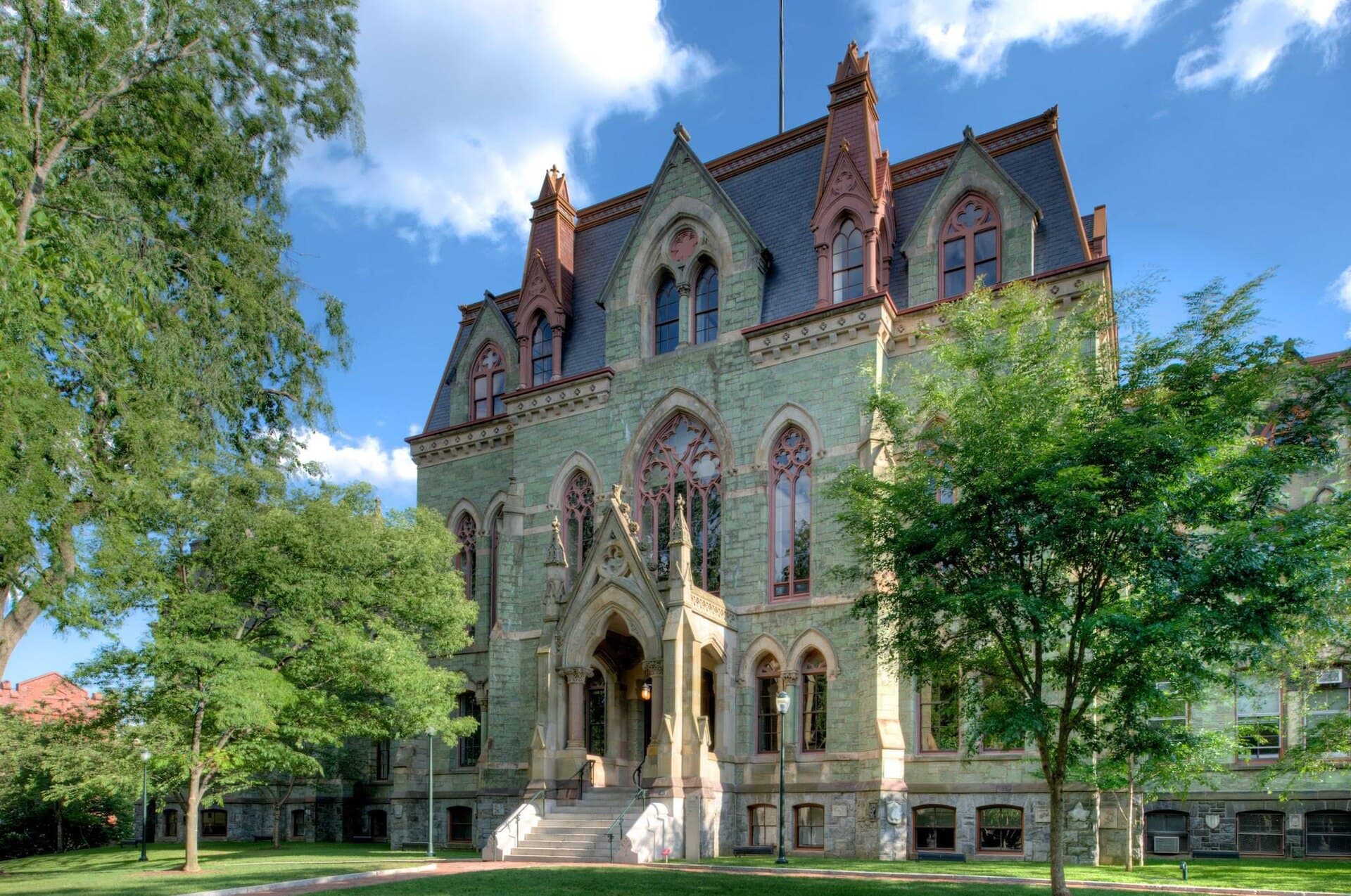
The University of Pennsylvania sits on the western bank of the Schuylkill River in Philadelphia, the city where the United States declared itself into being. Penn, as almost everyone calls it, began not with a royal charter or a church commission but with a pamphlet by Benjamin Franklin, and it has kept his practical, curious temperament through nearly three centuries. It is a member of the Ivy League, one of the country's oldest institutions of higher learning, and home to a striking number of firsts that were built rather than merely claimed.
For a project concerned with memory, Penn offers two of the sharpest stories in higher education. In one campus building, engineers assembled ENIAC, the machine that opened the electronic computing age, and the six women who programmed it went unnamed for decades. In another stands one of the world's great archaeology museums, keeping objects from Ur and Memphis.
In 1749 Franklin published Proposals Relating to the Education of Youth in Pensilvania, a short pamphlet arguing that Philadelphia's young people needed an academy teaching useful knowledge in English, from writing and arithmetic to natural science and commerce. It was a quiet break with the existing colonial colleges, which trained clergymen through Latin and Greek. Franklin gathered a board of trustees, served as its president, and secured a building already standing at Fourth and Arch streets: a great preaching hall erected for the evangelist George Whitefield, whose associated charity school had been chartered in 1740. The Academy of Philadelphia opened its doors to students in 1751, added a charitable school for poorer children, and in 1755 was chartered as the College of Philadelphia.
The claim to be the first university in America is a tangled one, and Penn's version rests on a specific event. In 1779 the revolutionary government of Pennsylvania rechartered the college as the University of the State of Pennsylvania, the first American institution to carry the name, and its trustees later adopted 1740, the date of the charity school charter, as the founding year. Harvard is older as a college, and other schools parse the word university differently, so the matter is best stated plainly and left there. What is not contested is that Penn opened the first medical school in the colonies in 1765.
Franklin remained a trustee until his death in 1790. The university he left behind spent its first century near Independence Hall and the old civic core, then outgrew it. In the early 1870s Penn moved across the river to open land in West Philadelphia, and its first building there, College Hall, rose in green serpentine stone as a Victorian Gothic announcement that the university intended to stay. It still anchors the campus, and in front of it sits a bronze of Franklin, seated and watchful, the founder installed permanently on College Green.
The campus spreads across roughly 300 acres of West Philadelphia, threaded by Locust Walk, a brick pedestrian spine that passes College Hall, the statue of Franklin, and a century and a half of architectural argument between Gothic revival, red-brick Georgian and modern glass. Penn organizes itself into twelve schools, including the Perelman School of Medicine, heir to that 1765 founding, plus law, engineering, nursing, veterinary medicine, and the school that gave the world a new kind of education altogether. In 1881 the industrialist Joseph Wharton, who had built a fortune in nickel and zinc and helped found Bethlehem Iron, gave the university 100,000 dollars to establish a School of Finance and Economy, asking for graduates educated to manage enterprises and serve public life as deliberately as doctors or lawyers were. The Wharton School that resulted was the first collegiate business school anywhere, and its model has been copied on every continent.
Two campus institutions carry the university's memory work in different registers. The Penn Museum, founded in 1887, holds around a million objects and ranks among the great archaeology collections of the world. Its curators dug with the British Museum at Ur in the 1920s and 1930s under Leonard Woolley, bringing back royal-tomb treasures from early Mesopotamia, and its entrance hall is commanded by a granite sphinx of Ramses II from Memphis, at nearly thirteen tons the largest sphinx in the Western Hemisphere. At the other end of the scale is the Kelly Writers House, a Victorian cottage on Locust Walk opened in 1995, where the university's literary life gathers around readings, broadcasts and a kitchen table, a deliberate wager that the humanities thrive in rooms built to human size.
The campus also collects smaller firsts. Houston Hall, opened in 1896, was the first student union at an American university, and Franklin Field became the country's first double-decker college stadium in the 1920s.
Penn's most consequential room is an unassuming one in the Moore School of Electrical Engineering. There, between 1943 and 1946, John Presper Eckert and John Mauchly led the construction of ENIAC, the Electronic Numerical Integrator and Computer, built under a wartime Army contract to calculate artillery firing tables. It was the first programmable, general-purpose electronic computer: thirty tons of hardware, around 18,000 vacuum tubes, and arithmetic thousands of times faster than any machine before it. When the Army unveiled it in February 1946, newspapers introduced the public to the electronic brain, and the computing age had a birthplace.
 Programming ENIAC meant physically routing the problem through the machine with cables and switches. United States Army photograph, public domain, via Wikimedia Commons.
The machine had no stored software. Programming it meant understanding the problem mathematically and then routing it through the hardware by hand, setting switches and plugging cables across forty panels. That work fell to six women recruited from the Army's corps of human computers: Kay McNulty, Betty Jean Jennings, Betty Snyder, Marlyn Wescoff, Fran Bilas and Ruth Lichterman. They worked out programming techniques from wiring diagrams, often without clearance to enter the room holding the machine they were configuring, and their job was classified as sub-professional. When ENIAC was presented to the press, the six programmers went unnamed, and they were not invited to the celebratory dinner that followed. Their part in the story was recovered by later historians, and formal recognition arrived only in 1997, when the surviving programmers, by then in their seventies, were inducted into the Women in Technology International Hall of Fame. The machine was remembered instantly; the people who first made it compute had to wait half a century. Four of ENIAC's original panels remain on display at Penn Engineering, on the campus where they first ran.
The pattern of practical invention has continued into the present, nowhere more visibly than in medicine. From the late 1990s the biochemist Katalin Karikó and the immunologist Drew Weissman worked at Penn on messenger RNA, meeting, as both liked to recall, in a queue for a photocopier. Their 2005 discovery that modified nucleosides let mRNA slip past the body's immune alarms made the molecule usable as a therapeutic, and it became the foundation of the Pfizer-BioNTech and Moderna COVID-19 vaccines. The story is not smooth: Karikó struggled for grants for years and was demoted by the university in the 1990s when her research was judged unpromising, and her vindication came from outside before it was celebrated within. In 2023 the pair shared the Nobel Prize in Physiology or Medicine.
Penn's alumni run across nearly every field: the linguist Noam Chomsky took his degrees there, the poet William Carlos Williams trained at its medical school, and its graduates include Supreme Court justices, astronauts and founders of major companies. Wharton alone has produced an outsized share of the people running global business.
Penn today enrolls around 22,000 undergraduate and graduate students and stands among the largest private employers in Pennsylvania, with a health system woven through the city around it. Its budget and laboratories are concentrated in medicine, engineering, business and the social sciences, and it sits consistently near the top of international rankings. The university has invested heavily along the Schuylkill riverfront in laboratory and innovation districts that extend the campus eastward toward the historic city.
The campus is open to walk, and Locust Walk between 34th and 40th streets makes a natural route past College Hall, the Franklin statue and the Kelly Writers House. The Penn Museum at 3260 South Street is the main ticketed attraction, with the Sphinx of Ramses II in its entrance hall and galleries spanning Mesopotamia, Egypt, Asia and the Americas. The ENIAC display at Penn Engineering can be seen in the Moore Building. Center City, with Independence Hall and Franklin's grave at Christ Church Burial Ground, is a short trip across the river, and the two together make a coherent day in the company of the university's founder.
Programming ENIAC meant physically routing the problem through the machine with cables and switches. United States Army photograph, public domain, via Wikimedia Commons.
The machine had no stored software. Programming it meant understanding the problem mathematically and then routing it through the hardware by hand, setting switches and plugging cables across forty panels. That work fell to six women recruited from the Army's corps of human computers: Kay McNulty, Betty Jean Jennings, Betty Snyder, Marlyn Wescoff, Fran Bilas and Ruth Lichterman. They worked out programming techniques from wiring diagrams, often without clearance to enter the room holding the machine they were configuring, and their job was classified as sub-professional. When ENIAC was presented to the press, the six programmers went unnamed, and they were not invited to the celebratory dinner that followed. Their part in the story was recovered by later historians, and formal recognition arrived only in 1997, when the surviving programmers, by then in their seventies, were inducted into the Women in Technology International Hall of Fame. The machine was remembered instantly; the people who first made it compute had to wait half a century. Four of ENIAC's original panels remain on display at Penn Engineering, on the campus where they first ran.
The pattern of practical invention has continued into the present, nowhere more visibly than in medicine. From the late 1990s the biochemist Katalin Karikó and the immunologist Drew Weissman worked at Penn on messenger RNA, meeting, as both liked to recall, in a queue for a photocopier. Their 2005 discovery that modified nucleosides let mRNA slip past the body's immune alarms made the molecule usable as a therapeutic, and it became the foundation of the Pfizer-BioNTech and Moderna COVID-19 vaccines. The story is not smooth: Karikó struggled for grants for years and was demoted by the university in the 1990s when her research was judged unpromising, and her vindication came from outside before it was celebrated within. In 2023 the pair shared the Nobel Prize in Physiology or Medicine.
Penn's alumni run across nearly every field: the linguist Noam Chomsky took his degrees there, the poet William Carlos Williams trained at its medical school, and its graduates include Supreme Court justices, astronauts and founders of major companies. Wharton alone has produced an outsized share of the people running global business.
Penn today enrolls around 22,000 undergraduate and graduate students and stands among the largest private employers in Pennsylvania, with a health system woven through the city around it. Its budget and laboratories are concentrated in medicine, engineering, business and the social sciences, and it sits consistently near the top of international rankings. The university has invested heavily along the Schuylkill riverfront in laboratory and innovation districts that extend the campus eastward toward the historic city.
The campus is open to walk, and Locust Walk between 34th and 40th streets makes a natural route past College Hall, the Franklin statue and the Kelly Writers House. The Penn Museum at 3260 South Street is the main ticketed attraction, with the Sphinx of Ramses II in its entrance hall and galleries spanning Mesopotamia, Egypt, Asia and the Americas. The ENIAC display at Penn Engineering can be seen in the Moore Building. Center City, with Independence Hall and Franklin's grave at Christ Church Burial Ground, is a short trip across the river, and the two together make a coherent day in the company of the university's founder.
History
Campus and academics
ENIAC and its programmers
Scholarship
The university today
Visiting
References and resources
- University of Pennsylvania: History (official)
- Penn University Archives: Penn History
- Penn Engineering: The ENIAC story (official)
- The Wharton School: History (official)
- Penn Museum: About the collections (official)
- Britannica: University of Pennsylvania
- Wikipedia: ENIAC
- Nobel Prize: 2023 Physiology or Medicine press release