Heritage · Country
Quebec Culture and Heritage
Quebec puts the words Je me souviens on its licence plates and has spent four centuries arguing about what that sentence should remember. This is a guide to its heritage: eleven Indigenous nations, the French language, the Quiet Revolution, and hundreds of parish churches looking for a future.Written to last.
By Confinity Heritage Editorial · Updated 2026-08-17 · 8-minute readQuiet tools, kept out of the way.
Quebec puts its motto on its licence plates. Je me souviens, I remember, was carved beneath the provincial arms on the Parliament Building in the 1880s by the architect Eugène-Étienne Taché, who never wrote down what exactly was to be remembered, and Quebecers have argued about the answer since. It suits a society whose politics turn on memory: of eleven Indigenous nations who were here first and are here still, of a French colony that lost a war in 1759 and kept its language anyway, of a Catholic province that dismantled its own church's authority inside a decade, and of two referendums on leaving Canada, the second lost by about one point.
Quebec is the largest of Canada's provinces, roughly 1.54 million square kilometres, running from the Saint Lawrence valley north to Ungava Bay. Its population passed nine million in the 2020s and is gathered along the river, with close to half of all Quebecers living in and around Montreal, while the northern half of the territory, Nunavik and Eeyou Istchee, holds only a few tens of thousands of people, most of them Inuit and Cree. French is the sole official language and the mother tongue of roughly four-fifths of the population.
Constitutionally Quebec is one province among ten, but it works unlike the others: a civil code descended from French law, its own pension plan and tax collection, its own immigration selection, and a National Assembly that has legislated on language and religion with no parallel elsewhere in Canada.
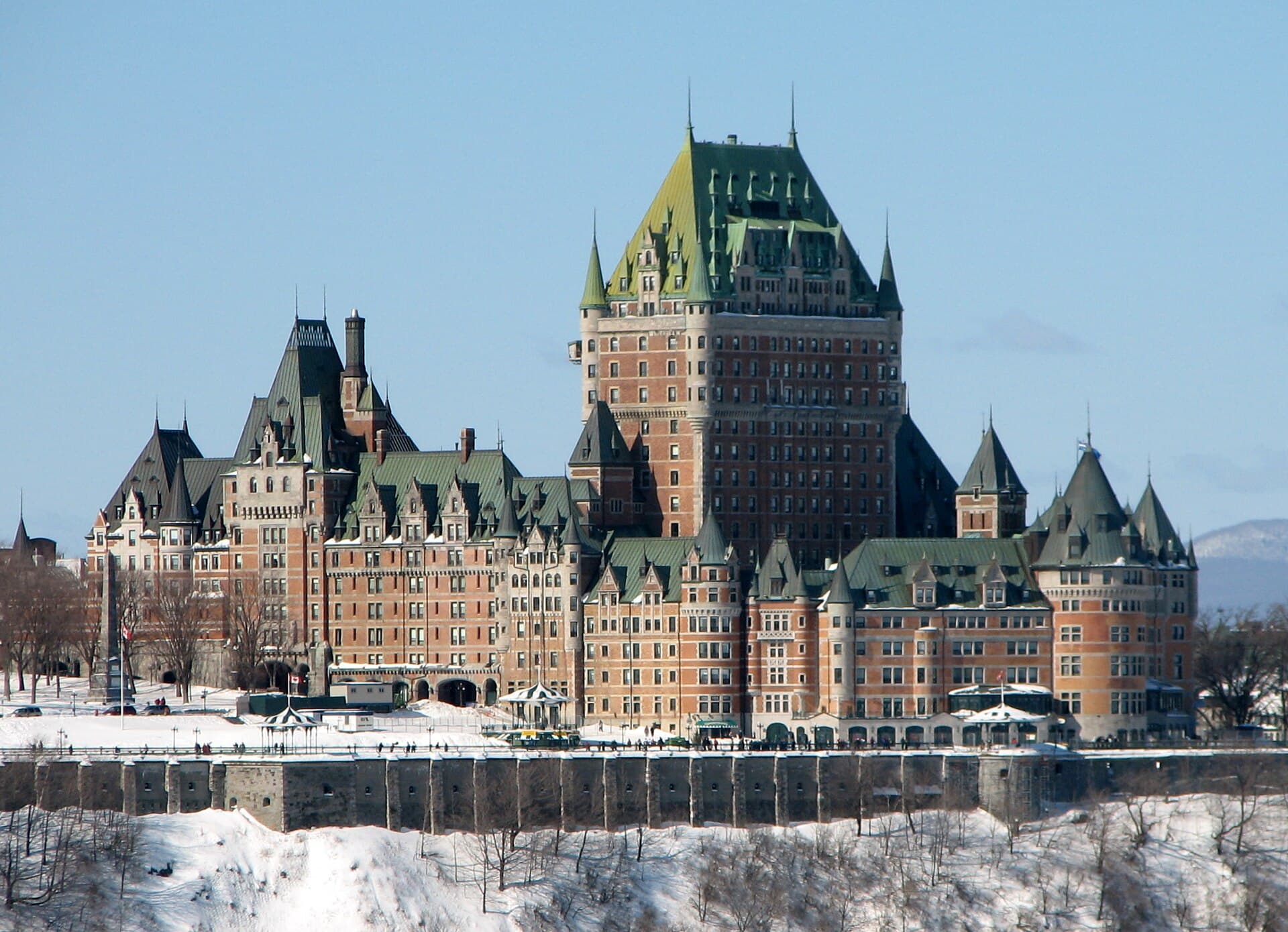
Quebec City. Founded by Samuel de Champlain in 1608 where the Saint Lawrence narrows, Quebec is the oldest French-speaking settlement in North America and the provincial capital. Its walled, cliff-topped Historic District was inscribed on the UNESCO World Heritage List in 1985.
 Quebec City is the only walled city left north of Mexico, and the walls survive because a governor blocked their demolition in the 1870s when the city wanted them gone. Photograph by Wilfredor, CC0, via Wikimedia Commons.
Montreal. Founded as Ville-Marie in 1642 on an island the Kanien'kehá:ka had long used, Montreal is the cultural capital of French North America. Old Montreal keeps the Notre-Dame Basilica and the fur-trade warehouses, and Pointe-à-Callière stands over the archaeology of the founding.
Wendake. The Huron-Wendat community north of Quebec City is a small urban reserve holding the nation's museum, a reconstructed longhouse and the 1730 Notre-Dame-de-Lorette chapel.
Kuujjuaq and the Nunavik villages. Fourteen Inuit communities on the Ungava and Hudson coasts, reachable only by air, with their own school board and cultural institute.
Quebec recognises eleven Indigenous nations: the Abenaki, Anishinabe (Algonquin), Atikamekw, Cree (Eeyou), Huron-Wendat, Innu, Maliseet (Wolastoqiyik), Mi'kmaq, Mohawk (Kanien'kehá:ka) and Naskapi, together with the Inuit of Nunavik. Their histories are distinct: the Innu of the north shore, the Cree of the James Bay lowlands, the Kanien'kehá:ka of Kahnawà:ke and Kanehsatà:ke, the Huron-Wendat dispersed from their Georgian Bay homeland in the seventeenth century and refounded at Wendake. Each keeps its own governance and heritage institutions.
The founding diplomatic act of the region was Indigenous as much as French. On 4 August 1701 delegations from roughly forty nations, some travelling more than a thousand kilometres, met French officials outside Montreal and concluded the Great Peace of Montreal, ending decades of war between the Haudenosaunee and the French and their allies; the chiefs signed with clan pictographs. Modern treaty-making resumed in 1975, when Cree and Inuit litigation over hydroelectric flooding produced the James Bay and Northern Quebec Agreement, the first comprehensive land-claim settlement in modern Canada; the Naskapi signed the Northeastern Quebec Agreement in 1978, and Quebec and the Cree the Paix des Braves in 2002.
Residential schools operated in Quebec as across Canada, and the Truth and Reconciliation Commission concluded in 2015 that the system amounted to cultural genocide. Quebec then held its own inquiry: the Viens Commission, chaired by retired judge Jacques Viens, examined how provincial police, health, youth-protection and justice services treated Indigenous people, reported in September 2019 that systemic discrimination ran through them, and issued 142 calls for action, after which the premier apologised on behalf of the state.
European settlement began with Jacques Cartier's voyages from 1534 and took root when Champlain built his habitation at Quebec in 1608. New France grew along the river under the seigneurial system, in which the crown granted long riverfront strips to seigneurs who sub-granted them to farming censitaires, a pattern still legible from the air and not abolished until 1854. Beyond the farms ranged the coureurs des bois, unlicensed traders who lived and often married among Indigenous nations.
The colony ended militarily on 13 September 1759, when British forces defeated Montcalm's army on the Plains of Abraham; the Treaty of Paris transferred it in 1763. London then changed course with the Quebec Act of 1774, restoring French civil law and allowing Catholics to hold office. Grievances over responsible government produced the Patriote rebellions of 1837 and 1838, put down with hangings and exile and followed by Lord Durham's recommendation that the French be assimilated. Confederation in 1867 gave Quebec control of civil law, education and culture, and the Catholic Church filled most of that space.
Then came the hinge. Between 1960 and about 1970 Quebec carried out the Quiet Revolution, a rapid and largely peaceful transfer of authority from church to state. Jean Lesage's Liberals, elected under the slogan Maîtres chez nous, created a Ministry of Education in 1964 and took over the clergy's schools, built public health and social services out of church-run hospitals and charities, nationalised the electricity companies into Hydro-Québec under René Lévesque, and set up the CEGEP colleges. Weekly mass attendance, among the highest in the Western world, fell within a generation to among the lowest; the birth rate went from the highest in Canada to the lowest; and a francophone middle class previously shut out of business took charge of the economy. The October Crisis of 1970, in which the Front de libération du Québec killed the minister Pierre Laporte, marked the violent edge of that decade.
Twice since, Quebecers have voted on leaving. The 1980 referendum asked for a mandate to negotiate sovereignty-association and was defeated by 59.56 per cent to 40.44. After the constitution was patriated in 1982 without Quebec's consent and the Meech Lake and Charlottetown accords failed, a second referendum was held on 30 October 1995: the No side won by 50.58 per cent to 49.42, a margin near 54,000 votes out of about 4.8 million cast, on a turnout above 93 per cent. Ottawa referred the question to the Supreme Court, which held in 1998 that a province cannot secede unilaterally but that a clear majority on a clear question would oblige the rest of Canada to negotiate; Parliament passed the Clarity Act in 2000. In November 2006 the House of Commons adopted a motion recognising that the Québécois form a nation within a united Canada, read by supporters as an overdue acknowledgement and by sovereigntists as symbolic. Positions here are held sincerely across the spectrum, and this page reports the record rather than judging it.
The name Quebec comes from an Algonquian word, usually given as kébec, meaning where the river narrows, for the point at Cap Diamant. Indigenous languages are still spoken here: Cree and Inuktitut have thousands of speakers and are used in northern schooling, Innu-aimun and Atikamekw remain in daily use, and Kanien'kéha, Naskapi, Anishinaabemowin, Mi'kmaq, Wolastoqey and Abenaki are held by smaller numbers with active revitalisation. The Huron-Wendat language, silent for more than a century, is being reconstructed from missionary manuscripts and taught again.
French arrived with settlers from Normandy, Poitou and the Paris basin, then developed on its own after 1763. Quebec French keeps sounds and words that vanished from European usage, including the affrication that turns tu and dire toward tsu and dzire. Joual, named for a working-class pronunciation of cheval, is the urban vernacular of Montreal; long treated as an embarrassment, it was put at the centre of Quebec literature by Michel Tremblay's 1968 play Les Belles-Sœurs. The province also swears in church furniture: the sacres, oaths built from words like tabarnak and calice, are an inheritance of the clerical order Quebec later dismantled.
Language policy is the most consequential legislation the province has passed. The Charter of the French Language, Bill 101, was adopted in 1977 under the first Parti Québécois government and drafted under the minister Camille Laurin. It made French the language of the legislature, courts, civil service, workplace and commercial signage, and required most children, including those of immigrants, to attend French-language schools. The effects were measurable: within two decades most immigrant children were schooled in French, francophones moved into management in numbers they had never held, and Montreal became a city where French is the common language of work. Courts struck down parts of the law, notably the sign provisions, and amendments including Bill 96 in 2022 extended it again. The Office québécois de la langue française, founded in 1961, administers it.
Quebec's folk imagination runs on tales told in winter. La Chasse-galerie, the legend of lumberjacks who bargain with the devil so their canoe will fly them home on New Year's Eve, provided they neither swear nor touch a steeple, was set down by Honoré Beaugrand in 1892 and has been painted, filmed and printed on beer labels since. The veillée, the house party where it would have been told, survives: fiddle, accordion, spoons, and the podorythmie by which the seated fiddler beats time with his own feet, carried on by groups such as La Bottine Souriante and Le Vent du Nord.
Spring brings the cabane à sucre, where families eat pea soup, beans and pork rinds in a wooden hall and finish with tire d'érable, hot syrup poured on clean snow and rolled onto a stick. On 24 June the province marks the Fête nationale, still widely called the Saint-Jean-Baptiste, with bonfires and open-air concerts; a Catholic feast adopted as a patriotic holiday in 1834, it became the official national holiday in 1977.
For three centuries Catholicism organised almost everything in French Quebec. The parish was the unit of settlement, the curé kept the registers of birth, marriage and death that now form the province's genealogical spine, and religious orders ran the schools, hospitals and orphanages. Maurice Duplessis tied that authority to a conservative state so tightly that his years in power are remembered as the Grande Noirceur, the Great Darkness.
The collapse was fast. After the Quiet Revolution, mass attendance fell from a Sunday majority to a small percentage, vocations dried up, and orders aged out of the institutions they had built. Most Quebecers still identify as Catholic on the census, and Sainte-Anne-de-Beaupré and Saint Joseph's Oratory each still draw more than a million visitors a year, but practice is now largely a matter of funerals and Christmas. The province defines itself as secular, and its 2019 law barring some public employees from wearing religious symbols at work is defended by many Quebecers as a continuation of the Quiet Revolution and opposed by others, including minority faith organisations, as a restriction on individual rights. Indigenous ceremonial life, long suppressed, is openly practised again, and immigration has built Muslim, Jewish, Sikh, Hindu and Orthodox Christian communities.
Traditional Quebec mourning was a parish affair held at home. The dead were washed and laid out in the front room for an exposition du corps over two or three days and nights, with neighbours arriving in relays to pray the rosary, eat and talk; then the funeral mass, burial in the parish cemetery, and a meal. Mourning dress and the memorial card were kept strictly, and the anniversary mass kept the name in circulation.
Commercial funeral homes displaced the parlour wake from the mid-twentieth century, and practice has since secularised faster here than almost anywhere in North America. Cremation, rare before the 1970s and long discouraged by the church, is now chosen for the great majority of deaths, and many funerals take place in a salon funéraire with no religious officiant. What survived is the gathering: the visitation, where the family stands for hours to receive the whole parish, the extended relatives, the workmates and the neighbours, remains a fixed obligation.
The cemeteries hold the record. Notre-Dame-des-Neiges, laid out on the north slope of Mount Royal in 1854 for the Catholics of Montreal, holds more than a million burials and is the largest cemetery in Canada, adjoining the Protestant Mount Royal Cemetery of 1852. Village burial grounds do the same work at small scale, their stones repeating a few surnames across two centuries.
Two modern atrocities are commemorated nationally. On 6 December 1989 a gunman entered the École Polytechnique in Montreal, separated the women from the men in a classroom and murdered fourteen women before killing himself; Canada marks the date as the National Day of Remembrance and Action on Violence Against Women, and fourteen beams of light are raised over the city each year. On 29 January 2017 a gunman opened fire on worshippers at the Islamic Cultural Centre of Quebec City during evening prayers, killing six men; Ottawa designated that date a national day of remembrance of the attack and of action against Islamophobia. Both are observed with the reading of names.
Quebec has the most complete Catholic parish records in the world, and any French Canadian family can be traced to an immigrant ancestor.
The registers begin in 1621 and were kept in duplicate under French and then British law, one copy for the parish and one deposited with the courts, so loss is rare. The Drouin collection gathers them to the 1940s, more than twelve million records, and the PRDH project at the Université de Montréal has reconstituted every family in the colony to 1799 from those registers. Between them, a Quebec family can usually be followed to the ship.
The founding population is small, a few thousand immigrants in the seventeenth century including the filles du roi, the eight hundred or so young women sent by the Crown to marry settlers, and almost every French Canadian descends from them repeatedly. Genealogy here is consequently a national pastime and a well-organised one.
Civil registration was taken over by the state in 1994; before that the parish record was the civil record.
Two other archives matter. The seigneurial land records document tenure along the St Lawrence, and the notarial minutes of New France, which survive in quantity, name relationships in marriage contracts and inventories.
For Indigenous families the record is different and harder: the mission registers of the Jesuits and Sulpicians, the Indian Affairs band lists, and the records of the residential schools now held by the National Centre for Truth and Reconciliation.
The Historic District of Old Québec, inscribed by UNESCO in 1985, protects the walled Upper Town, with the Château Frontenac, the Citadelle and the seminary, and the Lower Town around Place Royale, the square where Champlain's habitation stood and where the stone church of Notre-Dame-des-Victoires was built in 1688. Place Royale also shows how heritage decisions get made: from the 1960s the government expropriated and rebuilt the quarter to an idealised seventeenth-century appearance, a project admired for saving the district and criticised for the later buildings it erased.
The hardest preservation problem in Quebec is the churches. A society that built parish churches on an enormous scale now has far more religious buildings than it has worshippers, money or use for. The Conseil du patrimoine religieux du Québec, created in 1995 to administer public restoration funding, inventoried 2,751 places of worship of all denominations in 2003; by the mid-2020s roughly 965 of them, about 35 per cent, had been closed, sold, demolished or converted, and the council reports that some forty close in a typical year. They are often large, cold and costly, stand in villages with shrinking tax bases, and hold organs, glass and paintings that leave with them.
Responses vary. The better conversions turn churches into libraries, concert halls, archives and housing while keeping the volume, the windows and the memorial plaques intact; the worst strip the interior, sell the furnishings to dealers, or end in demolition after a fire in an unheated shell. The council keeps an inventory of movable religious heritage so objects can be traced when a parish closes.
Indigenous heritage is increasingly held by Indigenous institutions: the Huron-Wendat Museum at Wendake, the Aanischaaukamikw Cree Cultural Institute at Oujé-Bougoumou, and the Avataq Cultural Institute, which keeps the heritage of Nunavik and negotiates returns.
Quebec's documentary memory is unusually well digitised, largely because the parish registers survived. Bibliothèque et Archives nationales du Québec publishes newspapers, maps, photographs and civil registers free through its BAnQ numérique portal. The Programme de recherche en démographie historique at the Université de Montréal has computerised the baptism, marriage and burial acts of the Catholic population of Quebec from 1621 onward, a reconstruction of a founding population that serves genealogy and medical research alike, and through which a great many people of French Canadian descent can trace a documented line to a named seventeenth-century immigrant.
The Répertoire du patrimoine culturel du Québec publishes the province's heritage designations, and Avataq maintains Nunavik place-name and oral-history records.
Quebec exports more culture than its population would predict. Cirque du Soleil began with street performers at Baie-Saint-Paul in 1984 and reshaped the circus internationally; filmmakers including Denys Arcand, Denis Villeneuve and Xavier Dolan work at the top of world cinema; and its songwriters run from Gilles Vigneault, whose Gens du pays serves as an unofficial anthem, to Céline Dion and a francophone pop industry sustained in its own language.
Indigenous writers have moved to the centre of Quebec letters, among them the Innu poet Joséphine Bacon, the novelist Michel Jean, and the poet Natasha Kanapé Fontaine. The province continues to argue publicly about immigration levels and French, about religious symbols in public employment, and about the balance of provincial and federal authority. Sovereignty has receded as an electoral question since 1995 without leaving the landscape.
A language secured by law. The Charter of the French Language changed the working and schooling life of a province within twenty years, and minority-language planners elsewhere study it.
A founding population reconstructed. The Programme de recherche en démographie historique turned four centuries of parish registers into a searchable record, letting millions of descendants find a documented ancestor.
Treaties negotiated rather than imposed. The James Bay and Northern Quebec Agreement of 1975, reached after Cree and Inuit litigation halted a hydroelectric project, created Canada's first modern land-claim settlement and the regional governments of Nunavik and Eeyou Istchee.
Institutions in the nations' own hands. Indigenous nations in Quebec now run the museums, archives and language programmes that hold their heritage.
Quebec City is the only walled city left north of Mexico, and the walls survive because a governor blocked their demolition in the 1870s when the city wanted them gone. Photograph by Wilfredor, CC0, via Wikimedia Commons.
Montreal. Founded as Ville-Marie in 1642 on an island the Kanien'kehá:ka had long used, Montreal is the cultural capital of French North America. Old Montreal keeps the Notre-Dame Basilica and the fur-trade warehouses, and Pointe-à-Callière stands over the archaeology of the founding.
Wendake. The Huron-Wendat community north of Quebec City is a small urban reserve holding the nation's museum, a reconstructed longhouse and the 1730 Notre-Dame-de-Lorette chapel.
Kuujjuaq and the Nunavik villages. Fourteen Inuit communities on the Ungava and Hudson coasts, reachable only by air, with their own school board and cultural institute.
Quebec recognises eleven Indigenous nations: the Abenaki, Anishinabe (Algonquin), Atikamekw, Cree (Eeyou), Huron-Wendat, Innu, Maliseet (Wolastoqiyik), Mi'kmaq, Mohawk (Kanien'kehá:ka) and Naskapi, together with the Inuit of Nunavik. Their histories are distinct: the Innu of the north shore, the Cree of the James Bay lowlands, the Kanien'kehá:ka of Kahnawà:ke and Kanehsatà:ke, the Huron-Wendat dispersed from their Georgian Bay homeland in the seventeenth century and refounded at Wendake. Each keeps its own governance and heritage institutions.
The founding diplomatic act of the region was Indigenous as much as French. On 4 August 1701 delegations from roughly forty nations, some travelling more than a thousand kilometres, met French officials outside Montreal and concluded the Great Peace of Montreal, ending decades of war between the Haudenosaunee and the French and their allies; the chiefs signed with clan pictographs. Modern treaty-making resumed in 1975, when Cree and Inuit litigation over hydroelectric flooding produced the James Bay and Northern Quebec Agreement, the first comprehensive land-claim settlement in modern Canada; the Naskapi signed the Northeastern Quebec Agreement in 1978, and Quebec and the Cree the Paix des Braves in 2002.
Residential schools operated in Quebec as across Canada, and the Truth and Reconciliation Commission concluded in 2015 that the system amounted to cultural genocide. Quebec then held its own inquiry: the Viens Commission, chaired by retired judge Jacques Viens, examined how provincial police, health, youth-protection and justice services treated Indigenous people, reported in September 2019 that systemic discrimination ran through them, and issued 142 calls for action, after which the premier apologised on behalf of the state.
European settlement began with Jacques Cartier's voyages from 1534 and took root when Champlain built his habitation at Quebec in 1608. New France grew along the river under the seigneurial system, in which the crown granted long riverfront strips to seigneurs who sub-granted them to farming censitaires, a pattern still legible from the air and not abolished until 1854. Beyond the farms ranged the coureurs des bois, unlicensed traders who lived and often married among Indigenous nations.
The colony ended militarily on 13 September 1759, when British forces defeated Montcalm's army on the Plains of Abraham; the Treaty of Paris transferred it in 1763. London then changed course with the Quebec Act of 1774, restoring French civil law and allowing Catholics to hold office. Grievances over responsible government produced the Patriote rebellions of 1837 and 1838, put down with hangings and exile and followed by Lord Durham's recommendation that the French be assimilated. Confederation in 1867 gave Quebec control of civil law, education and culture, and the Catholic Church filled most of that space.
Then came the hinge. Between 1960 and about 1970 Quebec carried out the Quiet Revolution, a rapid and largely peaceful transfer of authority from church to state. Jean Lesage's Liberals, elected under the slogan Maîtres chez nous, created a Ministry of Education in 1964 and took over the clergy's schools, built public health and social services out of church-run hospitals and charities, nationalised the electricity companies into Hydro-Québec under René Lévesque, and set up the CEGEP colleges. Weekly mass attendance, among the highest in the Western world, fell within a generation to among the lowest; the birth rate went from the highest in Canada to the lowest; and a francophone middle class previously shut out of business took charge of the economy. The October Crisis of 1970, in which the Front de libération du Québec killed the minister Pierre Laporte, marked the violent edge of that decade.
Twice since, Quebecers have voted on leaving. The 1980 referendum asked for a mandate to negotiate sovereignty-association and was defeated by 59.56 per cent to 40.44. After the constitution was patriated in 1982 without Quebec's consent and the Meech Lake and Charlottetown accords failed, a second referendum was held on 30 October 1995: the No side won by 50.58 per cent to 49.42, a margin near 54,000 votes out of about 4.8 million cast, on a turnout above 93 per cent. Ottawa referred the question to the Supreme Court, which held in 1998 that a province cannot secede unilaterally but that a clear majority on a clear question would oblige the rest of Canada to negotiate; Parliament passed the Clarity Act in 2000. In November 2006 the House of Commons adopted a motion recognising that the Québécois form a nation within a united Canada, read by supporters as an overdue acknowledgement and by sovereigntists as symbolic. Positions here are held sincerely across the spectrum, and this page reports the record rather than judging it.
The name Quebec comes from an Algonquian word, usually given as kébec, meaning where the river narrows, for the point at Cap Diamant. Indigenous languages are still spoken here: Cree and Inuktitut have thousands of speakers and are used in northern schooling, Innu-aimun and Atikamekw remain in daily use, and Kanien'kéha, Naskapi, Anishinaabemowin, Mi'kmaq, Wolastoqey and Abenaki are held by smaller numbers with active revitalisation. The Huron-Wendat language, silent for more than a century, is being reconstructed from missionary manuscripts and taught again.
French arrived with settlers from Normandy, Poitou and the Paris basin, then developed on its own after 1763. Quebec French keeps sounds and words that vanished from European usage, including the affrication that turns tu and dire toward tsu and dzire. Joual, named for a working-class pronunciation of cheval, is the urban vernacular of Montreal; long treated as an embarrassment, it was put at the centre of Quebec literature by Michel Tremblay's 1968 play Les Belles-Sœurs. The province also swears in church furniture: the sacres, oaths built from words like tabarnak and calice, are an inheritance of the clerical order Quebec later dismantled.
Language policy is the most consequential legislation the province has passed. The Charter of the French Language, Bill 101, was adopted in 1977 under the first Parti Québécois government and drafted under the minister Camille Laurin. It made French the language of the legislature, courts, civil service, workplace and commercial signage, and required most children, including those of immigrants, to attend French-language schools. The effects were measurable: within two decades most immigrant children were schooled in French, francophones moved into management in numbers they had never held, and Montreal became a city where French is the common language of work. Courts struck down parts of the law, notably the sign provisions, and amendments including Bill 96 in 2022 extended it again. The Office québécois de la langue française, founded in 1961, administers it.
Quebec's folk imagination runs on tales told in winter. La Chasse-galerie, the legend of lumberjacks who bargain with the devil so their canoe will fly them home on New Year's Eve, provided they neither swear nor touch a steeple, was set down by Honoré Beaugrand in 1892 and has been painted, filmed and printed on beer labels since. The veillée, the house party where it would have been told, survives: fiddle, accordion, spoons, and the podorythmie by which the seated fiddler beats time with his own feet, carried on by groups such as La Bottine Souriante and Le Vent du Nord.
Spring brings the cabane à sucre, where families eat pea soup, beans and pork rinds in a wooden hall and finish with tire d'érable, hot syrup poured on clean snow and rolled onto a stick. On 24 June the province marks the Fête nationale, still widely called the Saint-Jean-Baptiste, with bonfires and open-air concerts; a Catholic feast adopted as a patriotic holiday in 1834, it became the official national holiday in 1977.
For three centuries Catholicism organised almost everything in French Quebec. The parish was the unit of settlement, the curé kept the registers of birth, marriage and death that now form the province's genealogical spine, and religious orders ran the schools, hospitals and orphanages. Maurice Duplessis tied that authority to a conservative state so tightly that his years in power are remembered as the Grande Noirceur, the Great Darkness.
The collapse was fast. After the Quiet Revolution, mass attendance fell from a Sunday majority to a small percentage, vocations dried up, and orders aged out of the institutions they had built. Most Quebecers still identify as Catholic on the census, and Sainte-Anne-de-Beaupré and Saint Joseph's Oratory each still draw more than a million visitors a year, but practice is now largely a matter of funerals and Christmas. The province defines itself as secular, and its 2019 law barring some public employees from wearing religious symbols at work is defended by many Quebecers as a continuation of the Quiet Revolution and opposed by others, including minority faith organisations, as a restriction on individual rights. Indigenous ceremonial life, long suppressed, is openly practised again, and immigration has built Muslim, Jewish, Sikh, Hindu and Orthodox Christian communities.
Traditional Quebec mourning was a parish affair held at home. The dead were washed and laid out in the front room for an exposition du corps over two or three days and nights, with neighbours arriving in relays to pray the rosary, eat and talk; then the funeral mass, burial in the parish cemetery, and a meal. Mourning dress and the memorial card were kept strictly, and the anniversary mass kept the name in circulation.
Commercial funeral homes displaced the parlour wake from the mid-twentieth century, and practice has since secularised faster here than almost anywhere in North America. Cremation, rare before the 1970s and long discouraged by the church, is now chosen for the great majority of deaths, and many funerals take place in a salon funéraire with no religious officiant. What survived is the gathering: the visitation, where the family stands for hours to receive the whole parish, the extended relatives, the workmates and the neighbours, remains a fixed obligation.
The cemeteries hold the record. Notre-Dame-des-Neiges, laid out on the north slope of Mount Royal in 1854 for the Catholics of Montreal, holds more than a million burials and is the largest cemetery in Canada, adjoining the Protestant Mount Royal Cemetery of 1852. Village burial grounds do the same work at small scale, their stones repeating a few surnames across two centuries.
Two modern atrocities are commemorated nationally. On 6 December 1989 a gunman entered the École Polytechnique in Montreal, separated the women from the men in a classroom and murdered fourteen women before killing himself; Canada marks the date as the National Day of Remembrance and Action on Violence Against Women, and fourteen beams of light are raised over the city each year. On 29 January 2017 a gunman opened fire on worshippers at the Islamic Cultural Centre of Quebec City during evening prayers, killing six men; Ottawa designated that date a national day of remembrance of the attack and of action against Islamophobia. Both are observed with the reading of names.
Quebec has the most complete Catholic parish records in the world, and any French Canadian family can be traced to an immigrant ancestor.
The registers begin in 1621 and were kept in duplicate under French and then British law, one copy for the parish and one deposited with the courts, so loss is rare. The Drouin collection gathers them to the 1940s, more than twelve million records, and the PRDH project at the Université de Montréal has reconstituted every family in the colony to 1799 from those registers. Between them, a Quebec family can usually be followed to the ship.
The founding population is small, a few thousand immigrants in the seventeenth century including the filles du roi, the eight hundred or so young women sent by the Crown to marry settlers, and almost every French Canadian descends from them repeatedly. Genealogy here is consequently a national pastime and a well-organised one.
Civil registration was taken over by the state in 1994; before that the parish record was the civil record.
Two other archives matter. The seigneurial land records document tenure along the St Lawrence, and the notarial minutes of New France, which survive in quantity, name relationships in marriage contracts and inventories.
For Indigenous families the record is different and harder: the mission registers of the Jesuits and Sulpicians, the Indian Affairs band lists, and the records of the residential schools now held by the National Centre for Truth and Reconciliation.
The Historic District of Old Québec, inscribed by UNESCO in 1985, protects the walled Upper Town, with the Château Frontenac, the Citadelle and the seminary, and the Lower Town around Place Royale, the square where Champlain's habitation stood and where the stone church of Notre-Dame-des-Victoires was built in 1688. Place Royale also shows how heritage decisions get made: from the 1960s the government expropriated and rebuilt the quarter to an idealised seventeenth-century appearance, a project admired for saving the district and criticised for the later buildings it erased.
The hardest preservation problem in Quebec is the churches. A society that built parish churches on an enormous scale now has far more religious buildings than it has worshippers, money or use for. The Conseil du patrimoine religieux du Québec, created in 1995 to administer public restoration funding, inventoried 2,751 places of worship of all denominations in 2003; by the mid-2020s roughly 965 of them, about 35 per cent, had been closed, sold, demolished or converted, and the council reports that some forty close in a typical year. They are often large, cold and costly, stand in villages with shrinking tax bases, and hold organs, glass and paintings that leave with them.
Responses vary. The better conversions turn churches into libraries, concert halls, archives and housing while keeping the volume, the windows and the memorial plaques intact; the worst strip the interior, sell the furnishings to dealers, or end in demolition after a fire in an unheated shell. The council keeps an inventory of movable religious heritage so objects can be traced when a parish closes.
Indigenous heritage is increasingly held by Indigenous institutions: the Huron-Wendat Museum at Wendake, the Aanischaaukamikw Cree Cultural Institute at Oujé-Bougoumou, and the Avataq Cultural Institute, which keeps the heritage of Nunavik and negotiates returns.
Quebec's documentary memory is unusually well digitised, largely because the parish registers survived. Bibliothèque et Archives nationales du Québec publishes newspapers, maps, photographs and civil registers free through its BAnQ numérique portal. The Programme de recherche en démographie historique at the Université de Montréal has computerised the baptism, marriage and burial acts of the Catholic population of Quebec from 1621 onward, a reconstruction of a founding population that serves genealogy and medical research alike, and through which a great many people of French Canadian descent can trace a documented line to a named seventeenth-century immigrant.
The Répertoire du patrimoine culturel du Québec publishes the province's heritage designations, and Avataq maintains Nunavik place-name and oral-history records.
Quebec exports more culture than its population would predict. Cirque du Soleil began with street performers at Baie-Saint-Paul in 1984 and reshaped the circus internationally; filmmakers including Denys Arcand, Denis Villeneuve and Xavier Dolan work at the top of world cinema; and its songwriters run from Gilles Vigneault, whose Gens du pays serves as an unofficial anthem, to Céline Dion and a francophone pop industry sustained in its own language.
Indigenous writers have moved to the centre of Quebec letters, among them the Innu poet Joséphine Bacon, the novelist Michel Jean, and the poet Natasha Kanapé Fontaine. The province continues to argue publicly about immigration levels and French, about religious symbols in public employment, and about the balance of provincial and federal authority. Sovereignty has receded as an electoral question since 1995 without leaving the landscape.
A language secured by law. The Charter of the French Language changed the working and schooling life of a province within twenty years, and minority-language planners elsewhere study it.
A founding population reconstructed. The Programme de recherche en démographie historique turned four centuries of parish registers into a searchable record, letting millions of descendants find a documented ancestor.
Treaties negotiated rather than imposed. The James Bay and Northern Quebec Agreement of 1975, reached after Cree and Inuit litigation halted a hydroelectric project, created Canada's first modern land-claim settlement and the regional governments of Nunavik and Eeyou Istchee.
Institutions in the nations' own hands. Indigenous nations in Quebec now run the museums, archives and language programmes that hold their heritage.
National Overview
Notable Cities
Historical Foundations
Linguistic and Etymological Roots
Cultural Identity
Religion and Spirituality
Remembrance and Mourning Traditions
Tracing a Family in Quebec
Heritage Preservation Efforts
Digital Heritage
Contemporary Cultural Influences
Success Stories
References and resources
- UNESCO, Historic District of Old Québec: the 1985 inscription.
- Great Peace of Montreal 1701: the treaty with roughly forty nations.
- James Bay and Northern Quebec Agreement: the 1975 Cree and Inuit settlement.
- Quebec Act: the 1774 statute on civil law and Catholic office.
- Quiet Revolution: the 1960s shift from church to state.
- Charter of the French Language: Bill 101 and its court history.
- Quebec Referendum 1980 and 1995: both counts.
- Conseil du patrimoine religieux du Québec: the church inventory and closures.
- BAnQ numérique: digitised newspapers and registers.
- Programme de recherche en démographie historique: parish registers from 1621.
- National Centre for Truth and Reconciliation: the residential-school record.