Heritage · Country
Oaxaca Culture and Heritage
On the night of 1 November families in Oaxaca take chairs, food and candles into the cemetery and sit with their dead until morning. This is a guide to Oaxacan heritage, from the most linguistically diverse state in Mexico to a remembrance practice UNESCO listed and the rest of the world then borrowed.Written to last.
By Confinity Heritage Editorial · Updated 2026-08-20 · 8-minute readQuiet tools, kept out of the way.
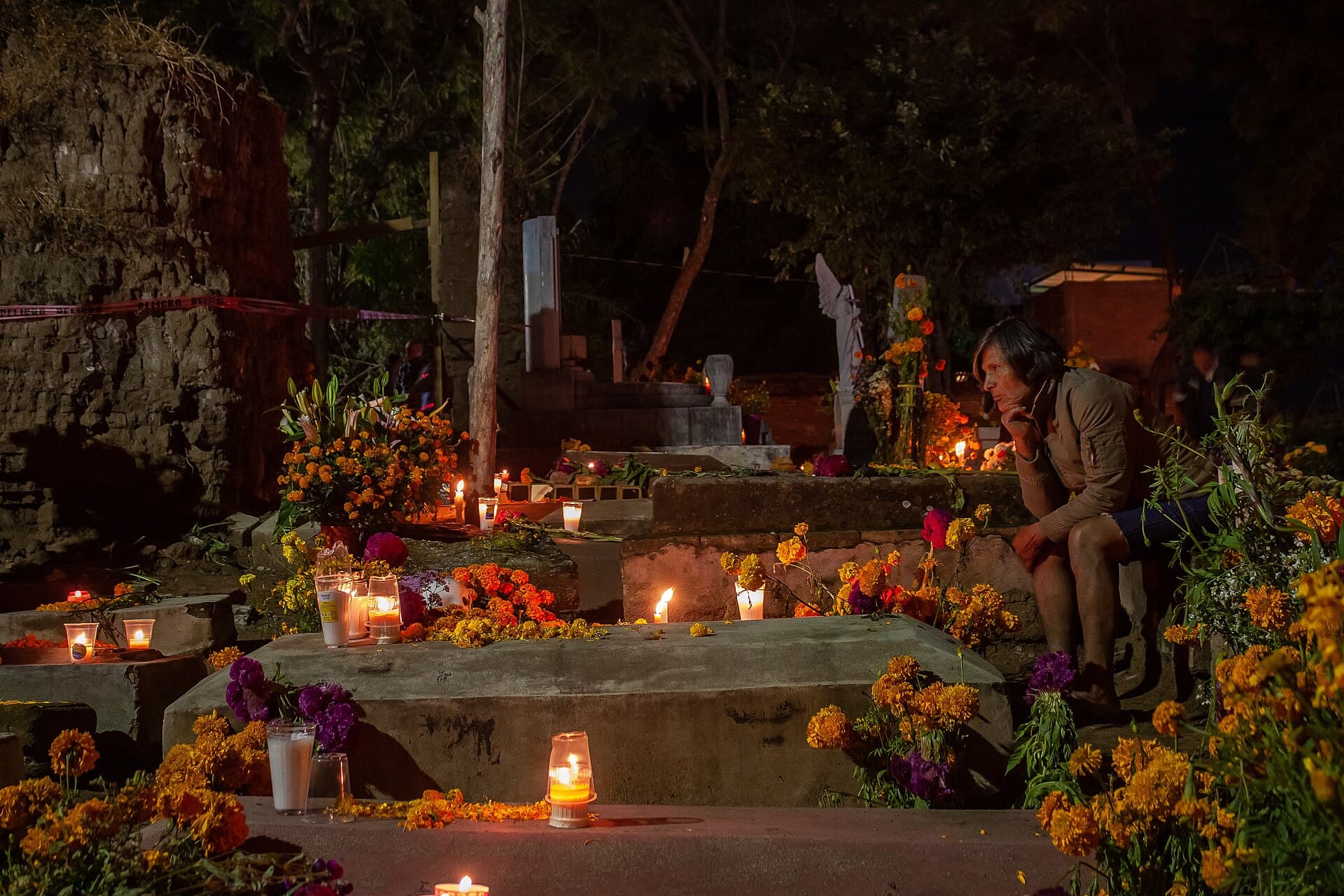
The word for it is velar, to keep watch. At Xoxocotlan and the other cemeteries around the city of Oaxaca, families arrive in the afternoon of 1 November, clean the grave, cover it in marigolds, set out candles, and then stay. They bring chairs and blankets, bread and chocolate, sometimes a band. Children fall asleep against the headstones. The point is not to visit the dead and leave; it is to spend the night in their company, once a year, on a date everyone agrees on.
Almost every culture in this series has a way of keeping its dead reachable. Oaxaca's is unusual in being public, scheduled, cheerful and completely unembarrassed, and in having survived long enough to be inscribed by UNESCO and then borrowed by the rest of the world.
Oaxaca is a state in southern Mexico covering about 93,800 square kilometres, with a population of roughly 4.1 million at the 2020 census. It is mountainous almost everywhere: the Sierra Madre del Sur and the Sierra Norte meet here, broken by the Central Valleys around the capital and running down to the Pacific coast and, in the east, to the flat and windy Isthmus of Tehuantepec.
The terrain explains the culture. Valleys separated by hard country produced communities that stayed distinct, and Oaxaca is the most linguistically and ethnically diverse state in Mexico, with sixteen Indigenous peoples formally recognised. It is also one of the poorest, with high rates of migration to northern Mexico and the United States, and it is governed at village level by usos y costumbres, customary systems in which most municipalities select their authorities through community assembly rather than party elections, a practice given legal recognition in the 1990s.
The capital is Oaxaca de Juárez, usually just Oaxaca.
Oaxaca de Juárez. A colonial city of green cantera stone laid out on a grid, whose historic centre and the ruins above it form a joint World Heritage site. Santo Domingo de Guzman, the great Dominican church, now shares its former convent with the Museo de las Culturas de Oaxaca, which holds the contents of Tomb 7.
Monte Alban. Not a town but the mountain-top city above the capital, levelled by hand around 500 BCE and the Zapotec capital for a thousand years.
Mitla. A Zapotec religious centre whose name comes from the Nahuatl for place of the dead, and whose walls carry geometric stone mosaics fitted without mortar, unlike anything else in Mesoamerica.
Juchitan de Zaragoza. The main town of the Isthmus, Isthmus Zapotec speaking, known for the public standing of women in its markets and for the muxes, and badly damaged in the earthquake of September 2017.
Teotitlan del Valle and San Bartolo Coyotepec. Craft villages, the first weaving wool rugs on treadle looms with natural dyes, the second producing the burnished black pottery, barro negro, that is the state's most recognisable ceramic.
Oaxaca holds some of the oldest evidence of agriculture in the Americas. The caves at Guila Naquitz in the Central Valleys yielded domesticated squash seeds around ten thousand years old and early maize cobs, and the site is part of a World Heritage inscription made specifically for that reason.
Monte Alban was founded around 500 BCE on a levelled ridge and became the capital of the Zapotec state, with a population in the tens of thousands, a plaza of temples and a ball court, and the carved slabs known as the Danzantes, once read as dancers and now generally understood as depicting killed or captive enemies. The city declined after about 800 CE, and power fragmented into smaller Zapotec and Mixtec kingdoms whose dynastic histories are recorded in painted screenfold books.
The Mixtec were among the finest metalworkers and lapidaries in the Americas. In 1932 Alfonso Caso excavated Tomb 7 at Monte Alban, a reused Zapotec tomb in which Mixtec nobles had later been buried with an assemblage of gold, turquoise, jade, rock crystal and carved jaguar bone. It is one of the richest burials ever found in the Americas and it stayed in Oaxaca, which at the time was not the obvious outcome.
The Spanish arrived in the 1520s, and Dominican friars built the churches and convents that give the state its colonial architecture. Two presidents of Mexico came from Oaxaca: Benito Juarez, a Zapotec from the Sierra, and Porfirio Diaz, whose long rule Juarez's admirers regard as the opposite of his legacy. The state has a strong tradition of political mobilisation that continues, most visibly in the teachers' movement and the confrontation of 2006.
Oaxaca is the most linguistically diverse part of Mexico and one of the most diverse places of its size anywhere. Sixteen Indigenous peoples are recognised, and the number of distinct languages is considerably higher, because what is called Zapotec and what is called Mixtec are each families of many varieties, some of them not mutually intelligible.
The largest groups are Zapotec, whose speakers call the language Diidxaza in the Isthmus and by other names elsewhere, and Mixtec, Tu'un savi, the rain's word. Then Mazatec, Mixe, or Ayuujk, Chinantec, Chatino, Triqui, Huave, Amuzgo, Cuicatec, Chontal, Zoque and others. At the far end, Ixcatec has been reduced to a very small number of elderly speakers and is among the most endangered languages in the Americas.
Two features are worth naming. Several Oaxacan languages are tonal, and the Mazatec whistled speech of the Sierra, in which tone alone carries a conversation across a valley, is a genuine speech register rather than a code. And the Mixtec codices are among the very few pre-Hispanic books to survive the conquest: painted on deerskin in a pictorial system recording genealogy, conquest and marriage, they can still be read, and they are the reason Mixtec dynastic history is known in detail from the tenth century onwards. Most of them are in European collections, the Codex Bodley at Oxford and the Codex Zouche-Nuttall in the British Museum among them.
The word that organises Oaxacan village life is guelaguetza, a Zapotec term for a reciprocal obligation: what is given at a wedding, a funeral or a house-building is recorded and returned when the giver's turn comes. Households keep account of it across years. Alongside it runs the tequio, communal labour owed to the village, and the cargo system, in which men and increasingly women serve unpaid in a ladder of civil and religious offices. These three together are what usos y costumbres actually consists of.
The state has borrowed the name for its largest festival. The Guelaguetza, held on two Mondays each July on a hillside above the capital, brings delegations from the eight regions to dance and to distribute the goods of their district into the crowd. It is a twentieth-century construction assembled from older village dances, and it is both a genuine expression of regional identity and a state-run tourist event, a tension Oaxacans discuss openly.
Craft is unusually alive here because it never fully industrialised. Barro negro at San Bartolo Coyotepec, the carved and painted wooden animals of San Martin Tilcajete and Arrazola, the rugs of Teotitlan dyed with cochineal and indigo, backstrap weaving at Santo Tomas Jalieza, and the huipiles of the Isthmus and the Mixe sierra are all made in specific villages by specific families. Mezcal, distilled from agave in small palenques, has followed the same pattern and is now the state's most conspicuous export.
Oaxaca is predominantly Catholic, and the Catholicism is layered over practices that were never abandoned. Village patron saint festivals are the main calendar, and the mayordomo who funds one takes on an expense that can absorb a year's income, in return for standing in the community.
 Santo Domingo was a Dominican convent, then a barracks and a stable through the nineteenth century, and its cloister now holds the museum that keeps the Tomb 7 gold. Photograph by Ovedc, CC BY-SA 4.0, via Wikimedia Commons.
Underneath sits an older understanding of the world in which places have owners, illness has causes that are social as much as physical, and specialists are consulted about both. Curanderos and hueseros practise across the state, and in the Sierra Mazateca the use of psilocybin mushrooms in healing vigils was a closed local practice until the 1950s, when the publication of an outsider's account brought a flood of visitors to Huautla de Jimenez and, by the account of the healer Maria Sabina herself, damaged the practice permanently. It is the sharpest cautionary tale in Mexican heritage about what publicity does to a living rite.
The dead occupy a specific position in this: not gone, not in a distant afterlife, but able to return, and dependent on the living to make the return possible.
Day of the Dead is not a Mexican Halloween and its date is not arbitrary. Deceased children, the angelitos, are received on 1 November, and adults on the 2nd, with the household work beginning days earlier. The ofrenda is an altar built at home in tiers, carrying photographs of the dead, water, salt, candles, copal incense, the marigold called cempasuchil whose colour and smell are held to guide the dead home, sugar skulls, pan de muerto, and the food and drink the person actually liked. The dead are understood to consume the essence of what is offered, which is why the food is described afterwards as having lost its taste.
A path of marigold petals is laid from the street to the altar so that the person can find the door. The point of the whole arrangement is that the dead are guests who need directions, not spirits to be appeased.
Then the vigil. In the Central Valleys, families go to the panteon on the night of the 1st, and the cemeteries at Xoxocotlan, Atzompa and San Felipe del Agua fill with candlelight, marigolds, bands, food and conversation until dawn. Comparsas, masked processions with music, move through the streets in the Isthmus and elsewhere. In many villages the church bells are rung for the dead by relays of people through the night.
Two things about this deserve emphasis. First, it is a genuinely composite practice: pre-Hispanic Mesoamerican observances for the dead, which fell in a different part of the year, were merged with the Catholic All Saints and All Souls, and the result is neither one thing nor the other. Second, its social function is precise. Because everyone goes on the same two nights, grief is not private and not permanent. A person who has lost someone recently is in the cemetery beside people who lost someone forty years ago, which is a way of saying that the loss becomes ordinary without becoming forgotten.
UNESCO proclaimed the Indigenous festivity dedicated to the dead a Masterpiece in 2003 and incorporated it into the Representative List in 2008.
Oaxaca holds genealogical documents older than any in Europe, and they are painted.
The Mixtec codices, the Nuttall, the Vindobonensis, the Bodley, the Selden, are screenfold books of deerskin and bark paper recording the dynasties of the Mixtec kingdoms across several centuries before the Spanish arrived. They are genealogies: marriages, births, successions, conquests, each person named by their calendar day-sign and a personal name, drawn in sequence. Lord Eight Deer Jaguar Claw, whose career fills much of the Nuttall, can be dated to the eleventh century. Almost all of them are now in European libraries, in Oxford, Vienna, London and Liverpool, and the communities they came from have been asking about that.
The Zapotec record is older still and carved: the inscriptions at Monte Albán and the Zapotec calendar are the earliest writing in the Americas.
After the conquest, Catholic parish registers begin in the sixteenth century, and Oaxacan parishes often kept separate books for Indigenous parishioners, so Mixtec, Zapotec and Mixe families can be traced in the colonial record. Civil registration dates from the Reform. FamilySearch has digitised a large share of both.
The living record is the municipality. More than four hundred Oaxacan municipalities are governed by usos y costumbres, customary law, in which assemblies choose officials and men serve unpaid cargos in rotation, and belonging is established by community membership rather than by paperwork.
Two World Heritage inscriptions cover Oaxaca. The Historic Centre of Oaxaca and the Archaeological Site of Monte Alban were listed together in 1987, deliberately joining the colonial city and the Zapotec capital above it as one property. The Prehistoric Caves of Yagul and Mitla in the Central Valley of Oaxaca were added in 2010 for the evidence of early plant domestication at Guila Naquitz and the rock art of the area.
Institutionally, the Museo de las Culturas de Oaxaca in the Santo Domingo convent is the principal collection and holds the Tomb 7 material; the Museo Textil de Oaxaca documents the state's weaving; and the Instituto de Artes Graficas de Oaxaca, founded by the artist Francisco Toledo in 1988, gave the city a free public art library. Toledo, who died in 2019, is the central figure in recent Oaxacan cultural preservation, having also fought successive campaigns against development around the historic centre and funded a network of libraries, print workshops and craft support across the state.
Earthquakes are the chronic physical threat. The September 2017 earthquake damaged or destroyed a large number of churches and civil buildings, particularly in the Isthmus, and restoration has been slow and contested, with communities arguing for traditional materials against faster engineered repairs.
Language documentation is the most active digital front, and it is being done substantially by Oaxacans. Talking dictionaries, recorded corpora, community radio in Indigenous languages, and a body of literature published in Zapotec, Mixtec and Mixe have all grown since the 1990s, and Oaxacan writers such as those working in Ayuujk have made a public argument that these are languages for writing and for the internet, not only for the home.
The codices are the state's most striking case of digital repatriation. Because the Mixtec painted books are held in Oxford, London, Vienna and elsewhere, high-resolution digitisation has, in practice, returned them to Oaxaca as images: they can now be read by Mixtec scholars and students who will never see the originals, and the Bodleian's work on the Codex Bodley has included collaboration with Mixtec communities on interpretation. The objects remain abroad and the argument about that continues, but the content is home.
Day of the Dead is now among the most photographed traditions on earth, and Oaxacan communities have had to think about that. Several villages have set their own rules about filming in cemeteries, which is a form of heritage governance made necessary by the internet.
Oaxaca's cultural export has been extraordinary and double-edged. Mole, mezcal, textiles and carved wooden figures have global markets, and Oaxacan cooks and artists work internationally. The imagery of Day of the Dead, above all the elegant skeleton derived from Jose Guadalupe Posada's Catrina, is now used worldwide, and the animated feature Coco brought a version of the tradition to an audience of hundreds of millions.
Two consequences are argued about locally. Design piracy is a recurring grievance: several international fashion houses have been publicly accused of copying Oaxacan community designs without permission or payment, and Mexico passed a law in 2022 to protect Indigenous collective intellectual property in response. And the sheer volume of visitors at the end of October has changed the cemeteries, with some communities welcoming the income and others restricting access on the night itself.
The other great modern fact is migration. Very large Oaxacan communities live in California and elsewhere in the United States, organised in hometown associations that fund village works and bring people back for the patron saint festival. Day of the Dead altars are built in Los Angeles kitchens, and Zapotec and Mixtec are spoken in Californian schools, which means Oaxacan heritage is now maintained across a border as a normal condition rather than an exception.
A remembrance practice recognised on its own terms. UNESCO proclaimed the Indigenous festivity dedicated to the dead in 2003 and inscribed it in 2008, recognising a household and village practice rather than a performance.
Tomb 7 stayed in Oaxaca. The richest burial assemblage found in the Americas was excavated in 1932 and remains in the city, in the museum in the Santo Domingo convent, rather than in Mexico City or abroad.
A colonial city and a Zapotec capital listed as one thing. The 1987 inscription treats Monte Alban and the historic centre below it as a single property, which is an argument about continuity as much as a designation.
Painted books returned as images. Digitisation of the Mixtec codices held in European collections has put the content back within reach of the communities whose history it records.
Santo Domingo was a Dominican convent, then a barracks and a stable through the nineteenth century, and its cloister now holds the museum that keeps the Tomb 7 gold. Photograph by Ovedc, CC BY-SA 4.0, via Wikimedia Commons.
Underneath sits an older understanding of the world in which places have owners, illness has causes that are social as much as physical, and specialists are consulted about both. Curanderos and hueseros practise across the state, and in the Sierra Mazateca the use of psilocybin mushrooms in healing vigils was a closed local practice until the 1950s, when the publication of an outsider's account brought a flood of visitors to Huautla de Jimenez and, by the account of the healer Maria Sabina herself, damaged the practice permanently. It is the sharpest cautionary tale in Mexican heritage about what publicity does to a living rite.
The dead occupy a specific position in this: not gone, not in a distant afterlife, but able to return, and dependent on the living to make the return possible.
Day of the Dead is not a Mexican Halloween and its date is not arbitrary. Deceased children, the angelitos, are received on 1 November, and adults on the 2nd, with the household work beginning days earlier. The ofrenda is an altar built at home in tiers, carrying photographs of the dead, water, salt, candles, copal incense, the marigold called cempasuchil whose colour and smell are held to guide the dead home, sugar skulls, pan de muerto, and the food and drink the person actually liked. The dead are understood to consume the essence of what is offered, which is why the food is described afterwards as having lost its taste.
A path of marigold petals is laid from the street to the altar so that the person can find the door. The point of the whole arrangement is that the dead are guests who need directions, not spirits to be appeased.
Then the vigil. In the Central Valleys, families go to the panteon on the night of the 1st, and the cemeteries at Xoxocotlan, Atzompa and San Felipe del Agua fill with candlelight, marigolds, bands, food and conversation until dawn. Comparsas, masked processions with music, move through the streets in the Isthmus and elsewhere. In many villages the church bells are rung for the dead by relays of people through the night.
Two things about this deserve emphasis. First, it is a genuinely composite practice: pre-Hispanic Mesoamerican observances for the dead, which fell in a different part of the year, were merged with the Catholic All Saints and All Souls, and the result is neither one thing nor the other. Second, its social function is precise. Because everyone goes on the same two nights, grief is not private and not permanent. A person who has lost someone recently is in the cemetery beside people who lost someone forty years ago, which is a way of saying that the loss becomes ordinary without becoming forgotten.
UNESCO proclaimed the Indigenous festivity dedicated to the dead a Masterpiece in 2003 and incorporated it into the Representative List in 2008.
Oaxaca holds genealogical documents older than any in Europe, and they are painted.
The Mixtec codices, the Nuttall, the Vindobonensis, the Bodley, the Selden, are screenfold books of deerskin and bark paper recording the dynasties of the Mixtec kingdoms across several centuries before the Spanish arrived. They are genealogies: marriages, births, successions, conquests, each person named by their calendar day-sign and a personal name, drawn in sequence. Lord Eight Deer Jaguar Claw, whose career fills much of the Nuttall, can be dated to the eleventh century. Almost all of them are now in European libraries, in Oxford, Vienna, London and Liverpool, and the communities they came from have been asking about that.
The Zapotec record is older still and carved: the inscriptions at Monte Albán and the Zapotec calendar are the earliest writing in the Americas.
After the conquest, Catholic parish registers begin in the sixteenth century, and Oaxacan parishes often kept separate books for Indigenous parishioners, so Mixtec, Zapotec and Mixe families can be traced in the colonial record. Civil registration dates from the Reform. FamilySearch has digitised a large share of both.
The living record is the municipality. More than four hundred Oaxacan municipalities are governed by usos y costumbres, customary law, in which assemblies choose officials and men serve unpaid cargos in rotation, and belonging is established by community membership rather than by paperwork.
Two World Heritage inscriptions cover Oaxaca. The Historic Centre of Oaxaca and the Archaeological Site of Monte Alban were listed together in 1987, deliberately joining the colonial city and the Zapotec capital above it as one property. The Prehistoric Caves of Yagul and Mitla in the Central Valley of Oaxaca were added in 2010 for the evidence of early plant domestication at Guila Naquitz and the rock art of the area.
Institutionally, the Museo de las Culturas de Oaxaca in the Santo Domingo convent is the principal collection and holds the Tomb 7 material; the Museo Textil de Oaxaca documents the state's weaving; and the Instituto de Artes Graficas de Oaxaca, founded by the artist Francisco Toledo in 1988, gave the city a free public art library. Toledo, who died in 2019, is the central figure in recent Oaxacan cultural preservation, having also fought successive campaigns against development around the historic centre and funded a network of libraries, print workshops and craft support across the state.
Earthquakes are the chronic physical threat. The September 2017 earthquake damaged or destroyed a large number of churches and civil buildings, particularly in the Isthmus, and restoration has been slow and contested, with communities arguing for traditional materials against faster engineered repairs.
Language documentation is the most active digital front, and it is being done substantially by Oaxacans. Talking dictionaries, recorded corpora, community radio in Indigenous languages, and a body of literature published in Zapotec, Mixtec and Mixe have all grown since the 1990s, and Oaxacan writers such as those working in Ayuujk have made a public argument that these are languages for writing and for the internet, not only for the home.
The codices are the state's most striking case of digital repatriation. Because the Mixtec painted books are held in Oxford, London, Vienna and elsewhere, high-resolution digitisation has, in practice, returned them to Oaxaca as images: they can now be read by Mixtec scholars and students who will never see the originals, and the Bodleian's work on the Codex Bodley has included collaboration with Mixtec communities on interpretation. The objects remain abroad and the argument about that continues, but the content is home.
Day of the Dead is now among the most photographed traditions on earth, and Oaxacan communities have had to think about that. Several villages have set their own rules about filming in cemeteries, which is a form of heritage governance made necessary by the internet.
Oaxaca's cultural export has been extraordinary and double-edged. Mole, mezcal, textiles and carved wooden figures have global markets, and Oaxacan cooks and artists work internationally. The imagery of Day of the Dead, above all the elegant skeleton derived from Jose Guadalupe Posada's Catrina, is now used worldwide, and the animated feature Coco brought a version of the tradition to an audience of hundreds of millions.
Two consequences are argued about locally. Design piracy is a recurring grievance: several international fashion houses have been publicly accused of copying Oaxacan community designs without permission or payment, and Mexico passed a law in 2022 to protect Indigenous collective intellectual property in response. And the sheer volume of visitors at the end of October has changed the cemeteries, with some communities welcoming the income and others restricting access on the night itself.
The other great modern fact is migration. Very large Oaxacan communities live in California and elsewhere in the United States, organised in hometown associations that fund village works and bring people back for the patron saint festival. Day of the Dead altars are built in Los Angeles kitchens, and Zapotec and Mixtec are spoken in Californian schools, which means Oaxacan heritage is now maintained across a border as a normal condition rather than an exception.
A remembrance practice recognised on its own terms. UNESCO proclaimed the Indigenous festivity dedicated to the dead in 2003 and inscribed it in 2008, recognising a household and village practice rather than a performance.
Tomb 7 stayed in Oaxaca. The richest burial assemblage found in the Americas was excavated in 1932 and remains in the city, in the museum in the Santo Domingo convent, rather than in Mexico City or abroad.
A colonial city and a Zapotec capital listed as one thing. The 1987 inscription treats Monte Alban and the historic centre below it as a single property, which is an argument about continuity as much as a designation.
Painted books returned as images. Digitisation of the Mixtec codices held in European collections has put the content back within reach of the communities whose history it records.
National Overview
Notable Cities
Historical Foundations
Linguistic and Etymological Roots
Cultural Identity
Religion and Spirituality
Remembrance and Mourning Traditions
Tracing a Family in Oaxaca
Heritage Preservation Efforts
Digital Heritage
Contemporary Cultural Influences
Success Stories
References and resources
- UNESCO, Indigenous festivity dedicated to the dead: the 2003 proclamation and 2008 inscription.
- UNESCO, Historic Centre of Oaxaca and Archaeological Site of Monte Alban: the 1987 joint inscription.
- UNESCO, Prehistoric Caves of Yagul and Mitla: the 2010 inscription and the evidence for early domestication.
- Day of the Dead, Wikipedia: the ofrenda, the dates and the composite origins.
- Monte Alban, Wikipedia: the Zapotec capital, the Danzantes and Tomb 7.
- Oaxaca, Wikipedia: geography, population and Indigenous peoples.
- Mixtec codices, Wikipedia: the painted books and where they are held.
- Guelaguetza, Wikipedia: the reciprocal obligation and the July festival.
- Francisco Toledo, Wikipedia: the artist and his cultural institutions in Oaxaca.
- Mitla, Wikipedia: the Zapotec site and its stone mosaics.