Heritage · Country
Northern Cyprus Culture and Heritage
In Famagusta the call to prayer comes from the west front of a fourteenth-century French Gothic cathedral. This guide follows the heritage of the northern part of Cyprus: Salamis and Bellapais, the Cypriot Turkish dialect and its Greek loanwords, and the bicommunal work of finding the island's missing.Written to last.
By Confinity Heritage Editorial · Updated 2026-08-17 · 8-minute readQuiet tools, kept out of the way.
In Famagusta the call to prayer comes from a French Gothic cathedral. St Nicholas was built in the fourteenth century by the Lusignan kings, who were crowned there as kings of Jerusalem, and since 1571 it has been the Lala Mustafa Pasha Mosque, its rose window and flying buttresses intact, a minaret rising from one of its western towers. Nicosia's cathedral of St Sophia has served as the Selimiye Mosque since 1570. Neither was demolished to make the change. The island's habit has been to reuse rather than erase, and that habit is the best short description of its heritage.
The northern part of Cyprus holds a large share of the island's medieval and classical monuments, and a community, the Turkish Cypriots, whose speech, food and music are closer to their Greek Cypriot neighbours than either is to the mainlands behind them. It also holds one of Europe's longest-running political disputes and the grief of a war that displaced both communities.
Northern Cyprus covers about 3,355 square kilometres, roughly a third of the island, running from the Morphou plain in the west along the Kyrenia range to the long finger of the Karpas peninsula. The Kyrenia range is a narrow limestone ridge rising to just over a thousand metres, with castles on three of its peaks and a coastal strip of citrus and olive below; south of it lies the Mesaoria plain that the two halves of the island share. The Turkish Cypriot administration's 2011 census counted 286,257 residents and later counts have put the figure above 380,000, a gap reflecting both growth and a long argument about counting settlers from Türkiye (Wikipedia).
The Turkish Republic of Northern Cyprus declared independence on 15 November 1983. Three days later the United Nations Security Council, in resolution 541, declared the declaration legally invalid, called for its withdrawal, and asked states not to recognise any Cypriot state other than the Republic of Cyprus; resolution 550 of 1984 repeated that call. Türkiye is the only state that recognises the declaration. The Republic of Cyprus and the great majority of states regard the area north of the ceasefire line as territory of the Republic under Turkish occupation, while Türkiye and the Turkish Cypriot leadership hold that the 1974 intervention was permitted by the 1960 Treaty of Guarantee and that Turkish Cypriots hold a right of self-determination of their own. This page uses Northern Cyprus as a geographic description and takes no position on that argument. In European Union law the whole island acceded in 2004, with the acquis suspended in the north pending a settlement.
North Nicosia (Lefkoşa). The northern half of the capital sits inside the same Venetian walls as the southern half, split by the buffer zone. Within it stand the Selimiye Mosque, the Gothic cathedral of St Sophia begun in 1209; the Büyük Han, an Ottoman caravanserai of 1572; and the Mevlevi Tekke, a dervish lodge now a museum.
Famagusta (Gazimağusa). The walled medieval town behind Venetian fortifications holds the ruins of what was once said to be 365 churches, the Lala Mustafa Pasha Mosque, and the tower shown to visitors as Othello's Castle. Just north lie the ruins of ancient Salamis, with its gymnasium, theatre and Roman baths standing on the shore.
Varosha (Maraş). The resort quarter on Famagusta's southern shore, whose population is usually put at around 39,000 before 1974, was fenced off after its mostly Greek Cypriot residents fled that August and has stood empty since. Security Council resolution 550 of 1984 demanded its transfer to United Nations administration for the return of its inhabitants, and resolution 789 of 1992 repeated that demand. On 8 October 2020 the Turkish Cypriot authorities reopened a stretch of the beachfront to visitors with Turkish support; the Republic of Cyprus, Greece, Russia and the European Union objected, and in July 2021 the Security Council called for the reversal of all steps taken at Varosha since October 2020 (UN Meetings Coverage).
Kyrenia (Girne). A horseshoe harbour under the mountains, guarded by a castle of Byzantine origin rebuilt by the Venetians. Inside it the Shipwreck Museum displays the Kyrenia ship, a Greek merchantman that sank around 300 BC, excavated in 1967 to 1969 and the oldest recovered Greek vessel.
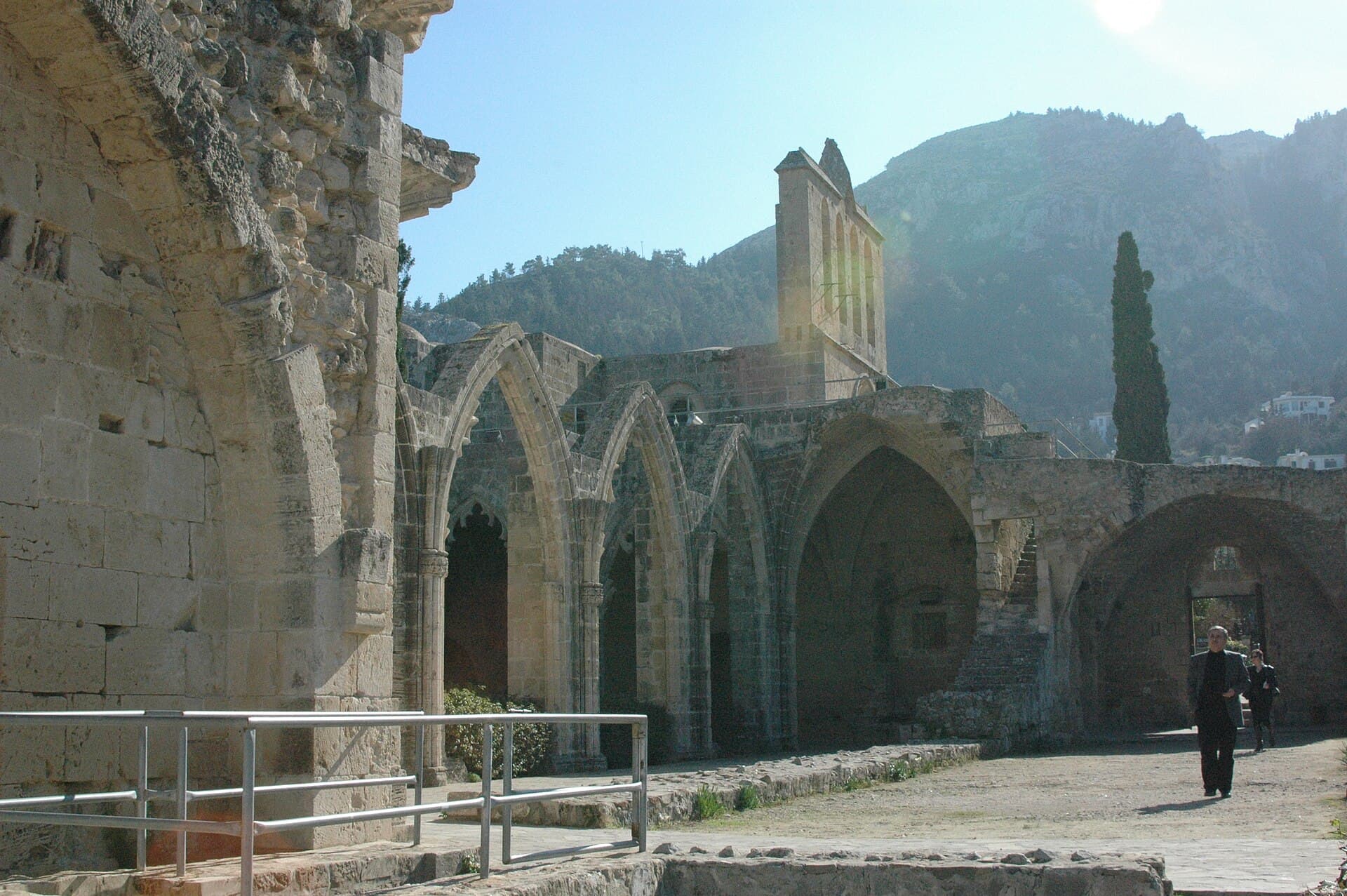
Bellapais and the Karpas. Above Kyrenia stands Bellapais Abbey, founded by Augustinian canons around 1200 and rebuilt by the Lusignans, its refectory and cloister among the finest Gothic work in the region. The Karpas peninsula, thinly settled and grazed by feral donkeys, holds the monastery of Apostolos Andreas and the villages where enclaved Greek Cypriots remained after 1974.
The deep history of the north belongs to the island as a whole, from Neolithic settlement through the Bronze Age copper trade to the Greek city-kingdoms, of which Salamis was the greatest. Byzantine rule gave way to the Lusignan kings from 1192, who built the cathedrals, abbeys and castles that still dominate the landscape, and then to the Venetians, who walled Nicosia and Famagusta after 1489.
 The castle holds the Kyrenia ship, a Greek merchant vessel that sank around 300 BC and was raised in the 1960s, one of the best preserved ancient hulls ever recovered. Photograph by Zairon, CC BY-SA 4.0, via Wikimedia Commons.
The Ottoman conquest of 1570 and 1571 is the hinge for this page. Nicosia fell in September 1570; Famagusta held out for eleven months and surrendered in August 1571. The Ottomans abolished the Latin church hierarchy, restored the Orthodox archbishopric and made it responsible for the Greek Cypriot population under the millet system, and settled Anatolian Muslims on the island by decree. Those settlers, with local converts, are the origin of the Turkish Cypriot community, which has been on the island for more than four and a half centuries. Ottoman rule also created Evkaf, the endowment administration that still holds substantial property.
Britain took over the administration in 1878 under the Cyprus Convention, annexed the island in 1914 and governed it as a Crown Colony from 1925. Independence came on 16 August 1960 under the Zurich and London agreements, with a constitution that divided offices between the communities: a Greek Cypriot president and a Turkish Cypriot vice-president, each with a veto on major legislation, a 70 to 30 split of the civil service, a 60 to 40 split of the army, and separate communal chambers. It proved unworkable. President Makarios proposed thirteen amendments in November 1963, the Turkish Cypriot side rejected them, and violence broke out that December. Turkish Cypriots withdrew or were driven into enclaves covering a small fraction of the island; the PRIO Cyprus Centre records that 25,000 to 30,000 became refugees in 1963 and 1964, with over a hundred villages attacked (PRIO). UNFICYP, the United Nations peacekeeping force, arrived in March 1964 and has never left.
On 15 July 1974 the Greek Cypriot National Guard, backed by the military government then ruling Greece, staged a coup against Makarios. Turkish forces landed on 20 July, a ceasefire followed, and a second advance on 14 to 16 August took the line that still divides the island. Both communities lost heavily. Around 160,000 to 165,000 Greek Cypriots were displaced from north to south and around 45,000 Turkish Cypriots from south to north, a movement formalised by the Vienna agreement of August 1975; with the earlier displacements, more than 200,000 people on an island of well under a million lost their homes. Roughly 1,500 Greek Cypriots and 500 Turkish Cypriots were listed as missing.
The declaration of 1983 followed nine years of failed talks. Crossings along the buffer zone opened on 23 April 2003. In 2004 a United Nations settlement plan went to separate referendums: Turkish Cypriots approved it by about 65 per cent, Greek Cypriots rejected it by about 76 per cent, and the Republic of Cyprus joined the European Union days later. Talks have continued and broken off since, most recently at Crans-Montana in 2017.
Cypriot Turkish grew from the speech of the sixteenth-century settlers, with a base in the Yörük dialects of the Taurus mountains, and has developed for four centuries alongside Cypriot Greek. The contact shows. It borrows Greek vocabulary, especially for plants, food and household things; it tends toward verb-object order where standard Turkish puts the verb last; and it drops the interrogative particle mi, marking a yes-or-no question by intonation alone, a feature linguists attribute to Greek influence (Wikipedia). Italian and English loanwords came with the Venetians and the British. Standard Turkish is the language of schooling and administration, which puts steady pressure on the dialect.
The place names carry the layers. Lefkoşa and Lefkosia are the same word; Gazimağusa and Ammochostos both descend from the Greek for hidden in sand; Girne and Keryneia likewise share a root. Bellapais is a worn-down French phrase for the abbey of peace, which passed through Italian and produced the Turkish name Beylerbeyi alongside it. After 1974 most settlements in the north were given Turkish names, so many places now carry two, and Cypriots of both communities routinely use the older name when talking about where a family came from. In the Karpas, Cypriot Greek is still spoken by the small enclaved community, and hellim and halloumi remain the same cheese under two names.
The shared island culture survives most obviously at the table. Hellim, grilled or fried, is common to both communities; so are molohiya, the jute-leaf stew, kolokas, the taro root braised with pork in the south and with lamb in the north, and the pomace spirit called zivaniya or zivania. Şeftali kebabı, minced meat wrapped in caul fat and grilled, is a Turkish Cypriot speciality with no equivalent in Türkiye. Village bread, olives, carob syrup and the dried figs of the Karpas belong to everyone.
Music runs the same way. The violin, oud, darbuka and the village folk dances are near-identical across the line, and several melodies exist in both languages with different words, the tune known to Turkish Cypriots as Dillirga and to Greek Cypriots as Dhillirga being the usual example. Weddings keep the henna night, the pinning of gold onto the couple, and the communal cooking of meat and pilaf. Basketry in the Karpas and silk in Lapithos carry the older crafts.
Turkish Cypriot public life is markedly secular in habit, a legacy of the Bektashi and Mevlevi strands of Ottoman Islam, and coffee-house argument is close to a civic institution.
Most Turkish Cypriots are Sunni Muslims of the Hanafi school. The Mevlevi order kept a lodge in Nicosia from the seventeenth century until the orders were closed in Türkiye in 1925, and the building is now a museum holding its shaykhs' tombs. Bektashi influence, more tolerant of drink and less concerned with ritual, left a lasting mark on attitudes.
The island's religious history is not tidy. The Linobambaki, descendants of Christians who conformed outwardly to Islam after 1571 while keeping Christian practice at home, lived for centuries with two names and two calendars, and several villages trace their origins to them. Orthodox worship continues at the monastery of Apostolos Andreas on the Karpas tip, a pilgrimage site for Cypriots of all communities, and in the Karpas villages where enclaved Greek Cypriots remained. The Maronite village of Kormakitis keeps its own Aramaic-influenced Arabic. Since 2009 a religious track of the peace process, facilitated by Sweden, has arranged services in churches in the north and prayers in mosques in the south, with the religious leaders of both communities meeting regularly.
Turkish Cypriot funerals follow Muslim practice: burial within a day where possible, the body washed and wrapped in a white shroud, the coffin shouldered to the cemetery, the grave oriented toward Mecca, and the hoca leading prayers. Before the coffin leaves the house those present are asked to forgive the deceased any wrong and answer helal olsun. Condolences are received at home for several days over soup and helva, and a mevlit, a devotional reading, is held at forty days and at anniversaries. Orthodox mourning in the Karpas keeps the memorial services of the third, ninth and fortieth day and the boiled wheat of kollyva.
Both communities left cemeteries behind. Since 2003, Greek Cypriots have travelled north and Turkish Cypriots south to tend family graves in villages they no longer live in, and to attend a service or a prayer in a building the other community now maintains.
The most important remembrance work on the island is the Committee on Missing Persons. Established in 1981 by the two communities under United Nations auspices, it began exhumations in 2006 and works from a single official list of 2,002 people, 1,510 Greek Cypriots and 492 Turkish Cypriots, who disappeared in the violence of 1963 and 1964 and the events of 1974. Its bicommunal teams of archaeologists, anthropologists and geneticists work side by side in a laboratory inside the United Nations protected area, and it does not attribute blame; its purpose is to return remains to families. By 30 November 2025 it had exhumed 1,713 sets of remains and identified 1,058 people from the list, 762 Greek Cypriots and 296 Turkish Cypriots, along with 216 others (Cyprus Mail). Much of what it knows about burial sites came from ordinary people who spoke to the Turkish Cypriot journalist Sevgül Uludağ, who from 2002 until her death in June 2026 collected testimony about the graves of Greek Cypriots and Turkish Cypriots alike. She won the International Women's Media Foundation's Courage in Journalism prize in 2008 and was nominated for the Nobel Peace Prize in 2019 by parties from both communities (Wikipedia).
Northern Cyprus keeps a civil registry that only Turkey recognises, and the records of the people who used to live there are in the south.
The 1974 division moved populations in both directions, and each community left its property and much of its paperwork behind. Greek Cypriot land in the north is registered in the Republic of Cyprus's land registry; Turkish Cypriot land in the south is registered in the north's. The Immovable Property Commission, established in 2006, handles claims, and the European Court of Human Rights has treated it as a domestic remedy, so a very great deal of Cypriot family history now takes the form of a property file.
Ottoman records cover the period to 1878, sharia court registers holding marriage and inheritance for the Muslim population, and British colonial administration from 1878 introduced systematic civil registration and a well-kept cadastre, which is why the property claims are documentable at all.
The Committee on Missing Persons works across the line, with bicommunal teams excavating and a genetics laboratory matching remains to relatives from both communities. More than a thousand people have been identified and returned for burial, and each case is a document two administrations that do not recognise each other have agreed on.
Turkish settlement from the mainland after 1974 added a population whose records are Turkish, and whose status is one of the questions any settlement would have to resolve.
The bicommunal Technical Committee on Cultural Heritage, created by the two leaders in 2008 and supported by the European Union and the UN Development Programme, treats the heritage of each community as the concern of both. It has worked on more than 180 projects, restoring Orthodox, Maronite and Armenian churches, mosques and minarets, hamams, fortifications and aqueducts on both sides of the line, and holds a European Heritage Award for the work (Europa Nostra). Its largest single project is the monastery of Apostolos Andreas on the Karpas, structurally saved by bicommunal teams with about five million euros from the Church of Cyprus and Evkaf, a second phase of conservation completing in 2026 (UNDP). The committee has also stabilised the Othello Tower and stretches of the Famagusta walls.
Religious heritage on both sides of the line has suffered, and each community documents the losses on the other side. The Republic of Cyprus and the Church of Cyprus have catalogued churches in the north converted to other uses, left to decay or stripped of icons and frescoes; the best-known case is the sixth-century Kanakaria mosaics, cut from a church apse in the Karpas in the late 1970s and recovered after a US federal court ordered their return in 1989. Turkish Cypriot representatives and Evkaf have catalogued mosques and Muslim cemeteries in the south damaged or neglected since 1974, and arson attacks on mosques there were condemned and investigated by the Republic's government. The committee is the only mechanism that addresses both records at once.
Documentation has become a form of insurance. The Technical Committee on Cultural Heritage laser-scans monuments before and during conservation, so a measured record survives whatever happens to the building, and the Cyprus Institute has built three-dimensional records of sites including Salamis.
The PRIO Cyprus Centre's displacement project publishes an online record of every village on the island with its pre-1974 population by community, its old and new names, and the routes people took when they left. The Committee on Missing Persons maintains a genetic database matching remains to relatives, and the Association for Historical Dialogue and Research, at the Home for Cooperation in the buffer zone, has gathered oral histories from both communities into a shared archive.
Higher education is the north's largest export. The Eastern Mediterranean University in Famagusta, founded in 1979, and Near East University in Nicosia draw tens of thousands of international students, mostly from Türkiye, Africa and the Middle East, giving Famagusta a young and multilingual population alongside its medieval walls.
Trade across the line runs under the European Union's green line regulation, and the 2021 protected designation of origin for halloumi and hellim was designed to allow producers in the north to sell into EU markets under inspection, making a shared food into a shared economic mechanism. Turkish Cypriot writers and musicians work in both Cypriot and Turkish contexts, the London diaspora sustains a substantial community, and bicommunal choirs, film festivals and the buffer-zone cultural centres keep a small shared cultural life going.
More than a thousand returned to their families. The Committee on Missing Persons had identified 1,058 people from its official list by the end of November 2025, from remains exhumed by teams drawn from both communities.
Churches and mosques repaired by one committee. The Technical Committee on Cultural Heritage has worked on more than 180 monuments across the divide since 2008, including the rescue of Apostolos Andreas, funded jointly by the Church of Cyprus and Evkaf.
A capital that never stopped cooperating. The Nicosia Master Plan, begun in 1979 after the two mayors agreed to run the city's sewerage system together, has restored large parts of the walled city on both sides and won the Aga Khan Award for Architecture in 2007.
The crossings opened. Since 23 April 2003 Cypriots have been able to cross the buffer zone, allowing hundreds of thousands to see their villages, tend family graves and visit churches and mosques on the other side.
The castle holds the Kyrenia ship, a Greek merchant vessel that sank around 300 BC and was raised in the 1960s, one of the best preserved ancient hulls ever recovered. Photograph by Zairon, CC BY-SA 4.0, via Wikimedia Commons.
The Ottoman conquest of 1570 and 1571 is the hinge for this page. Nicosia fell in September 1570; Famagusta held out for eleven months and surrendered in August 1571. The Ottomans abolished the Latin church hierarchy, restored the Orthodox archbishopric and made it responsible for the Greek Cypriot population under the millet system, and settled Anatolian Muslims on the island by decree. Those settlers, with local converts, are the origin of the Turkish Cypriot community, which has been on the island for more than four and a half centuries. Ottoman rule also created Evkaf, the endowment administration that still holds substantial property.
Britain took over the administration in 1878 under the Cyprus Convention, annexed the island in 1914 and governed it as a Crown Colony from 1925. Independence came on 16 August 1960 under the Zurich and London agreements, with a constitution that divided offices between the communities: a Greek Cypriot president and a Turkish Cypriot vice-president, each with a veto on major legislation, a 70 to 30 split of the civil service, a 60 to 40 split of the army, and separate communal chambers. It proved unworkable. President Makarios proposed thirteen amendments in November 1963, the Turkish Cypriot side rejected them, and violence broke out that December. Turkish Cypriots withdrew or were driven into enclaves covering a small fraction of the island; the PRIO Cyprus Centre records that 25,000 to 30,000 became refugees in 1963 and 1964, with over a hundred villages attacked (PRIO). UNFICYP, the United Nations peacekeeping force, arrived in March 1964 and has never left.
On 15 July 1974 the Greek Cypriot National Guard, backed by the military government then ruling Greece, staged a coup against Makarios. Turkish forces landed on 20 July, a ceasefire followed, and a second advance on 14 to 16 August took the line that still divides the island. Both communities lost heavily. Around 160,000 to 165,000 Greek Cypriots were displaced from north to south and around 45,000 Turkish Cypriots from south to north, a movement formalised by the Vienna agreement of August 1975; with the earlier displacements, more than 200,000 people on an island of well under a million lost their homes. Roughly 1,500 Greek Cypriots and 500 Turkish Cypriots were listed as missing.
The declaration of 1983 followed nine years of failed talks. Crossings along the buffer zone opened on 23 April 2003. In 2004 a United Nations settlement plan went to separate referendums: Turkish Cypriots approved it by about 65 per cent, Greek Cypriots rejected it by about 76 per cent, and the Republic of Cyprus joined the European Union days later. Talks have continued and broken off since, most recently at Crans-Montana in 2017.
Cypriot Turkish grew from the speech of the sixteenth-century settlers, with a base in the Yörük dialects of the Taurus mountains, and has developed for four centuries alongside Cypriot Greek. The contact shows. It borrows Greek vocabulary, especially for plants, food and household things; it tends toward verb-object order where standard Turkish puts the verb last; and it drops the interrogative particle mi, marking a yes-or-no question by intonation alone, a feature linguists attribute to Greek influence (Wikipedia). Italian and English loanwords came with the Venetians and the British. Standard Turkish is the language of schooling and administration, which puts steady pressure on the dialect.
The place names carry the layers. Lefkoşa and Lefkosia are the same word; Gazimağusa and Ammochostos both descend from the Greek for hidden in sand; Girne and Keryneia likewise share a root. Bellapais is a worn-down French phrase for the abbey of peace, which passed through Italian and produced the Turkish name Beylerbeyi alongside it. After 1974 most settlements in the north were given Turkish names, so many places now carry two, and Cypriots of both communities routinely use the older name when talking about where a family came from. In the Karpas, Cypriot Greek is still spoken by the small enclaved community, and hellim and halloumi remain the same cheese under two names.
The shared island culture survives most obviously at the table. Hellim, grilled or fried, is common to both communities; so are molohiya, the jute-leaf stew, kolokas, the taro root braised with pork in the south and with lamb in the north, and the pomace spirit called zivaniya or zivania. Şeftali kebabı, minced meat wrapped in caul fat and grilled, is a Turkish Cypriot speciality with no equivalent in Türkiye. Village bread, olives, carob syrup and the dried figs of the Karpas belong to everyone.
Music runs the same way. The violin, oud, darbuka and the village folk dances are near-identical across the line, and several melodies exist in both languages with different words, the tune known to Turkish Cypriots as Dillirga and to Greek Cypriots as Dhillirga being the usual example. Weddings keep the henna night, the pinning of gold onto the couple, and the communal cooking of meat and pilaf. Basketry in the Karpas and silk in Lapithos carry the older crafts.
Turkish Cypriot public life is markedly secular in habit, a legacy of the Bektashi and Mevlevi strands of Ottoman Islam, and coffee-house argument is close to a civic institution.
Most Turkish Cypriots are Sunni Muslims of the Hanafi school. The Mevlevi order kept a lodge in Nicosia from the seventeenth century until the orders were closed in Türkiye in 1925, and the building is now a museum holding its shaykhs' tombs. Bektashi influence, more tolerant of drink and less concerned with ritual, left a lasting mark on attitudes.
The island's religious history is not tidy. The Linobambaki, descendants of Christians who conformed outwardly to Islam after 1571 while keeping Christian practice at home, lived for centuries with two names and two calendars, and several villages trace their origins to them. Orthodox worship continues at the monastery of Apostolos Andreas on the Karpas tip, a pilgrimage site for Cypriots of all communities, and in the Karpas villages where enclaved Greek Cypriots remained. The Maronite village of Kormakitis keeps its own Aramaic-influenced Arabic. Since 2009 a religious track of the peace process, facilitated by Sweden, has arranged services in churches in the north and prayers in mosques in the south, with the religious leaders of both communities meeting regularly.
Turkish Cypriot funerals follow Muslim practice: burial within a day where possible, the body washed and wrapped in a white shroud, the coffin shouldered to the cemetery, the grave oriented toward Mecca, and the hoca leading prayers. Before the coffin leaves the house those present are asked to forgive the deceased any wrong and answer helal olsun. Condolences are received at home for several days over soup and helva, and a mevlit, a devotional reading, is held at forty days and at anniversaries. Orthodox mourning in the Karpas keeps the memorial services of the third, ninth and fortieth day and the boiled wheat of kollyva.
Both communities left cemeteries behind. Since 2003, Greek Cypriots have travelled north and Turkish Cypriots south to tend family graves in villages they no longer live in, and to attend a service or a prayer in a building the other community now maintains.
The most important remembrance work on the island is the Committee on Missing Persons. Established in 1981 by the two communities under United Nations auspices, it began exhumations in 2006 and works from a single official list of 2,002 people, 1,510 Greek Cypriots and 492 Turkish Cypriots, who disappeared in the violence of 1963 and 1964 and the events of 1974. Its bicommunal teams of archaeologists, anthropologists and geneticists work side by side in a laboratory inside the United Nations protected area, and it does not attribute blame; its purpose is to return remains to families. By 30 November 2025 it had exhumed 1,713 sets of remains and identified 1,058 people from the list, 762 Greek Cypriots and 296 Turkish Cypriots, along with 216 others (Cyprus Mail). Much of what it knows about burial sites came from ordinary people who spoke to the Turkish Cypriot journalist Sevgül Uludağ, who from 2002 until her death in June 2026 collected testimony about the graves of Greek Cypriots and Turkish Cypriots alike. She won the International Women's Media Foundation's Courage in Journalism prize in 2008 and was nominated for the Nobel Peace Prize in 2019 by parties from both communities (Wikipedia).
Northern Cyprus keeps a civil registry that only Turkey recognises, and the records of the people who used to live there are in the south.
The 1974 division moved populations in both directions, and each community left its property and much of its paperwork behind. Greek Cypriot land in the north is registered in the Republic of Cyprus's land registry; Turkish Cypriot land in the south is registered in the north's. The Immovable Property Commission, established in 2006, handles claims, and the European Court of Human Rights has treated it as a domestic remedy, so a very great deal of Cypriot family history now takes the form of a property file.
Ottoman records cover the period to 1878, sharia court registers holding marriage and inheritance for the Muslim population, and British colonial administration from 1878 introduced systematic civil registration and a well-kept cadastre, which is why the property claims are documentable at all.
The Committee on Missing Persons works across the line, with bicommunal teams excavating and a genetics laboratory matching remains to relatives from both communities. More than a thousand people have been identified and returned for burial, and each case is a document two administrations that do not recognise each other have agreed on.
Turkish settlement from the mainland after 1974 added a population whose records are Turkish, and whose status is one of the questions any settlement would have to resolve.
The bicommunal Technical Committee on Cultural Heritage, created by the two leaders in 2008 and supported by the European Union and the UN Development Programme, treats the heritage of each community as the concern of both. It has worked on more than 180 projects, restoring Orthodox, Maronite and Armenian churches, mosques and minarets, hamams, fortifications and aqueducts on both sides of the line, and holds a European Heritage Award for the work (Europa Nostra). Its largest single project is the monastery of Apostolos Andreas on the Karpas, structurally saved by bicommunal teams with about five million euros from the Church of Cyprus and Evkaf, a second phase of conservation completing in 2026 (UNDP). The committee has also stabilised the Othello Tower and stretches of the Famagusta walls.
Religious heritage on both sides of the line has suffered, and each community documents the losses on the other side. The Republic of Cyprus and the Church of Cyprus have catalogued churches in the north converted to other uses, left to decay or stripped of icons and frescoes; the best-known case is the sixth-century Kanakaria mosaics, cut from a church apse in the Karpas in the late 1970s and recovered after a US federal court ordered their return in 1989. Turkish Cypriot representatives and Evkaf have catalogued mosques and Muslim cemeteries in the south damaged or neglected since 1974, and arson attacks on mosques there were condemned and investigated by the Republic's government. The committee is the only mechanism that addresses both records at once.
Documentation has become a form of insurance. The Technical Committee on Cultural Heritage laser-scans monuments before and during conservation, so a measured record survives whatever happens to the building, and the Cyprus Institute has built three-dimensional records of sites including Salamis.
The PRIO Cyprus Centre's displacement project publishes an online record of every village on the island with its pre-1974 population by community, its old and new names, and the routes people took when they left. The Committee on Missing Persons maintains a genetic database matching remains to relatives, and the Association for Historical Dialogue and Research, at the Home for Cooperation in the buffer zone, has gathered oral histories from both communities into a shared archive.
Higher education is the north's largest export. The Eastern Mediterranean University in Famagusta, founded in 1979, and Near East University in Nicosia draw tens of thousands of international students, mostly from Türkiye, Africa and the Middle East, giving Famagusta a young and multilingual population alongside its medieval walls.
Trade across the line runs under the European Union's green line regulation, and the 2021 protected designation of origin for halloumi and hellim was designed to allow producers in the north to sell into EU markets under inspection, making a shared food into a shared economic mechanism. Turkish Cypriot writers and musicians work in both Cypriot and Turkish contexts, the London diaspora sustains a substantial community, and bicommunal choirs, film festivals and the buffer-zone cultural centres keep a small shared cultural life going.
More than a thousand returned to their families. The Committee on Missing Persons had identified 1,058 people from its official list by the end of November 2025, from remains exhumed by teams drawn from both communities.
Churches and mosques repaired by one committee. The Technical Committee on Cultural Heritage has worked on more than 180 monuments across the divide since 2008, including the rescue of Apostolos Andreas, funded jointly by the Church of Cyprus and Evkaf.
A capital that never stopped cooperating. The Nicosia Master Plan, begun in 1979 after the two mayors agreed to run the city's sewerage system together, has restored large parts of the walled city on both sides and won the Aga Khan Award for Architecture in 2007.
The crossings opened. Since 23 April 2003 Cypriots have been able to cross the buffer zone, allowing hundreds of thousands to see their villages, tend family graves and visit churches and mosques on the other side.
National Overview
Notable Cities
Historical Foundations
Linguistic and Etymological Roots
Cultural Identity
Religion and Spirituality
Remembrance and Mourning Traditions
Tracing a Family in Northern Cyprus
Heritage Preservation Efforts
Digital Heritage
Contemporary Cultural Influences
Success Stories
References and resources
- Northern Cyprus, Wikipedia: area, population, the 1983 declaration, resolutions 541 and 550.
- PRIO Cyprus Centre, Displacement in Cyprus: figures for both communities, 1963 to 1974.
- Committee on Missing Persons in Cyprus: mandate and the exhumation programme.
- Cyprus Mail, Twelve missing persons identified in 2025: CMP totals to 30 November 2025.
- Sevgül Uludağ, Wikipedia: her work on burial sites.
- Europa Nostra, Technical Committee on Cultural Heritage: the bicommunal programme.
- UNDP Cyprus, Apostolos Andreas Monastery: the restoration.
- Aga Khan Award, Rehabilitation of the Walled City, Nicosia: the Nicosia Master Plan.
- Cypriot Turkish, Wikipedia: the dialect and its syntax.
- Apostolos Andreas Monastery, Wikipedia: the site and its pilgrimage.
- Encyclopaedia Britannica, Cyprus: geography and history.