Heritage · Country
Andorra Culture and Heritage
In a single high valley of the eastern Pyrenees, Andorra has kept the same two lords, the President of France and the Bishop of Urgell, since the paréage of 1278. This is a guide to its Romanesque churches and shepherds' pastures, to the Catholic remembrance that gathers on Meritxell Day, and to how a nation of 468 square kilometres safeguards its memory.Written to last.
By Confinity Heritage Editorial · Updated 2026-07-31 · 8-minute readQuiet tools, kept out of the way.
High in the eastern Pyrenees, where the branches of the Valira river gather the snowmelt of a dozen peaks, lies a country that has kept the same two rulers for more than seven centuries. Andorra is a co-principality, its headship shared between the President of France and the Bishop of Urgell in Catalonia, an arrangement first drawn up in the paréage of 1278 to settle a quarrel between a bishop and a count. Few borders in Europe have held so steady, and few small nations have guarded their inherited customs with such patience. To travel Andorra's valleys is to move among Romanesque bell towers, communal summer pastures, and water-powered iron forges, each of them a way the mountain communities have recorded who they were and who they wished to remain.
That inheritance is compact but deep. Within 468 square kilometres Andorra holds a UNESCO cultural landscape, a set of surviving Romanesque churches, an old parliament house of 1580, and a Marian devotion that gives the nation both its patron and its national day. Its people speak Catalan, bury their dead in parish cemeteries tended across generations, and gather each 8 September at a mountain sanctuary that burned and was rebuilt within living memory.
Andorra occupies a high basin on the southern flank of the Pyrenees, landlocked between France and Spain and drained by the Gran Valira river system. One of Europe's smallest states at about 468 square kilometres, it is also among the highest: its capital, Andorra la Vella, sits at 1,023 metres, the highest capital city in Europe. Its resident population is around 89,750 in 2026, only a minority of them Andorran nationals, the rest long-settled Spanish, Portuguese, and French residents.
The country is divided into seven parishes, the parròquies: Andorra la Vella, Canillo, Encamp, Escaldes-Engordany, La Massana, Ordino, and Sant Julià de Lòria. Older than the modern state, these ancient units of self-government remain the frame of Andorran identity; the newest, Escaldes-Engordany, was separated from the capital only in 1978. For most of its history the land was poor, its economy built on sheep, tobacco, and iron; today it lives largely on tourism, winter skiing, and duty-free retail, which draw several million visitors a year.
Andorra la Vella. The capital carries the country in miniature: la Vella means "the old", and its Barri Antic, the old quarter, still winds in narrow stone lanes above the Valira. At its heart stands the Casa de la Vall, a fortified manor of 1580 that served as the seat of the Consell General, the Andorran parliament, until 2011. Its upper hall keeps the cabinet known as the closet of the seven keys, one lock for each parish, in which the nation's founding documents were once secured.
Escaldes-Engordany. Adjoining the capital, Escaldes takes its name from the hot springs, escaldes, that rise here, long valued for bathing and now the basis of Caldea, one of the largest thermal spa complexes in southern Europe. Above it, reached by a mountain lane, stands the Romanesque church of Sant Miquel d'Engolasters, whose tall Lombard bell tower is among the most recognisable in the country.
Sant Julià de Lòria. The southernmost parish and the gateway from Spain, Sant Julià grew prosperous on tobacco, cultivated on its terraces and processed in a landmark factory; the story is told today in a tobacco museum housed in the old Reig works. The parish is also a stronghold of Andorran folk dance, keeping the solemn contrapàs and the livelier marratxa in its festivals.
Ordino. The northern parish of Ordino was home to Andorra's old landed families, whose grandest house, the Casa d'Areny-Plandolit, survives as a museum of aristocratic mountain life. Ordino today balances that heritage with the ski slopes of Ordino-Arcalís and an annual classical music festival.
Andorran tradition traces the country's freedom to Charlemagne, who is said to have granted the valleys a charter in gratitude for their help against the Moors; the national anthem, El Gran Carlemany, adopted on 8 September 1921, still opens in Andorra's own voice, calling the emperor "my father". Whatever its basis, the valleys did lie within the Carolingian frontier, and by the ninth century their lordship had passed to the bishops of Urgell.
The decisive settlement came in 1278. A long dispute between the Bishop of Urgell and the Count of Foix over lordship of the valleys was resolved by a paréage, a treaty of shared sovereignty, confirmed by a second agreement in 1288. From that point Andorra had two lords rather than one, and it has kept the form ever since: the count's rights passed through the house of Foix and the kings of Navarre to the crown of France, and finally to the French head of state, while the bishop's rights have remained with the see of Urgell.
The valleys governed their internal affairs by custom and through the Consell de la Terra. In 1748 the jurist Antoni Fiter i Rossell compiled the Manual Digest, a codification of Andorran history, institutions, and customary law that guided the country's rulers for generations; it was followed soon after by Antoni Puig's Politar Andorrà. Reform came slowly. The Nova Reforma, the New Reform of 1866, broadened participation and established an elected Consell General of twenty-four members, and full political rights arrived only in the twentieth century. In 1993 Andorrans approved a written constitution by referendum, defining the country as a parliamentary co-principality, and Andorra took its own seat at the United Nations and the Council of Europe the same year.
Catalan is the sole official language of Andorra, the only country in the world where it holds that status alone. The language ties Andorra to Catalonia, Valencia, the Balearic Islands, and Roussillon across the French border, a shared literary and liturgical tradition reaching back to the Middle Ages. In daily life Spanish, Portuguese, and French are widely heard, reflecting the immigrant majority, but public affairs, schooling, and civic ceremony are conducted in Catalan.
The origin of the name Andorra is uncertain. The most cited proposal derives it from a pre-Roman or Basque word, andurrial, meaning shrub or scrubland, in keeping with the high, wooded terrain; other suggestions look to an Arabic root from the era of the Spanish March against Moorish Iberia, or to earlier Iberian forms. No single etymology has won agreement, and the ambiguity is itself a small record of the many peoples who crossed the Pyrenean passes.
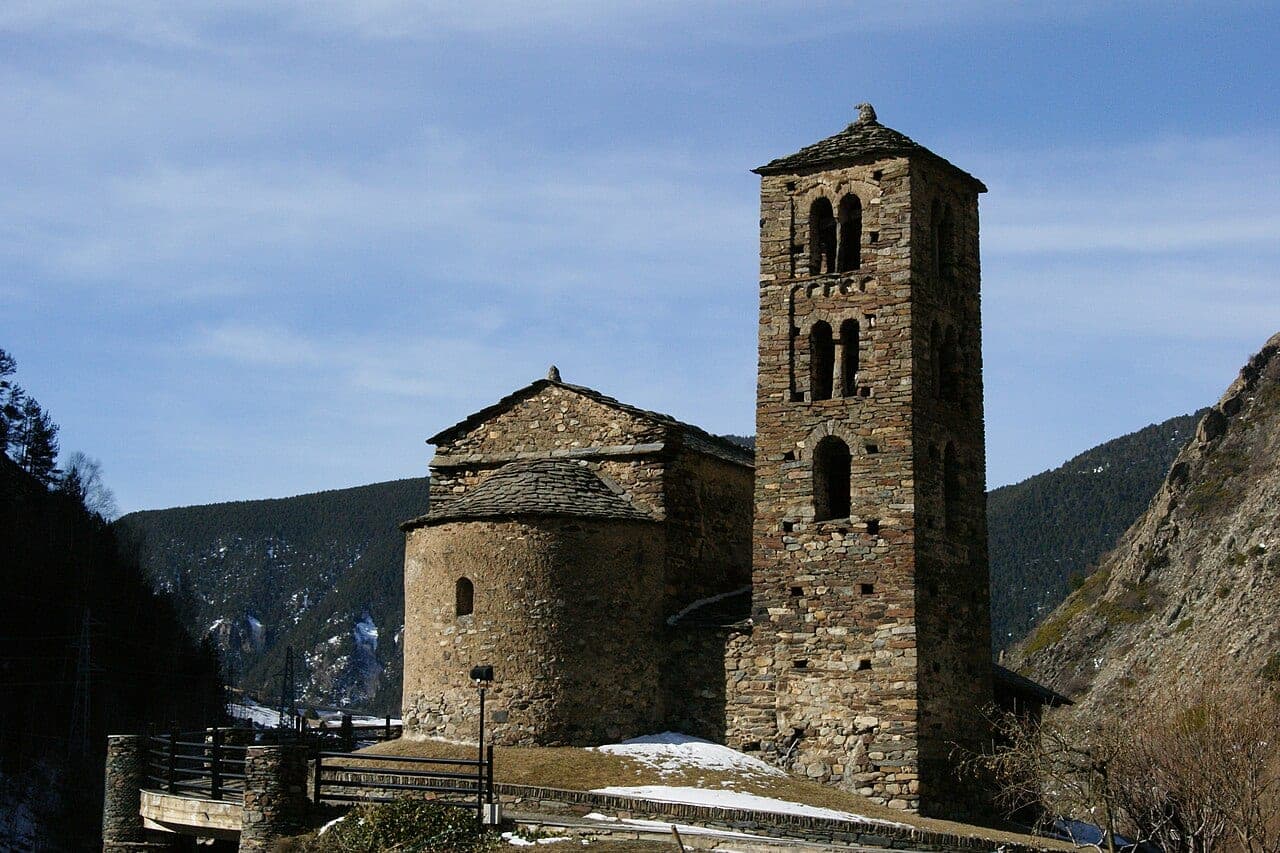
Andorra's cultural identity rests on its mountain inheritance and its Catalan roots. Its most enduring artistic legacy is Romanesque: between the ninth and fourteenth centuries the valleys built small stone churches with slender Lombard bell towers, painted inside with frescoes and carved altar fronts of remarkable quality for so remote a land. Many original murals were moved to museums in the twentieth century, but the buildings remain the signature of the Andorran landscape.
The country's folk dances carry the same continuity. The contrapàs is a solemn, processional dance, once led through the streets on feast days and best preserved in Andorra la Vella and Sant Julià de Lòria; the marratxa is quicker and more festive, danced in groups. Both are kept alive by the esbarts, the folk-dance companies of the parishes, and performed to the flabiol and tabor of Pyrenean tradition.
Iron gives Andorra another thread of memory. From the seventeenth to the nineteenth centuries, water-powered forges known as fargues turned local ore into metal for the Catalan market, using the technique of the Catalan forge. The best preserved of them, the Farga Rossell in La Massana, built between 1842 and 1846, worked until the trade collapsed and now serves as an iron interpretation centre. Andorran cooking is food of the high country: trinxat of cabbage and potato, escudella stew, cured meats, river trout, and mountain mushrooms, shaped by long winters and shared at the parish festivals.
Andorra is overwhelmingly Roman Catholic, and the faith is woven into the structure of the state: one of the two co-princes is the Bishop of Urgell, whose see lies just across the border at La Seu d'Urgell, so that the spiritual and the temporal have never been fully separate in Andorran life. The 1993 constitution guarantees religious freedom while acknowledging a special relationship with the Catholic Church.
 Andorra has dozens of small Romanesque churches for a population the size of a large town, because each valley community built and maintained its own. Photograph by Krzysztof Golik, CC BY-SA 4.0, via Wikimedia Commons.
The heart of Andorran devotion is Our Lady of Meritxell, the country's patron saint. According to tradition a Romanesque statue of the Virgin was found at Meritxell, in the parish of Canillo, in the Middle Ages, and a sanctuary grew up around it. The image was canonically crowned by Pope Benedict XV in 1921, and its feast on 8 September became both a religious festival and the national day. Each parish also keeps its own patron and its festa major, the annual festival that combines Mass, procession, communal meals, and folk dance; and the Romanesque churches, from Santa Coloma to Sant Joan de Caselles, remain living places of worship as well as monuments.
Andorran remembrance follows the Roman Catholic pattern shared across the Catalan Pyrenees, shaped by the closeness of small parishes where nearly everyone is known. When a death occurs, the family holds a wake and the parish gathers for a funeral Mass, the missa de difunts, before burial in the parish cemetery; a further Mass is often said on the month's mind and on the anniversary, keeping the departed within the round of parish prayer. In communities this small, a funeral is a village occasion, and the cemetery beside the church is visited and tended rather than left apart.
The great day of collective remembrance is All Saints, Tots Sants, on 1 November, followed by All Souls on 2 November. Families clean and dress the graves, light candles, and lay chrysanthemums, and the cemeteries fill with those returning to their home parishes; the customary sweets of the season, panellets of almond and pine nut, belong to the same Catalan tradition. It is the moment when Andorra's scattered families gather most surely around their dead.
Meritxell Day, on 8 September, joins private grief to national memory. As both the feast of the patron and the national holiday, it draws pilgrims to the sanctuary at Canillo for Mass and procession. That the present sanctuary is itself a rebuilding, raised after fire destroyed the medieval chapel and its ancient statue in 1972, gives the day an added weight: the nation honours its patroness in a shrine that holds loss and renewal together.
Andorran identity is attached to a house, not to a surname, and the house is what the records are organised around.
The casa is the family property and the family name in one: a household is known by its house name, which stays with the building through the generations that live in it. Inheritance ran to a single heir, the hereu or the pubilla, in order to keep the house and its land undivided, which means Andorran genealogy is unusually easy to follow in one line and unusually complicated in all the others, because the siblings who did not inherit left.
The written record is parish. Andorra has six historic parishes and their registers of baptism, marriage and burial run back several centuries, held by the parish and by the Arxiu Nacional d'Andorra in Andorra la Vella. The co-principality's own administrative records, and the manual digest of Andorran law, sit alongside them.
Two things narrow a search usefully. The population was tiny for most of its history, in the low thousands, so a surname and a parish will often identify one family rather than a hundred. And Andorran nationality has been restrictive: for much of the twentieth century most residents were Spanish or French citizens, so a family living here for decades may be documented in another country's civil register while its house name appears only in the Andorran parish book.
Andorra's foremost heritage cause is the Madriu-Perafita-Claror Valley, its first and so far only UNESCO World Heritage site. Inscribed as a cultural landscape in 2004 and slightly extended in 2006, the valley covers about 4,247 hectares, roughly nine percent of the national territory, preserving a long record of how a mountain society lived off its high country. Within it lie summer pastures grazed in common since the Middle Ages, shepherds' stone huts and dairies, terraced fields, iron-working remains, and two small year-round hamlets, Entremesaigües and Ramio, of granite houses under schist roofs. Reached only on foot, it protects the pastoral and iron heritage of the Pyrenees in a single living valley.
Alongside the valley, Andorra guards its built inheritance through its cultural heritage law and the national museums network. The Romanesque churches are its jewels: Santa Coloma, the oldest, whose nave dates to the eighth or ninth century and whose round Lombard tower was raised in the twelfth; Sant Joan de Caselles in Canillo, an eleventh to twelfth century church holding a celebrated altarpiece of 1575 by the Master of Canillo; and Sant Miquel d'Engolasters above Escaldes. The Casa de la Vall, vacated by parliament in 2011, has been conserved as a museum of Andorran governance, its seven-keyed cabinet and old council chamber preserved, while ethnographic sites such as the Farga Rossell forge and the Casa d'Areny-Plandolit in Ordino complete a small but carefully kept national collection.
For a country of its size, Andorra maintains a serious documentary memory. The Arxiu Nacional d'Andorra, the national archive, holds the records of the parishes, the Consell General, and private families reaching back centuries, including manuscripts once kept in the Casa de la Vall, and has worked to catalogue and digitise its holdings. The national museums portal presents the country's museums and monuments online, and the government's heritage inventory records the protected sites of each parish.
Digitisation has also served the Romanesque legacy, whose displaced frescoes are documented in catalogues and, in several cases, reproduced in the churches from which they were taken. Andorra's small scale makes broad digital access an achievable goal, bringing the principality's records within reach of its dispersed families and of scholars abroad.
Modern Andorra balances its inherited culture against a tourism economy that brings millions across its borders each year. The parishes still hold their festes majors and keep their folk-dance companies, and the calendar keeps its old shape around Meritxell Day and the saints. Newer institutions have grown alongside them: the Ordino classical music festival, contemporary art in the capital's galleries, and a sporting identity built on Alpine skiing and a football team that plays in Catalan-speaking company.
Catalan culture remains the country's window on the wider world. Andorra competed at the Eurovision Song Contest between 2004 and 2009, singing in Catalan on an international stage, and Andorran writers and publishers take part in the broader Catalan literary sphere. Through all of it, the mountain landscape and the Romanesque skyline remain the fixed points of Andorran self-understanding, the images by which Andorrans and their visitors alike recognise the place.
A whole valley inscribed. The listing of the Madriu-Perafita-Claror Valley in 2004 gave Andorra its first UNESCO World Heritage site and, unusually, protected not a single monument but an entire working landscape, the pastures, forges, and stone dwellings of a mountain people.
The old parliament preserved. When the Consell General moved to a new chamber in 2011, the Casa de la Vall of 1580 could have fallen silent. Instead it was conserved and opened as a museum, so that the seven-keyed cabinet and the hall where the valleys governed themselves remain open to the public.
A sanctuary rebuilt. The fire that destroyed the medieval shrine and statue of Our Lady of Meritxell in 1972 might have severed a centuries-old devotion. A new sanctuary, designed by the architect Ricard Bofill and completed later in the decade, gathered the pilgrimage again, and 8 September remains the fullest day in the Andorran year.
Iron memory kept. The Farga Rossell, one of the last Catalan forges that anchored the Andorran economy, was saved from ruin and reborn as an iron interpretation centre, preserving the knowledge of a craft that shaped the valleys for two hundred years.
Andorra has dozens of small Romanesque churches for a population the size of a large town, because each valley community built and maintained its own. Photograph by Krzysztof Golik, CC BY-SA 4.0, via Wikimedia Commons.
The heart of Andorran devotion is Our Lady of Meritxell, the country's patron saint. According to tradition a Romanesque statue of the Virgin was found at Meritxell, in the parish of Canillo, in the Middle Ages, and a sanctuary grew up around it. The image was canonically crowned by Pope Benedict XV in 1921, and its feast on 8 September became both a religious festival and the national day. Each parish also keeps its own patron and its festa major, the annual festival that combines Mass, procession, communal meals, and folk dance; and the Romanesque churches, from Santa Coloma to Sant Joan de Caselles, remain living places of worship as well as monuments.
Andorran remembrance follows the Roman Catholic pattern shared across the Catalan Pyrenees, shaped by the closeness of small parishes where nearly everyone is known. When a death occurs, the family holds a wake and the parish gathers for a funeral Mass, the missa de difunts, before burial in the parish cemetery; a further Mass is often said on the month's mind and on the anniversary, keeping the departed within the round of parish prayer. In communities this small, a funeral is a village occasion, and the cemetery beside the church is visited and tended rather than left apart.
The great day of collective remembrance is All Saints, Tots Sants, on 1 November, followed by All Souls on 2 November. Families clean and dress the graves, light candles, and lay chrysanthemums, and the cemeteries fill with those returning to their home parishes; the customary sweets of the season, panellets of almond and pine nut, belong to the same Catalan tradition. It is the moment when Andorra's scattered families gather most surely around their dead.
Meritxell Day, on 8 September, joins private grief to national memory. As both the feast of the patron and the national holiday, it draws pilgrims to the sanctuary at Canillo for Mass and procession. That the present sanctuary is itself a rebuilding, raised after fire destroyed the medieval chapel and its ancient statue in 1972, gives the day an added weight: the nation honours its patroness in a shrine that holds loss and renewal together.
Andorran identity is attached to a house, not to a surname, and the house is what the records are organised around.
The casa is the family property and the family name in one: a household is known by its house name, which stays with the building through the generations that live in it. Inheritance ran to a single heir, the hereu or the pubilla, in order to keep the house and its land undivided, which means Andorran genealogy is unusually easy to follow in one line and unusually complicated in all the others, because the siblings who did not inherit left.
The written record is parish. Andorra has six historic parishes and their registers of baptism, marriage and burial run back several centuries, held by the parish and by the Arxiu Nacional d'Andorra in Andorra la Vella. The co-principality's own administrative records, and the manual digest of Andorran law, sit alongside them.
Two things narrow a search usefully. The population was tiny for most of its history, in the low thousands, so a surname and a parish will often identify one family rather than a hundred. And Andorran nationality has been restrictive: for much of the twentieth century most residents were Spanish or French citizens, so a family living here for decades may be documented in another country's civil register while its house name appears only in the Andorran parish book.
Andorra's foremost heritage cause is the Madriu-Perafita-Claror Valley, its first and so far only UNESCO World Heritage site. Inscribed as a cultural landscape in 2004 and slightly extended in 2006, the valley covers about 4,247 hectares, roughly nine percent of the national territory, preserving a long record of how a mountain society lived off its high country. Within it lie summer pastures grazed in common since the Middle Ages, shepherds' stone huts and dairies, terraced fields, iron-working remains, and two small year-round hamlets, Entremesaigües and Ramio, of granite houses under schist roofs. Reached only on foot, it protects the pastoral and iron heritage of the Pyrenees in a single living valley.
Alongside the valley, Andorra guards its built inheritance through its cultural heritage law and the national museums network. The Romanesque churches are its jewels: Santa Coloma, the oldest, whose nave dates to the eighth or ninth century and whose round Lombard tower was raised in the twelfth; Sant Joan de Caselles in Canillo, an eleventh to twelfth century church holding a celebrated altarpiece of 1575 by the Master of Canillo; and Sant Miquel d'Engolasters above Escaldes. The Casa de la Vall, vacated by parliament in 2011, has been conserved as a museum of Andorran governance, its seven-keyed cabinet and old council chamber preserved, while ethnographic sites such as the Farga Rossell forge and the Casa d'Areny-Plandolit in Ordino complete a small but carefully kept national collection.
For a country of its size, Andorra maintains a serious documentary memory. The Arxiu Nacional d'Andorra, the national archive, holds the records of the parishes, the Consell General, and private families reaching back centuries, including manuscripts once kept in the Casa de la Vall, and has worked to catalogue and digitise its holdings. The national museums portal presents the country's museums and monuments online, and the government's heritage inventory records the protected sites of each parish.
Digitisation has also served the Romanesque legacy, whose displaced frescoes are documented in catalogues and, in several cases, reproduced in the churches from which they were taken. Andorra's small scale makes broad digital access an achievable goal, bringing the principality's records within reach of its dispersed families and of scholars abroad.
Modern Andorra balances its inherited culture against a tourism economy that brings millions across its borders each year. The parishes still hold their festes majors and keep their folk-dance companies, and the calendar keeps its old shape around Meritxell Day and the saints. Newer institutions have grown alongside them: the Ordino classical music festival, contemporary art in the capital's galleries, and a sporting identity built on Alpine skiing and a football team that plays in Catalan-speaking company.
Catalan culture remains the country's window on the wider world. Andorra competed at the Eurovision Song Contest between 2004 and 2009, singing in Catalan on an international stage, and Andorran writers and publishers take part in the broader Catalan literary sphere. Through all of it, the mountain landscape and the Romanesque skyline remain the fixed points of Andorran self-understanding, the images by which Andorrans and their visitors alike recognise the place.
A whole valley inscribed. The listing of the Madriu-Perafita-Claror Valley in 2004 gave Andorra its first UNESCO World Heritage site and, unusually, protected not a single monument but an entire working landscape, the pastures, forges, and stone dwellings of a mountain people.
The old parliament preserved. When the Consell General moved to a new chamber in 2011, the Casa de la Vall of 1580 could have fallen silent. Instead it was conserved and opened as a museum, so that the seven-keyed cabinet and the hall where the valleys governed themselves remain open to the public.
A sanctuary rebuilt. The fire that destroyed the medieval shrine and statue of Our Lady of Meritxell in 1972 might have severed a centuries-old devotion. A new sanctuary, designed by the architect Ricard Bofill and completed later in the decade, gathered the pilgrimage again, and 8 September remains the fullest day in the Andorran year.
Iron memory kept. The Farga Rossell, one of the last Catalan forges that anchored the Andorran economy, was saved from ruin and reborn as an iron interpretation centre, preserving the knowledge of a craft that shaped the valleys for two hundred years.
National Overview
Notable Cities
Historical Foundations
Linguistic and Etymological Roots
Cultural Identity
Religion and Spirituality
Remembrance and Mourning Traditions
Tracing a Family in Andorra
Heritage Preservation Efforts
Digital Heritage
Contemporary Cultural Influences
Success Stories
References and resources
- UNESCO World Heritage Centre: Madriu-Perafita-Claror Valley. The 2004 inscription and 2006 extension of Andorra's cultural landscape.
- UNESCO World Heritage Centre: Andorra. The state-party page for Andorra's World Heritage.
- Encyclopaedia Britannica: Andorra. Geography, history, and government of the co-principality.
- Wikipedia: Andorra. The parishes, constitution, and national statistics.
- Wikipedia: Casa de la Vall. The 1580 house, the closet of the seven keys, and the old parliament.
- Wikipedia: Antoni Fiter i Rossell. The author of the 1748 Manual Digest.
- Wikipedia: Our Lady of Meritxell. The patroness, the 1972 fire, and the rebuilt sanctuary.
- Wikipedia: Sant Joan de Caselles. The Romanesque church of Canillo and its 1575 altarpiece.
- Wikipedia: Church of Santa Coloma d'Andorra. Andorra's oldest church and its round Lombard tower.
- Museus d'Andorra. The national museums network, including the Farga Rossell iron centre and the Casa d'Areny-Plandolit.