For families who want their stories to last. learn about the founding circle.

Heritage · Legacy

Frida Kahlo Legacy

Explore the life and art of Frida Kahlo, whose self-portraits boldly examine themes of identity, suffering, and resilience. Known for her unique style and activism, Kahlo remains a powerful symbol of strength and cultural pride.

Written to last.

By Confinity Heritage Editorial · Updated 2026-07-20 · 6-minute read
Quiet tools, kept out of the way.
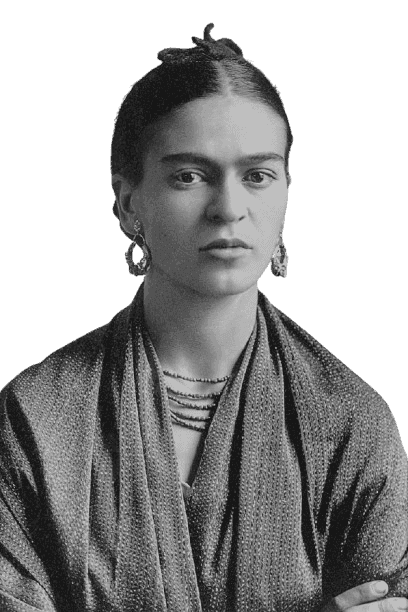
Black-and-white portrait of Frida Kahlo as a young woman, wearing a textured shawl and ornate earrings, her hair pulled back with a ribbon, gazing directly at the camera with a serious, composed expression.
Frida Kahlo (1907–1954) was a Mexican painter who turned a body broken by illness and an accident into some of the most recognisable images of the twentieth century. Born Magdalena Carmen Frida Kahlo y Calderón in Coyoacán, then a town on the southern edge of Mexico City, she produced a small body of work, roughly 150 finished paintings, of which about a third are self-portraits. She painted her own face, her marriage to the muralist Diego Rivera, her miscarriages and surgeries, and a Mexican identity she wore in her clothes as deliberately as she set it on canvas. Critics abroad filed her under Surrealism, a label she refused. For most of her life she was known first as Rivera's wife; only after her death did she become, in her own right, one of the defining artists and cultural figures of modern Mexico. Kahlo was born on 6 July 1907 in the family home in Coyoacán, though she later told people she was born in 1910, the year the Mexican Revolution began, so that her life would run alongside that of modern Mexico. Her father, Guillermo Kahlo, was a photographer of German descent who had emigrated to Mexico; her mother, Matilde Calderón y González, was of Indigenous and Spanish ancestry. That mixed inheritance, European and Mexican, sat at the centre of how Kahlo later understood herself. Illness reached her early. Around the age of six she contracted polio, which left her right leg thinner and shorter than the left and gave her a limp she disguised for the rest of her life beneath long skirts and layered clothing. She was, even so, an active and clever child, encouraged by her father, who taught her to use a camera and to retouch photographs, and who took her with him on walks and to work. In 1922 Kahlo entered the Escuela Nacional Preparatoria, one of the most prestigious schools in the country, which had only recently begun admitting girls. She was one of about 35 female students among roughly 2,000, and she intended to study medicine. It was there she first crossed paths with Diego Rivera, who was painting a mural in the school's auditorium. She fell in with a group of politically minded students and read widely, and her ambitions pointed toward science rather than art. That path ended on 17 September 1925. The wooden bus Kahlo was riding home collided with a streetcar, and an iron handrail passed through her pelvis. Her injuries were catastrophic: a fractured spine in three places, a shattered pelvis, a broken collarbone and ribs, eleven fractures in her right leg, and a mangled and dislocated right foot. She spent roughly a month in hospital and many more months in bed. She would undergo some thirty operations over her lifetime and live with chronic pain, wearing a series of plaster and steel corsets to support her back. During her long convalescence, unable to move and encased in a body cast, Kahlo began to paint. Her parents rigged a special easel that let her work lying down and fixed a mirror to the canopy of her bed so she could see herself. Her earliest finished work, a self-portrait in a velvet dress painted in 1926, was a gift for her first sweetheart, Alejandro Gómez Arias. She later explained that she painted herself so often because she spent so much time alone, and because she was the subject she knew best. The accident closed the door on medicine and opened another that she would walk through for the rest of her life. Kahlo's output was small and intensely personal. Working in bursts between hospital stays, she completed only around 150 paintings, many of them modest in size and painted on metal in the format of the Mexican retablo or ex-voto, the small devotional pictures that give thanks for a miracle or record a disaster. She owned around two thousand of these folk objects, and their flat, frontal, storytelling style shaped her own. Her recurring subject was her own life told without decoration. Henry Ford Hospital (1932) shows her bleeding on a hospital bed after a miscarriage in Detroit, tethered to floating images of a lost child and her own damaged body. The Broken Column (1944) portrays her torso split open to reveal a cracked classical column in place of her spine, her skin studded with nails. Self-Portrait with Thorn Necklace and Hummingbird (1940) surrounds her steady, unsmiling face with a monkey, a black cat, and a necklace of thorns that draws blood at her throat. The Wounded Deer (1946) gives her head to a stag pierced by arrows. These are not comfortable pictures, and Kahlo did not intend them to be. The largest and best known is The Two Fridas (1939), painted around the time of her divorce, a double self-portrait of two seated women whose exposed hearts are joined by a single vein. One Frida wears European dress, the other a Tehuana costume, a visual argument about the two halves of her identity that runs through her work. When the French Surrealist writer André Breton visited Mexico in 1938, he declared Kahlo a natural Surrealist and helped arrange a Paris exhibition of her work in 1939. Kahlo was unconvinced. She insisted that she did not deal in dreams or the unconscious but in her own experience, and she is often quoted as saying, "I never painted dreams. I painted my own reality." Whatever the label, the recognition was real: at the Paris show the Louvre bought her painting The Frame, reportedly the first work by a twentieth-century Mexican artist to enter the museum's collection. Kahlo and Diego Rivera married on 21 August 1929, when she was 22 and he was 42 and already Mexico's most celebrated muralist. Her parents, unsettled by the match, are said to have compared it to the union of an elephant and a dove. The marriage was creative, combative, and often painful. Both had affairs; Rivera's included a relationship with Kahlo's younger sister, Cristina, while Kahlo's included, among others, the exiled Bolshevik leader Leon Trotsky, who with his wife stayed at the Kahlo family home from 1937 to 1939. The couple divorced in 1939 and remarried in December 1940, settling into a second marriage on terms more of their own making. Politics ran through both their lives. Kahlo joined the Mexican Communist Party in the late 1920s and remained committed to left-wing causes to the end. Her last public appearance, on 2 July 1954, was at a demonstration in Mexico City against the United States-backed coup in Guatemala, eleven days before she died. Rivera and Kahlo's home was a gathering point for artists, exiles, and political figures, and their allegiances shaped both what they painted and how they lived. Kahlo's Mexican identity was as considered as her canvases. She embraced Mexicanidad, the nationalist cultural movement that emerged after the Mexican Revolution to celebrate Indigenous heritage and folk tradition against European models. She dressed in the long skirts and embroidered blouses of the Tehuana women of the Isthmus of Tehuantepec, a region known for its strong matriarchal culture, and wore pre-Columbian jewellery and elaborate braided hairstyles. The clothing carried several meanings at once: a statement of national pride, an alliance with Indigenous Mexico, and a practical way to conceal her injured leg and her corsets. At the centre of it all stood La Casa Azul, the cobalt-blue house in Coyoacán where Kahlo was born, where she and Rivera lived for long stretches, and where she would die. Filled with folk art, votive paintings, pre-Columbian sculpture, and the animals she kept, the house was both her home and, increasingly, her subject. The final years were hard. In 1950 Kahlo spent about a year in hospital, and gangrene in her right foot led, in 1953, to the amputation of her right leg below the knee. That same year she was given her first solo exhibition in her own country, at the Galería Arte Contemporáneo in Mexico City. Too ill to stand, she arrived by ambulance and received her guests from a four-poster bed installed in the gallery for the occasion. She died at La Casa Azul on 13 July 1954, aged 47. The official cause was recorded as a pulmonary embolism, though some have suspected an overdose. Rivera died in 1957, and in 1958 La Casa Azul opened to the public as the Museo Frida Kahlo, preserving her studio, her bed and mirror, her clothes, and her collections much as she left them. For two decades after her death, though, Kahlo remained a relatively minor figure in the wider art world, better known as Rivera's wife than as a painter in her own right. That changed from the late 1970s onward. A new generation of feminist art historians, along with the Chicano civil rights movement in the United States, took up her work; Hayden Herrera's influential 1983 biography brought her story to a broad audience, and the 2002 film Frida, with Salma Hayek in the title role, carried it further still. Her image, the joined brows, the flowers, the direct gaze, became one of the most reproduced faces in modern culture, printed on everything from gallery walls to banknotes; the current Mexican 500-peso note carries her portrait alongside Rivera's. The market followed the reputation: in 2025 her 1940 painting The Dream (The Bed) sold at auction for about 54.7 million dollars, a record for any work by a woman artist. Museums from the Tate to the National Museum of Women in the Arts now hold and study her paintings, and her exhibitions travel the world. Kahlo left an unusually complete record of a single life told from the inside. She painted her own body when medicine could not repair it, set down her miscarriages and her operations and her grief without softening them, and made her clothes, her house, and her politics part of the same continuous act of self-description. Much of what we know of her feeling comes not from what others said about her but from what she chose to show, in paint and in the diary she kept in her last years. That is worth holding onto for reasons beyond her fame. A life recorded in a person's own hand resists being flattened into a single anecdote or a decorative face on a tote bag. Kahlo's real story is more specific and more difficult than the icon: a woman in near-constant pain who kept working, who was politically stubborn, who loved and fought with the same man for twenty-five years, and who insisted on being the author of her own image rather than the subject of someone else's. Keeping that record intact, in her museum, her paintings, and the sourced facts of her biography, is how a life stays legible to the people who come after it.
What we preserve here

A life worth keeping is a life worth re-reading. Confinity exists so the lives in your own family are kept with the same care.

You're reading 6 of 8 in 'Lives that changed how we remember'

More legacies to read

All legacies
Heritage library
Start your own archive