Heritage · Country
Lesotho Culture and Heritage
A kingdom folded entirely into the mountains, where San painters worked the caves for four thousand years and Moshoeshoe I forged a nation on the crown of Thaba Bosiu. This is a guide to Basotho memory, from lithoko praise poetry to the graves of the kings, and the people keeping it whole.Written to last.
By Confinity Heritage Editorial · Updated 2026-07-31 · 8-minute readQuiet tools, kept out of the way.
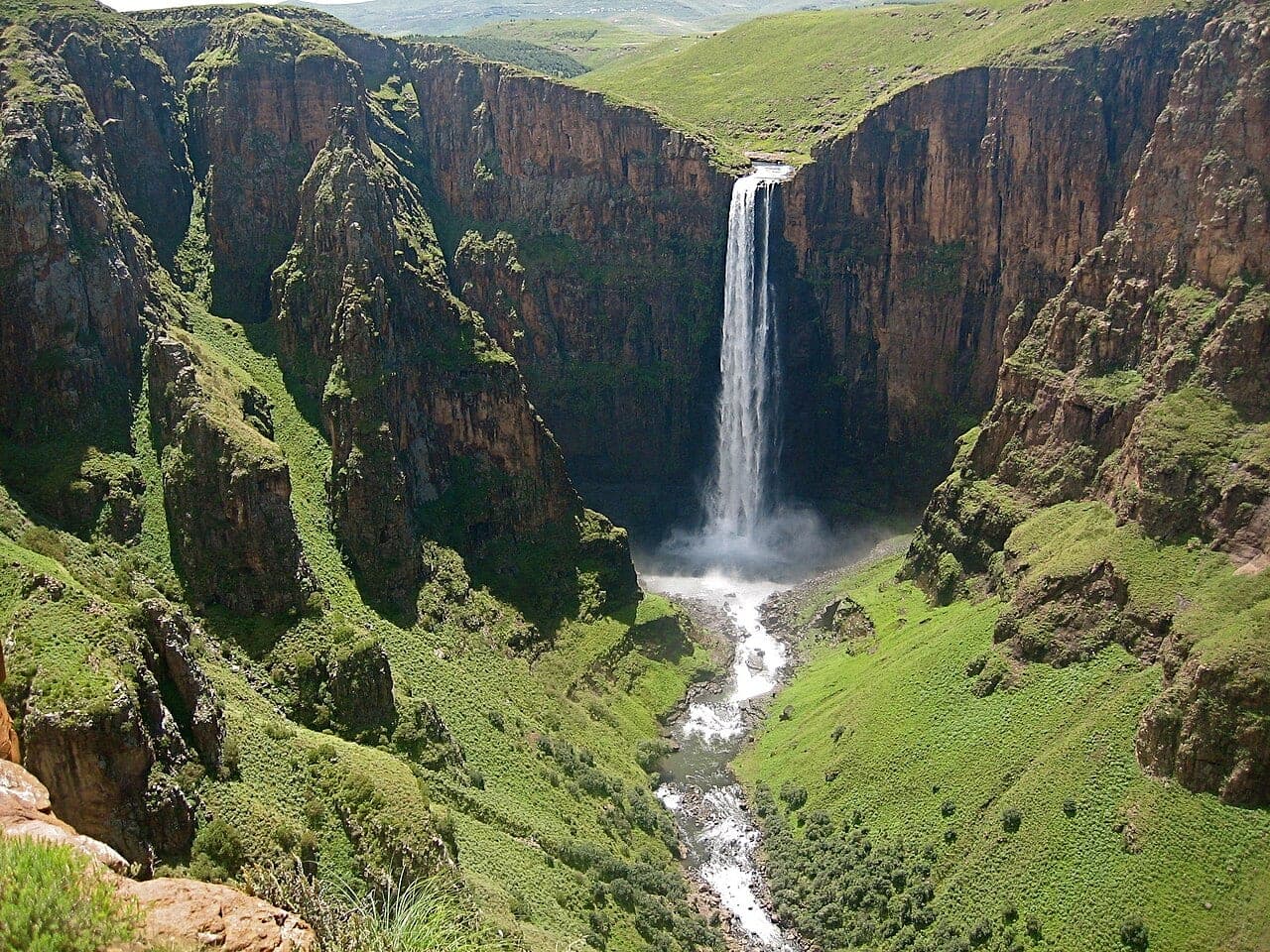
There is one country on earth that lies entirely above 1,000 metres. Lesotho, wrapped completely inside South Africa, has no lowland at all: its lowest point, where the Makhaleng meets the Senqu (Orange) River, sits near 1,400 metres, the highest low point of any nation, and its peaks climb past 3,400. The Basotho call their home the kingdom in the sky, and the phrase is geography before it is poetry. Winter brings snow to the passes, and the water gathered here is piped down to supply a much larger neighbour.
Altitude has done more than shape the weather. In the 1820s, when the wars and migrations of the Difaqane were scattering peoples across the interior of Southern Africa, a chief named Moshoeshoe I led his followers onto the flat top of a mountain called Thaba Bosiu and, from that natural fortress, gathered the survivors of broken clans into a single Basotho nation. Much of what Lesotho remembers is kept in high places: the caves where San painters worked for four thousand years, the praise poetry recited for chiefs and kings, and the mountain itself, still the resting place of the founder.
Lesotho is a landlocked kingdom of 30,355 square kilometres, entirely enclosed by South Africa, one of only three sovereign states completely surrounded by a single other country. Its terrain is almost all upland: the narrow western lowland belt, where most people live, still sits well above a thousand metres, while the eastern two-thirds rise into the Maloti and Drakensberg ranges, culminating in Thabana Ntlenyana at 3,482 metres, the highest peak in Africa south of Kilimanjaro (Britannica). The Senqu, known downstream as the Orange, rises here, and the Lesotho Highlands Water Project sends much of its flow through dams to South Africa.
The population of roughly 2.2 million is among the most homogeneous in Africa: almost everyone is Mosotho and speaks Sesotho, within the clan and chieftaincy system Moshoeshoe I knitted together two centuries ago. Lesotho is a constitutional monarchy: King Letsie III reigns as a ceremonial head of state, while an elected parliament and prime minister govern, and power has changed hands constitutionally, most recently after the 2022 elections. Maseru, on the Mohokare (Caledon) River at the South African border, is the capital and largest city.
Maseru. The capital grew from a British police camp set up in 1869, just after Basutoland came under Crown protection, on the Mohokare River across from the Free State. Its older public buildings use the honey-coloured local sandstone typical of Lesotho, and the city holds the royal palace, parliament and the main markets.
Teyateyaneng. Known universally as TY, the capital of Berea district was founded in 1886 by Chief Gabasheane Masupha, a son of Moshoeshoe I, and its name is usually read as "place of quick sands". TY is the acknowledged craft centre of Lesotho, home to weaving cooperatives such as Elelloang Basali whose mohair rugs and wall-hangings reach collectors abroad.
Leribe (Hlotse). The chief town of the northern Leribe district grew around a Paris Evangelical mission station founded in 1876 and a colonial garrison. The district is known for the fossilised dinosaur footprints at nearby Subeng and Tsikoane.
Mafeteng. The main town of the southern lowlands takes its name from an early trader the Basotho called Lehardt, and is often glossed as "the place of passers-by". It anchors a farming district that saw heavy fighting in the colonial wars and still serves the maize and sorghum belt.
The first people of the mountains were the San, whose painted rock-shelters across the Maloti and Drakensberg record a presence reaching back many thousands of years. Bantu-speaking Sotho-Tswana farmers and herders moved in over the second millennium AD, and the two ways of life overlapped for a long period, with the newcomers recorded in the paintings themselves.
 Moshoeshoe I held Thaba Bosiu against every force sent at it through the wars of the nineteenth century, and the mountain is why Lesotho exists as a country rather than a district. Public domain, via Wikimedia Commons.
The Basotho nation was made in a single lifetime and largely in one place. During the Difaqane, the upheavals of the 1820s that convulsed the interior, Moshoeshoe I moved his people onto Thaba Bosiu, "the mountain at night", in 1824. The plateau's sheer cliffs made it almost impregnable, and from it he combined diplomacy with the offer of refuge, building a kingdom by gathering the remnants of shattered communities rather than by conquest (Britannica). As the century wore on, Boer farmers from the Orange Free State pressed on Basotho land along the Caledon, and the wars of 1858 and 1865 to 1868 cost the kingdom much of its western farmland. Facing the risk of being overrun, Moshoeshoe appealed to Queen Victoria for protection.
Britain declared Basutoland a protectorate in 1868, halting the Boer advance and preserving the territory that survives today. Cape Colony rule from 1871 brought an attempt to disarm the population and the Gun War of 1880 to 1881, after which Britain resumed direct rule in 1884. When the Union of South Africa formed in 1910, Basutoland was kept out, and that separation, with the survival of the monarchy, is why Lesotho is independent at all. Independence came on 4 October 1966 under Moshoeshoe II, and through later spells of one-party rule and coalition instability the monarchy has endured as the unifying institution, with King Letsie III reigning since 1996.
Lesotho has two official languages, Sesotho and English, and the name of the country is a lesson in how the language builds meaning. The root is Sotho; the Sesotho prefix system then generates a whole family of words from it. Lesotho is the land, Basotho are the people, a single person is a Mosotho, and Sesotho is both the language and the way of life. The country's name means, quite literally, the land of the people who speak Sesotho (Wikipedia).
Sesotho is a Southern Bantu language spoken by virtually the entire population, which makes Lesotho unusually unified. It was among the first Southern African languages committed to print, after missionaries reached Morija in 1833 and reduced it to writing, publishing scripture, a newspaper and eventually novels in Sesotho. Place names carry their own memory: Thaba Bosiu records the night Moshoeshoe first climbed it, and Maseru means "the place of red sandstone". English, the colonial administrative language, remains the medium of government, commerce and higher education.
Two objects announce Basotho identity anywhere in the world: the blanket and the hat. The Basotho blanket began as a colonial trade good and became a national dress; tradition holds that a woollen blanket was presented to Moshoeshoe I around 1860, that he adopted it in place of the animal-skin kaross, and that it spread through the kingdom during his reign (SA Fashion history). Worn pinned at the shoulder and patterned with maize cobs, crowns and shields that carry meaning, it marks birth, initiation, marriage and mourning. The mokorotlo, the conical straw hat whose shape is said to echo Mount Qiloane near Thaba Bosiu, is the other emblem, so central that it sits at the centre of the national flag.
The Basotho pony is a third icon. Descended from horses brought to the Cape by European settlers from 1652 and traded up into the mountains, it became a small, surefooted, hardy animal suited to the high passes and the shepherd's companion. Reports that the true bloodline is now rare have prompted efforts to protect it.
Basotho expressive culture is carried above all in words and music. Lithoko, the praise poems, are the classical high form: declamatory verse reciting the deeds and lineage of chiefs and kings, performed rather than written and rooted in the lebollo initiation schools. From that root grew famo, the country's signature popular music, built on the accordion, a drum and a deep bass under rhythmic Sesotho vocals drawn from the praise tradition (Pan African Music). Famo began among shepherds and travelled with Basotho migrant miners to the South African gold fields in the early twentieth century. At the table, papa, a stiff maize porridge, is eaten with moroho (cooked greens), while motoho, a sour fermented sorghum porridge, and joala, home-brewed sorghum beer, carry ceremonial weight.
Lesotho is a predominantly Christian country, a legacy of the missions that arrived in the 1830s. The Roman Catholic Church has the largest following, and the Lesotho Evangelical Church, descended directly from the Paris Evangelical Missionary Society that founded Morija, is the other major body, alongside Anglican, Pentecostal and African-initiated congregations.
Beneath and beside the churches runs Basotho traditional belief. It recognises a creator, Molimo, approached with reverence but rarely addressed directly; the working spiritual relationships of daily life are with the Badimo, the ancestors, who remain part of the family after death and mediate between the living and the divine. The ancestors are honoured at moments of illness, decision and transition, and the ngaka, the traditional healer and diviner, is still sought out across much of the country. Many Basotho move between church and ancestral practice without any sense of contradiction.
For the Basotho, death does not sever a person from the family; it changes their standing within it. The dead join the Badimo, so remembrance is less a single farewell than the beginning of a continuing relationship. A funeral is a large communal undertaking: in the days between death and burial the home fills each evening for prayer and condolence, relatives, neighbours and burial societies arrive with money, food and labour, and an animal is often slaughtered to feed the many who come. Burial in one's own place, among one's own people, matters intensely, because it is where descendants will return to speak to the departed.
Mourning is observed on the body and in conduct. A widow traditionally wears mourning dress and withdraws from parts of ordinary social life for a set period; the deep phase of mourning is closed by a cleansing ceremony that returns the bereaved to normal life, and the later unveiling of a headstone has become a second gathering at which the life is remembered aloud. These observances, and their heavier weight on women, are debated within Lesotho today as churches, courts and families negotiate gentler forms, but the underlying conviction, that the dead remain present and are owed remembrance, holds firm.
Royal death raises the same logic to the scale of the nation. The kings of Lesotho are buried on Thaba Bosiu itself, their graves making the founding mountain a national shrine. The tomb of Moshoeshoe I is deliberately plain, a simple stone enclosure on the plateau where he built the nation; Moshoeshoe II was laid to rest there in 1996, and other royals lie nearby (Thaba Bosiu heritage). To climb Thaba Bosiu is, for a Mosotho, to visit the birthplace and the burial place of the kingdom at once.
Lesotho's records are missionary, colonial and, more than in most countries, held by the chieftainship.
The Paris Evangelical Missionary Society arrived in 1833 at the invitation of Moshoeshoe I, and its stations kept baptism, marriage and burial registers that are the earliest written vital records for Basotho families. Catholic and Anglican missions followed. Those books are held by the churches and in part by the Lesotho National Archives in Maseru, alongside the Basutoland protectorate series, with parallel material at Kew and in Paris.
The chiefs hold the other record. Land in Lesotho is not owned individually; it is allocated by chiefs, and the chieftainship itself descends from Moshoeshoe through a well-documented royal genealogy. Establishing a family's right to a field, or a person's place in a village, is done through the chief's knowledge and the community's, and it is the effective register.
The migrant labour system is the archive most Basotho families need. For a century a very large share of Basotho men worked in the South African gold mines, recruited through the labour organisation that ran the system, and their employment, medical, injury and death records were made in South Africa. Silicosis and mine accidents killed and disabled men whose paperwork is in Johannesburg, and the compensation claims brought in recent decades have depended on retrieving it.
The mountain kingdom's older layer is the San rock art, and the Basotho praise poems, the lithoko, which name and place the men they were composed for.
Lesotho's single UNESCO World Heritage property is the Maloti-Drakensberg Park, a transboundary site shared with South Africa. The listing began on the South African side as the uKhahlamba Drakensberg Park in 2000 and, in June 2013, was extended across the border to take in the Sehlabathebe National Park in Lesotho, giving the country its first World Heritage Site (UNESCO). The park protects the largest and most concentrated body of rock paintings in Africa south of the Sahara, made by San artists over some four thousand years, in a landscape of sandstone arches, caves and pools that shelters endangered species such as the bearded vulture and the Maloti minnow.
Thaba Bosiu is managed as a national monument, with a visitor centre and a cultural village at its foot where Basotho building, dress and custom are shown in a living setting. The country's principal documentary institution is the Morija Museum and Archives, established in 1956 at the old mission village of Morija. It holds the records of the Lesotho Evangelical Church back to the mission's founding in 1833, along with rare books, photographs and maps and the output of the Morija Printing Works, which produced Leselinyana la Lesotho ("The Little Light of Lesotho"), the pioneering Sesotho newspaper first issued in 1863 (Morija Museum). Thin budgets and ageing media remain constant pressures on that record.
Lesotho's digital heritage effort is modest in scale but clearly directed. The Morija Museum and Archives has worked to catalogue and progressively digitise its collections, converting fragile mission records, early Sesotho publications and historic photographs into more durable and shareable form, consolidating heritage that once passed through a single printing works.
The San rock art of the Maloti-Drakensberg has an expanding online presence too. The British Museum's African rock art image project has published freely accessible photographs of Drakensberg painted panels for study without disturbing the shelters that hold them. Beyond the institutions, the liveliest archive is informal: famo recordings, lithoko performances and Sesotho-language storytelling circulate constantly online, sustained by a Basotho diaspora in South Africa and beyond. The unfinished task is to gather these scattered recordings into stable, openly accessible repositories before analogue media and elder memory fade.
Lesotho's most far-reaching cultural export was written more than a century ago in the print shop at Morija. Thomas Mokopu Mofolo (1876 to 1948), who worked there as a proofreader and secretary, published Moeti oa Bochabela ("The Traveller to the East") in 1907, widely regarded as the first novel written in an African language, and in 1925 the Morija Sesuto Book Depot issued his Chaka, a fictional retelling of the rise and fall of the Zulu king, now counted a landmark of modern African literature (Britannica). Morija honours that inheritance each year with an arts and cultural festival at the site where it began.
Contemporary Basotho culture keeps the old forms in circulation while remixing them freely. Famo remains the popular soundtrack of the nation; the mokorotlo and the blanket appear as readily on fashion runways and at national ceremonies as in the villages; and the weavers of Teyateyaneng carry Basotho design into international markets. Cross-border migration, the defining social fact of modern Lesotho, has itself become a cultural engine, feeding the music, the language and the remittance economy that sustains the ceremonies in which the culture is lived.
A nation's first World Heritage listing. The 2013 extension of the Maloti-Drakensberg Park to include Sehlabathebe gave Lesotho its first UNESCO World Heritage Site and placed the country, jointly with South Africa, in custody of the largest concentration of rock paintings in sub-Saharan Africa.
The founder's mountain, kept whole. Thaba Bosiu survives as both the birthplace of the nation and the burial place of its kings, protected as a national monument with a cultural village at its foot, so that the single site where Basotho identity was forged remains open and central to national life.
A first novel in an African language. Thomas Mofolo's career at Morija produced the first Sesotho novel and, in Chaka, a work that carried Basotho letters onto the world stage, and the Morija Museum and Archives keeps the records of that literary birth in the village where it happened.
Craft that pays its way. The weaving cooperatives of Teyateyaneng have turned Basotho design skill into a durable livelihood, keeping mohair spinning, dyeing and weaving alive in local hands.
Moshoeshoe I held Thaba Bosiu against every force sent at it through the wars of the nineteenth century, and the mountain is why Lesotho exists as a country rather than a district. Public domain, via Wikimedia Commons.
The Basotho nation was made in a single lifetime and largely in one place. During the Difaqane, the upheavals of the 1820s that convulsed the interior, Moshoeshoe I moved his people onto Thaba Bosiu, "the mountain at night", in 1824. The plateau's sheer cliffs made it almost impregnable, and from it he combined diplomacy with the offer of refuge, building a kingdom by gathering the remnants of shattered communities rather than by conquest (Britannica). As the century wore on, Boer farmers from the Orange Free State pressed on Basotho land along the Caledon, and the wars of 1858 and 1865 to 1868 cost the kingdom much of its western farmland. Facing the risk of being overrun, Moshoeshoe appealed to Queen Victoria for protection.
Britain declared Basutoland a protectorate in 1868, halting the Boer advance and preserving the territory that survives today. Cape Colony rule from 1871 brought an attempt to disarm the population and the Gun War of 1880 to 1881, after which Britain resumed direct rule in 1884. When the Union of South Africa formed in 1910, Basutoland was kept out, and that separation, with the survival of the monarchy, is why Lesotho is independent at all. Independence came on 4 October 1966 under Moshoeshoe II, and through later spells of one-party rule and coalition instability the monarchy has endured as the unifying institution, with King Letsie III reigning since 1996.
Lesotho has two official languages, Sesotho and English, and the name of the country is a lesson in how the language builds meaning. The root is Sotho; the Sesotho prefix system then generates a whole family of words from it. Lesotho is the land, Basotho are the people, a single person is a Mosotho, and Sesotho is both the language and the way of life. The country's name means, quite literally, the land of the people who speak Sesotho (Wikipedia).
Sesotho is a Southern Bantu language spoken by virtually the entire population, which makes Lesotho unusually unified. It was among the first Southern African languages committed to print, after missionaries reached Morija in 1833 and reduced it to writing, publishing scripture, a newspaper and eventually novels in Sesotho. Place names carry their own memory: Thaba Bosiu records the night Moshoeshoe first climbed it, and Maseru means "the place of red sandstone". English, the colonial administrative language, remains the medium of government, commerce and higher education.
Two objects announce Basotho identity anywhere in the world: the blanket and the hat. The Basotho blanket began as a colonial trade good and became a national dress; tradition holds that a woollen blanket was presented to Moshoeshoe I around 1860, that he adopted it in place of the animal-skin kaross, and that it spread through the kingdom during his reign (SA Fashion history). Worn pinned at the shoulder and patterned with maize cobs, crowns and shields that carry meaning, it marks birth, initiation, marriage and mourning. The mokorotlo, the conical straw hat whose shape is said to echo Mount Qiloane near Thaba Bosiu, is the other emblem, so central that it sits at the centre of the national flag.
The Basotho pony is a third icon. Descended from horses brought to the Cape by European settlers from 1652 and traded up into the mountains, it became a small, surefooted, hardy animal suited to the high passes and the shepherd's companion. Reports that the true bloodline is now rare have prompted efforts to protect it.
Basotho expressive culture is carried above all in words and music. Lithoko, the praise poems, are the classical high form: declamatory verse reciting the deeds and lineage of chiefs and kings, performed rather than written and rooted in the lebollo initiation schools. From that root grew famo, the country's signature popular music, built on the accordion, a drum and a deep bass under rhythmic Sesotho vocals drawn from the praise tradition (Pan African Music). Famo began among shepherds and travelled with Basotho migrant miners to the South African gold fields in the early twentieth century. At the table, papa, a stiff maize porridge, is eaten with moroho (cooked greens), while motoho, a sour fermented sorghum porridge, and joala, home-brewed sorghum beer, carry ceremonial weight.
Lesotho is a predominantly Christian country, a legacy of the missions that arrived in the 1830s. The Roman Catholic Church has the largest following, and the Lesotho Evangelical Church, descended directly from the Paris Evangelical Missionary Society that founded Morija, is the other major body, alongside Anglican, Pentecostal and African-initiated congregations.
Beneath and beside the churches runs Basotho traditional belief. It recognises a creator, Molimo, approached with reverence but rarely addressed directly; the working spiritual relationships of daily life are with the Badimo, the ancestors, who remain part of the family after death and mediate between the living and the divine. The ancestors are honoured at moments of illness, decision and transition, and the ngaka, the traditional healer and diviner, is still sought out across much of the country. Many Basotho move between church and ancestral practice without any sense of contradiction.
For the Basotho, death does not sever a person from the family; it changes their standing within it. The dead join the Badimo, so remembrance is less a single farewell than the beginning of a continuing relationship. A funeral is a large communal undertaking: in the days between death and burial the home fills each evening for prayer and condolence, relatives, neighbours and burial societies arrive with money, food and labour, and an animal is often slaughtered to feed the many who come. Burial in one's own place, among one's own people, matters intensely, because it is where descendants will return to speak to the departed.
Mourning is observed on the body and in conduct. A widow traditionally wears mourning dress and withdraws from parts of ordinary social life for a set period; the deep phase of mourning is closed by a cleansing ceremony that returns the bereaved to normal life, and the later unveiling of a headstone has become a second gathering at which the life is remembered aloud. These observances, and their heavier weight on women, are debated within Lesotho today as churches, courts and families negotiate gentler forms, but the underlying conviction, that the dead remain present and are owed remembrance, holds firm.
Royal death raises the same logic to the scale of the nation. The kings of Lesotho are buried on Thaba Bosiu itself, their graves making the founding mountain a national shrine. The tomb of Moshoeshoe I is deliberately plain, a simple stone enclosure on the plateau where he built the nation; Moshoeshoe II was laid to rest there in 1996, and other royals lie nearby (Thaba Bosiu heritage). To climb Thaba Bosiu is, for a Mosotho, to visit the birthplace and the burial place of the kingdom at once.
Lesotho's records are missionary, colonial and, more than in most countries, held by the chieftainship.
The Paris Evangelical Missionary Society arrived in 1833 at the invitation of Moshoeshoe I, and its stations kept baptism, marriage and burial registers that are the earliest written vital records for Basotho families. Catholic and Anglican missions followed. Those books are held by the churches and in part by the Lesotho National Archives in Maseru, alongside the Basutoland protectorate series, with parallel material at Kew and in Paris.
The chiefs hold the other record. Land in Lesotho is not owned individually; it is allocated by chiefs, and the chieftainship itself descends from Moshoeshoe through a well-documented royal genealogy. Establishing a family's right to a field, or a person's place in a village, is done through the chief's knowledge and the community's, and it is the effective register.
The migrant labour system is the archive most Basotho families need. For a century a very large share of Basotho men worked in the South African gold mines, recruited through the labour organisation that ran the system, and their employment, medical, injury and death records were made in South Africa. Silicosis and mine accidents killed and disabled men whose paperwork is in Johannesburg, and the compensation claims brought in recent decades have depended on retrieving it.
The mountain kingdom's older layer is the San rock art, and the Basotho praise poems, the lithoko, which name and place the men they were composed for.
Lesotho's single UNESCO World Heritage property is the Maloti-Drakensberg Park, a transboundary site shared with South Africa. The listing began on the South African side as the uKhahlamba Drakensberg Park in 2000 and, in June 2013, was extended across the border to take in the Sehlabathebe National Park in Lesotho, giving the country its first World Heritage Site (UNESCO). The park protects the largest and most concentrated body of rock paintings in Africa south of the Sahara, made by San artists over some four thousand years, in a landscape of sandstone arches, caves and pools that shelters endangered species such as the bearded vulture and the Maloti minnow.
Thaba Bosiu is managed as a national monument, with a visitor centre and a cultural village at its foot where Basotho building, dress and custom are shown in a living setting. The country's principal documentary institution is the Morija Museum and Archives, established in 1956 at the old mission village of Morija. It holds the records of the Lesotho Evangelical Church back to the mission's founding in 1833, along with rare books, photographs and maps and the output of the Morija Printing Works, which produced Leselinyana la Lesotho ("The Little Light of Lesotho"), the pioneering Sesotho newspaper first issued in 1863 (Morija Museum). Thin budgets and ageing media remain constant pressures on that record.
Lesotho's digital heritage effort is modest in scale but clearly directed. The Morija Museum and Archives has worked to catalogue and progressively digitise its collections, converting fragile mission records, early Sesotho publications and historic photographs into more durable and shareable form, consolidating heritage that once passed through a single printing works.
The San rock art of the Maloti-Drakensberg has an expanding online presence too. The British Museum's African rock art image project has published freely accessible photographs of Drakensberg painted panels for study without disturbing the shelters that hold them. Beyond the institutions, the liveliest archive is informal: famo recordings, lithoko performances and Sesotho-language storytelling circulate constantly online, sustained by a Basotho diaspora in South Africa and beyond. The unfinished task is to gather these scattered recordings into stable, openly accessible repositories before analogue media and elder memory fade.
Lesotho's most far-reaching cultural export was written more than a century ago in the print shop at Morija. Thomas Mokopu Mofolo (1876 to 1948), who worked there as a proofreader and secretary, published Moeti oa Bochabela ("The Traveller to the East") in 1907, widely regarded as the first novel written in an African language, and in 1925 the Morija Sesuto Book Depot issued his Chaka, a fictional retelling of the rise and fall of the Zulu king, now counted a landmark of modern African literature (Britannica). Morija honours that inheritance each year with an arts and cultural festival at the site where it began.
Contemporary Basotho culture keeps the old forms in circulation while remixing them freely. Famo remains the popular soundtrack of the nation; the mokorotlo and the blanket appear as readily on fashion runways and at national ceremonies as in the villages; and the weavers of Teyateyaneng carry Basotho design into international markets. Cross-border migration, the defining social fact of modern Lesotho, has itself become a cultural engine, feeding the music, the language and the remittance economy that sustains the ceremonies in which the culture is lived.
A nation's first World Heritage listing. The 2013 extension of the Maloti-Drakensberg Park to include Sehlabathebe gave Lesotho its first UNESCO World Heritage Site and placed the country, jointly with South Africa, in custody of the largest concentration of rock paintings in sub-Saharan Africa.
The founder's mountain, kept whole. Thaba Bosiu survives as both the birthplace of the nation and the burial place of its kings, protected as a national monument with a cultural village at its foot, so that the single site where Basotho identity was forged remains open and central to national life.
A first novel in an African language. Thomas Mofolo's career at Morija produced the first Sesotho novel and, in Chaka, a work that carried Basotho letters onto the world stage, and the Morija Museum and Archives keeps the records of that literary birth in the village where it happened.
Craft that pays its way. The weaving cooperatives of Teyateyaneng have turned Basotho design skill into a durable livelihood, keeping mohair spinning, dyeing and weaving alive in local hands.
National Overview
Notable Cities
Historical Foundations
Linguistic and Etymological Roots
Cultural Identity
Religion and Spirituality
Remembrance and Mourning Traditions
Tracing a Family in Lesotho
Heritage Preservation Efforts
Digital Heritage
Contemporary Cultural Influences
Success Stories
References and resources
- Encyclopaedia Britannica: Lesotho. Geography, the founding of the nation under Moshoeshoe I, the colonial wars and independence.
- UNESCO World Heritage Centre: Maloti-Drakensberg Park. The transboundary listing, the 2013 extension to Sehlabathebe, and the San rock art.
- Wikipedia: Lesotho. Geography, history, government and the meaning of the country's name.
- Wikipedia: Maletsunyane Falls. The 192-metre waterfall near Semonkong.
- Morija Museum and Archives: Museum History. The mission archive, the printing works and Leselinyana la Lesotho.
- Encyclopaedia Britannica: Thomas Mokopu Mofolo. The Sesotho novelist and the publication of Chaka.
- Pan African Music: Introducing Lesotho's accordion music. The origins and form of famo.
- Britannica: Teyateyaneng. The craft town of the Berea district and its weaving traditions.