Culture · Essay
Sokushinbutsu: the monks who became their own memorials
In the mountains of northern Japan, a small number of ascetic monks spent years preparing their own bodies to endure after death, and are enshrined, robed and seated, to this day. On the most extreme act of remembrance ever undertaken, and its point.Written to last.
By Confinity Editorial · 2026-08-23 · 6-minute readQuiet tools, kept out of the way.
In a handful of temples in Yamagata prefecture, in Japan's snowy north, visitors are shown to an altar where a figure sits in robes, in the lotus position, head bowed. It is not a statue. It is a monk, and he has been sitting there for two or three centuries.
These are the sokushinbutsu, the term means, roughly, a buddha in this very body, and they represent the most extreme answer any tradition has given to a question this library asks on every page: what should remain of a person, and who should do the work of remaining? The sokushinbutsu's answer: I will, myself, entirely.
 The practice belonged chiefly to the mountain ascetics of the Mount Yudono tradition, and it was not an act of despair but the summit of a long vocation, undertaken by senior monks after decades of austerity. The preparation took years. Its core was mokujikigyō, the tree-eating discipline: a diet reduced to nuts, seeds, bark and roots of the mountain, which stripped the body of the fat and moisture that feed decay, while the monk continued his rounds of cold-water austerities and recitation. The final stage was withdrawal into a cramped underground chamber, to meditate and chant until the chanting stopped.
Most attempts, it should be said plainly, did not end in preservation; the bodies decayed like any other and were buried with honour. The rare successes, examined years later and found intact, were robed, enthroned and enshrined, and roughly two dozen remain across northern Japan, the best known, such as Shinnyokai-shōnin, still receiving visitors and new robes from the priests who tend them. The state authorities of the Meiji era outlawed the practice in the nineteenth century, and it ended.
The doctrine matters, because without it the practice reads as morbid spectacle, which it was not. In the tradition's own terms the sokushinbutsu is not dead: he has entered a profound meditative state, nyūjō, in which he waits, across whatever centuries it takes, for the far future in which he can assist the buddha to come. His preserved body is not a corpse but a post: a man on duty. Several of the most venerated undertook the practice explicitly as intercession during famines, offering the merit of their austerity for the starving villages below the mountain.
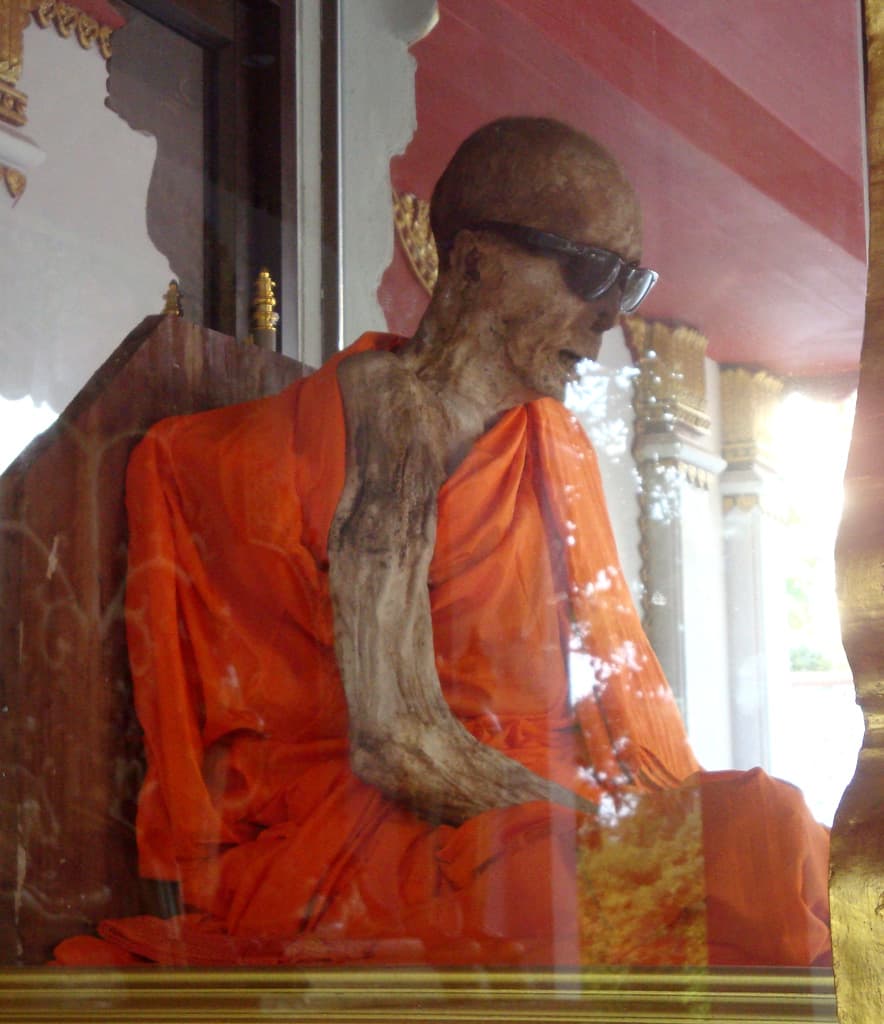
The wider Buddhist world holds related figures, whole-body relics of monks in China and Southeast Asia, revered where they sat, and the robed monk of the photograph above, enshrined in Thailand, belongs to that broader family: teachers whose communities, finding the body undecayed, took it as a sign and kept the teacher present.
This library has walked a long spectrum of what families and cultures preserve: the face in paint, the face in plaster, the dressed dead of Palermo, each an attempt by the living to keep some portion of a person. Sokushinbutsu is the spectrum's end point: the person performing their own preservation, in advance, by will alone, cutting the living out of the work entirely.
And the verdict, after three centuries, is instructive. The discipline preserved the presence and lost the rest: of most enshrined sokushinbutsu, little survives beyond a name, a date and the fact of the feat itself, the biographies thinned to legend even in their own temples. The most complete act of self-preservation on record still needed what every ordinary person needs, somebody writing the life down, and did not get it. Bodies, it turns out, keep worse than stories. A family with an archive like Confinity holds more of a grandmother than Mount Yudono holds of its saints, which is the gentlest possible argument for the easier discipline: write, while the person is still telling.
The practice belonged chiefly to the mountain ascetics of the Mount Yudono tradition, and it was not an act of despair but the summit of a long vocation, undertaken by senior monks after decades of austerity. The preparation took years. Its core was mokujikigyō, the tree-eating discipline: a diet reduced to nuts, seeds, bark and roots of the mountain, which stripped the body of the fat and moisture that feed decay, while the monk continued his rounds of cold-water austerities and recitation. The final stage was withdrawal into a cramped underground chamber, to meditate and chant until the chanting stopped.
Most attempts, it should be said plainly, did not end in preservation; the bodies decayed like any other and were buried with honour. The rare successes, examined years later and found intact, were robed, enthroned and enshrined, and roughly two dozen remain across northern Japan, the best known, such as Shinnyokai-shōnin, still receiving visitors and new robes from the priests who tend them. The state authorities of the Meiji era outlawed the practice in the nineteenth century, and it ended.
The doctrine matters, because without it the practice reads as morbid spectacle, which it was not. In the tradition's own terms the sokushinbutsu is not dead: he has entered a profound meditative state, nyūjō, in which he waits, across whatever centuries it takes, for the far future in which he can assist the buddha to come. His preserved body is not a corpse but a post: a man on duty. Several of the most venerated undertook the practice explicitly as intercession during famines, offering the merit of their austerity for the starving villages below the mountain.
The wider Buddhist world holds related figures, whole-body relics of monks in China and Southeast Asia, revered where they sat, and the robed monk of the photograph above, enshrined in Thailand, belongs to that broader family: teachers whose communities, finding the body undecayed, took it as a sign and kept the teacher present.
This library has walked a long spectrum of what families and cultures preserve: the face in paint, the face in plaster, the dressed dead of Palermo, each an attempt by the living to keep some portion of a person. Sokushinbutsu is the spectrum's end point: the person performing their own preservation, in advance, by will alone, cutting the living out of the work entirely.
And the verdict, after three centuries, is instructive. The discipline preserved the presence and lost the rest: of most enshrined sokushinbutsu, little survives beyond a name, a date and the fact of the feat itself, the biographies thinned to legend even in their own temples. The most complete act of self-preservation on record still needed what every ordinary person needs, somebody writing the life down, and did not get it. Bodies, it turns out, keep worse than stories. A family with an archive like Confinity holds more of a grandmother than Mount Yudono holds of its saints, which is the gentlest possible argument for the easier discipline: write, while the person is still telling.
The discipline