Culture · Essay
Pchum Ben: fifteen days of feeding the ancestors nobody else remembers
For a fortnight Cambodians rise before dawn to throw rice into the dark at seven pagodas, feeding hungry ghosts who cannot receive an ordinary offering. On the merit economy behind it, and what it meant after 1979.Written to last.
By Confinity Editorial · 2026-04-23 · 6-minute readQuiet tools, kept out of the way.
The rite happens before sunrise, and the timing is not aesthetic.
Cambodians rise in the dark, take balls of sticky rice mixed with sesame and coconut, and go to a pagoda. There they throw the rice into shaded corners of the grounds, or set it out on the ground, walking and scattering. It has to be done before dawn, because the ghosts being fed cannot bear light.
Then they do it again the next morning, at a different pagoda, and the next, until they have covered seven.
Theravada Buddhism, the tradition of Cambodia, holds that the dead may be reborn in several states, and one of them is as a preta, a hungry ghost: a being with a vast appetite and a mouth too small to satisfy it, unable to receive food directly.
The ancestors most in need are the ones in that condition. They cannot be given an ordinary offering at a shrine, because they cannot take it. So they are given rice thrown on the ground in the dark, which they can.
The reach is stated precisely: seven generations. The living are making merit and transferring it back seven generations, to ancestors nobody now alive can name.
That last point is the heart of the festival. Pchum Ben is designed for the dead who have been forgotten. If a family remembers you, you are provided for. The rite exists for everyone else, and it works precisely because it does not require a name.
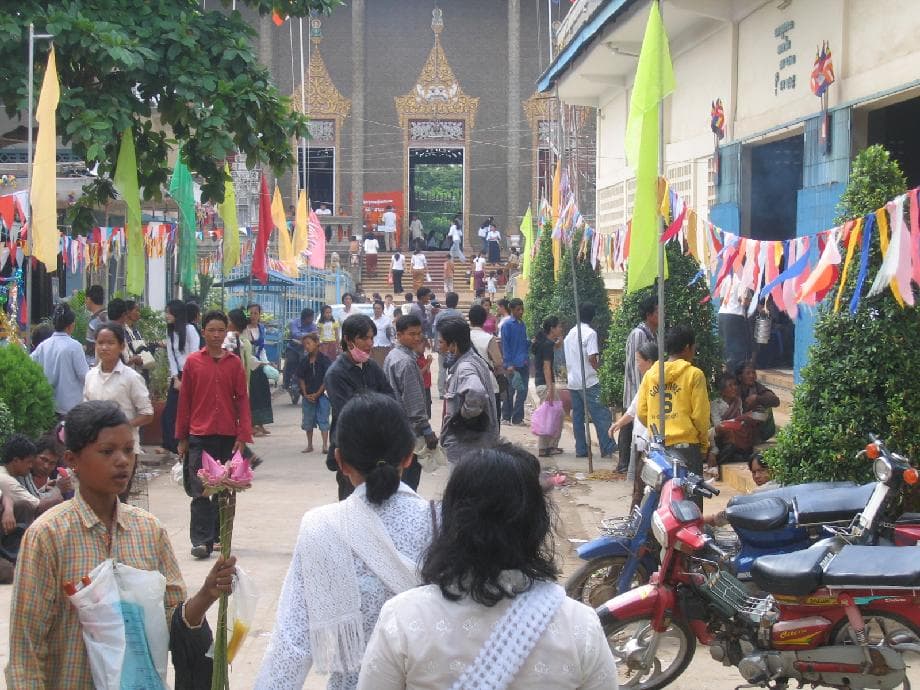 The observance runs fifteen days at the close of the rainy-season retreat, in September or October.
The first fourteen are Kan Ben, and the obligation is to attend a pagoda on each of them. Convention holds that a family should visit seven different pagodas over the period, partly so that an ancestor searching for their descendants has a better chance of finding the right one.
Food is brought for the monks, who eat and then chant, and the merit generated by the giving is dedicated to the dead. Money is given. The pagoda, for a fortnight, is the busiest place in the district.
The fifteenth day is Pchum Ben itself, a national holiday, when the gathering is largest and families return to their home villages. Cambodian roads and bus stations are as congested as Korea's at Chuseok or the Philippines' at Undas, for the same reason.
The mechanism deserves stating without embarrassment, because it is unlike most of the traditions here.
This is not remembrance in the sense of recollection. It is a transfer. The living perform meritorious acts, chiefly giving to monks, and the merit is formally dedicated to named or unnamed dead, improving their condition. The dead are dependent on the living for something they cannot obtain themselves.
That produces an obligation with real force. Failing to observe Pchum Ben is not a lapse of sentiment; it leaves your ancestors hungry. The rice thrown in the dark is a last provision for those whose descendants did not turn up.
The hungry ghost festival of Chinese practice runs the same logic through a different tradition, and Sat Thai in Thailand is the near neighbour: rice offerings, temple merit, the same fortnight of the same lunar calendar.
Any account of Cambodian remembrance has to deal with what the twentieth century did, and Pchum Ben carries it directly.
Between 1975 and 1979 the Khmer Rouge killed something in the region of a fifth of the population. Buddhism was dismantled: monks were defrocked, killed or put to labour, pagodas were destroyed or repurposed, and the observance of Pchum Ben stopped along with everything else.
When it resumed it had a second job. An enormous number of the dead had no grave, no rite, no recorded date and, in many cases, no surviving relative who knew where they died. In Buddhist terms these are precisely the dead most likely to be wandering and unprovided for.
So a festival built for forgotten ancestors met a generation of them at once. Cambodians describe Pchum Ben in exactly those terms, and the annual attendance figures reflect it. It is one of the few cases where an ancient rite turned out to fit a modern catastrophe without alteration.
Almost everything else in this library depends on knowing who. A spirit tablet needs a name carved on it. The Zoroastrian priest needs a list. The griot holds the genealogy in his head.
Pchum Ben deliberately does not. The rice is for whoever is there. It is remembrance without records, and it is the correct design for a society that has lost its records, which is why it did the work it did after 1979.
It is also, honestly, the weaker form. Cambodians who can name their dead name them; the anonymous rice is what remains when nobody can. A tradition that has had to lean on it this heavily is not an argument for doing without a list.
The observance runs fifteen days at the close of the rainy-season retreat, in September or October.
The first fourteen are Kan Ben, and the obligation is to attend a pagoda on each of them. Convention holds that a family should visit seven different pagodas over the period, partly so that an ancestor searching for their descendants has a better chance of finding the right one.
Food is brought for the monks, who eat and then chant, and the merit generated by the giving is dedicated to the dead. Money is given. The pagoda, for a fortnight, is the busiest place in the district.
The fifteenth day is Pchum Ben itself, a national holiday, when the gathering is largest and families return to their home villages. Cambodian roads and bus stations are as congested as Korea's at Chuseok or the Philippines' at Undas, for the same reason.
The mechanism deserves stating without embarrassment, because it is unlike most of the traditions here.
This is not remembrance in the sense of recollection. It is a transfer. The living perform meritorious acts, chiefly giving to monks, and the merit is formally dedicated to named or unnamed dead, improving their condition. The dead are dependent on the living for something they cannot obtain themselves.
That produces an obligation with real force. Failing to observe Pchum Ben is not a lapse of sentiment; it leaves your ancestors hungry. The rice thrown in the dark is a last provision for those whose descendants did not turn up.
The hungry ghost festival of Chinese practice runs the same logic through a different tradition, and Sat Thai in Thailand is the near neighbour: rice offerings, temple merit, the same fortnight of the same lunar calendar.
Any account of Cambodian remembrance has to deal with what the twentieth century did, and Pchum Ben carries it directly.
Between 1975 and 1979 the Khmer Rouge killed something in the region of a fifth of the population. Buddhism was dismantled: monks were defrocked, killed or put to labour, pagodas were destroyed or repurposed, and the observance of Pchum Ben stopped along with everything else.
When it resumed it had a second job. An enormous number of the dead had no grave, no rite, no recorded date and, in many cases, no surviving relative who knew where they died. In Buddhist terms these are precisely the dead most likely to be wandering and unprovided for.
So a festival built for forgotten ancestors met a generation of them at once. Cambodians describe Pchum Ben in exactly those terms, and the annual attendance figures reflect it. It is one of the few cases where an ancient rite turned out to fit a modern catastrophe without alteration.
Almost everything else in this library depends on knowing who. A spirit tablet needs a name carved on it. The Zoroastrian priest needs a list. The griot holds the genealogy in his head.
Pchum Ben deliberately does not. The rice is for whoever is there. It is remembrance without records, and it is the correct design for a society that has lost its records, which is why it did the work it did after 1979.
It is also, honestly, the weaker form. Cambodians who can name their dead name them; the anonymous rice is what remains when nobody can. A tradition that has had to lean on it this heavily is not an argument for doing without a list.
Who is being fed
Kan Ben and Pchum Ben